
resources available to enable each organization to achieve its long-term goals (Help School Lecture Materials)
Or: Strategic management is the process of studying current and future environments, planning the organization's goals, implementing and controlling the implementation of decisions to achieve those goals in the current and future environments.
The important feature that all business strategies are concerned with when forming and it is used to distinguish the main business plans is “competitive advantage”. Reality shows that there is no competitor without strategy, because strategies have the sole purpose and guarantee for businesses to find and gain their sustainable advantage over competitors.
2.3. The importance of Strategic Management.
For any company, strategy is considered the backbone that helps the company proactively shape the way it operates its business, linking the independent and separate actions and decisions of managers and employees into a unified "Combat Plan" that tightly connects the entire company.
2.4. Strategic management process.
The strategic management process is an eight-step process that includes strategic planning, strategy implementation, and strategy evaluation. Although the first six steps describe the planning process, the implementation and evaluation steps are equally important. Even the most perfect strategies can fail if managers do not know how to implement and evaluate them properly.
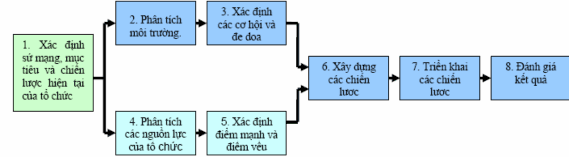
Figure 1. Process model of Strategic Management
(Source: Strategic Management Textbook – Help University, Malaysia)
2.5 Introduction to the basic model of Strategic Management:
Comprehensive environmental research
1
2
Feedback
Forming a strategy
3
Strategy execution
4
Review the external and internal situation using SWOT analysis
Mission, Goals, Strategy, Policy
Program, Budget, Process
Evaluation and control
Effective
Figure 2. Basic model of Strategic Management
(Source: Strategic Management Textbook – Help University, Malaysia)
The basic model of strategic management represents the steps taken in the management process of a business related to issues such as: Comprehensive market research, thereby helping businesses determine
Forming and building strategies in production and business activities, as well as implementing those strategies most effectively, at the same time evaluating and controlling whether the implementation of those strategies is effective or not, thereby providing feedback to comprehensively review the entire business operation process of the enterprise...
2.6 Introduce 5 basic tasks to be performed in strategic management:
Develop the company's Mission and Strategic Vision
Set Goals
Develop Strategies to Achieve Goals
set out
Strategy Execution Application
Monitoring, Evaluation, and Correction
Review and revise if necessary
Review and revise if necessary
Improve/Change
Improve / Change
Restore old content if needed
Mission 1
Mission 2
Mission 3
Mission 4
Mission 5
Figure 3. Five tasks to be performed in strategic management
(Source: Strategic Management Textbook – Help University, Malaysia)
Task 1: Define strategic vision
- Includes thinking strategically about: The Company's future business plan; The Company's desired "destination".
- Things to do include: Drawing a roadmap for the future; Deciding on a future business location to invest in; Setting a long-term direction; Identifying the uniqueness of the Company.
Task 2: Set goals
- Move from strategic mission and vision to specific performance indicators.
- Establish performance measurement measures.
- Drive the company to be innovative and results-focused.
- Helps prevent complacency and premature self-satisfaction.
Task 3: Strategize
- Strategy includes answering the questions:
- Should you focus on a particular business or many things at the same time (multi-functional).
- Serve multiple target customer groups or a niche market.
- Develop a broad or narrow product line.
- Pursue a competitive advantage based on:
- Low cost
- Product advantages
- The company's special capabilities
Task 4: Implement and deploy strategy
- Take action to implement a newly selected strategy.
- Monitor the implementation of the strategy.
- Improve capacity and performance in strategy execution.
- Show specific progress with measurable parameters . Task 5: Monitor, evaluate and improve if necessary
- The tasks of formulating, implementing and executing strategy are not one-time tasks.
- Customer needs and competitive situations are always changing.
- New opportunities are constantly emerging; technological advances; external changes.
- One or more aspects of the strategy may not be progressing smoothly.
- New managers with new perspectives take office.
- Lessons learned by the company during the process.
- All these factors give rise to the need for continuous improvement and responsiveness.
The five tasks are closely related to each other, from the task of defining vision and mission to setting goals, formulating strategy to implementing and executing strategy, and finally evaluating the proposed business strategy. What are the unreasonable issues? Which implementation steps are not performed well? so that they can be edited to be more reasonable and have a better strategy implementation method.
2.7. Main tools used to study strategic management 2.7.1. Delta project model:
Delta Model
Business mission
Determine competitive position
Industry structure
Comprehensive customer solutions
Components fixed to the system
Best product
Business Strategic Calendar
Operating efficiency
Innovation, improvement
Identify target customers
Strategic Timeline for Adaptation
Strategy Map
4 different perspectives
Financial, Customer, Internal Process, Learning & Growth
Adjacency matrix and column matrix | ||
Maybe you are interested!
-
 Current Status of Business Organization and Implementation of Inbound Tourism Program at Lotus Tours Travel Company
 -
 Current Accounting Status Determining Business Results At Thanh Son Company Limited.
 -
 Current Status of Cost Accounting and Business Management at Minh Vu Investment, Trade and Construction Joint Stock Company.
 -
 Current Status of School Counseling Skills Training for High School Teachers in Particularly Difficult Areas, Bac Kan Province
 -
 Current Production and Business Status of Du Hotel Joint Stock Company
Testing and Feedback
Figure 4. Delta Project Model
(Source: Strategic Management Textbook – Help University, Malaysia)
The Delta project model reflects the 3 strategic positions of the business including: Customer solutions; Low cost; Differentiation.
There are 6 important areas:
Strategic Focus: Which System to Operate in?
Offer relevant products: complementary or similar products Offer values such as product and service portfolios
Supply Chain: The Connection Between Supply Chains Within a Company Distribution Channel: A One-size-fits-all Marketing Approach
Innovation: Collaborate with external stakeholders to develop innovation policies.
2.7.2 Strategic map:
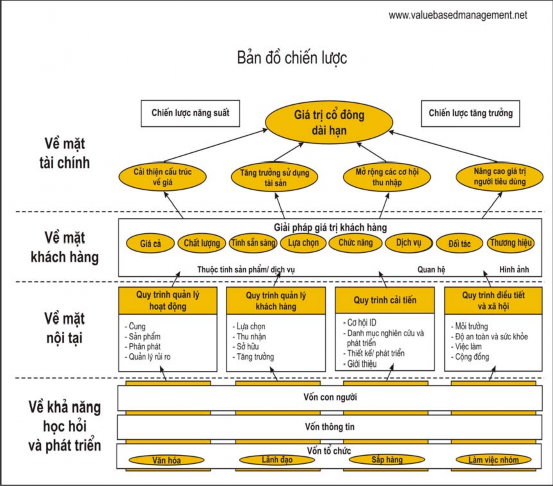
Figure 5: Strategy Map
(Source: Strategic Management Textbook – Help University, Malaysia)
Description of Strategy Map:
- Information is clearly summarized to make communication easier.
- Four directions: Finance, customers, internal, lessons and development
- The financial sector aims to create long-term shareholder value and build a cost structure, leverage assets based on a productivity strategy and a growth strategy that expands opportunities, enhancing customer value
- The final four elements of Strategic Innovation are supported by price, availability, selection, functionality, service, partners, and branding.
- From the company's internal perspective, the process of operating and managing customer relationships contributes to adjusting and improving the image of products and services.
- All these processes are reflected through human resource management, information management and corporate capital, which are understood as corporate culture, leadership, connection and teamwork.
- Finally, the cause-effect relationship is depicted with arrows.
By connecting elements such as shareholder value creation, customer relationship management, operations, quality management, etc. to the organizational structure on a chart. The strategy map is visualized more specifically and helps the communication process between executives with each other and with employees. In this way, alignment can be created around the strategy, making strategy execution easier.
2.8. Some supporting tools for strategic management analysis:
2.8.1. Macroenvironmental analysis (PEST model).
In fact, industries and businesses are in a large macro environment, which includes six segments: Economic, technological, socio-cultural, demographic, political-legal, and global. Changes in the macro environment can have a direct impact on any given force in the industry, thus altering its relative power to other forces and to itself, ultimately
together changing the attractiveness of an industry. [Assoc. Prof. Dr. Le The Gioi; Dr. Nguyen Thanh Liem; Master. Tran Huu Hai, (2009)].
Politics - law
Economy
Threat of potential competitors
Supplier capacity
Rivalry among existing companies
Customer purchasing capacity
International
Threat of substitute product competition
Technology
Society - Population
Figure 6: Macroenvironmental analysis model
2.8.2. Industry environment analysis (PORTER's 5 competitive forces model.)
An industry is a group of firms that offer products or services that are close substitutes for each other. In competition, firms within the industry influence each other. Generally, each industry consists of a mixture and variety of competitive strategies that firms pursue to try to achieve higher than average returns. In industry analysis, we often use the five forces model of competition by Michael E. Porter, a professor at the Harvard Business School, for analysis and evaluation.
5 competitive forces model
Substitute Products (from companies in other industries)
Suppliers of key inputs
Competition between
companies selling
Buyer
New companies can enter the industry
Figure 7: Five competitive forces model
(Source: Strategic Management Textbook – Help University, Malaysia)
2.8.3. In addition, in strategic management analysis, other analysis tools are also used such as: Internal environmental analysis (SWOT model), to identify strengths, weaknesses and see the company's opportunities as well as the challenges that the company faces.
CHAPTER 3: RESEARCH METHODOLOGY
To carry out the above tasks in assessing the current status of business management strategy in the telecommunications sector of Bac Kan Electricity Company. This chapter introduces some of the following research methods:
3.1. Approach:
Based on knowledge of Strategic Management, especially through Delta Project model, Strategy Map and other supporting tools along with sources of documents, annual reports of 2008, 2009, 2010 of DLBK company, related documents... conduct a survey, analyze the current status of business strategy of DLBK company using qualitative method and case study method, from which propose recommendations until 2015.
3.2. Research process:
3.2.1 Identify and catalog data: Collect to evaluate the current business strategy of DLBK company according to each element of these two tools.
3.2.2 Data collection implementation:
3.2.2.1. Secondary data:
Secondary data is determined through statistical methods and annual analysis of DLBK company. These data are collected from functional departments such as: Finance and Accounting Department; Planning Department; Telecommunications Center; Administration Department; Community Relations Department such as:
- Annual business performance report.
- Human resource planning report.
- Report on competitors' production and business results.
3.2.2.2. Primary data: Conducted by methods
Direct observation method: Daily activities in DLBK company, mainly the working process, contact with partners, employees...
Directly at the DLBK company's offices and member companies to visually observe and record people's behaviors and conduct.
Method of obtaining expert opinions through group discussion
Group discussions will be conducted with a group of 5 members in different fields but with the same research purpose on corporate strategic management. The number of discussions is 2 times within 1 hour for each interview. The 3rd time will be the conclusion for the interview content and ask for expert opinions to evaluate the interview results to serve the issue of interest: And assess the current status of the business development strategy of Bac Kan Electricity Company.
Interview method:
Direct interview: Interview the deputy director in charge of telecommunications and the head of the telecommunications center with short and concise questions, ensuring that the purpose of the interview is achieved.
- Interview with Mr. Ngo Van Gia, Deputy Director in charge of telecommunications business.
The interview content will focus on four criteria: Finance; Customers; Internal; Training and development.
Regarding finance: General assessment of the suitability and unsuitability of the financial management mechanism, and solutions; Investment work to expand business activities.
About customers: Current status of identifying target customers correctly or not. Assessment of current customer loyalty and customer satisfaction. Company's approach and goals in customer solutions in the new period.
Internally, the company: The suitability of human resource arrangement, the professional qualifications of the workforce, the management and administration qualifications of the leadership team. Directions for improvement and development.
Regarding training and development: Training and retraining to improve professional qualifications, management and administration skills. Recruitment to replace and expand business operations.
- Interview with Mr. Nguyen Van Tan, Deputy Head of Telecommunications Center.
The interview content will focus on five criteria: Business organization and implementation, distribution channels, marketing, products and services, improvement and innovation.
Regarding business activities: Organizing business activities, arranging business networks and linking current stages. Reform direction.
About distribution channels: The company's current product and service distribution network, coverage compared to competitors. Plan to expand the distribution network.
About Marketing: Current status of Marketing activities and comparison with competitors.
Innovation in form, content and methods of action.
About products and services: Differences and conveniences compared to competitors, customer perception and acceptance.
About innovation and new team: Applying advanced science and technology, modern equipment combined with training to improve business efficiency.
(Interview results in appendix 3 and appendix 4)