
usually has 2-3 seeds, ripens unevenly. Average fruit quality 14-150Brix. This is an early ripening grape variety, time from cutting to ripening 87-95 days. Average to high yield. This is a cross between Tokay and Ribier, made at the Frens Federal Garden Research Station (California, USA).
This grape variety is grown mainly for fresh consumption. It is susceptible to many fungal diseases.
2.2.3.2. Ribier purple grape variety
The plant has strong vitality, large leaves, rough underside, many hairs. The fruit cluster and fruit shape are similar to Cardinal red grapes because it is the parent variety of red grapes. The fruit is purple-black, the fruit weight is quite large 4.5 -5g, the fruit skin is thin. The fruit stem is not firmly connected to the embryo. The fruit quality is average with 14-160Brix.
This variety has a longer growing period than the Cardinal, from cutting to maturity 105 - 110 days. This variety is less susceptible to late blight than the Cardinal.
2.2.3.3. Variety NH.01-48 (White Malaga)
This variety was imported from Thailand to the Nha Ho Cotton and Fiber Plant Research Institute in 1996 and was recognized by the Ministry of Agriculture and Rural Development for dissemination in 1999. This variety grows well when grafted on Couderc 1613 rootstock and grows poorly when grown from its cuttings.
Time from cutting to harvest is 115 - 120 days. Yield is 16 - 20 tons/ha/crop. Fruit clusters are medium to large. Fruit size is medium. Fruit is elongated. Fruit is green when ripe. Fruit has 2-3 seeds. Brix level is 16-20%.
This variety is lightly to moderately affected by many pests and diseases, especially anthracnose (Gloeosporium ampelophagum.) and fruit rot or gray mold (Botrytis cinerea) is moderately affected (According to the report of
Dr. Nguyen Tho, Institute of Post-Harvest Technology at the Ninh Thuan Grape Production and Consumption Workshop, December 2002).
2.2.3.4. Black Queen breed
The Black Queen grape variety was imported from California, USA to Vinh Hao Grape Seed Farm in June 1997 and was permitted by the People's Committee of Binh Thuan Province for large-scale testing in November 1999.
The Black Queen variety grows very strongly on Couderc 1613 rootstock and grows strongly when grown from its cuttings. The time from cutting to harvest is 115 - 120 days. The average yield is from 16-24 tons/ha/crop. The fruit clusters are very large, the fruit size is large, the fruit is oval to slightly round. When ripe, the fruit skin is black. The fruit skin is tightly attached to the crispy fruit flesh. The fruit has from 3-4 seeds. Brix level is from 17-20%.
This variety is less susceptible to pests and diseases, except for moderate susceptibility to Botrytis cinerea. This is one of the promising fresh grape varieties in our country.
2.2.3.5. RedStar variety
Red Star variety imported from California (USA) (1998). The tree has average vitality. Time from cutting to maturity is 110 - 115 days. Leaves are light green, less hairy, deeply cleft, medium to large in size (16-19cm). Inflorescences are branched. Fruit clusters are conical, large in size, cluster weight 600-800g. Average number of fruits per cluster is 70-90. Fruits are spherical, each fruit has 2-4 seeds; when ripe, the fruit is red; fruit weight 7.8-8.3g. The fruit shell sticks tightly to the fruit flesh, the fruit flesh is crispy. Good fruit quality with 16-170Brix. Average yield is 12-14 tons/ha/crop.
This is one of the promising fresh grape varieties in our country. This grape variety is more resistant to late blight than the red Cardinal grape.
2.2.3.6. Pakchong Seedless variety
This variety was imported from Thailand (1997). The tree has medium to high vitality. Time from cutting to ripening is 90 - 95 days. Leaves are dark green, less hairy, deeply cleft, small to medium sized (13-16cm). The flower clusters are branched. The fruit clusters are conical, medium to large in size, with a cluster weight of 200-350g. The average number of fruits per cluster is 95-130. Seedless, spherical fruits are black when ripe; fruit weight is 2.3-2.5g. The fruit skin is tightly attached to the fruit flesh, the fruit flesh is moderately firm. The fruit quality is good with 16-170Brix. The fruit clusters are characterized by uneven ripening. The average yield is 10-13 tons/ha/crop. This grape variety is resistant to late blight.
2.2.3.7. Same as NH.02-04
This is the most promising wine grape variety, imported from France in 1994. The tree has high vitality. The time from cutting to ripening is from 110 - 115 days. The leaves are round, light green, less hairy, deeply cleft, of medium size (15-17cm). The flower clusters are long, with few branches. The fruit clusters are conical, elongated, the fruit cluster weight is 200-250g. The average number of fruits per cluster is 150-180. The fruit is spherical, each fruit has 2-3 seeds; when ripe, the fruit is slightly yellowish green; the fruit weight is 1.2-1.4g. The flavor is delicious, the fruit flesh is soft. High acidity and sugar content 16-180Brix, thin fruit skin. The yield is quite high, 15-18 tons/ha/crop.
This grape variety can be grown for winemaking and juice processing very well. They have high resistance to many diseases.
2.2.3.8. Chambourci variety (NH.02-10)
This is a wine grape variety imported from Australia in 1994. The tree has average vitality. The time from cutting to ripening is from 95 - 110 days. The leaves are purple, thin, dark green, less hairy, of medium size (15-17cm). The leaf stalks are red, the flower clusters are branched. The fruit clusters are slightly elongated cones, the fruit cluster weight is 150-200g. The fruit is spherical, each fruit has 2-3 seeds; when ripe, the fruit is dark black; the fruit weight is 1.8-2.0g. The flavor is sweet and sour. High acidity and sugar content 16-170Brix, the skin
Thick fruit. Average yield 8-10 tons/ha/crop. Wine and soft drinks made from this grape variety have quite attractive colors.
This grape variety is highly resistant to many diseases except rust, which is often severely damaged by thrips.
2.2.3.9. RubiRed variety (NH.02-09)
This is a grape variety imported from Australia in 1994. The tree has average vitality. The time from cutting to ripening is from 100 - 110 days. The leaves are slightly round, thick, light green, less hairy, shallowly split, of medium size (15-17cm). The flower clusters are many branches. The fruit clusters are slightly round conical; the fruit cluster weight is 50-150g. The fruit is spherical, each fruit has 1-3 seeds; when ripe, the fruit is dark black; the fruit weight is 1.3-1.5g. The taste is sweet and sour. High acidity and sugar content 18-200Brix, thick fruit skin. Average yield is 7-10 tons/ha/crop.
Wines and soft drinks made from this grape variety have quite attractive colors. This grape variety is highly resistant to late blight and anthracnose, is susceptible to rust, and is often severely damaged by thrips.
2.2.3.10. Promising rootstock grape varieties
Couderc 1613
This rootstock was imported in early 1999. It is a hybrid of Solanis and Othello. This variety has very high vitality. The root system develops strongly and is resistant to soil nematodes. This variety can adapt to many types of soil and has a very good resistance to adverse environmental conditions such as saline, wet or dry soil. In particular, they have the ability to receive grafts very well with a high graft survival rate of over 95%.
The tree has a large trunk diameter and grows strongly right from the beginning, when the cuttings are first taken, which is relatively favorable for grafting techniques. This variety has a very high resistance to pests and diseases, with almost no signs of downy mildew, powdery mildew and anthracnose.
Ramsey
This rootstock was imported from Australia in 1997; it has high vitality. The tree has the ability to grow strongly. The roots are resistant to soil nematodes. This variety has a very good ability to withstand adverse environmental conditions such as saline, wet or dry soil. They have the ability to receive grafts very well with a high graft survival rate of over 95%. This variety has a very high resistance to pests and diseases, only being slightly affected by rust fungus. However, in the early stages of incubation, the seedlings grow slowly, with small trunk diameters, making grafting difficult. It takes a long time for the tree to have a large enough diameter for grafting.
Table 2.2: Comparison of advantages and disadvantages of Cardinal grape variety and Black Queen and White Malaga grape varieties
Cardinal grape variety | Black Queen and White Malaga grape varieties | |
Advantage: | - Short growing time, from cutting to harvest 90 days. - Easy to care for. | - High productivity and quality - Few pests and diseases - The color and design are so beautiful - If the correct grape cultivation techniques are applied, the grapes will be of good quality and safe. - High consumption price (5000-18000 VND/kg) |
Disadvantages: | - Infected with many pests and diseases - Suffering from fruit cracking disease in both sunny and rainy seasons - The fruit quality is not high - Low consumption price (1500-4000 VND/kg) | - Fruit rot occurs moderately and can be controlled by cultivation measures and the use of pesticides. - High requirements for intensive investment and farming techniques. |
Maybe you are interested!
-

 Advantages and Disadvantages of Swap Contracts in Vietnam
 -
 Advantages and Disadvantages in Organizing Professional Group Activities in the Direction of Developing Teaching Capacity
 -
 Advantages and Disadvantages of Current Payment Methods at Vietinbank
 -
 Comparing the Advantages and Disadvantages of On-the-Job and Off-the-Job Training
 -
 Advantages and Disadvantages of Carrying Out the Topic
Source: Grapevine development project - Tuy Phong district, Binh Thuan province, period 2004 - 2010
In addition to the two rootstocks mentioned above, fresh grape varieties Anab-e-Shahi, Alden,.... with good characteristics such as nematode resistance, very good tolerance to adverse environmental conditions are also used as rootstocks. The evaluation results of the cotton research center show that fresh grape varieties NH.01-48,
Black Queen, Pakchong grafted on these rootstocks grow very strongly and give higher yields than those grown directly from cuttings.
2.3. Factors affecting grape growing and processing in Khanh Hoa, Ninh Thuan, Binh Thuan.
2.3.1. Factors affecting grape growing and processing in Khanh Hoa
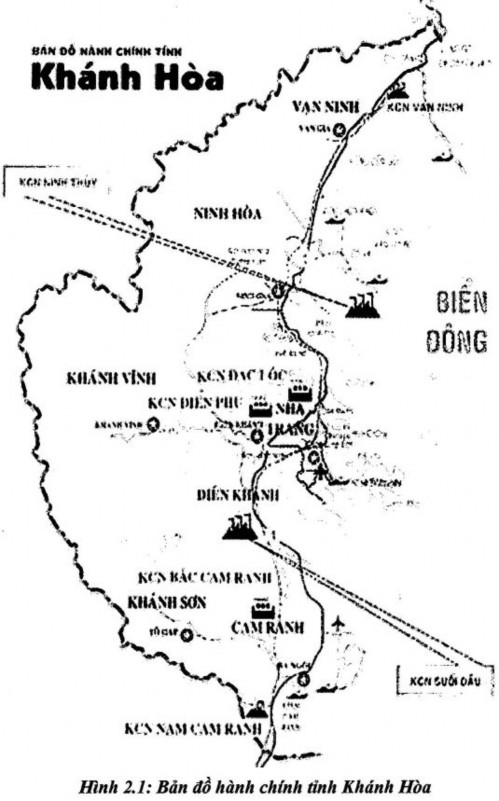
Khanh Hoa is a province in the South Central Coast region, located in the furthest curve extending out to the sea to the East.
North: borders Phu Yen province. South: borders Ninh Thuan province.
West: borders Dak Lak and Gia Lai provinces. East: borders the East Sea.
In terms of administrative organization, by 2001, Khanh Hoa included: 1 city, 1 town, 6 districts, 5 townships, 27 wards and 104 communes.
2.3.1.1. Natural conditions
PP
PP
Khanh Hoa's climate is both influenced by the tropical monsoon climate and the oceanic climate, so it is relatively mild. The average annual temperature is 26 0 C. The total temperature is about 9500 0 C. The average annual rainfall is over
below 2000m, in which the coastal plain is commonly 1000-1200mm.
Khanh Hoa includes the main soil groups:
Sand and sand dunes cover an area of 10,550 hectares, accounting for 2% of the natural area, distributed along the coast.
Alluvial soil covers an area of 39,300 hectares, accounting for 7.5% of the natural area, distributed in coastal plains such as Ninh Hoa, Dien Khanh, Cam Ranh...
Saline and saline soil covers an area of 7,950 hectares, accounting for 1.5% of the natural area, distributed along the coast of Ninh Hoa, Van Ninh, and Cam Ranh.
24,250 ha of gray, infertile land, accounting for 4.6% of the natural area.
Red-yellow soil and other types of soil cover an area of 443,750 hectares, accounting for 84.4% of the natural area, mainly distributed in mountainous areas with steep slopes.
2.3.1.2. Socio-economic conditions
According to statistics, by December 31, 2004, the average population of Khanh Hoa province reached 1,111,000 people with a population growth rate of 1.34%. The recent population growth in Khanh Hoa is mainly due to mechanical population growth due to economic development.
The labor structure in agriculture has decreased, which proves that non-agricultural economic sectors in Khanh Hoa have developed, attracting labor from rural to urban areas.
Khanh Hoa's economic structure has changed in a positive direction: the proportion of agriculture, forestry and fishery has decreased from 28.9% (in 2000) to 19.4% (in 2004); the proportion of industry and construction has increased from 36.5% (in 2000) to 41% (in 2004); the proportion of services has increased from 34.6% in 2000 to 39.6% in 2004.
Average GDP/person/year increased continuously: 7,796,513 VND (2002), 2004: 10,552,000 VND.
2.3.2. Factors affecting grape growing and processing in Ninh Thuan
PP
Ninh Thuan is a coastal province in the South Central Coast region, separated from the old Thuan Hai province (April 1992). Ninh Thuan has a 105 km long coastline, with over 24,480 km2 of territorial waters, surrounded by the following provinces:
North: borders Khanh Hoa province. South: borders Binh Thuan province. West: borders Lam Dong province. East: borders the East Sea.
In terms of administrative organization, by 2001, Ninh Thuan included: 1 PR-TC town; 4 districts: Ninh Son, Ninh Hai, Ninh Phuoc, and the newly established Bac Ai district, 44 communes, 3 towns and 9 wards.