
I.2. TECHNICAL SPECIFICATIONS
A pulse current is made up of the following basic elements:
- The pulse shape that creates that pulse current.
Maybe you are interested!
-

 Building software to manage a bank of multiple choice questions for university admissions - 16
 -
 Building software to manage a bank of multiple choice questions for university admissions - 26
 -
 Research on building software to convert measurement data of 3D coordinate measuring machine QM333 - 5
 -
 Building software to manage a bank of multiple choice questions for university admissions - 1
 -
 Organizing Capacity Training to Develop School Education Programs According to the New General Education Program for Management and Teaching Staff
- Line frequency
- Current amplitude
- Pulse mixing (pulse modulation).
I.2.1 Pulse shape
An electrical pulse has the following basic parameters:
- Pulse shape: the main pulse shapes are square (rectangular) pulses, spiked (triangular) pulses, sinusoidal pulses, and plowshare pulses. Pulse shape determines the stimulating properties of an electrical pulse. Pulses with high slopes (square pulses, spiked pulses) have the ability to strongly stimulate muscles that are still well innervated, while pulses with low slopes (plowshare pulses) are more suitable for muscles that have reduced or lost innervation. Sinusoidal pulses are an intermediate form between the above two types, and have a very good regulating effect.
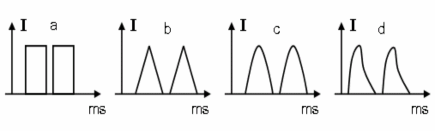
Figure 1. 2: Pulse shapes
a- Square pulse; b- Spike pulse;
c- Sine wave pulse; d- Plow blade pulse
- Pulse time: includes ramp time (t a ), maintenance time (t i ), descent time (t b ) and the next pause (t p ) until the start of a new pulse. The combination of the above elements forms a pulse cycle (t).
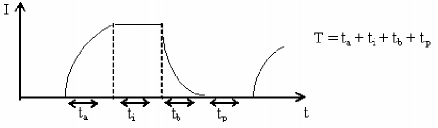
Figure 1. 3: Pulse stages
Pulse amplitude: is the magnitude of an electrical pulse, reflecting the strong or weak stimulation ability of the pulse.
- Pulse current can be continuous, uniform in amplitude and frequency, or intermittent, with frequency or amplitude modulation ( Figure 2.4 ).
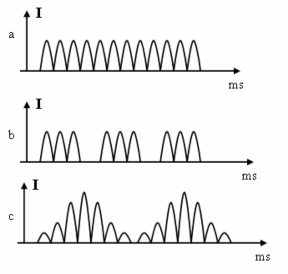
Figure 1.4: Shape change for 1 type of electric pulse
a. Continuous pulse current
b. Intermittent pulse current
c. Amplitude modulated pulse current .
The combination of shape, duration and amplitude of the pulse determines the amount of charge transmitted from an electric pulse to the body tissue (effect on nutrition), as well as its nature and stimulating ability. It can be seen that the sinusoidal pulse is the form that most fully meets the above criteria, it has effects on both sensation, on muscle contraction, and on nutrition; at the same time, it can stimulate both normal tissues as well as tissues whose response ability has decreased, thanks to the moderate up and down slopes and gradual increase and decrease, so it is the most common pulse form in clinical applications.
I.2.2 Line frequency
Is the number of cycles that appear in a period of 1 second (unit is Hz). Each pulse current has its own characteristic frequency pattern, reflecting the specific effects of that type of current. The current frequency can vary from a few pulses to several thousand pulses per second. However, when the frequency is above 3,000Hz, the effects of the frequencies are no longer different, because the body's tissues cannot respond to changes in current too quickly (Wedensky inhibition).
But pulse currents with frequencies below 1,000 Hz are called low frequency pulse currents. Pulse currents with frequencies above 1,000Hz to 10,000Hz are called medium frequency pulse currents.
I.2.3 Current amplitude
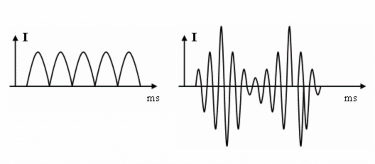
Figure 1.5: Current amplitude
a- DF current is a current with stable amplitude throughout its existence.
b- Interference current is a current with amplitude
rhythmic variation (AMF flow )
Is the amplitude of all the pulses that make up the pulse current. The current amplitude can be stable throughout the existence of the pulse current or can vary according to predetermined rhythms.
I.2.4 Pulse blending
We all know that if we only maintain a monotonous form of stimulation, it will quickly lead to the body's adaptation (habituation phenomenon). Pulse modulation (mixing the frequency and amplitude of the pulse) will create a variety of stimulation, prevent habituation and enhance the effectiveness of the pulse currents.
Currently, in physical therapy practice there are the following pulsed electric currents:
This:
- Square pulse current (Ledue current)
- Spike current (Faradie current)
- Plow blade pulse current (Lapie current, Exponentiel current)
- Sine wave current (Bernard current, Diadynamic current)
- Trabert series 2-5 (Ultra-reiz series)
- Interferential lines (Nemec line, Interferentiel line)
- Russian stim
- TENS line
- Direct current frequency 8000Hz.
I.3. PHYSIOLOGICAL CHARACTERISTICS
I.3.1 Body response to pulsed currents
Threshold and habituation phenomenon : the effect of a pulsed electric current on a healthy body always goes through the following 3 stages:
- Sensation phase : is the first response very quickly after establishing the electric field in the body tissue. At this time, the current intensity is still very low, only a few mA left. The patient feels a tingling sensation like ants crawling on the skin, then gradually leaks like needles pricking. This phase will pass quickly if the current intensity continues to increase.
- Muscle contraction phase : when the current intensity is strong enough, it will create a muscle contraction response from mild to strong that the patient can feel very weak, like the muscle is vibrating to the rhythm of the electric current. On the other hand, the treatment technician can also notice the muscle contraction phenomenon by looking or touching directly on the treatment area, the muscle will contract and swell to the rhythm of the pulsed electric current.
- Pain phase : is a manifestation of excessive response to strong gas flow.
degree exceeded the allowable limit. From gentle contractions turned into sensations
muscle twisting sensation, causing uncomfortable pain and can lead to unpredictable side effects. Therefore, pain is a manifestation that should be avoided during treatment.
The above response stages are called the “threshold” of the body tissue to the pulse current, which is a general rule for all types of pulse current, regardless of the technical parameters of the current. However, the level of response depends on the individual sensitivity of each person and the pathological condition of the body tissue.
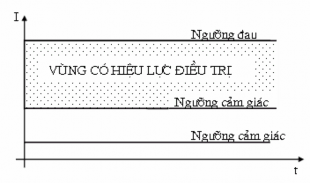
Figure 1.6: Area of treatment effect
The thresholds of electric pulses continuously increase during the treatment. This reflects a basic characteristic of the body's tissue, which is the phenomenon of adaptation (or habituation) to an external stimulus (in this case, an electrical stimulus), which occurs very quickly after the start of treatment, especially for high-frequency currents (medium-frequency currents). The adaptation phenomenon causes the effect of the electric pulse to decrease, which is a problem that needs to be overcome in treatment practice.
There are some basic measures to avoid habituation that are commonly applied:
- Continuously increase the current intensity in several steps to maintain the intensity level in the range from above the threshold of sensation to the threshold of pain. This is the intensity range with the best treatment effect (called the “therapeutic range”).
- Pulse modulation by alternating groups of pulses with different frequency numbers (CP current, LP current, interference current), interrupted by periods without current (exercise rhythm, Burst current - TENS, Russian stimulation current), creating rhythmic current amplitude (AMF current, surge current...)
- Limiting the treatment time is a simple and effective measure, partly depending on the subjective consciousness of the treating technician. It is necessary to overcome the mentality that the treatment time must be prolonged to be more effective. In fact, except for a few lines that require a relatively long treatment time (such as the TENS line), in general, the time for a treatment session is usually no more than 10 minutes (average from 4-6 minutes), a treatment session is no more than 10 days, if multiple treatment sessions are needed, they must be spaced 3 to 4 weeks apart.
- Response to direct current and alternating current : the main difference is that direct current causes an electrolytic effect under the electrodes (galvanic effect), while alternating current does not. The higher the intensity, the greater the electrolytic effect and the more pain. This will limit the intensity of direct current. With alternating current, this problem does not occur, so much higher intensities can be applied without pain. This is especially beneficial in the treatment of muscle stimulation, where higher current intensities are required.
Another difference between direct current and alternating current is polarity. With alternating current, the electrodes have no polarity. If two electrodes of the same size are used, the effect on both electrodes is the same, and both electrodes can be used as stimulating electrodes. With direct current, the
Electrodes have polarity, that is, they have a negative and a positive pole. There are differences in the effects under the electrodes. The negative electrode stimulates more strongly, so it is often used as the active electrode.
- Response to low frequency current and medium frequency current: we
Everyone knows that skin resistance is divided into two types:
Impedance (r 0 ): depends on the line frequency and has a relatively stable value of 1000 ohm ( ).
Capacitance (r 0 ): is a variable resistance depending on the volume of the shallow layer of organization and the current frequency. Capacitance will reduce the current frequency capability. The relationship between frequency and capacitance is shown through
following formula:
R c =
1
2. . f . c
In which : r c : capacitive reactance
f: line frequency
c: organizational capacity
Low frequency current (e.g. 50Hz) will respond to an RC of about 3200 . By law, current will follow the path of least resistance. Therefore it will follow the path of impedance. This resistance is quite large, so the effect will occur on a shallow surface, causing very strong skin stimulation.
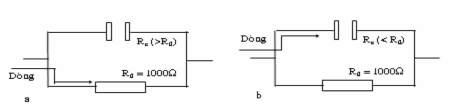
Figure 1.7: Path of pulse currents
a- Path of low frequency pulse current
b- Path of medium frequency pulse current