
- Training: reflected in the number of hours of formal training provided to each professional. Adequate training in accounting and auditing topics is important so that audit staff are equipped with the necessary skills and knowledge to perform a quality audit.
- Supervision and review: the number of hours that directors/audit team leaders spend on review during the total time of an audit.
(b) Criteria for assessing audit quality related to the audit process: including information on the number of errors detected by the internal quality review process of the audit unit and by the audit quality monitoring agency; results of internal professional competence checks of auditors; information on the level of investment in facilities.
Maybe you are interested!
-
 Building a Civilized and Modern Tourism Environment; Strengthening Tourism Promotion and Advertising
 -
 Strengthening Tourism Promotion and Advertising; Focusing on Investing in Building Brands and Typical Tourism Products of Hai Phong:
 -
 Strengthening the Economic - Financial Information System, Legalizing the Provision of Information on Banking Activities and Financial Markets
 -
 Identify Rating Levels and Rating Scales
zt2i3t4l5ee
zt2a3gstourism,quan lan,quang ninh,ecology,ecotourism,minh chau,van don,geography,geographical basis,tourism development,science
zt2a3ge
zc2o3n4t5e6n7ts
of the islanders. Therefore, this indicator will be divided into two sub-indicators:
a1. Natural tourism attractiveness a2. Cultural tourism attractiveness
b. Tourist capacity
The two island communes in Quan Lan have different capacities to receive tourists. Minh Chau Commune is home to many standard hotels and resorts, attracting high-income domestic and international tourists. Meanwhile, Quan Lan Commune has many motels mainly built and operated by local people, so the scale and quality are not high, and will be suitable for ordinary tourists such as students.
c. Time of exploitation of Quan Lan Island Commune:
Quan Lan tourism is seasonal due to weather and climate conditions and festivals only take place on certain days of the year, specifically in spring. In Quan Lan commune, the period from April to June and from September to November is considered the best time to visit Quan Lan because the cultural tourism activities are mainly associated with festivals taking place during this time.
Minh Chau island commune:
Tourism exploitation time is all year round, because this is a place with a number of tourist attractions with diverse ecosystems such as Bai Tu Long National Park Research Center, Tram forest, Turtle Laying Beach, so besides coming to the beach for tourism and vacation in the summer, Minh Chau will attract research groups to come for tourism combined with research at other times of the year.
d. Sustainability
The sustainability of ecotourism sites in Quan Lan and Minh Chau communes depends on the sensitivity of the ecosystems to climate changes.
landscape. In general, these tourist destinations have a fairly high level of sustainability, because they are natural ecosystems, planned and protected. However, if a large number of tourists gather at certain times, it can exceed the carrying capacity and affect the sustainability of the environment (polluted beaches, damaged trees, animals moving away from their habitats, etc.), then the sustainability of the above ecosystems (natural ecosystems, human ecosystems) will also be affected and become less sustainable.
e. Location and accessibility
Both island communes have ports to take tourists to visit from Van Don wharf:
- Quan Lan – Van Don traffic route:
Phuc Thinh – Viet Anh high-speed boat and Quang Minh high-speed boat, depart at 8am and 2pm from Van Don to Quan Lan, and at 7am and 1pm from Quan Lan to Van Don. There are also wooden boats departing at 7am and 1pm.
- Van Don - Minh Chau traffic route:
Chung Huong high-speed train, Minh Chau train, morning 7:30 and afternoon 13:30 from Van Don to Minh Chau, morning 6:30 and afternoon 13:00 from Minh Chau to Van Don.
f. Infrastructure
Despite receiving investment attention, the issue of infrastructure and technical facilities for tourism on Quan Lan Island is still an issue that needs to be resolved because it has a direct impact on the implementation of ecotourism activities. The minimum conditions for serving tourists such as accommodation, electricity, water, communication, especially medical services, and security work need to be given top priority. Ecotourism spots in Minh Chau commune are assessed to have better infrastructure and technical facilities for tourism because there are quite complete and synchronous conditions for serving tourists, meeting many needs of domestic and foreign tourists.
3.2.1.4. Determine assessment levels and assessment scales
Corresponding to the levels of each criterion, the index is the score of those levels in the order of 4, 3, 2, 1 decreasing according to the standard of each level: very attractive (4), attractive (3), average (2), less attractive (1).
3.2.1.5. Determining the coefficients of the criteria
For the assessment of DLST in the two communes of Quan Lan and Minh Chau islands, the students added evaluation coefficients to show the importance of the criteria and indicators as follows:
Coefficient 3 with criteria: Attractiveness, Exploitation time. These are the 2 most important criteria for attracting tourists to tourism in general and eco-tourism in particular, so they have the highest coefficient.
Coefficient 2 with criteria: Capacity, Infrastructure, Location and accessibility . Because the assessment area is an island commune of Van Don district, the above criteria are selected by the author with appropriate coefficients at the average level.
Coefficient 1 with criteria: Sustainability. Quan Lan has natural and human-made ecotourism sites, with high biodiversity and little impact from local human factors. Most of the ecotourism sites are still wild, so they are highly sustainable.
3.2.1.6. Results of DLST assessment on Quan Lan island
a. Assessment of the potential for natural tourism development
For Minh Chau commune:
+ Natural tourism attractiveness is determined to be very attractive (4 points) and the most important coefficient (coefficient 3), so the score of the Attractiveness criterion is 4 x 3 = 12.
+ Capacity is determined as average (2 points) and the coefficient is quite important (coefficient 2), then the score of Capacity criterion is 2 x 2 = 4.
+ Exploitation time is long (4 points), the most important coefficient (coefficient 3) so the score of the Exploitation time criterion is 4 x 3 = 12.
+ Sustainability is determined as sustainable (4 points), the important coefficient is the average coefficient (coefficient 1), so the score of the Sustainability criterion is 4 x 1 = 4 points
+ Location and accessibility are determined to be quite favorable (2 points), the coefficient is quite important (coefficient 2), the criterion score is 2 x 2 = 4 points.
+ Infrastructure is assessed as good (3 points), the coefficient is quite important (coefficient 2), then the score of the Infrastructure criterion is 3 x 2 = 6 points.
The total score for evaluating DLST in Minh Chau commune according to 6 evaluation criteria is determined as: 12 + 4 + 12 + 4 + 4 + 6 = 42 points
Similar assessment for Quan Lan commune, we have the following table:
Table 3.3: Assessment of the potential for natural ecotourism development in Quan Lan and Minh Chau communes
Attractiveness of self-tourismof course
Capacity
Mining time
Sustainability
Location and accessibility
Infrastructure
Result
Point
DarkMulti
Point
DarkMulti
Point
DarkMulti
Point
DarkMulti
Point
DarkMulti
Point
DarkMulti
CommuneMinh Chau
12
12
4
8
12
12
4
4
4
8
6
8
42/52
Quan CommuneLan
6
12
6
8
9
12
4
4
4
8
4
8
33/52
b. Assessment of the potential for humanistic tourism development
For Quan Lan commune:
+ The attractiveness of human tourism is determined to be very attractive (4 points) and the most important coefficient (coefficient 3), so the score of the Attractiveness criterion is 4 x 3 = 12.
+ Capacity is determined to be large (3 points) and the coefficient is quite important (coefficient 2), then the score of the Capacity criterion is 3 x 2 = 6.
+ Mining time is average (3 points), the most important coefficient (coefficient 3) so the score of the Mining time criterion is 3 x 3 = 9.
+ Sustainability is determined as sustainable (4 points), the important coefficient is the average coefficient (coefficient 1), so the score of the Sustainability criterion is 4 x 1 = 4 points.
+ Location and accessibility are determined to be quite favorable (2 points), the coefficient is quite important (coefficient 2), the criterion score is 2 x 2 = 4 points.
+ Infrastructure is rated as average (2 points), the coefficient is quite important (coefficient 2), then the score of the Infrastructure criterion is 2 x 2 = 4 points.
The total score for evaluating DLST in Quan Lan commune according to 6 evaluation criteria is determined as: 12 + 6 + 6 + 4 + 4 + 4 = 36 points.
Similar assessment with Minh Chau commune we have the following table:
Table 3.4: Assessment of the potential for developing humanistic eco-tourism in Quan Lan and Minh Chau communes
Attractiveness of human tourismliterature
Capacity
Mining time
Sustainability
Location and accessibility
Infrastructure
Result
Point
DarkMulti
Point
DarkMulti
Point
DarkMulti
Point
DarkMulti
Point
DarkMulti
Point
DarkMulti
Quan CommuneLan
12
12
6
8
9
12
4
4
4
8
4
8
39/52
Minh CommuneChau
6
12
4
8
12
12
4
4
4
8
6
8
36/52
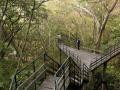
Basically, both Minh Chau and Quan Lan localities have quite favorable conditions for developing ecotourism. However, Quan Lan commune has more advantages to develop ecotourism in a humanistic direction, because this is an area with many famous historical relics such as Quan Lan Communal House, Quan Lan Pagoda, Temple worshiping the hero Tran Khanh Du, ... along with local festivals held annually such as the wind praying ceremony (March 15), Quan Lan festival (June 10-19); due to its location near the port and long exploitation time, the beaches in Quan Lan commune (especially Quan Lan beach) are no longer hygienic and clean to ensure the needs of tourists coming to relax and swim; this is also an area with many beautiful landscapes such as Got Beo wind pass, Ong Phong head, Voi Voi cave, but the ability to access these places is still very limited (dirt hill road, lots of gravel and rocks), especially during rainy and windy times; In addition, other natural resources such as mangrove forests and sea worms have not been really exploited for tourism purposes and ecotourism development. On the contrary, Minh Chau commune has more advantages in developing ecotourism in the direction of natural tourism, this is an area with diverse ecosystems such as at Rua De Beach, Bai Tu Long National Park Conservation Center...; Minh Chau beach is highly appreciated for its natural beauty and cleanliness, ranked in the top ten most beautiful beaches in Vietnam; Minh Chau commune is also home to Tram forest with a large area and a purity of up to 90%, suitable for building bridges through the forest (a very effective type of natural ecotourism currently applied by many countries) for tourists to sightsee, as well as for the purpose of studying and researching.
Figure 3.1: Thenmala Forest Bridge (India) Source: https://www.thenmalaecotourism.com/(August 21, 2019)
3.2.2. Using SWOT matrix to evaluate Quan Lan island tourism
General assessment of current tourism activities of Quan Lan island is shown through the following SWOT matrix:
Table 3.5: SWOT matrix evaluating tourism activities on Quan Lan island
Internal agent
Strengths- There is a lot of potential for tourism development, especially natural ecotourism and humanistic ecotourism.- The unskilled labor force is relatively abundant.- resource environmentunpolluted, still
Weaknesses- Poorly developed infrastructure, especially traffic routes to tourist destinations on the island.- The team of professional staff is still weak.- Tourism products in general
quite wild, originalintact
general and DLST in particularalone is monotonous.
External agents
Opportunity- Tourism is a key industry in the socio-economic development strategy of the province and Van Don economic zone.- Quan Lan was selected as a pilot area for eco-tourism development within the framework of the green growth project between Quang Ninh province and the Japanese organization JICA.- The flow of tourists and especially ecotourism in the world tends toincreasing
Challenge- Weather and climate change abnormally.- Competition in tourism products is increasingly fierce, especially with other localities in the province such as Ha Long, Mong Cai...- Awareness of tourists, especially domestic tourists, about ecotourism and nature conservation is not high.
Through summary analysis using SWOT matrix we see that:
To exploit strengths and take advantage of opportunities, it is necessary to:
- Diversify products and service types (build more tourism routes aimed at specific needs of tourists: experiential tourism immersed in nature, spiritual cultural tourism...)
- Effective exploitation of resources and differentiated products (natural resources and human resources)
div.maincontent .p { color: black; font-family:"Times New Roman", serif; font-style: normal; font-weight: normal; text-decoration: none; font-size: 14pt; margin:0pt; } div.maincontent p { color: black; font-family:"Times New Roman", serif; font-style: normal; font-weight: normal; text-decoration: none; font-size: 14pt; margin:0pt; } div.maincontent .s1 { color: black; font-family:"Times New Roman", serif; font-style: normal; font-weight: normal; text-decoration: none; font-size: 13pt; } div.maincontent .s2 { color: black; font-family:"Times New Roman", serif; font-style: normal; font-weight: normal; text-decoration: none; font-size: 13pt; } div.maincontent .s3 { color: #0D0D0D; font-family:"Times New Roman", serif; font-style: normal; font-weight: bold; text-decoration: none; font-size: 14pt; } div.maincontent .s4 { color: black; font-family:"Times New Roman", serif; font-style: italic; font-weight: normal; text-decoration: none; font-size: 14pt; } div.maincontent .s5 { color: black; font-family:"Times New Roman", serif; font-style: italic; font-weight: bold; text-decoration: none; font-size: 14pt; } div.maincontent .s6 { color: black; font-family:"Times New Roman", serif; font-style: italic; font-weight: normal; text-decoration: none; font-size: 14pt; vertical-align: -3pt; } div.maincontent .s7 { color: black; font-family:"Times New Roman", serif; font-style: italic; font-weight: normal; text-decoration: none; font-size: 14pt; vertical-align: -2pt; } div.maincontent .s8 { color: black; font-family:"Times New Roman", serif; font-style: italic; font-weight: normal; text-decoration: none; font-size: 14pt; vertical-align: -1pt; } div.maincontent .s9 { color: black; font-family:"Times New Roman", serif; font-style: normal; font-weight: normal; text-decoration: none; font-size: 14pt; } div.maincontent .s10 { color: black; font-family:"Times New Roman", serif; font-style: normal; font-weight: bold; text-decoration: none; font-size: 14pt; } div.maincontent .s11 { color: black; font-family:"Times New Roman", serif; font-style: normal; font-weight: normal; text-decoration: none; font-size: 14pt; } div.maincontent .s12 { color: black; font-family:Symbol, serif; font-style: normal; font-weight: normal; text-decoration: none; font-size: 14pt; } div.maincontent .s13 { color: black; font-family:Wingdings; font-style: normal; font-weight: normal; text-decoration: none; font-size: 14pt; } div.maincontent .s14 { color: black; font-family:"Times New Roman", serif; font-style: normal; font-weight: normal; text-decoration: none; font-size: 9pt; vertical-align: 5pt; } div.maincontent .s15 { color: black; font-family:"Times New Roman", serif; font-style: normal; font-weight: normal; text-decoration: none; font-size: 9pt; vertical-align: 5pt; } div.maincontent .s16 { color: black; font-family:Cambria, serif; font-style: italic; font-weight: normal; text-decoration: none; font-size: 14pt; } div.maincontent .s17 { color: #080808; font-family:"Times New Roman", serif; font-style: normal; font-weight: bold; text-decoration: none; font-size: 14pt; } div.maincontent .s18 { color: #080808; font-family:"Times New Roman", serif; font-style: normal; font-weight: normal; text-decoration: none; font-size: 14pt; } div.maincontent .s19 { color: black; font-family:"Times New Roman", serif; font-style: normal; font-weight: normal; text-decoration: none; font-size: 11pt; } div.maincontent .s20 { color: black; font-family:"Times New Roman", serif; font-style: normal; font-weight: normal; text-decoration: none; font-size: 10pt; } div.maincontent .s21 { color: black; font-family:"Times New Roman", serif; font-style: normal; font-weight: bold; text-decoration: none; font-size: 11pt; } div.maincontent .s22 { color: black; font-family:"Times New Roman", serif; font-style: normal; font-weight: normal; text-decoration: none; font-size: 11pt; } div.maincontent .s23 { color: black; font-family:"Times New Roman", serif; font-style: italic; font-weight: normal; text-decoration: none; font-size: 14pt; } div.maincontent .s24 { color: #212121; font-family:"Times New Roman", serif; font-style: normal; font-weight: normal; tex
Identify Rating Levels and Rating Scales
zt2i3t4l5ee
zt2a3gstourism,quan lan,quang ninh,ecology,ecotourism,minh chau,van don,geography,geographical basis,tourism development,science
zt2a3ge
zc2o3n4t5e6n7ts
of the islanders. Therefore, this indicator will be divided into two sub-indicators:
a1. Natural tourism attractiveness a2. Cultural tourism attractiveness
b. Tourist capacity
The two island communes in Quan Lan have different capacities to receive tourists. Minh Chau Commune is home to many standard hotels and resorts, attracting high-income domestic and international tourists. Meanwhile, Quan Lan Commune has many motels mainly built and operated by local people, so the scale and quality are not high, and will be suitable for ordinary tourists such as students.
c. Time of exploitation of Quan Lan Island Commune:
Quan Lan tourism is seasonal due to weather and climate conditions and festivals only take place on certain days of the year, specifically in spring. In Quan Lan commune, the period from April to June and from September to November is considered the best time to visit Quan Lan because the cultural tourism activities are mainly associated with festivals taking place during this time.
Minh Chau island commune:
Tourism exploitation time is all year round, because this is a place with a number of tourist attractions with diverse ecosystems such as Bai Tu Long National Park Research Center, Tram forest, Turtle Laying Beach, so besides coming to the beach for tourism and vacation in the summer, Minh Chau will attract research groups to come for tourism combined with research at other times of the year.
d. Sustainability
The sustainability of ecotourism sites in Quan Lan and Minh Chau communes depends on the sensitivity of the ecosystems to climate changes.
landscape. In general, these tourist destinations have a fairly high level of sustainability, because they are natural ecosystems, planned and protected. However, if a large number of tourists gather at certain times, it can exceed the carrying capacity and affect the sustainability of the environment (polluted beaches, damaged trees, animals moving away from their habitats, etc.), then the sustainability of the above ecosystems (natural ecosystems, human ecosystems) will also be affected and become less sustainable.
e. Location and accessibility
Both island communes have ports to take tourists to visit from Van Don wharf:
- Quan Lan – Van Don traffic route:
Phuc Thinh – Viet Anh high-speed boat and Quang Minh high-speed boat, depart at 8am and 2pm from Van Don to Quan Lan, and at 7am and 1pm from Quan Lan to Van Don. There are also wooden boats departing at 7am and 1pm.
- Van Don - Minh Chau traffic route:
Chung Huong high-speed train, Minh Chau train, morning 7:30 and afternoon 13:30 from Van Don to Minh Chau, morning 6:30 and afternoon 13:00 from Minh Chau to Van Don.
f. Infrastructure
Despite receiving investment attention, the issue of infrastructure and technical facilities for tourism on Quan Lan Island is still an issue that needs to be resolved because it has a direct impact on the implementation of ecotourism activities. The minimum conditions for serving tourists such as accommodation, electricity, water, communication, especially medical services, and security work need to be given top priority. Ecotourism spots in Minh Chau commune are assessed to have better infrastructure and technical facilities for tourism because there are quite complete and synchronous conditions for serving tourists, meeting many needs of domestic and foreign tourists.
3.2.1.4. Determine assessment levels and assessment scales
Corresponding to the levels of each criterion, the index is the score of those levels in the order of 4, 3, 2, 1 decreasing according to the standard of each level: very attractive (4), attractive (3), average (2), less attractive (1).
3.2.1.5. Determining the coefficients of the criteria
For the assessment of DLST in the two communes of Quan Lan and Minh Chau islands, the students added evaluation coefficients to show the importance of the criteria and indicators as follows:
Coefficient 3 with criteria: Attractiveness, Exploitation time. These are the 2 most important criteria for attracting tourists to tourism in general and eco-tourism in particular, so they have the highest coefficient.
Coefficient 2 with criteria: Capacity, Infrastructure, Location and accessibility . Because the assessment area is an island commune of Van Don district, the above criteria are selected by the author with appropriate coefficients at the average level.
Coefficient 1 with criteria: Sustainability. Quan Lan has natural and human-made ecotourism sites, with high biodiversity and little impact from local human factors. Most of the ecotourism sites are still wild, so they are highly sustainable.
3.2.1.6. Results of DLST assessment on Quan Lan island
a. Assessment of the potential for natural tourism development
For Minh Chau commune:
+ Natural tourism attractiveness is determined to be very attractive (4 points) and the most important coefficient (coefficient 3), so the score of the Attractiveness criterion is 4 x 3 = 12.
+ Capacity is determined as average (2 points) and the coefficient is quite important (coefficient 2), then the score of Capacity criterion is 2 x 2 = 4.
+ Exploitation time is long (4 points), the most important coefficient (coefficient 3) so the score of the Exploitation time criterion is 4 x 3 = 12.
+ Sustainability is determined as sustainable (4 points), the important coefficient is the average coefficient (coefficient 1), so the score of the Sustainability criterion is 4 x 1 = 4 points
+ Location and accessibility are determined to be quite favorable (2 points), the coefficient is quite important (coefficient 2), the criterion score is 2 x 2 = 4 points.
+ Infrastructure is assessed as good (3 points), the coefficient is quite important (coefficient 2), then the score of the Infrastructure criterion is 3 x 2 = 6 points.
The total score for evaluating DLST in Minh Chau commune according to 6 evaluation criteria is determined as: 12 + 4 + 12 + 4 + 4 + 6 = 42 points
Similar assessment for Quan Lan commune, we have the following table:
Table 3.3: Assessment of the potential for natural ecotourism development in Quan Lan and Minh Chau communes
Attractiveness of self-tourismof course
Capacity
Mining time
Sustainability
Location and accessibility
Infrastructure
Result
Point
DarkMulti
Point
DarkMulti
Point
DarkMulti
Point
DarkMulti
Point
DarkMulti
Point
DarkMulti
CommuneMinh Chau
12
12
4
8
12
12
4
4
4
8
6
8
42/52
Quan CommuneLan
6
12
6
8
9
12
4
4
4
8
4
8
33/52
b. Assessment of the potential for humanistic tourism development
For Quan Lan commune:
+ The attractiveness of human tourism is determined to be very attractive (4 points) and the most important coefficient (coefficient 3), so the score of the Attractiveness criterion is 4 x 3 = 12.
+ Capacity is determined to be large (3 points) and the coefficient is quite important (coefficient 2), then the score of the Capacity criterion is 3 x 2 = 6.
+ Mining time is average (3 points), the most important coefficient (coefficient 3) so the score of the Mining time criterion is 3 x 3 = 9.
+ Sustainability is determined as sustainable (4 points), the important coefficient is the average coefficient (coefficient 1), so the score of the Sustainability criterion is 4 x 1 = 4 points.
+ Location and accessibility are determined to be quite favorable (2 points), the coefficient is quite important (coefficient 2), the criterion score is 2 x 2 = 4 points.
+ Infrastructure is rated as average (2 points), the coefficient is quite important (coefficient 2), then the score of the Infrastructure criterion is 2 x 2 = 4 points.
The total score for evaluating DLST in Quan Lan commune according to 6 evaluation criteria is determined as: 12 + 6 + 6 + 4 + 4 + 4 = 36 points.
Similar assessment with Minh Chau commune we have the following table:
Table 3.4: Assessment of the potential for developing humanistic eco-tourism in Quan Lan and Minh Chau communes
Attractiveness of human tourismliterature
Capacity
Mining time
Sustainability
Location and accessibility
Infrastructure
Result
Point
DarkMulti
Point
DarkMulti
Point
DarkMulti
Point
DarkMulti
Point
DarkMulti
Point
DarkMulti
Quan CommuneLan
12
12
6
8
9
12
4
4
4
8
4
8
39/52
Minh CommuneChau
6
12
4
8
12
12
4
4
4
8
6
8
36/52
Basically, both Minh Chau and Quan Lan localities have quite favorable conditions for developing ecotourism. However, Quan Lan commune has more advantages to develop ecotourism in a humanistic direction, because this is an area with many famous historical relics such as Quan Lan Communal House, Quan Lan Pagoda, Temple worshiping the hero Tran Khanh Du, ... along with local festivals held annually such as the wind praying ceremony (March 15), Quan Lan festival (June 10-19); due to its location near the port and long exploitation time, the beaches in Quan Lan commune (especially Quan Lan beach) are no longer hygienic and clean to ensure the needs of tourists coming to relax and swim; this is also an area with many beautiful landscapes such as Got Beo wind pass, Ong Phong head, Voi Voi cave, but the ability to access these places is still very limited (dirt hill road, lots of gravel and rocks), especially during rainy and windy times; In addition, other natural resources such as mangrove forests and sea worms have not been really exploited for tourism purposes and ecotourism development. On the contrary, Minh Chau commune has more advantages in developing ecotourism in the direction of natural tourism, this is an area with diverse ecosystems such as at Rua De Beach, Bai Tu Long National Park Conservation Center...; Minh Chau beach is highly appreciated for its natural beauty and cleanliness, ranked in the top ten most beautiful beaches in Vietnam; Minh Chau commune is also home to Tram forest with a large area and a purity of up to 90%, suitable for building bridges through the forest (a very effective type of natural ecotourism currently applied by many countries) for tourists to sightsee, as well as for the purpose of studying and researching.
Figure 3.1: Thenmala Forest Bridge (India) Source: https://www.thenmalaecotourism.com/(August 21, 2019)
3.2.2. Using SWOT matrix to evaluate Quan Lan island tourism
General assessment of current tourism activities of Quan Lan island is shown through the following SWOT matrix:
Table 3.5: SWOT matrix evaluating tourism activities on Quan Lan island
Internal agent
Strengths- There is a lot of potential for tourism development, especially natural ecotourism and humanistic ecotourism.- The unskilled labor force is relatively abundant.- resource environmentunpolluted, still
Weaknesses- Poorly developed infrastructure, especially traffic routes to tourist destinations on the island.- The team of professional staff is still weak.- Tourism products in general
quite wild, originalintact
general and DLST in particularalone is monotonous.
External agents
Opportunity- Tourism is a key industry in the socio-economic development strategy of the province and Van Don economic zone.- Quan Lan was selected as a pilot area for eco-tourism development within the framework of the green growth project between Quang Ninh province and the Japanese organization JICA.- The flow of tourists and especially ecotourism in the world tends toincreasing
Challenge- Weather and climate change abnormally.- Competition in tourism products is increasingly fierce, especially with other localities in the province such as Ha Long, Mong Cai...- Awareness of tourists, especially domestic tourists, about ecotourism and nature conservation is not high.
Through summary analysis using SWOT matrix we see that:
To exploit strengths and take advantage of opportunities, it is necessary to:
- Diversify products and service types (build more tourism routes aimed at specific needs of tourists: experiential tourism immersed in nature, spiritual cultural tourism...)
- Effective exploitation of resources and differentiated products (natural resources and human resources)
div.maincontent .p { color: black; font-family:"Times New Roman", serif; font-style: normal; font-weight: normal; text-decoration: none; font-size: 14pt; margin:0pt; } div.maincontent p { color: black; font-family:"Times New Roman", serif; font-style: normal; font-weight: normal; text-decoration: none; font-size: 14pt; margin:0pt; } div.maincontent .s1 { color: black; font-family:"Times New Roman", serif; font-style: normal; font-weight: normal; text-decoration: none; font-size: 13pt; } div.maincontent .s2 { color: black; font-family:"Times New Roman", serif; font-style: normal; font-weight: normal; text-decoration: none; font-size: 13pt; } div.maincontent .s3 { color: #0D0D0D; font-family:"Times New Roman", serif; font-style: normal; font-weight: bold; text-decoration: none; font-size: 14pt; } div.maincontent .s4 { color: black; font-family:"Times New Roman", serif; font-style: italic; font-weight: normal; text-decoration: none; font-size: 14pt; } div.maincontent .s5 { color: black; font-family:"Times New Roman", serif; font-style: italic; font-weight: bold; text-decoration: none; font-size: 14pt; } div.maincontent .s6 { color: black; font-family:"Times New Roman", serif; font-style: italic; font-weight: normal; text-decoration: none; font-size: 14pt; vertical-align: -3pt; } div.maincontent .s7 { color: black; font-family:"Times New Roman", serif; font-style: italic; font-weight: normal; text-decoration: none; font-size: 14pt; vertical-align: -2pt; } div.maincontent .s8 { color: black; font-family:"Times New Roman", serif; font-style: italic; font-weight: normal; text-decoration: none; font-size: 14pt; vertical-align: -1pt; } div.maincontent .s9 { color: black; font-family:"Times New Roman", serif; font-style: normal; font-weight: normal; text-decoration: none; font-size: 14pt; } div.maincontent .s10 { color: black; font-family:"Times New Roman", serif; font-style: normal; font-weight: bold; text-decoration: none; font-size: 14pt; } div.maincontent .s11 { color: black; font-family:"Times New Roman", serif; font-style: normal; font-weight: normal; text-decoration: none; font-size: 14pt; } div.maincontent .s12 { color: black; font-family:Symbol, serif; font-style: normal; font-weight: normal; text-decoration: none; font-size: 14pt; } div.maincontent .s13 { color: black; font-family:Wingdings; font-style: normal; font-weight: normal; text-decoration: none; font-size: 14pt; } div.maincontent .s14 { color: black; font-family:"Times New Roman", serif; font-style: normal; font-weight: normal; text-decoration: none; font-size: 9pt; vertical-align: 5pt; } div.maincontent .s15 { color: black; font-family:"Times New Roman", serif; font-style: normal; font-weight: normal; text-decoration: none; font-size: 9pt; vertical-align: 5pt; } div.maincontent .s16 { color: black; font-family:Cambria, serif; font-style: italic; font-weight: normal; text-decoration: none; font-size: 14pt; } div.maincontent .s17 { color: #080808; font-family:"Times New Roman", serif; font-style: normal; font-weight: bold; text-decoration: none; font-size: 14pt; } div.maincontent .s18 { color: #080808; font-family:"Times New Roman", serif; font-style: normal; font-weight: normal; text-decoration: none; font-size: 14pt; } div.maincontent .s19 { color: black; font-family:"Times New Roman", serif; font-style: normal; font-weight: normal; text-decoration: none; font-size: 11pt; } div.maincontent .s20 { color: black; font-family:"Times New Roman", serif; font-style: normal; font-weight: normal; text-decoration: none; font-size: 10pt; } div.maincontent .s21 { color: black; font-family:"Times New Roman", serif; font-style: normal; font-weight: bold; text-decoration: none; font-size: 11pt; } div.maincontent .s22 { color: black; font-family:"Times New Roman", serif; font-style: normal; font-weight: normal; text-decoration: none; font-size: 11pt; } div.maincontent .s23 { color: black; font-family:"Times New Roman", serif; font-style: italic; font-weight: normal; text-decoration: none; font-size: 14pt; } div.maincontent .s24 { color: #212121; font-family:"Times New Roman", serif; font-style: normal; font-weight: normal; tex -
 Training and Professional Development of Land Price Management Team
- The number and nature of deficiencies identified during the audit unit's internal quality review. This indicator, over time, can provide comparative information to evaluate a company's efforts towards improving audit quality. In addition, whether findings are appropriately remedied can indicate a comprehensive approach to internal quality assessment at a company.
- Number and nature of issues identified by supervisory bodies/professional associations. The number and nature of findings by supervisory bodies/professional associations can be an indicator of audit quality. This indicator, over time, can provide comparative information to evaluate a firm's efforts to improve audit quality.

- Results of the auditor's professional competence test: Professional competence is an important factor in audit quality. Developing and implementing a periodic professional examination program for auditors can be useful in assessing and improving audit quality.
- The level of investment in infrastructure to improve audit quality. This indicator measures the level of spending on technology systems development, training and guidance, audit methods and risk management. A firm's adequate investment in infrastructure should theoretically help improve audit quality.
(c) Criteria for assessing audit quality related to audit results: including information on the quality of audited financial statements; feedback from audit committees; information on lawsuits against auditors and information on findings of audit quality monitoring agencies, and sanctions of state management agencies.
- Frequency and significance of detected misstatements and restatements of financial statements due to misstatements in subsequent periods. Restatements of financial statements due to misstatements are a strong indicator of audit quality. Notable issues include the frequency of restatements, the number of periods restated, and the materiality of the information restated. The frequency of restatements can indicate problems with audit quality, however, users of financial statements need to be aware of other factors that can affect this indicator, such as the complexity of the financial statements. The length of time financial statements are restated, as well as the materiality of the information restated, indicate whether misstatements are detected quickly and in a timely manner.
- The frequency, nature and impact of detected frauds and deficiencies in internal control. Trends in detected frauds and deficiencies can be an indication of audit quality.
- Frequency, magnitude, and outcome of lawsuits against auditors. Trends in the frequency, magnitude, and outcome of lawsuits against auditors can provide objective and quantifiable information about audit quality and risk.
- The number and nature of the audit quality supervision agency's findings; the regulatory agency's sanctions against auditors and audited entities.
The above are some criteria that can be used to evaluate audit quality from the PCAOB's perspective. Based on the specific situation, the State Audit Office should issue a set of criteria to evaluate the quality of audit teams as well as disseminate this set of criteria to auditors and audit teams. Developing a set of detailed, appropriate and accurate quality assessment criteria will be the basis for improving the effectiveness of the State Audit Office's quality control activities.
5.2.2. Perfecting audit methods and procedures
The research results of the thesis also show that the auditing method and process are the second most important factors affecting the quality of auditing financial statements of banks. Therefore, the State Audit Office needs to focus on perfecting the auditing method and process. The specific content as well as the conditions for implementing the recommendations include:
(a) Perfecting the audit method based on risk assessment and materiality determination
Based on the characteristics of auditing financial statements of banks, it can be seen that the auditing method based on risk assessment and materiality determination is a suitable and important method to improve the quality of auditing banks. Therefore, the State Audit Office needs to conduct a survey on the auditing method based on risk assessment and materiality determination at a number of foreign State Audit agencies and a number of large independent auditing companies (such as Big 4) to have a basis for applying it to the practical operations of the State Audit Office. The State Audit Office can also organize training courses on the auditing method based on risk assessment and materiality determination in various forms, including coordination and inviting lecturers from large independent auditing companies (such as Big 4) to help officers, civil servants, and auditors of the State Audit Office better understand both the theory and practice of this auditing method.
(b) Perfecting sampling techniques
Objective sampling is a basis for ensuring audit quality, especially for banks with very large transaction volumes. Therefore, when conducting audits, auditors need to apply a combination of different sampling methods, including sampling using sampling software to increase the objectivity of the selected sample.
Regarding the sample size, the sample size in control testing and substantive testing should be based on the specific characteristics of the audited business items. In general, the higher the risk and size of the business item, the larger the sample size. State auditors also need to comply with and apply CMKTNN 1530 - Audit sampling in financial auditing to select samples. There are 2 methods for selecting sample elements for testing: statistical sampling and non-statistical sampling. In the statistical sampling method, the selected elements in the sample
randomly so that each sampling unit has a known probability of being selected. For non-statistical sampling methods, the state auditor uses professional judgment to select the sample elements.
(i) Random selection: Is the selection of sample elements at random (e.g. using some random number selection program, such as random number tables).
(ii) Systematic selection: Is a systematic selection in which the number of sampling units in the population is divided by the sample size to determine the sampling interval. When using the systematic sampling method, the state auditor determines that the sampling units in the population are not arranged so that the sampling interval coincides with a certain arrangement pattern in the population.
(iii) Value-based selection: This is a selection method based on the value of an element, whereby elements with a larger value criterion have a higher chance of being selected. The value criterion can be in monetary units or in physical units.
(iv) Random selection: This is the selection of a sample without any order but must avoid any bias or subjective prejudice and thus ensure that all elements in the population have a chance of being selected. Random selection is not a suitable method for statistical sampling.
(v) Block selection: This is the selection of one or more consecutive blocks of elements in a population. Block selection is rarely used in audit sampling because most populations are structured so that elements in a series may have characteristics that are similar to each other but different from other elements in the population. Although in some cases, testing a block of elements is also an appropriate audit procedure, this method is not usually used to select sample elements when the state auditor intends to draw conclusions about the entire population based on the sample.
(c) Select branches to audit and determine the scope of the audit
Some audits, when selecting a branch sample, base their selection primarily on the size of the branch's assets and loan portfolio relative to total assets and loan portfolio, without paying attention to other risk factors. In some cases, small branches may have risks that have a large impact on banking operations. Because
Therefore, in addition to the asset size criterion, auditors need to select branches based on other risk factors such as:
- The branch has violations discovered in previous years.
- The branch has assets/revenue/expenses that fluctuate greatly compared to the previous year and fluctuate compared to the general trend of the bank.
- The branch has many changes in operations, for example, implementing new types of products and services.
- Branch has changes in key personnel such as director, head of accounting department
maths...
The scope of the audit, expressed through the sample size selected, is one of the factors.
important to determine the ability to detect material errors during the audit process. The scope of the audit can be expressed through the size of the balance transactions selected for testing. In general, the larger the audit scope, the higher the ability to detect material errors. When deciding on the scope of the audit, the auditor needs to consider the level of risk, the level of materiality as well as the time and cost to perform the audit procedures, with the goal of achieving a low level of audit risk while the audit cost is at an appropriate level.
To help the auditor decide the scope of the audit, the auditor may perform control tests such as:
- Observe the implementation of business processes to see if bank employees actually comply with business processes.
- Interview bank staff related to the process to know whether the staff has mastered the process and followed the process. Identify points where risks may arise due to staff not understanding or mastering the bank's regulations, and what suggestions do the staff have to handle the risks. Interview staff to know whether the risks they face are low or high, from which appropriate audit procedures can be adjusted.
- Select a sample of documents to check the completeness, validity of the documents and compliance with bank regulations.
(d) Completing the preparation and issuance of audit reports
Enhance the role and responsibility of the Department-level Appraisal Council as well as the Audit Quality Control Team at the units. Accordingly, specific responsibilities are stipulated.
The Council's body if it does not detect that the Audit Team does not comply with the approved Technical Plan; allows illegal audit recommendations, recommendations without sufficient evidence to cause complaints and lawsuits about the unit's audit results.
(e) Checking the implementation of audit conclusions and recommendations
Annually, the State Audit Office needs to summarize and evaluate the implementation of the State Audit Office's recommendations, clearly identifying the reasons for the delay in implementation or failure to implement audit recommendations. In particular, it is necessary to clearly analyze the reasons from the audited unit and the reasons from the State Audit Office (recommendations that are not in accordance with the law; recommendations that are imposed without sufficient evidence...) so that the State Audit Office's leaders can have timely instructions to adjust and supplement solutions to improve the audit quality of the State Audit Office.
5.2.3. Building and enhancing the professional capacity of the State Audit team
The human factor is the most important factor determining the success of the State Audit Office, therefore, the State Audit Office needs to screen the existing auditors early to eliminate those who are not virtuous or talented enough. Strengthen training, education, and annual professional examinations to improve the professional qualifications of the existing staff. Research results show that the professional factor of the State Audit Office is the third factor that has a direct impact on the quality of audit reports. Therefore, the building and strengthening of the professional capacity of the State Audit Office team needs to be demonstrated through the following specific actions:
Firstly, the State Audit needs to continue to send staff to fully participate in training programs of the State Audit; Implement the review of training needs; Organize training courses and at the same time compile specialized documents at levels 1, 2, 3 of the Major for approval by the audit leadership; Continue to organize research courses, continue to coordinate with external training organizations such as ACCA, ICAEW, ... to study and improve professional skills, focusing on information technology training courses. In addition, organizing seminars with units in the industry in the direction of specializing in industry operations, seminars on evaluating the implementation of sample audit plans applied to commercial banks are also activities to improve the quality of audit services.
quality of the State Audit team. Through the seminars, the State Audit Department VII can complete the shortcomings in the sample bank audit plan, submit it to the leaders for approval to issue a decision for implementation.
Second, the State Audit Office needs to focus on training and fostering professional skills for the audit team. Professional skills that need to be fostered for the State Audit Office include: skills in analyzing, assessing materiality, and auditing risks; skills in collecting audit evidence, evaluating audit evidence; skills in applying audit standards, professional auditing methods; auditing skills in an information technology environment (proficient use of audit support software); skills in organizing work implementation, teamwork skills; behavioral skills, communication, persuasion, and emotional control... These skills are important factors to improve the quality of auditors, and are the basis for improving the effectiveness of the State Audit Office's audit activities.
Third, the State Audit Office needs to have a reasonable strategy for recruiting audit civil servants: There needs to be a reasonable ratio between recruiting new graduates and recruiting qualified candidates to transfer to the State Audit Office.
- For new graduates, it is necessary to focus on those who are eligible for direct recruitment such as valedictorians of universities and academies related to auditing activities, graduates of prestigious universities in the world, etc.
- For those transferring to work at the State Audit Office, it is necessary to focus on recruiting for auditing fields that require a lot of practical experience such as banking auditing, state budget revenue and expenditure auditing, investment project auditing, environmental auditing, etc.
To implement this recommendation, every year, the State Audit Office needs to estimate a portion of the budget to organize training courses or send State Auditors to training facilities. The Audit Training and Professional Development School under the State Audit Office will be the focal unit to carry out tasks related to training activities, fostering knowledge, professional skills and other knowledge for officers, civil servants and public employees in the Audit sector.
5.2.4 . Improving the requirements on professional ethics of State Auditors
THANTRONG is one of the important factors that affect audit quality with a statistical significance level of 1%. In addition, the factors TUANTHU and DOCLAP also have a positive impact on audit quality. That means that the factors of professional prudence and confidentiality in particular and the factors of professional ethics of state auditors in general directly affect the quality of auditing of banks. Therefore, there is a need for specific solutions to improve the professional ethics of state auditors.
Firstly, strengthen the training and control of professional ethics of auditors of the State Audit Office in the direction of using measures to prevent violations of professional ethics, creating awareness of auditors about preserving and cultivating professional ethics. Prevention and suppression of violations of professional ethics of auditing need to be taken seriously both in terms of ideological viewpoints and practical actions. In addition to designing and developing rules, processes, and procedures for conducting auditing activities, it is necessary to pay attention to, propagate, and foster ethics and standards of professional ethics. The State Audit Office needs to regularly and continuously organize training courses on ethics and standards of professional ethics of auditing. In addition, it is also necessary to include this regulation in the training programs of universities, becoming the output standard of skills for auditing students.
Second, strengthen the control of professional ethics of auditors of the State Audit Office by many measures, many public services, from many sides and at different levels. Control measures such as legal measures, administrative measures, educational measures, and training to improve the sense of responsibility. In addition to hard measures, it is necessary to implement soft measures, creating and maintaining self-respect, love for the profession and sense of responsibility of auditors. The State Audit Office should attach importance to methods of controlling professional ethics in the direction of soft control by the honor and self-respect of auditors. Self-respect and professional honor will help auditors improve their responsibility, self-awareness and self-preservation of their qualities in the face of temptations, invitations and proposals. And it is also self-respect and professional honor that will help them have a calm, cautious and proper attitude in their relationships with the audited unit, with audit leaders and with audit colleagues. Regarding the force participating in controlling professional ethics