
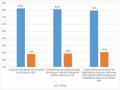
Regarding providing full information and explanation to customers, up to 16% of nurses do not do it. There is an equal ratio between the examination and inpatient areas.
Qualitative research shows that providing complete information to all pediatric patients' families is very difficult to do because the number of pediatric patients in the hospital is always overloaded. Although not fully explaining information to customers is a violation of medical ethics, not fulfilling assigned responsibilities (receiving, caring for, performing procedures for all pediatric patients) is also a violation of professional work regulations. That is the contradiction that nurses have to face, between the options, completing professional work while ignoring full explanation to customers is understandable for nurses [75],[77],[157]. The solution is no other way than to reduce the workload or increase human resources. And that is a long-term solution.
An important characteristic of a physician's ethics is compassion, defined as understanding and caring for a person's pain, which is essential to medical practice [156]. Patients respond better to treatment if they receive sympathy. Research results: more than 90% of clients said that when their children were in pain due to injections, surgery, etc., nurses cared for, encouraged, and comforted them to help them feel less pain. Research results on nurses also showed that 99.5% of nurses had a caring attitude and needed to help children when they were in pain.
The beautiful images of nurses in the eyes of patients and their families demonstrate professional ethics, as commented by a customer: "The attitude of the reception staff and the blood collectors is very good, enthusiastic, and guides the patients gently. When my child cried while taking blood, the doctor was gentle and comforted him, without yelling", which should be respected and encouraged to develop.
Maybe you are interested!
-
 Managing medical ethics education for nursing students in medical colleges - 32
 -
 Managing medical ethics education for nursing students in medical colleges - 1
 -
 Solution 2: Managing the Development and Implementation of a Set of Quality Criteria for Medical Ethics Education for Nursing Students in Medical Colleges
 -
 Strengthening Inspection, Evaluation, and Experience Sharing in Medical Ethics Education for Students
 -
 Concept of Medical Ethics and Professional Ethical Standards of Physicians
Research results show that 97% of customers trust nurses to keep treatment confidential. Research on nurses shows that the act of disclosing patient information without permission accounts for 1.9%. These are acts such as disclosing information to people who are familiar with the patient but are not the patient's legal representative. However, the research also shows that there has been no reflection of violations from patients' relatives. Therefore, the assessment of ethical issues in this behavior is not really clear.
The research results show that more than 5% of customers believe that they and their children are not respected for their honor and dignity. This result is similar to the results when evaluating nurses: the phenomenon of disrespect for the honor and dignity of patients accounts for 5.6%. Behaviors that do not respect dignity such as yelling at the patient's family, being impolite to older people, etc. [10],[25].
However, this reflection is emotional and lacks concrete evidence or comparison of specific standards. Therefore, this behavior is difficult to measure. However, service providers also need to listen to improve their image because customer friendliness is essential in customer service.
* Behavior that causes resentment towards customers of the service provider
The behaviors that cause patient frustration that the media is currently reflecting and creating public concern are the behaviors of yelling at pediatric patients and the behaviors of taking money/envelopes from pediatric patients' relatives by health workers in general and nurses in particular [16],[19].
The code of ethics of the Vietnam Nursing Association [32] stipulates that nurses must be “Friendly to patients and their families” . Our research results show that the percentage of clients who said they had been yelled at accounted for nearly 23%. The number of clients who had seen nurses yell at other pediatric patients or their families accounted for nearly 20% of the total number of clients. The percentage of patients and their families
The rate of being yelled at in the hospital is higher than in the medical examination, the difference is statistically significant. The research results on the nursing staff showed that the behaviors of authoritarianism, arrogance, harassment, delay, and indifference accounted for 2.8%.
The act of receiving money as compensation/envelopes from the patient's family, depending on the circumstances, may violate professional ethics and, at worst, violate the law [29],[32]. However, the act of receiving money from the patient's family for the purpose of providing additional services outside of working hours, or the act of receiving money/envelopes in cases where the patient's family thanks them after being discharged from the hospital/after recovering from the disease, there is no regulation prohibiting the act of receiving money/envelopes in this case. There is a difference in the rate of giving money between the two medical examination and treatment services at the Examination Department and the Emergency Department.
The rate of relatives receiving money and envelopes in our study was lower than the result of a study at Viet Duc Hospital in 2010 [17], the situation of giving money to medical staff as a gratuity accounted for 24% (of which 22% were given to doctors; 16% to nurses; 9% to caregivers; 4% to security guards); lower than the study at Viet Duc Hospital in 2009 [46], the phenomenon of paying extra money to medical staff in addition to hospital fees accounted for 1.2% (of which: 73.3% were voluntary; 26.7% were suggested by medical staff).
Because the nature of the medical profession is not only professional expertise, not only fulfilling responsibilities, but also love, dedication to conscience, the value of which cannot be measured by money, so receiving money from the patient's family needs to be clearly distinguished. Hospitals need to identify violations as well as organize effective management to ensure that no negative things happen, ensuring that the patient's family can feel secure when receiving medical care for their children at the hospital [50],[85],[86].
Fraud in treatment and medication use is a violation of the law and hospital regulations [87]. Research results from patients' relatives show that more than 5% believe that nurses are dishonest in treatment and medication use. Although only
These are doubts, emotional and no specific incident has been discovered, but doubts will cause customers to lose confidence in the service provider.
Research shows that nurses with negative behavior and professional abuse for profit in health care still exist at a rate of 3.3% of nurses. This is a problem in the health sector that needs to be thoroughly resolved, in order to protect the ethics and reputation of doctors in providing health care to people. Realizing this, hospitals are the implementing units that need to step up the fight against fraud in practice. There needs to be stricter management measures in patient care and treatment processes [84],[95],[116].
4.1.2.3. Nurses' awareness of medical ethics and love for the profession
*Awareness of medical ethics of nurses in relationships with customers
A clear understanding of customer rights and obligations in patient care will help nurses understand unauthorized behaviors and their responsibilities in patient care.
Nurses must have their own functions and duties in daily patient care. However, in the work, it is necessary to combine the creativity of nurses to help improve the quality of patient care such as: knowledge, sensitivity, adaptability, patience and experience [7],[8]. Recognizing one's role and duties in patient care is of great significance in ensuring the best implementation of professional ethics of nurses.
The research results show that regarding the perception of the relationship with the customer of nurses: 54.2% think that nurses are responsible for patient care; 31.8% think that nurses are service providers. In each perception, there are certain standards in patient care in different ways. From the service provider's perspective, the patient and the patient's family can be understood as the customer, from the perspective that nurses are the patient care providers,
The patient and the patient's family are often understood to mean the patient and the physician [53],[126].
Although there are different views, all ethical rules from laws to nursing association rules respect human values and the noble values of physicians [32],[123].
The research results also showed that nurses have a fairly good awareness of their clients' rights, with 82.7% of nurses believing that clients have the right to know about their illness; 78.5% believing that clients have the right to be explained, to choose, and to receive care techniques. However, up to 4.2% of nurses do not know/do not know about their clients' rights. It is this incomplete understanding of clients' rights that causes nurses to violate clients' rights when they think they are not violating them [50].
Such inadequate awareness explains the ethical status of nurses in their relationships with clients that we have presented in the above section. That shows that legal documents such as: Law on Anti-Corruption; Law on Medical Examination and Treatment; Code of Conduct of the Vietnam Nursing Association; Nursing Rules need to be specified in the dissemination to nurses. That will hopefully reduce the ethical violations of nurses [31],[86].
Yelling behaviors are behaviors that have conflicting opinions between nurses and patients. There are opinions that nurses should not yell, but there are also opinions that it is normal. In nurses' minds, it is understood that it is when they see patients and their families violating the rules of medical examination and treatment, or it is explained that it is when they are stressed. There are also cases where it is simply explained that they are talking loudly because there are too many patients, it is very noisy, if they do not speak loudly, others will not be able to hear.
Here, there needs to be more clarity in the awareness of nurses as well as family members about yelling and being yelled at. Increasing public understanding, raising awareness of nurses, and assigning reasonable work to nurses will hopefully reduce the problem of nurses yelling at patients [18],[40],[83].
Giving money/envelopes is a phenomenon that from a social perspective, most people consider it an unethical behavior. However, from another perspective, the perception of nurses and their families is that it is normal if the family wants to thank them, a nuance of a traditional culture from ancient times to the present of humans [23],[94], especially when a life is saved or health is restored. Our research clearly reflects that.
In fact, the attitude of nurses towards customers giving tips and envelopes is also reflected quite accurately in the study: 38.3% think that patients and their families should not give envelopes; 35% think that they want to influence to get better care; 15.4% think that having tips/envelopes is fine, not having them is fine; 9.3% think that receiving envelopes as a sign of gratitude from patients is normal. The study shows that more than 60% of nurses agree or agree with customers giving envelopes.
According to customers' perception of the behavior of giving money/envelopes to nurses, it is not entirely negative when up to 58% said that they wanted to thank the nurses for taking care of their children enthusiastically and thoughtfully; 40% said that they gave money because they were afraid that their children would not be well cared for by the nurses; 2.7% said that they gave envelopes because they saw others doing the same. Only a small percentage of 1.9% said that there was a suggestion from the nurses.
This result is also consistent with the qualitative research that we obtained through interviews with some subjects when they said that they gave money to thank the doctors and nurses for taking good care of their children. However, from the perspective of awareness, giving money
Is it right or wrong to give money to nurses? 96.5% of people think it is wrong and 3.5% think it is right. Perhaps, because of such perceptions between nurses and patients' families, the situation of families giving money to nurses still exists, not only at the National Children's Hospital but also in many other hospitals [23],[48],[90].
Thus, regarding the issue of compensation/envelopes, there must be regulations on what behaviors are allowed and what behaviors are not allowed, and there needs to be clarity in ethical standards [22].
Furthermore, while the health sector is always fighting against negative phenomena of a small number of nurses, the patients' families themselves do not have many reactions or struggles for their own rights. Regarding the attitude and reaction of customers when being yelled at by nurses, the attitude of customers sending feedback to hospital leaders accounts for the highest rate at 53%; followed by direct feedback with nearly 46%; sending feedback to other agencies accounts for 9.8%; not knowing what to do accounts for 17.1%. This rate is also almost the same when asked about the attitude and reaction of relatives when nurses suggest giving tips/envelopes [10],[23].
However, when asking the subjects qualitatively, in reality, the patient's family members have never sent their feedback to the hospital leadership or any agency, and have not even given direct feedback to the nurses. It is the indifferent attitude and lack of struggle of the customers that is the ground for condoning the behaviors that some nurses display (such as yelling at patients or suggesting giving money/envelopes). Understanding, along with social norms, plays an important role in forming an ethical relationship between nurses and customers [111],[146].
From qualitative research, we believe that although the ethical behavior of nurses is regulated by legal regulations and hospital rules and regulations, it is also regulated by the understanding and attitudes of customers. Customers play an important role.
in the formation of unethical behaviors of nurses. If customers have knowledge and understanding, and fight against unethical behaviors, the ethics of nurses will be improved and the quality of healthcare services will be gradually improved. Customers are the main subjects in forming the principles of providing medical services of hospitals in general and of nurses in particular [127],[133].
However, when making this assessment, we also considered it quite carefully because customers themselves have difficulty recognizing wrongdoings, especially in specialized and specific fields such as patient care. Moreover, the provision of services in the healthcare sector is different from other industries. If in other industries "the customer is king", it is very difficult to do so in the healthcare sector when customers are the ones who need the intervention of medical staff in situations of waiting and worrying about the illness their family members are suffering from. It is because of the concern for the patient's health that family members violate hospital regulations and are willing to spend money to compensate medical staff [16],[46].
Previous studies often assess the level of satisfaction or the presence or absence of negative conditions in nurses, while not mentioning the perspective from the client themselves. Clients can be the driving force or the cause of negative behaviors in nurses. From such a perspective, our research team has analyzed in depth to have a more comprehensive view of the negative issues of nurses. Thereby, finding effective intervention solutions to improve nurses' medical ethics to ensure the best quality of care.
* Nurses' perceptions of peer relationships
In fact, there is no document that specifically regulates illegal acts in the ethics of nurses' relationships with colleagues. The hospital also