
Table 4.2: Production forest planting objectives in Luc Ngan district
Goals, products
production forest
Main crop species | |
I/ Wood product supply group | |
1. Raw materials: paper, chips, peeling,... | Eucalyptus, Acacia, etc. |
2. Construction materials | Types of Acacia, Pine, Xoai ta, Bach piano,… |
3. Mine pillar wood | Acacia, Horsetail Pine, Eucalyptus, etc. |
4. Household wood | Types of Acacia, Xoan ta, Pine, etc. |
II/ Non-wood product supply group | |
1. Bamboo | - Bamboo - Stream |
2. Bamboo shoots | Imported bamboo and domestic bamboo, Luong |
3. Rosin | Macro code |
4. White Canarium fruit and sap | White filling |
Maybe you are interested!
-
 Identify Rating Levels and Rating Scales
zt2i3t4l5ee
zt2a3gstourism,quan lan,quang ninh,ecology,ecotourism,minh chau,van don,geography,geographical basis,tourism development,science
zt2a3ge
zc2o3n4t5e6n7ts
of the islanders. Therefore, this indicator will be divided into two sub-indicators:
a1. Natural tourism attractiveness a2. Cultural tourism attractiveness
b. Tourist capacity
The two island communes in Quan Lan have different capacities to receive tourists. Minh Chau Commune is home to many standard hotels and resorts, attracting high-income domestic and international tourists. Meanwhile, Quan Lan Commune has many motels mainly built and operated by local people, so the scale and quality are not high, and will be suitable for ordinary tourists such as students.
c. Time of exploitation of Quan Lan Island Commune:
Quan Lan tourism is seasonal due to weather and climate conditions and festivals only take place on certain days of the year, specifically in spring. In Quan Lan commune, the period from April to June and from September to November is considered the best time to visit Quan Lan because the cultural tourism activities are mainly associated with festivals taking place during this time.
Minh Chau island commune:
Tourism exploitation time is all year round, because this is a place with a number of tourist attractions with diverse ecosystems such as Bai Tu Long National Park Research Center, Tram forest, Turtle Laying Beach, so besides coming to the beach for tourism and vacation in the summer, Minh Chau will attract research groups to come for tourism combined with research at other times of the year.
d. Sustainability
The sustainability of ecotourism sites in Quan Lan and Minh Chau communes depends on the sensitivity of the ecosystems to climate changes.
landscape. In general, these tourist destinations have a fairly high level of sustainability, because they are natural ecosystems, planned and protected. However, if a large number of tourists gather at certain times, it can exceed the carrying capacity and affect the sustainability of the environment (polluted beaches, damaged trees, animals moving away from their habitats, etc.), then the sustainability of the above ecosystems (natural ecosystems, human ecosystems) will also be affected and become less sustainable.
e. Location and accessibility
Both island communes have ports to take tourists to visit from Van Don wharf:
- Quan Lan – Van Don traffic route:
Phuc Thinh – Viet Anh high-speed boat and Quang Minh high-speed boat, depart at 8am and 2pm from Van Don to Quan Lan, and at 7am and 1pm from Quan Lan to Van Don. There are also wooden boats departing at 7am and 1pm.
- Van Don - Minh Chau traffic route:
Chung Huong high-speed train, Minh Chau train, morning 7:30 and afternoon 13:30 from Van Don to Minh Chau, morning 6:30 and afternoon 13:00 from Minh Chau to Van Don.
f. Infrastructure
Despite receiving investment attention, the issue of infrastructure and technical facilities for tourism on Quan Lan Island is still an issue that needs to be resolved because it has a direct impact on the implementation of ecotourism activities. The minimum conditions for serving tourists such as accommodation, electricity, water, communication, especially medical services, and security work need to be given top priority. Ecotourism spots in Minh Chau commune are assessed to have better infrastructure and technical facilities for tourism because there are quite complete and synchronous conditions for serving tourists, meeting many needs of domestic and foreign tourists.
3.2.1.4. Determine assessment levels and assessment scales
Corresponding to the levels of each criterion, the index is the score of those levels in the order of 4, 3, 2, 1 decreasing according to the standard of each level: very attractive (4), attractive (3), average (2), less attractive (1).
3.2.1.5. Determining the coefficients of the criteria
For the assessment of DLST in the two communes of Quan Lan and Minh Chau islands, the students added evaluation coefficients to show the importance of the criteria and indicators as follows:
Coefficient 3 with criteria: Attractiveness, Exploitation time. These are the 2 most important criteria for attracting tourists to tourism in general and eco-tourism in particular, so they have the highest coefficient.
Coefficient 2 with criteria: Capacity, Infrastructure, Location and accessibility . Because the assessment area is an island commune of Van Don district, the above criteria are selected by the author with appropriate coefficients at the average level.
Coefficient 1 with criteria: Sustainability. Quan Lan has natural and human-made ecotourism sites, with high biodiversity and little impact from local human factors. Most of the ecotourism sites are still wild, so they are highly sustainable.
3.2.1.6. Results of DLST assessment on Quan Lan island
a. Assessment of the potential for natural tourism development
For Minh Chau commune:
+ Natural tourism attractiveness is determined to be very attractive (4 points) and the most important coefficient (coefficient 3), so the score of the Attractiveness criterion is 4 x 3 = 12.
+ Capacity is determined as average (2 points) and the coefficient is quite important (coefficient 2), then the score of Capacity criterion is 2 x 2 = 4.
+ Exploitation time is long (4 points), the most important coefficient (coefficient 3) so the score of the Exploitation time criterion is 4 x 3 = 12.
+ Sustainability is determined as sustainable (4 points), the important coefficient is the average coefficient (coefficient 1), so the score of the Sustainability criterion is 4 x 1 = 4 points
+ Location and accessibility are determined to be quite favorable (2 points), the coefficient is quite important (coefficient 2), the criterion score is 2 x 2 = 4 points.
+ Infrastructure is assessed as good (3 points), the coefficient is quite important (coefficient 2), then the score of the Infrastructure criterion is 3 x 2 = 6 points.
The total score for evaluating DLST in Minh Chau commune according to 6 evaluation criteria is determined as: 12 + 4 + 12 + 4 + 4 + 6 = 42 points
Similar assessment for Quan Lan commune, we have the following table:
Table 3.3: Assessment of the potential for natural ecotourism development in Quan Lan and Minh Chau communes
Attractiveness of self-tourismof course
Capacity
Mining time
Sustainability
Location and accessibility
Infrastructure
Result
Point
DarkMulti
Point
DarkMulti
Point
DarkMulti
Point
DarkMulti
Point
DarkMulti
Point
DarkMulti
CommuneMinh Chau
12
12
4
8
12
12
4
4
4
8
6
8
42/52
Quan CommuneLan
6
12
6
8
9
12
4
4
4
8
4
8
33/52
b. Assessment of the potential for humanistic tourism development
For Quan Lan commune:
+ The attractiveness of human tourism is determined to be very attractive (4 points) and the most important coefficient (coefficient 3), so the score of the Attractiveness criterion is 4 x 3 = 12.
+ Capacity is determined to be large (3 points) and the coefficient is quite important (coefficient 2), then the score of the Capacity criterion is 3 x 2 = 6.
+ Mining time is average (3 points), the most important coefficient (coefficient 3) so the score of the Mining time criterion is 3 x 3 = 9.
+ Sustainability is determined as sustainable (4 points), the important coefficient is the average coefficient (coefficient 1), so the score of the Sustainability criterion is 4 x 1 = 4 points.
+ Location and accessibility are determined to be quite favorable (2 points), the coefficient is quite important (coefficient 2), the criterion score is 2 x 2 = 4 points.
+ Infrastructure is rated as average (2 points), the coefficient is quite important (coefficient 2), then the score of the Infrastructure criterion is 2 x 2 = 4 points.
The total score for evaluating DLST in Quan Lan commune according to 6 evaluation criteria is determined as: 12 + 6 + 6 + 4 + 4 + 4 = 36 points.
Similar assessment with Minh Chau commune we have the following table:
Table 3.4: Assessment of the potential for developing humanistic eco-tourism in Quan Lan and Minh Chau communes
Attractiveness of human tourismliterature
Capacity
Mining time
Sustainability
Location and accessibility
Infrastructure
Result
Point
DarkMulti
Point
DarkMulti
Point
DarkMulti
Point
DarkMulti
Point
DarkMulti
Point
DarkMulti
Quan CommuneLan
12
12
6
8
9
12
4
4
4
8
4
8
39/52
Minh CommuneChau
6
12
4
8
12
12
4
4
4
8
6
8
36/52
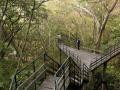
Basically, both Minh Chau and Quan Lan localities have quite favorable conditions for developing ecotourism. However, Quan Lan commune has more advantages to develop ecotourism in a humanistic direction, because this is an area with many famous historical relics such as Quan Lan Communal House, Quan Lan Pagoda, Temple worshiping the hero Tran Khanh Du, ... along with local festivals held annually such as the wind praying ceremony (March 15), Quan Lan festival (June 10-19); due to its location near the port and long exploitation time, the beaches in Quan Lan commune (especially Quan Lan beach) are no longer hygienic and clean to ensure the needs of tourists coming to relax and swim; this is also an area with many beautiful landscapes such as Got Beo wind pass, Ong Phong head, Voi Voi cave, but the ability to access these places is still very limited (dirt hill road, lots of gravel and rocks), especially during rainy and windy times; In addition, other natural resources such as mangrove forests and sea worms have not been really exploited for tourism purposes and ecotourism development. On the contrary, Minh Chau commune has more advantages in developing ecotourism in the direction of natural tourism, this is an area with diverse ecosystems such as at Rua De Beach, Bai Tu Long National Park Conservation Center...; Minh Chau beach is highly appreciated for its natural beauty and cleanliness, ranked in the top ten most beautiful beaches in Vietnam; Minh Chau commune is also home to Tram forest with a large area and a purity of up to 90%, suitable for building bridges through the forest (a very effective type of natural ecotourism currently applied by many countries) for tourists to sightsee, as well as for the purpose of studying and researching.
Figure 3.1: Thenmala Forest Bridge (India) Source: https://www.thenmalaecotourism.com/(August 21, 2019)
3.2.2. Using SWOT matrix to evaluate Quan Lan island tourism
General assessment of current tourism activities of Quan Lan island is shown through the following SWOT matrix:
Table 3.5: SWOT matrix evaluating tourism activities on Quan Lan island
Internal agent
Strengths- There is a lot of potential for tourism development, especially natural ecotourism and humanistic ecotourism.- The unskilled labor force is relatively abundant.- resource environmentunpolluted, still
Weaknesses- Poorly developed infrastructure, especially traffic routes to tourist destinations on the island.- The team of professional staff is still weak.- Tourism products in general
quite wild, originalintact
general and DLST in particularalone is monotonous.
External agents
Opportunity- Tourism is a key industry in the socio-economic development strategy of the province and Van Don economic zone.- Quan Lan was selected as a pilot area for eco-tourism development within the framework of the green growth project between Quang Ninh province and the Japanese organization JICA.- The flow of tourists and especially ecotourism in the world tends toincreasing
Challenge- Weather and climate change abnormally.- Competition in tourism products is increasingly fierce, especially with other localities in the province such as Ha Long, Mong Cai...- Awareness of tourists, especially domestic tourists, about ecotourism and nature conservation is not high.
Through summary analysis using SWOT matrix we see that:
To exploit strengths and take advantage of opportunities, it is necessary to:
- Diversify products and service types (build more tourism routes aimed at specific needs of tourists: experiential tourism immersed in nature, spiritual cultural tourism...)
- Effective exploitation of resources and differentiated products (natural resources and human resources)
div.maincontent .p { color: black; font-family:"Times New Roman", serif; font-style: normal; font-weight: normal; text-decoration: none; font-size: 14pt; margin:0pt; } div.maincontent p { color: black; font-family:"Times New Roman", serif; font-style: normal; font-weight: normal; text-decoration: none; font-size: 14pt; margin:0pt; } div.maincontent .s1 { color: black; font-family:"Times New Roman", serif; font-style: normal; font-weight: normal; text-decoration: none; font-size: 13pt; } div.maincontent .s2 { color: black; font-family:"Times New Roman", serif; font-style: normal; font-weight: normal; text-decoration: none; font-size: 13pt; } div.maincontent .s3 { color: #0D0D0D; font-family:"Times New Roman", serif; font-style: normal; font-weight: bold; text-decoration: none; font-size: 14pt; } div.maincontent .s4 { color: black; font-family:"Times New Roman", serif; font-style: italic; font-weight: normal; text-decoration: none; font-size: 14pt; } div.maincontent .s5 { color: black; font-family:"Times New Roman", serif; font-style: italic; font-weight: bold; text-decoration: none; font-size: 14pt; } div.maincontent .s6 { color: black; font-family:"Times New Roman", serif; font-style: italic; font-weight: normal; text-decoration: none; font-size: 14pt; vertical-align: -3pt; } div.maincontent .s7 { color: black; font-family:"Times New Roman", serif; font-style: italic; font-weight: normal; text-decoration: none; font-size: 14pt; vertical-align: -2pt; } div.maincontent .s8 { color: black; font-family:"Times New Roman", serif; font-style: italic; font-weight: normal; text-decoration: none; font-size: 14pt; vertical-align: -1pt; } div.maincontent .s9 { color: black; font-family:"Times New Roman", serif; font-style: normal; font-weight: normal; text-decoration: none; font-size: 14pt; } div.maincontent .s10 { color: black; font-family:"Times New Roman", serif; font-style: normal; font-weight: bold; text-decoration: none; font-size: 14pt; } div.maincontent .s11 { color: black; font-family:"Times New Roman", serif; font-style: normal; font-weight: normal; text-decoration: none; font-size: 14pt; } div.maincontent .s12 { color: black; font-family:Symbol, serif; font-style: normal; font-weight: normal; text-decoration: none; font-size: 14pt; } div.maincontent .s13 { color: black; font-family:Wingdings; font-style: normal; font-weight: normal; text-decoration: none; font-size: 14pt; } div.maincontent .s14 { color: black; font-family:"Times New Roman", serif; font-style: normal; font-weight: normal; text-decoration: none; font-size: 9pt; vertical-align: 5pt; } div.maincontent .s15 { color: black; font-family:"Times New Roman", serif; font-style: normal; font-weight: normal; text-decoration: none; font-size: 9pt; vertical-align: 5pt; } div.maincontent .s16 { color: black; font-family:Cambria, serif; font-style: italic; font-weight: normal; text-decoration: none; font-size: 14pt; } div.maincontent .s17 { color: #080808; font-family:"Times New Roman", serif; font-style: normal; font-weight: bold; text-decoration: none; font-size: 14pt; } div.maincontent .s18 { color: #080808; font-family:"Times New Roman", serif; font-style: normal; font-weight: normal; text-decoration: none; font-size: 14pt; } div.maincontent .s19 { color: black; font-family:"Times New Roman", serif; font-style: normal; font-weight: normal; text-decoration: none; font-size: 11pt; } div.maincontent .s20 { color: black; font-family:"Times New Roman", serif; font-style: normal; font-weight: normal; text-decoration: none; font-size: 10pt; } div.maincontent .s21 { color: black; font-family:"Times New Roman", serif; font-style: normal; font-weight: bold; text-decoration: none; font-size: 11pt; } div.maincontent .s22 { color: black; font-family:"Times New Roman", serif; font-style: normal; font-weight: normal; text-decoration: none; font-size: 11pt; } div.maincontent .s23 { color: black; font-family:"Times New Roman", serif; font-style: italic; font-weight: normal; text-decoration: none; font-size: 14pt; } div.maincontent .s24 { color: #212121; font-family:"Times New Roman", serif; font-style: normal; font-weight: normal; tex
Identify Rating Levels and Rating Scales
zt2i3t4l5ee
zt2a3gstourism,quan lan,quang ninh,ecology,ecotourism,minh chau,van don,geography,geographical basis,tourism development,science
zt2a3ge
zc2o3n4t5e6n7ts
of the islanders. Therefore, this indicator will be divided into two sub-indicators:
a1. Natural tourism attractiveness a2. Cultural tourism attractiveness
b. Tourist capacity
The two island communes in Quan Lan have different capacities to receive tourists. Minh Chau Commune is home to many standard hotels and resorts, attracting high-income domestic and international tourists. Meanwhile, Quan Lan Commune has many motels mainly built and operated by local people, so the scale and quality are not high, and will be suitable for ordinary tourists such as students.
c. Time of exploitation of Quan Lan Island Commune:
Quan Lan tourism is seasonal due to weather and climate conditions and festivals only take place on certain days of the year, specifically in spring. In Quan Lan commune, the period from April to June and from September to November is considered the best time to visit Quan Lan because the cultural tourism activities are mainly associated with festivals taking place during this time.
Minh Chau island commune:
Tourism exploitation time is all year round, because this is a place with a number of tourist attractions with diverse ecosystems such as Bai Tu Long National Park Research Center, Tram forest, Turtle Laying Beach, so besides coming to the beach for tourism and vacation in the summer, Minh Chau will attract research groups to come for tourism combined with research at other times of the year.
d. Sustainability
The sustainability of ecotourism sites in Quan Lan and Minh Chau communes depends on the sensitivity of the ecosystems to climate changes.
landscape. In general, these tourist destinations have a fairly high level of sustainability, because they are natural ecosystems, planned and protected. However, if a large number of tourists gather at certain times, it can exceed the carrying capacity and affect the sustainability of the environment (polluted beaches, damaged trees, animals moving away from their habitats, etc.), then the sustainability of the above ecosystems (natural ecosystems, human ecosystems) will also be affected and become less sustainable.
e. Location and accessibility
Both island communes have ports to take tourists to visit from Van Don wharf:
- Quan Lan – Van Don traffic route:
Phuc Thinh – Viet Anh high-speed boat and Quang Minh high-speed boat, depart at 8am and 2pm from Van Don to Quan Lan, and at 7am and 1pm from Quan Lan to Van Don. There are also wooden boats departing at 7am and 1pm.
- Van Don - Minh Chau traffic route:
Chung Huong high-speed train, Minh Chau train, morning 7:30 and afternoon 13:30 from Van Don to Minh Chau, morning 6:30 and afternoon 13:00 from Minh Chau to Van Don.
f. Infrastructure
Despite receiving investment attention, the issue of infrastructure and technical facilities for tourism on Quan Lan Island is still an issue that needs to be resolved because it has a direct impact on the implementation of ecotourism activities. The minimum conditions for serving tourists such as accommodation, electricity, water, communication, especially medical services, and security work need to be given top priority. Ecotourism spots in Minh Chau commune are assessed to have better infrastructure and technical facilities for tourism because there are quite complete and synchronous conditions for serving tourists, meeting many needs of domestic and foreign tourists.
3.2.1.4. Determine assessment levels and assessment scales
Corresponding to the levels of each criterion, the index is the score of those levels in the order of 4, 3, 2, 1 decreasing according to the standard of each level: very attractive (4), attractive (3), average (2), less attractive (1).
3.2.1.5. Determining the coefficients of the criteria
For the assessment of DLST in the two communes of Quan Lan and Minh Chau islands, the students added evaluation coefficients to show the importance of the criteria and indicators as follows:
Coefficient 3 with criteria: Attractiveness, Exploitation time. These are the 2 most important criteria for attracting tourists to tourism in general and eco-tourism in particular, so they have the highest coefficient.
Coefficient 2 with criteria: Capacity, Infrastructure, Location and accessibility . Because the assessment area is an island commune of Van Don district, the above criteria are selected by the author with appropriate coefficients at the average level.
Coefficient 1 with criteria: Sustainability. Quan Lan has natural and human-made ecotourism sites, with high biodiversity and little impact from local human factors. Most of the ecotourism sites are still wild, so they are highly sustainable.
3.2.1.6. Results of DLST assessment on Quan Lan island
a. Assessment of the potential for natural tourism development
For Minh Chau commune:
+ Natural tourism attractiveness is determined to be very attractive (4 points) and the most important coefficient (coefficient 3), so the score of the Attractiveness criterion is 4 x 3 = 12.
+ Capacity is determined as average (2 points) and the coefficient is quite important (coefficient 2), then the score of Capacity criterion is 2 x 2 = 4.
+ Exploitation time is long (4 points), the most important coefficient (coefficient 3) so the score of the Exploitation time criterion is 4 x 3 = 12.
+ Sustainability is determined as sustainable (4 points), the important coefficient is the average coefficient (coefficient 1), so the score of the Sustainability criterion is 4 x 1 = 4 points
+ Location and accessibility are determined to be quite favorable (2 points), the coefficient is quite important (coefficient 2), the criterion score is 2 x 2 = 4 points.
+ Infrastructure is assessed as good (3 points), the coefficient is quite important (coefficient 2), then the score of the Infrastructure criterion is 3 x 2 = 6 points.
The total score for evaluating DLST in Minh Chau commune according to 6 evaluation criteria is determined as: 12 + 4 + 12 + 4 + 4 + 6 = 42 points
Similar assessment for Quan Lan commune, we have the following table:
Table 3.3: Assessment of the potential for natural ecotourism development in Quan Lan and Minh Chau communes
Attractiveness of self-tourismof course
Capacity
Mining time
Sustainability
Location and accessibility
Infrastructure
Result
Point
DarkMulti
Point
DarkMulti
Point
DarkMulti
Point
DarkMulti
Point
DarkMulti
Point
DarkMulti
CommuneMinh Chau
12
12
4
8
12
12
4
4
4
8
6
8
42/52
Quan CommuneLan
6
12
6
8
9
12
4
4
4
8
4
8
33/52
b. Assessment of the potential for humanistic tourism development
For Quan Lan commune:
+ The attractiveness of human tourism is determined to be very attractive (4 points) and the most important coefficient (coefficient 3), so the score of the Attractiveness criterion is 4 x 3 = 12.
+ Capacity is determined to be large (3 points) and the coefficient is quite important (coefficient 2), then the score of the Capacity criterion is 3 x 2 = 6.
+ Mining time is average (3 points), the most important coefficient (coefficient 3) so the score of the Mining time criterion is 3 x 3 = 9.
+ Sustainability is determined as sustainable (4 points), the important coefficient is the average coefficient (coefficient 1), so the score of the Sustainability criterion is 4 x 1 = 4 points.
+ Location and accessibility are determined to be quite favorable (2 points), the coefficient is quite important (coefficient 2), the criterion score is 2 x 2 = 4 points.
+ Infrastructure is rated as average (2 points), the coefficient is quite important (coefficient 2), then the score of the Infrastructure criterion is 2 x 2 = 4 points.
The total score for evaluating DLST in Quan Lan commune according to 6 evaluation criteria is determined as: 12 + 6 + 6 + 4 + 4 + 4 = 36 points.
Similar assessment with Minh Chau commune we have the following table:
Table 3.4: Assessment of the potential for developing humanistic eco-tourism in Quan Lan and Minh Chau communes
Attractiveness of human tourismliterature
Capacity
Mining time
Sustainability
Location and accessibility
Infrastructure
Result
Point
DarkMulti
Point
DarkMulti
Point
DarkMulti
Point
DarkMulti
Point
DarkMulti
Point
DarkMulti
Quan CommuneLan
12
12
6
8
9
12
4
4
4
8
4
8
39/52
Minh CommuneChau
6
12
4
8
12
12
4
4
4
8
6
8
36/52
Basically, both Minh Chau and Quan Lan localities have quite favorable conditions for developing ecotourism. However, Quan Lan commune has more advantages to develop ecotourism in a humanistic direction, because this is an area with many famous historical relics such as Quan Lan Communal House, Quan Lan Pagoda, Temple worshiping the hero Tran Khanh Du, ... along with local festivals held annually such as the wind praying ceremony (March 15), Quan Lan festival (June 10-19); due to its location near the port and long exploitation time, the beaches in Quan Lan commune (especially Quan Lan beach) are no longer hygienic and clean to ensure the needs of tourists coming to relax and swim; this is also an area with many beautiful landscapes such as Got Beo wind pass, Ong Phong head, Voi Voi cave, but the ability to access these places is still very limited (dirt hill road, lots of gravel and rocks), especially during rainy and windy times; In addition, other natural resources such as mangrove forests and sea worms have not been really exploited for tourism purposes and ecotourism development. On the contrary, Minh Chau commune has more advantages in developing ecotourism in the direction of natural tourism, this is an area with diverse ecosystems such as at Rua De Beach, Bai Tu Long National Park Conservation Center...; Minh Chau beach is highly appreciated for its natural beauty and cleanliness, ranked in the top ten most beautiful beaches in Vietnam; Minh Chau commune is also home to Tram forest with a large area and a purity of up to 90%, suitable for building bridges through the forest (a very effective type of natural ecotourism currently applied by many countries) for tourists to sightsee, as well as for the purpose of studying and researching.
Figure 3.1: Thenmala Forest Bridge (India) Source: https://www.thenmalaecotourism.com/(August 21, 2019)
3.2.2. Using SWOT matrix to evaluate Quan Lan island tourism
General assessment of current tourism activities of Quan Lan island is shown through the following SWOT matrix:
Table 3.5: SWOT matrix evaluating tourism activities on Quan Lan island
Internal agent
Strengths- There is a lot of potential for tourism development, especially natural ecotourism and humanistic ecotourism.- The unskilled labor force is relatively abundant.- resource environmentunpolluted, still
Weaknesses- Poorly developed infrastructure, especially traffic routes to tourist destinations on the island.- The team of professional staff is still weak.- Tourism products in general
quite wild, originalintact
general and DLST in particularalone is monotonous.
External agents
Opportunity- Tourism is a key industry in the socio-economic development strategy of the province and Van Don economic zone.- Quan Lan was selected as a pilot area for eco-tourism development within the framework of the green growth project between Quang Ninh province and the Japanese organization JICA.- The flow of tourists and especially ecotourism in the world tends toincreasing
Challenge- Weather and climate change abnormally.- Competition in tourism products is increasingly fierce, especially with other localities in the province such as Ha Long, Mong Cai...- Awareness of tourists, especially domestic tourists, about ecotourism and nature conservation is not high.
Through summary analysis using SWOT matrix we see that:
To exploit strengths and take advantage of opportunities, it is necessary to:
- Diversify products and service types (build more tourism routes aimed at specific needs of tourists: experiential tourism immersed in nature, spiritual cultural tourism...)
- Effective exploitation of resources and differentiated products (natural resources and human resources)
div.maincontent .p { color: black; font-family:"Times New Roman", serif; font-style: normal; font-weight: normal; text-decoration: none; font-size: 14pt; margin:0pt; } div.maincontent p { color: black; font-family:"Times New Roman", serif; font-style: normal; font-weight: normal; text-decoration: none; font-size: 14pt; margin:0pt; } div.maincontent .s1 { color: black; font-family:"Times New Roman", serif; font-style: normal; font-weight: normal; text-decoration: none; font-size: 13pt; } div.maincontent .s2 { color: black; font-family:"Times New Roman", serif; font-style: normal; font-weight: normal; text-decoration: none; font-size: 13pt; } div.maincontent .s3 { color: #0D0D0D; font-family:"Times New Roman", serif; font-style: normal; font-weight: bold; text-decoration: none; font-size: 14pt; } div.maincontent .s4 { color: black; font-family:"Times New Roman", serif; font-style: italic; font-weight: normal; text-decoration: none; font-size: 14pt; } div.maincontent .s5 { color: black; font-family:"Times New Roman", serif; font-style: italic; font-weight: bold; text-decoration: none; font-size: 14pt; } div.maincontent .s6 { color: black; font-family:"Times New Roman", serif; font-style: italic; font-weight: normal; text-decoration: none; font-size: 14pt; vertical-align: -3pt; } div.maincontent .s7 { color: black; font-family:"Times New Roman", serif; font-style: italic; font-weight: normal; text-decoration: none; font-size: 14pt; vertical-align: -2pt; } div.maincontent .s8 { color: black; font-family:"Times New Roman", serif; font-style: italic; font-weight: normal; text-decoration: none; font-size: 14pt; vertical-align: -1pt; } div.maincontent .s9 { color: black; font-family:"Times New Roman", serif; font-style: normal; font-weight: normal; text-decoration: none; font-size: 14pt; } div.maincontent .s10 { color: black; font-family:"Times New Roman", serif; font-style: normal; font-weight: bold; text-decoration: none; font-size: 14pt; } div.maincontent .s11 { color: black; font-family:"Times New Roman", serif; font-style: normal; font-weight: normal; text-decoration: none; font-size: 14pt; } div.maincontent .s12 { color: black; font-family:Symbol, serif; font-style: normal; font-weight: normal; text-decoration: none; font-size: 14pt; } div.maincontent .s13 { color: black; font-family:Wingdings; font-style: normal; font-weight: normal; text-decoration: none; font-size: 14pt; } div.maincontent .s14 { color: black; font-family:"Times New Roman", serif; font-style: normal; font-weight: normal; text-decoration: none; font-size: 9pt; vertical-align: 5pt; } div.maincontent .s15 { color: black; font-family:"Times New Roman", serif; font-style: normal; font-weight: normal; text-decoration: none; font-size: 9pt; vertical-align: 5pt; } div.maincontent .s16 { color: black; font-family:Cambria, serif; font-style: italic; font-weight: normal; text-decoration: none; font-size: 14pt; } div.maincontent .s17 { color: #080808; font-family:"Times New Roman", serif; font-style: normal; font-weight: bold; text-decoration: none; font-size: 14pt; } div.maincontent .s18 { color: #080808; font-family:"Times New Roman", serif; font-style: normal; font-weight: normal; text-decoration: none; font-size: 14pt; } div.maincontent .s19 { color: black; font-family:"Times New Roman", serif; font-style: normal; font-weight: normal; text-decoration: none; font-size: 11pt; } div.maincontent .s20 { color: black; font-family:"Times New Roman", serif; font-style: normal; font-weight: normal; text-decoration: none; font-size: 10pt; } div.maincontent .s21 { color: black; font-family:"Times New Roman", serif; font-style: normal; font-weight: bold; text-decoration: none; font-size: 11pt; } div.maincontent .s22 { color: black; font-family:"Times New Roman", serif; font-style: normal; font-weight: normal; text-decoration: none; font-size: 11pt; } div.maincontent .s23 { color: black; font-family:"Times New Roman", serif; font-style: italic; font-weight: normal; text-decoration: none; font-size: 14pt; } div.maincontent .s24 { color: #212121; font-family:"Times New Roman", serif; font-style: normal; font-weight: normal; tex -
 Crop Area and Production From 2000 to 2008
 -
 Special-use Forest System - An Important Dlst Resource: A- Overview of Special-use Forests in the Dhcntb Region:
 -
 Industrial Production Area, Industrial Park, Traditional Craft Village, Farm:
 -
 Research Results on the Effects of Fertilization on Growth and Productivity of Planted Forests
It can be seen that the goal of concentrated production forest planting in Luc Ngan has been defined quite clearly, specifically to provide raw materials for paper, chips, peeling, or mine pole wood,... with the main tree species being Eucalyptus, Acacia of all kinds, Pine,...
Regarding non-timber forest products, the target of afforestation has also been relatively clearly defined:
For Pine, the current price of pine resin is very high (14,000 VND/kg), so the development of this product has certain advantages. Bamboo and Bamboo products have also had new developments, while White Canarium is still in its initial stage.
4.1.3. Area of planted forests and production forests in Luc Ngan district
The area of planted forests as well as production forests of Luc Ngan district is presented in table 4.3.
Table 4.3: Summary of forest area and cover by district in Bac Giang province
District
Natural area (ha) | Natural forest area (ha) | Forest area (ha) | Area of vacant land planned for forestry (ha) | Forest cover (%) | |
1. Hiep Hoa | 20,107.9 | - | 167.4 | - | 0.8 |
2. Lang Giang | 24,575.2 | 236.7 | 3,577.6 | 108.7 | 15.3 |
3. Luc Nam | 59,690.0 | 14,679.0 | 16,309.9 | 1,411.6 | 49.3 |
4. Luc Ngan | 101,223.7 | 12,120.5 | 31,510.9 | 14,138.2 | 42.5 |
5. Son Dong | 84,432.4 | 44,670.7 | 12,233.3 | 13,005.4 | 65.3 |
6. Bac Giang City | 3,221.8 | - | 97.6 | - | 3.0 |
7. Tan Yen | 20,373.8 | 0.7 | 2,080.4 | 79.0 | 10.2 |
8. Viet Yen | 17,135.4 | - | 772.6 | 75.2 | 4.4 |
9. Yen Dung | 21,338.2 | - | 2,501.9 | 30.8 | 11.0 |
10. Yen The | 30,101.5 | 1,869.3 | 12,248.5 | 1,800.3 | 41.8 |
Provincewide | 382,220.0 | 73,576.9 | 81,500.1 | 30,649.2 | 39.1 |
(Source: Bac Giang Provincial People's Committee, Forest and forestry land area in 2005)
According to data in Table 4.3, Luc Ngan is a mountainous district with the largest natural area in Bac Giang province (101,223.7 ha), accounting for 26.5% of the province's total area; continued
These are Son Dong district (84,432.4 ha) and Luc Nam district (59,690 ha). The natural forest area of Luc Ngan district is 12,120.5 ha, ranking third after Son Dong and Luc Nam. However, the planted forest area in Luc Ngan is the largest in the province (31,510.9 ha), accounting for 38.7% of the planted forest area of the whole province; Luc Nam is the district with the second largest planted forest area in the province, however, the area is only 16,309.9 ha (only 51.8% of the planted forest area of Luc Ngan district). The area of vacant land planned for forestry in Luc Ngan district is the highest in the province (14,138.2 ha), accounting for 46.1% of the total vacant land planned for forestry in Bac Giang province; followed by Son Dong district (13,005.4 ha), other units in the province do not have much of this area left. Forest coverage of Luc Ngan district ranks third in the province (42.5%), but has also approximated the national forest coverage criteria by 2010 (43-44%). With all these advantages, it can be said that Luc Ngan is truly a promising location for the development of production forest plantation.
Table 4.4: Forest area and forestry land in Luc Ngan district.
Category
Area (ha) | Structure (%) | |
Natural area | 101,223.7 | 100 |
I. Forested land | 43,631.4 | 43.1 |
A. Natural forest | 12,120.5 | 27.8 |
1. Timber forest | 12,119.8 | 99.9 |
2.Bamboo forest | 0.7 | 0.1 |
B. Planted forests | 31,510.9 | 72.2 |
1. Planted forests have reserves | 5,108.7 | 16.4 |
2.Planted forests have no reserves | 11,224.2 | 35.6 |
3. Specialty plants | 15,106.0 | 48.0 |
II. Non-forest land planned for forestry | 14,138.2 | 14.0 |
III. Other land | 43,454.1 | 42.9 |
(Source: Bac Giang Provincial People's Committee, Forest and forestry land area in 2005)
Through Table 4.4, we can see that the forested land area of Luc Ngan district is 43,631.4 ha - accounting for 43.1% of the total land area of the district; of which the planted forest area is 31,510.9 ha - accounting for 72.2% of the total forested land area. This is truly an advantage for the development of planted forests in general and production forests in particular in the locality. With 11,224.2 ha of young forest (no reserves), it shows that the attention and investment in afforestation of Luc Ngan district has increased sharply in recent years. In addition, the land fund planned for forestry is 14,138.2 ha of bare land (accounting for 14% of the total land fund of the district) - this is both a strength and a potential for forestry development in the region.
Table 4.5: Forest area and forestry land in Luc Ngan district classified by function
Unit: ha.
Soil type, forest type
Total acreage | Classification by function | ||
Protection | Manufacture | ||
Natural area | 101,223.7 | ||
I. Forested land | 43,631.4 | 21,419.6 | 22,211.8 |
A. Natural forest | 12,120.5 | 9,591.0 | 2,529.5 |
1. Timber forest | 12,119.8 | 9,590.3 | 2,529.5 |
2.Bamboo forest | 0.7 | 0.7 | |
B. Planted forests | 31,510.9 | 11,128.6 | 19,682.3 |
1. Planted forests have reserves | 5,108.7 | 3,186.1 | 1,994.6 |
2.Planted forests have no reserves | 11,224.2 | 4,756.1 | 6,468.1 |
4. Specialty plants | 15,106.0 | 3,886.4 | 11,219.6 |
II. Non-forest land (plan for forestry) | 14,138.2 | 5,693.3 | 8,444.9 |
III. Other land | 43,454.1 | ||
(Source: Bac Giang Provincial People's Committee, Forest and forestry land area in 2005)
Data in Table 4.5 shows that in the total of 43,631.4 hectares of forested land, the areas of protection forests and production forests do not differ much (21,419.6 hectares of protection forests and 22,211.8 hectares of production forests). However, the areas of natural forests and planted forests classified by function have quite clear differences: natural forests with protection functions have an area nearly 4 times larger than the areas of natural forests with production functions (9,591.0 hectares compared to 2,529.5 hectares); with planted forests, the areas with production functions are nearly double the areas of forests with protection functions (19,682.3 hectares and 11,128.6 hectares). In addition to 1,994.6 hectares of production forests with reserves ready for harvest, the whole district still has 6,468.1 hectares of production forests without reserves and 11,219.6 hectares of trees.
Luc Ngan also allocates a large amount of land for forestry development, especially for the development of production forests: 8,444.9 hectares of non-forest land planned for production forests (accounting for 59.7% of the total area of bare land planned for forestry).
Forest and forestry land areas in communes of Luc Ngan district are presented in table 4.6.
Table 4.6. Forest land area of Luc Ngan district divided by commune.
Commune
Acreage natural (ha) | Natural forest naturally | Forest planted (ha) | Land not Forest (plan for forestry) (ha) | Coverage forest cover (%) | |
1. Bien Son | 4,209.0 | 1,946.2 | 530.2 | 43.6 | |
2. Rough Sea | 1,851.5 | 4.5 | 907.7 | 14.6 | 49.0 |
3. Cam Son | 4,052.0 | 751.1 | 1,405.3 | 933.5 | 51.4 |
4. Giap Son | 1,863.5 | 765.5 | 10.7 | 40.4 | |
5. Hong Giang | 1,494.0 | 81.5 | 5.5 | ||
6. Support | 4,527.0 | 3,020.4 | 569.5 | 60.1 | |
7. Kim Son | 7,584.5 | 1,296.9 | 114.9 | 16.8 | |
8. Perseverance | 5,600.0 | 973.6 | 2,707.3 | 157.8 | 63.5 |
9.Kien Thanh | 3,147.5 | 1,226.5 | 238.4 | 38.3 | |
10.My An | 1,545.0 | 32.1 | 379.5 | 29.1 | 26.6 |
11. Indonesia | 2,966.0 | 371.9 | 894.8 | 490.7 | 41.5 |
12. Nghia Ho | 968.4 | ||||
13. Phong Minh | 7,022.5 | 2,420.2 | 455.4 | 1,576.1 | 40.6 |
14. Wind and Cloud | 6,014.0 | 175.5 | 1,969.4 | 1,459.4 | 33.2 |
15. Phuong Son | 2,078.8 | 7.8 | 335.2 | 0.8 | 16.5 |
16. Fat Field | 715.0 | 278.4 | 0.5 | 38.8 | |
17. Phu Nhuan | 2,392.2 | 461.1 | 1,108.1 | 141.7 | 64.3 |
18. Quy Son | 4,008.9 | 1,464.5 | 95.3 | 35.7 | |
19. Son Hai | 5,267.5 | 842.5 | 2,277.4 | 1.00.1 | 56.1 |
20. TT Chu | 264.1 | ||||
21.Thanh Hai | 2,600.0 | 452.6 | 374.3 | 17.4 | |
22. Tru Huu | 1,288.3 | 98.6 | 1,189.7 | 7.7 | |
23. Xinhua | 3,060.0 | 1,431.6 | 36.6 | 46.6 | |
24.Tan Lap | 5,581.0 | 1,173.4 | 1,215.1 | 1,627.1 | 42.1 |
25. Tan Moc | 3,748.0 | 554.3 | 1,160.7 | 782.6 | 45.1 |
26. Tan Quang | 1,724.5 | 1,039.8 | 60.3 | ||
27.Tan Son | 5,320.0 | 648.2 | 1,861.8 | 1,508.2 | 44.5 |
28.Xa Ly | 4,085.5 | 977.2 | 410.9 | 1,714.5 | 30.6 |
29. Gia Pass | 4,414.5 | 2,727.1 | 513.2 | 720.3 | 73.2 |
30.Dong Coc | 1,830.5 | 806.6 | 11.3 | 44.1 | |
District-wide | 101,223.7 | 12,120.5 | 31,510.9 | 14,138.2 | 41.6 |
(Source: Bac Giang Provincial People's Committee, Forest and forestry land area in 2005)
Through the data in Table 4.6, we see that the communes with large planted forest areas are Ho Dap with 3,020.4 ha; Kien Lao with 2,707.3 ha; Son Hai with 2,277.4 ha; Phong Van with 1,969.4 ha; Bien Son with 1,946.2 ha; Tan Son with 1,861.8 ha;... In 14,138.2 ha of non-forest land planned for forestry, the communes still have a lot of vacant land that can be planted with forests such as Xa Ly with 1,714.5 ha; Phong Minh with 1,576.1 ha; Tan Lap with 1,627.1 ha; Tan Son with 1,508.2 ha; Phong Van with 1,459.4 ha; … Although the district's forest cover is uneven, it is quite high: 17/30 communes have a forest cover of 40% or more, some communes have a forest cover of over 60% such as Deo Gia (73.2%), Phu Nhuan (64.3%), Kien Lao (63.5%), Tan Quang (60.3%),...
Data in Table 4.7 shows that in the period 2000 - 2005, Luc Ngan district planted
1,891.8 hectares of concentrated production forest are planted, with an average of over 300 hectares planted each year.
Table 4.7: Area of concentrated production forests in Luc Ngan district in the period 2000 - 2005



Unit: ha.
Year of implementation
Implementing unit
2000 | 2001 | 2002 | 2003 | 2004 | 2005 | |
1. Luc Ngan Forestry | 111.7 | 177.0 | 160.5 | 168.7 | 110.4 | 113.7 |
Macro code | 111.7 | 169.5 | 145.5 | 132.0 | 66.2 | 22.4 |
Eucalyptus Urophylla | 7.5 | 10.0 | 10.3 | 19.1 | ||
Glue | 15.0 | 26.7 | 33.9 | 72.2 | ||
2. Vietnam - Germany Forestry Project | 324.4 | 151.7 | 237.9 | 266.3 | 69.5 | |
Eucalyptus + Acacia | 324.4 | 100.7 | 125.4 | 142.3 | ||
Macro code | 51.0 | 112.5 | 124.0 | 91.5 | ||
Flower slices, Medicinal herbs, White canarium | 20.0 | 22.0 | ||||
Total | 436.1 | 177.0 | 312.2 | 406.6 | 376.7 | 183.2 |



The main tree species in production forestry are still Pinus brevicii and Pinus brevicii mixed with Acacia auriculiformis. In recent years, Acacia hybrid and Eucalyptus Urophylla with selected varieties and propagated by tissue culture and cuttings have begun to receive attention. In 2001, Luc Ngan Forest Enterprise planted 7.5 hectares of Eucalyptus Urophylla ; in 2002, planted 15 hectares of Acacia hybrid. In 2005, the area planted with Eucalyptus
Urophylla increased to 19.1 ha and Acacia hybrid to 72.2 ha . With the planted forest areas
Production is supported by the KFW project for investment. The direction of production forest planting, in addition to the main purpose of timber extraction, the project also aims to build sustainable forest stands. After 20-25 years of restoration, the mature pine forest is accompanied by regenerated trees of some light-loving species, so the main forest planting species is still Pinus sylvatica or Pinus sylvatica mixed with Acacia auriculiformis; some small areas are experimenting with planting pure Canarium or Myrtle.
In addition to the concentrated production forest area of Luc Ngan Forest Enterprise and households participating in the KFW project, every year the district also has a quantity of timber trees and minor forest products planted in scattered forest gardens and small private farms.
The results of afforestation in Luc Ngan district in recent years can be seen.
There has been a clear distinction between afforestation in general and afforestation in particular since 2000.
General comments:
Intensive forest planting to increase productivity in Bac Giang province in general and Luc Ngan district in particular has received real attention, especially since the Program to plant 5 million hectares of new forests.
The implementation of forest planting in actual production has achieved positive results: The selection of forest planting structure has initially followed the product orientation as well as the actual conditions of the locality. Currently, Luc Ngan is one of the areas of raw materials for mine pillars for the Northeast coal region with species of Bach
Luc Ngan is also a potential raw material area providing wood chips, paper and in the near future, providing wood panel materials for the laminated wood factory of the Northeast Forestry and Agriculture Company (Vinafor).
With the existing planted forest area and land fund for afforestation, Luc Ngan in particular and Bac Giang province in general have really made significant progress in developing production forests.
4.2. Summary and evaluation of production forest planting models in Luc Ngan district - Bac Giang province
4.2.1. Plant species for production forests
Species present in the planted forests of Luc Ngan district include both fast-growing timber species that provide small timber and firewood and large timber species, as shown in Table 4.8.
Table 4.8. List of tree species introduced for afforestation in Luc Ngan
Species name
The
stage
Large timber supply | Supply medium and small wood | Beyond wood | |
Before 1990 | Black Cassia, Green Lim, Flower Lat, Horsetail Pine. | White eucalyptus, Xoan ta. | Plastic: Pine, Pine, Fruit: Plum |
Plastic: Pine, Pine | |||
Black Cassia, | horsetail, | ||
Great Code, | Acacia species, | Fruit: Plum | |
From 1990 to present | White filling, Slice | Xoan ta, Bach | |
flowers, medicinal herbs, | all kinds of guitars | Bamboo, Use chalk, | |
Xoan ta. | Agarwood (test) | ||
test) |
According to the list of tree species in Table 4.8, it can be seen that before and after 1990, species such as Pinus latifolia, Latinae, Cassia alba, and Canarium cypressa were all planted with the purpose of providing large timber. However, in reality, these species grow slowly, so they are mainly planted in protective forests, scattered or on small areas, with little or no statistical area. With production forests, the stage
Before 1990, the species that could provide small and medium-sized timber were simply white eucalyptus and Xoan ta. After 1990, like many other localities in the country, Luc Ngan began to have new changes in the use of forest tree species. The species that could provide timber combined with non-timber forest products were not many, the amount of non-timber forest products was not large but played a quite important role in the daily life of a part of the people.
4.2.2. Technical measures: