
TD2- I like to travel with friends and relatives.
0.713 | 0.749 | |
TD3- For me, traveling is a favorite experience. | 0.628 | 0.830 |
Travel experience: Cronbach's Alpha = 0.767 | ||
KN1- I have a lot of experience participating in Hue 1 day tour | 0.590 | 0.700 |
KN2- I enjoyed my previous tour. | 0.558 | 0.734 |
KN3- I was satisfied with my previous tour. | 0.657 | 0.627 |
Tour availability and quality: Cronbach's Alpha = 0.787 | ||
CL1: Tours are always available and diverse | 0.703 | 0.627 |
CL2: Tour has many attractive and interesting destinations | 0.595 | 0.751 |
CL3: Tour quality is guaranteed | 0.592 | 0.749 |
Tour price: Cronbach's Alpha = 0.747 | ||
GC1: The price of a 1-day Hue tour is reasonable. | 0.546 | 0.703 |
GC2: The company has many incentive programs | 0.564 | 0.673 |
GC3: Diverse payment methods | 0.619 | 0.615 |
Tour advertising: Cronbach's Alpha = 0.757 | ||
QC1: Attractive advertisement for Hue 1-day tour | 0.585 | 0.676 |
QC2: Full tour information, easy to find | 0.547 | 0.719 |
QC3: Information was passed on to me by word of mouth. | 0.627 | 0.627 |
Tour booking location: Cronbach's Alpha = 0.716 | ||
DD1: Convenient tour booking location | 0.558 | 0.608 |
DD2: Can I book a tour by phone? | 0.553 | 0.606 |
DD3: Can I book a tour online? | 0.504 | 0.667 |
Reference group: Cronbach's Alpha = 0.788 | ||
NTK1: Friends and relatives suggested I choose the tour. | 0.544 | 0.801 |
NTK2: The travel community suggested me to choose a tour | 0.704 | 0.627 |
NTK3: Local people suggested I choose the tour | 0.643 | 0.697 |
Decision to choose Hue 1 day tour product: Cronbach's Alpha = 0.771 | ||
QD1: I decided to choose the 1-day Hue tour to meet my needs. get my needs | 0.631 | 0.668 |
QD2: I think the decision to choose the 1-day Hue tour is absolutely correct | 0.567 | 0.733 |
QD3: I will recommend this tour to my relatives and friends. | 0.624 | 0.671 |
Maybe you are interested!
-

 Factors affecting the cooperative relationship of travel companies with suppliers in the tourism supply chain - 1
 -
 Research Results of Factors Affecting the Implementation of Management Accounting to Evaluate Operational Efficiency in Travel Enterprises
 -
 Factors Influencing Russians Travel Abroad
 -
 Tourism and travel services Factors affecting domestic tourist satisfaction at tourist destinations in An Giang province - 1
 -
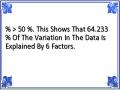 % > 50 %. This Shows That 64.233 % Of The Variation In The Data Is Explained By 6 Factors.
(Source: Data processing results via SPSS software)
Through the above test results, we can see that the scale groups have Cronbach's Alpha coefficients greater than 0.6 and have total correlation coefficients of observed variables greater than 0.3. When removing an observed variable from the factor, the Cronbach's Alpha coefficient is lower, reducing the reliability of the scale. From there, we can conclude that the observed variables in those factor groups are suitable for further testing.
2.2.3.2 Exploratory factor analysis (EFA)
For the independent variable
After testing the reliability of the scale, we conduct exploratory factor analysis, abbreviated as EFA, to reduce a set of k observed variables into a set F (with F
< k) more meaningful factors. According to Hair and Associates (1998): “Exploratory factor analysis is a statistical analysis method used to reduce a set of interdependent observed variables into a smaller set of variables (called factors) so that they are meaningful but still contain most of the information content of the original set of variables”.
Analyzing data through SPSS 20 software, we have the results
Table 2.7: KMO test results
KMO Test and Bartlett's Test
KMO Test | 0.813 | |
Bartlett test | Chi-square index | 1531,563 |
Df | 300 | |
Sig. | 0.000 |
(Source: Data processing results via SPSS software)
Looking at the table above, we can see:
- KMO coefficient = 0.813 so factor analysis is appropriate.
- Sig. (Barlett's Test) = 0.000 (Sig. < 0.05) shows that the variables are correlated with each other in the population.
Table 2.8: Total variance explained by factors
Eigenvalue
1,107 | |
Number of factors | 8 |
Total variance product | 70,700% |
(Source: Data processing results via SPSS software)
Looking at the table above, we can see:
- Eigenvalue = 1.107 > 1 represents the portion of variation explained by each extracted factor that best summarizes the information.
- Cumulative variance = 70,700% >50%. This shows that 70,700% of the data variation is explained by 8 factors in the model.
Table 2.9: Factor rotation matrix
Factor
1 | 2 | 3 | 4 | 5 | 6 | 7 | 8 | |
GC3 | 0.800 | |||||||
GC2 | 0.777 | |||||||
GC1 | 0.706 | |||||||
ST2 | 0.568 | |||||||
TD1 | 0.867 | |||||||
TD2 | 0.839 | |||||||
TD3 | 0.725 | |||||||
NTK2 | 0.858 | |||||||
NTK3 | 0.826 | |||||||
NTK1 | 0.731 | |||||||
KN3 | 0.797 | |||||||
KN1 | 0.749 | |||||||
KN2 | 0.711 | |||||||
DC2 | 0.823 | |||||||
DC3 | 0.798 | |||||||
DC1 | 0.737 | |||||||
QC3 | 0.811 | |||||||
QC2 | 0.756 | |||||||
QC1 | 0.733 | |||||||
CL3 | 0.795 | |||||||
CL1 | 0.698 | |||||||
CL2 | 0.692 | |||||||
DD3 | 0.790 | |||||||
DD1 | 0.747 | |||||||
DD2 | 0.687 |
(Source: Data processing results via SPSS software)
After exploratory factor analysis for independent variables. The correlation coefficient between variables ST1, ST3 and the factor "Travel Interest" is less than 0.5. Therefore, these two variables were removed from the factor. At the same time, the difference between the factor loading coefficient of the factor "Tour price" of variable ST2 in the factor "Travel Interest" is greater than or equal to 0.3. Therefore, variable ST2 is included in the factor "Tour price".
Name and annotate the factors:
- Factor 1: “Tour price”. Includes variables: GC3 – “Diverse payment methods”
GC2 – “The company has many promotional programs for tours”
GC1 – “Reasonable tour price”
ST2 – “I like visiting historical sites”
- Factor 2: “Tourism attitude”. Includes variables: TD1 – “I am interested in Hue tourism development”
TD3 – “For me, traveling is a favorite experience”
TD2 – “I like to travel with friends and relatives”
- Factor 3: “Reference group”. Includes variables: NTK3 – “Local people suggest I choose the tour” NTK2 – “The tourist community suggests I choose the tour” NTK1 – “Friends and relatives suggest I choose the tour”
- Factor 4: “Travel experience”. Includes variables: KN3 – “I was satisfied with the previous tour” KN2 – “I enjoyed the previous tour”
KN1 – “I have a lot of experience participating in Hue 1 day tour”
- Factor 5: “Travel motivation”. Includes variables:
DC2 – “I chose the tour because I wanted to have fun with friends and family”
DC1 – “I chose the tour to relieve stress”
DC3 – “I chose the tour to explore and learn about Hue culture”
- Factor 6: “Tour advertising”. Including variables: QC1 – “Attractive tour advertising”
QC3 – “Tour information was passed on to me by word of mouth”
QC2 – “Complete tour information, easy to find”
- Factor 7: “Availability and quality of tours”
CL1 – “Tours are always available, diverse
CL2 – “The tour has many attractive and interesting destinations” CL3 – “The tour quality is guaranteed”
- Factor 8: “Tour booking location”. Includes variables: DD1 – “Convenient tour booking location”
DD2 – “I can book a tour by phone” DD3 – “I can book a tour by Internet”
For the dependent variable: “Decision to choose Hue 1-day tour product”
In order to check the suitability of the data for factor analysis, using the index of KMO test and Balett test to conduct a general assessment of tourists' decision to purchase Hue 1-day tour products through 3 observed variables.
The results are shown in the following table:
Table 2.10: Rotated matrix of factors determining the choice of Hue 1-day tour product
Factor matrix
KMO coefficient | 0.694 |
Eigenvalues | 2,064 |
Total variance extracted | 68.732% |
Sig. of Bartlett's test | 0.000 |
(Source: Data processing results via SPSS software)
Looking at the table above, we can see:
- KMO coefficient = 0.694 > 0.05
- Sig. = 0.000 so using factor analysis is appropriate
- Eigenvalues > 1
- Cumulative variance = 68.732% > 50% so it meets the requirements.
- All variables have factor loadings > 0.05
The model is adjusted after analyzing and testing the reliability of the scale.
Adjust as follows:
Calibration model
Multiple regression analysis
After analyzing and testing the reliability of the scale, we have the calibration model:
Tour price
Travel attitude
Reference group
Travel experience
Decide to choose Hue 1 day tour product
Travel motive
Tour advertising
Availability and quality
number of tours
Tour booking location
H1
H2
H3
H4
H5
H6
H7
H8
Figure 2.2: Calibration model diagram
2.2.3.3 Pearson correlation coefficient matrix analysis
To test the Pearson correlation coefficient, we first need to create representative variables from the final factor rotation results. Specifically as follows:
- QD – Variable representing the factor group “Decision to choose Hue 1-day tour product”
- GC – Variable representing the factor group “Tour price”
- TD – Variable representing the factor group “Tourism attitude”
- NTK – Variable representing the factor group “Reference group”
- KN – Variable representing the factor group “Travel experience”
- DC – Variable representing the factor group “Travel motivation”
- QC – Variable representing the factor group “Tour advertising”
- CL – Variable representing the factor group “Availability and quality of tours”
- DD – Variable representing the factor group “Tour booking location”
The results of the linear correlation coefficient statistics are shown as follows:
Table 2.11: Correlation analysis of groups of factors affecting the decision to choose Hue 1-day tour products
GC | TD | Designer | KN | DC | QC | CL | DD | |
Pearson correlation coefficient | 0.369 | 0.260 | 0.245 | 0.291 | 0.149 | 0.166 | 0.348 | 0.320 |
Sig. | 0.000 | 0.001 | 0.003 | 0.000 | 0.069 | 0.043 | 0.000 | 0.000 |
(Source: Data processing results via SPSS software)
The correlation results show that Sig. correlation between DC variable and dependent variable QD is greater than 0.05 (0.069 > 0.05). Thus, this variable will be eliminated before being put into regression processing. The remaining independent variables: TD, KN, NTK, DD, QC, CL, GC Sig. each of these independent variables with the dependent variable is less than 0.05. This proves that there is a close correlation with the dependent variable QD, so it should be retained to run the linear regression equation.
Regression analysis left 7 variables, which are: TD, KN, NTK, DD, QC, CL, GC and one dependent variable is QD.
2.2.3.4 Multiple regression analysis
The correlation coefficient test shows that there are 7 independent variables that are correlated with the dependent variable, meeting the Sig coefficient condition. Therefore, it should be included in the multivariate regression analysis. The multivariate regression analysis helps to determine which factors contribute more, less or not to the change of the dependent variable in order to provide appropriate solutions.
The multiple regression model has the following form:
QD = + * GC + *TD + *NTK + *KN + *QC + *CL + *DD
In there:
“...0,...1,...2,...3,...4,...5,...6,...7”: Regression coefficients
Dependent variable QD: “Decision to choose Hue 1-day tour product” GC: “Price”
TD: “Travel attitude” NTK: “Reference group” KN: “Travel experience” QC: “Tour advertisement”
CL: “Tour availability and quality” DD: “Tour booking location”
Evaluation and validation of model fit


Table 2.12: Model fit assessment
Model
R | R | R correction | Estimated standard error | Durbin-Watson | |
1 | 0.774 | 0.600 | 0.580 | 0.64820569 | 1,778 |
(Source: Data processing results via SPSS software)
Looking at the model fit assessment table, we can see:
- The R value of 77.4% shows that the relationship between the variables is correlated.
quite closely

- Adjusted R Square reflects the influence of independent variables on the dependent variable. In this case, the 7 independent variables included affect 58% of the change in the dependent variable, the remaining 42% is due to variables outside the model and random errors .