
rough, become a murder tool[81/117] . Here , the author raises the issue of identifying the enemy in peaceful life is not simple. Especially in the later war without gunfire, identifying the enemy becomes more complicated and difficult than ever.
Besides directly reflecting the fight against the expansionist invaders in the north and the Pol Pot group in the southwestern border, the image and impression of the resistance war against the US are still strongly imprinted in many short stories after 1975. However, on the background of the war, the authors focused more on the issue of social ethics, the issue of building the concept of innovation and human personality in the new stage of the revolution. That is the perspective of approaching the reality of war in a series of short stories: Two people return to the regiment (Thai Ba Loi), Beautiful day (Ma Van Khang), The picture (Nguyen Minh Chau), Aunt Ut (Thanh Que), Living with two-way time (Vu Tu Nam), The flowers of the mangroves, The house on the sand, Peaceful dawn (Duong Thu Huong) ...
Two people return to the regiment (Thai Ba Loi) is a work with a very early premonition of the ethical issues of people in war and from the battlefield to the rear, from wartime to peacetime. Through the character Tri, the author abandoned the simple, one-sided view of people. Here, people are discovered and expressed mainly on the ethical level, studied in the process of personality formation. War is the environment that reveals the complexity of human personality. Originally a good reconnaissance team leader in combat, but in love, Tri is ready to use tricks to defeat his opponent. Even though that person is a friend who has been through life and death with him, in his heart there is only a little regret, it is only fleeting like the sound of a small bullet in a big battle[67/667] . Later on, in the steps of fame of his life, he continues to trample on many other spiritual values. However, in
Maybe you are interested!
-
 Identify Rating Levels and Rating Scales
zt2i3t4l5ee
zt2a3gstourism,quan lan,quang ninh,ecology,ecotourism,minh chau,van don,geography,geographical basis,tourism development,science
zt2a3ge
zc2o3n4t5e6n7ts
of the islanders. Therefore, this indicator will be divided into two sub-indicators:
a1. Natural tourism attractiveness a2. Cultural tourism attractiveness
b. Tourist capacity
The two island communes in Quan Lan have different capacities to receive tourists. Minh Chau Commune is home to many standard hotels and resorts, attracting high-income domestic and international tourists. Meanwhile, Quan Lan Commune has many motels mainly built and operated by local people, so the scale and quality are not high, and will be suitable for ordinary tourists such as students.
c. Time of exploitation of Quan Lan Island Commune:
Quan Lan tourism is seasonal due to weather and climate conditions and festivals only take place on certain days of the year, specifically in spring. In Quan Lan commune, the period from April to June and from September to November is considered the best time to visit Quan Lan because the cultural tourism activities are mainly associated with festivals taking place during this time.
Minh Chau island commune:
Tourism exploitation time is all year round, because this is a place with a number of tourist attractions with diverse ecosystems such as Bai Tu Long National Park Research Center, Tram forest, Turtle Laying Beach, so besides coming to the beach for tourism and vacation in the summer, Minh Chau will attract research groups to come for tourism combined with research at other times of the year.
d. Sustainability
The sustainability of ecotourism sites in Quan Lan and Minh Chau communes depends on the sensitivity of the ecosystems to climate changes.
landscape. In general, these tourist destinations have a fairly high level of sustainability, because they are natural ecosystems, planned and protected. However, if a large number of tourists gather at certain times, it can exceed the carrying capacity and affect the sustainability of the environment (polluted beaches, damaged trees, animals moving away from their habitats, etc.), then the sustainability of the above ecosystems (natural ecosystems, human ecosystems) will also be affected and become less sustainable.
e. Location and accessibility
Both island communes have ports to take tourists to visit from Van Don wharf:
- Quan Lan – Van Don traffic route:
Phuc Thinh – Viet Anh high-speed boat and Quang Minh high-speed boat, depart at 8am and 2pm from Van Don to Quan Lan, and at 7am and 1pm from Quan Lan to Van Don. There are also wooden boats departing at 7am and 1pm.
- Van Don - Minh Chau traffic route:
Chung Huong high-speed train, Minh Chau train, morning 7:30 and afternoon 13:30 from Van Don to Minh Chau, morning 6:30 and afternoon 13:00 from Minh Chau to Van Don.
f. Infrastructure
Despite receiving investment attention, the issue of infrastructure and technical facilities for tourism on Quan Lan Island is still an issue that needs to be resolved because it has a direct impact on the implementation of ecotourism activities. The minimum conditions for serving tourists such as accommodation, electricity, water, communication, especially medical services, and security work need to be given top priority. Ecotourism spots in Minh Chau commune are assessed to have better infrastructure and technical facilities for tourism because there are quite complete and synchronous conditions for serving tourists, meeting many needs of domestic and foreign tourists.
3.2.1.4. Determine assessment levels and assessment scales
Corresponding to the levels of each criterion, the index is the score of those levels in the order of 4, 3, 2, 1 decreasing according to the standard of each level: very attractive (4), attractive (3), average (2), less attractive (1).
3.2.1.5. Determining the coefficients of the criteria
For the assessment of DLST in the two communes of Quan Lan and Minh Chau islands, the students added evaluation coefficients to show the importance of the criteria and indicators as follows:
Coefficient 3 with criteria: Attractiveness, Exploitation time. These are the 2 most important criteria for attracting tourists to tourism in general and eco-tourism in particular, so they have the highest coefficient.
Coefficient 2 with criteria: Capacity, Infrastructure, Location and accessibility . Because the assessment area is an island commune of Van Don district, the above criteria are selected by the author with appropriate coefficients at the average level.
Coefficient 1 with criteria: Sustainability. Quan Lan has natural and human-made ecotourism sites, with high biodiversity and little impact from local human factors. Most of the ecotourism sites are still wild, so they are highly sustainable.
3.2.1.6. Results of DLST assessment on Quan Lan island
a. Assessment of the potential for natural tourism development
For Minh Chau commune:
+ Natural tourism attractiveness is determined to be very attractive (4 points) and the most important coefficient (coefficient 3), so the score of the Attractiveness criterion is 4 x 3 = 12.
+ Capacity is determined as average (2 points) and the coefficient is quite important (coefficient 2), then the score of Capacity criterion is 2 x 2 = 4.
+ Exploitation time is long (4 points), the most important coefficient (coefficient 3) so the score of the Exploitation time criterion is 4 x 3 = 12.
+ Sustainability is determined as sustainable (4 points), the important coefficient is the average coefficient (coefficient 1), so the score of the Sustainability criterion is 4 x 1 = 4 points
+ Location and accessibility are determined to be quite favorable (2 points), the coefficient is quite important (coefficient 2), the criterion score is 2 x 2 = 4 points.
+ Infrastructure is assessed as good (3 points), the coefficient is quite important (coefficient 2), then the score of the Infrastructure criterion is 3 x 2 = 6 points.
The total score for evaluating DLST in Minh Chau commune according to 6 evaluation criteria is determined as: 12 + 4 + 12 + 4 + 4 + 6 = 42 points
Similar assessment for Quan Lan commune, we have the following table:
Table 3.3: Assessment of the potential for natural ecotourism development in Quan Lan and Minh Chau communes
Attractiveness of self-tourismof course
Capacity
Mining time
Sustainability
Location and accessibility
Infrastructure
Result
Point
DarkMulti
Point
DarkMulti
Point
DarkMulti
Point
DarkMulti
Point
DarkMulti
Point
DarkMulti
CommuneMinh Chau
12
12
4
8
12
12
4
4
4
8
6
8
42/52
Quan CommuneLan
6
12
6
8
9
12
4
4
4
8
4
8
33/52
b. Assessment of the potential for humanistic tourism development
For Quan Lan commune:
+ The attractiveness of human tourism is determined to be very attractive (4 points) and the most important coefficient (coefficient 3), so the score of the Attractiveness criterion is 4 x 3 = 12.
+ Capacity is determined to be large (3 points) and the coefficient is quite important (coefficient 2), then the score of the Capacity criterion is 3 x 2 = 6.
+ Mining time is average (3 points), the most important coefficient (coefficient 3) so the score of the Mining time criterion is 3 x 3 = 9.
+ Sustainability is determined as sustainable (4 points), the important coefficient is the average coefficient (coefficient 1), so the score of the Sustainability criterion is 4 x 1 = 4 points.
+ Location and accessibility are determined to be quite favorable (2 points), the coefficient is quite important (coefficient 2), the criterion score is 2 x 2 = 4 points.
+ Infrastructure is rated as average (2 points), the coefficient is quite important (coefficient 2), then the score of the Infrastructure criterion is 2 x 2 = 4 points.
The total score for evaluating DLST in Quan Lan commune according to 6 evaluation criteria is determined as: 12 + 6 + 6 + 4 + 4 + 4 = 36 points.
Similar assessment with Minh Chau commune we have the following table:
Table 3.4: Assessment of the potential for developing humanistic eco-tourism in Quan Lan and Minh Chau communes
Attractiveness of human tourismliterature
Capacity
Mining time
Sustainability
Location and accessibility
Infrastructure
Result
Point
DarkMulti
Point
DarkMulti
Point
DarkMulti
Point
DarkMulti
Point
DarkMulti
Point
DarkMulti
Quan CommuneLan
12
12
6
8
9
12
4
4
4
8
4
8
39/52
Minh CommuneChau
6
12
4
8
12
12
4
4
4
8
6
8
36/52
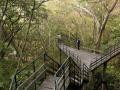
Basically, both Minh Chau and Quan Lan localities have quite favorable conditions for developing ecotourism. However, Quan Lan commune has more advantages to develop ecotourism in a humanistic direction, because this is an area with many famous historical relics such as Quan Lan Communal House, Quan Lan Pagoda, Temple worshiping the hero Tran Khanh Du, ... along with local festivals held annually such as the wind praying ceremony (March 15), Quan Lan festival (June 10-19); due to its location near the port and long exploitation time, the beaches in Quan Lan commune (especially Quan Lan beach) are no longer hygienic and clean to ensure the needs of tourists coming to relax and swim; this is also an area with many beautiful landscapes such as Got Beo wind pass, Ong Phong head, Voi Voi cave, but the ability to access these places is still very limited (dirt hill road, lots of gravel and rocks), especially during rainy and windy times; In addition, other natural resources such as mangrove forests and sea worms have not been really exploited for tourism purposes and ecotourism development. On the contrary, Minh Chau commune has more advantages in developing ecotourism in the direction of natural tourism, this is an area with diverse ecosystems such as at Rua De Beach, Bai Tu Long National Park Conservation Center...; Minh Chau beach is highly appreciated for its natural beauty and cleanliness, ranked in the top ten most beautiful beaches in Vietnam; Minh Chau commune is also home to Tram forest with a large area and a purity of up to 90%, suitable for building bridges through the forest (a very effective type of natural ecotourism currently applied by many countries) for tourists to sightsee, as well as for the purpose of studying and researching.
Figure 3.1: Thenmala Forest Bridge (India) Source: https://www.thenmalaecotourism.com/(August 21, 2019)
3.2.2. Using SWOT matrix to evaluate Quan Lan island tourism
General assessment of current tourism activities of Quan Lan island is shown through the following SWOT matrix:
Table 3.5: SWOT matrix evaluating tourism activities on Quan Lan island
Internal agent
Strengths- There is a lot of potential for tourism development, especially natural ecotourism and humanistic ecotourism.- The unskilled labor force is relatively abundant.- resource environmentunpolluted, still
Weaknesses- Poorly developed infrastructure, especially traffic routes to tourist destinations on the island.- The team of professional staff is still weak.- Tourism products in general
quite wild, originalintact
general and DLST in particularalone is monotonous.
External agents
Opportunity- Tourism is a key industry in the socio-economic development strategy of the province and Van Don economic zone.- Quan Lan was selected as a pilot area for eco-tourism development within the framework of the green growth project between Quang Ninh province and the Japanese organization JICA.- The flow of tourists and especially ecotourism in the world tends toincreasing
Challenge- Weather and climate change abnormally.- Competition in tourism products is increasingly fierce, especially with other localities in the province such as Ha Long, Mong Cai...- Awareness of tourists, especially domestic tourists, about ecotourism and nature conservation is not high.
Through summary analysis using SWOT matrix we see that:
To exploit strengths and take advantage of opportunities, it is necessary to:
- Diversify products and service types (build more tourism routes aimed at specific needs of tourists: experiential tourism immersed in nature, spiritual cultural tourism...)
- Effective exploitation of resources and differentiated products (natural resources and human resources)
div.maincontent .p { color: black; font-family:"Times New Roman", serif; font-style: normal; font-weight: normal; text-decoration: none; font-size: 14pt; margin:0pt; } div.maincontent p { color: black; font-family:"Times New Roman", serif; font-style: normal; font-weight: normal; text-decoration: none; font-size: 14pt; margin:0pt; } div.maincontent .s1 { color: black; font-family:"Times New Roman", serif; font-style: normal; font-weight: normal; text-decoration: none; font-size: 13pt; } div.maincontent .s2 { color: black; font-family:"Times New Roman", serif; font-style: normal; font-weight: normal; text-decoration: none; font-size: 13pt; } div.maincontent .s3 { color: #0D0D0D; font-family:"Times New Roman", serif; font-style: normal; font-weight: bold; text-decoration: none; font-size: 14pt; } div.maincontent .s4 { color: black; font-family:"Times New Roman", serif; font-style: italic; font-weight: normal; text-decoration: none; font-size: 14pt; } div.maincontent .s5 { color: black; font-family:"Times New Roman", serif; font-style: italic; font-weight: bold; text-decoration: none; font-size: 14pt; } div.maincontent .s6 { color: black; font-family:"Times New Roman", serif; font-style: italic; font-weight: normal; text-decoration: none; font-size: 14pt; vertical-align: -3pt; } div.maincontent .s7 { color: black; font-family:"Times New Roman", serif; font-style: italic; font-weight: normal; text-decoration: none; font-size: 14pt; vertical-align: -2pt; } div.maincontent .s8 { color: black; font-family:"Times New Roman", serif; font-style: italic; font-weight: normal; text-decoration: none; font-size: 14pt; vertical-align: -1pt; } div.maincontent .s9 { color: black; font-family:"Times New Roman", serif; font-style: normal; font-weight: normal; text-decoration: none; font-size: 14pt; } div.maincontent .s10 { color: black; font-family:"Times New Roman", serif; font-style: normal; font-weight: bold; text-decoration: none; font-size: 14pt; } div.maincontent .s11 { color: black; font-family:"Times New Roman", serif; font-style: normal; font-weight: normal; text-decoration: none; font-size: 14pt; } div.maincontent .s12 { color: black; font-family:Symbol, serif; font-style: normal; font-weight: normal; text-decoration: none; font-size: 14pt; } div.maincontent .s13 { color: black; font-family:Wingdings; font-style: normal; font-weight: normal; text-decoration: none; font-size: 14pt; } div.maincontent .s14 { color: black; font-family:"Times New Roman", serif; font-style: normal; font-weight: normal; text-decoration: none; font-size: 9pt; vertical-align: 5pt; } div.maincontent .s15 { color: black; font-family:"Times New Roman", serif; font-style: normal; font-weight: normal; text-decoration: none; font-size: 9pt; vertical-align: 5pt; } div.maincontent .s16 { color: black; font-family:Cambria, serif; font-style: italic; font-weight: normal; text-decoration: none; font-size: 14pt; } div.maincontent .s17 { color: #080808; font-family:"Times New Roman", serif; font-style: normal; font-weight: bold; text-decoration: none; font-size: 14pt; } div.maincontent .s18 { color: #080808; font-family:"Times New Roman", serif; font-style: normal; font-weight: normal; text-decoration: none; font-size: 14pt; } div.maincontent .s19 { color: black; font-family:"Times New Roman", serif; font-style: normal; font-weight: normal; text-decoration: none; font-size: 11pt; } div.maincontent .s20 { color: black; font-family:"Times New Roman", serif; font-style: normal; font-weight: normal; text-decoration: none; font-size: 10pt; } div.maincontent .s21 { color: black; font-family:"Times New Roman", serif; font-style: normal; font-weight: bold; text-decoration: none; font-size: 11pt; } div.maincontent .s22 { color: black; font-family:"Times New Roman", serif; font-style: normal; font-weight: normal; text-decoration: none; font-size: 11pt; } div.maincontent .s23 { color: black; font-family:"Times New Roman", serif; font-style: italic; font-weight: normal; text-decoration: none; font-size: 14pt; } div.maincontent .s24 { color: #212121; font-family:"Times New Roman", serif; font-style: normal; font-weight: normal; tex
Identify Rating Levels and Rating Scales
zt2i3t4l5ee
zt2a3gstourism,quan lan,quang ninh,ecology,ecotourism,minh chau,van don,geography,geographical basis,tourism development,science
zt2a3ge
zc2o3n4t5e6n7ts
of the islanders. Therefore, this indicator will be divided into two sub-indicators:
a1. Natural tourism attractiveness a2. Cultural tourism attractiveness
b. Tourist capacity
The two island communes in Quan Lan have different capacities to receive tourists. Minh Chau Commune is home to many standard hotels and resorts, attracting high-income domestic and international tourists. Meanwhile, Quan Lan Commune has many motels mainly built and operated by local people, so the scale and quality are not high, and will be suitable for ordinary tourists such as students.
c. Time of exploitation of Quan Lan Island Commune:
Quan Lan tourism is seasonal due to weather and climate conditions and festivals only take place on certain days of the year, specifically in spring. In Quan Lan commune, the period from April to June and from September to November is considered the best time to visit Quan Lan because the cultural tourism activities are mainly associated with festivals taking place during this time.
Minh Chau island commune:
Tourism exploitation time is all year round, because this is a place with a number of tourist attractions with diverse ecosystems such as Bai Tu Long National Park Research Center, Tram forest, Turtle Laying Beach, so besides coming to the beach for tourism and vacation in the summer, Minh Chau will attract research groups to come for tourism combined with research at other times of the year.
d. Sustainability
The sustainability of ecotourism sites in Quan Lan and Minh Chau communes depends on the sensitivity of the ecosystems to climate changes.
landscape. In general, these tourist destinations have a fairly high level of sustainability, because they are natural ecosystems, planned and protected. However, if a large number of tourists gather at certain times, it can exceed the carrying capacity and affect the sustainability of the environment (polluted beaches, damaged trees, animals moving away from their habitats, etc.), then the sustainability of the above ecosystems (natural ecosystems, human ecosystems) will also be affected and become less sustainable.
e. Location and accessibility
Both island communes have ports to take tourists to visit from Van Don wharf:
- Quan Lan – Van Don traffic route:
Phuc Thinh – Viet Anh high-speed boat and Quang Minh high-speed boat, depart at 8am and 2pm from Van Don to Quan Lan, and at 7am and 1pm from Quan Lan to Van Don. There are also wooden boats departing at 7am and 1pm.
- Van Don - Minh Chau traffic route:
Chung Huong high-speed train, Minh Chau train, morning 7:30 and afternoon 13:30 from Van Don to Minh Chau, morning 6:30 and afternoon 13:00 from Minh Chau to Van Don.
f. Infrastructure
Despite receiving investment attention, the issue of infrastructure and technical facilities for tourism on Quan Lan Island is still an issue that needs to be resolved because it has a direct impact on the implementation of ecotourism activities. The minimum conditions for serving tourists such as accommodation, electricity, water, communication, especially medical services, and security work need to be given top priority. Ecotourism spots in Minh Chau commune are assessed to have better infrastructure and technical facilities for tourism because there are quite complete and synchronous conditions for serving tourists, meeting many needs of domestic and foreign tourists.
3.2.1.4. Determine assessment levels and assessment scales
Corresponding to the levels of each criterion, the index is the score of those levels in the order of 4, 3, 2, 1 decreasing according to the standard of each level: very attractive (4), attractive (3), average (2), less attractive (1).
3.2.1.5. Determining the coefficients of the criteria
For the assessment of DLST in the two communes of Quan Lan and Minh Chau islands, the students added evaluation coefficients to show the importance of the criteria and indicators as follows:
Coefficient 3 with criteria: Attractiveness, Exploitation time. These are the 2 most important criteria for attracting tourists to tourism in general and eco-tourism in particular, so they have the highest coefficient.
Coefficient 2 with criteria: Capacity, Infrastructure, Location and accessibility . Because the assessment area is an island commune of Van Don district, the above criteria are selected by the author with appropriate coefficients at the average level.
Coefficient 1 with criteria: Sustainability. Quan Lan has natural and human-made ecotourism sites, with high biodiversity and little impact from local human factors. Most of the ecotourism sites are still wild, so they are highly sustainable.
3.2.1.6. Results of DLST assessment on Quan Lan island
a. Assessment of the potential for natural tourism development
For Minh Chau commune:
+ Natural tourism attractiveness is determined to be very attractive (4 points) and the most important coefficient (coefficient 3), so the score of the Attractiveness criterion is 4 x 3 = 12.
+ Capacity is determined as average (2 points) and the coefficient is quite important (coefficient 2), then the score of Capacity criterion is 2 x 2 = 4.
+ Exploitation time is long (4 points), the most important coefficient (coefficient 3) so the score of the Exploitation time criterion is 4 x 3 = 12.
+ Sustainability is determined as sustainable (4 points), the important coefficient is the average coefficient (coefficient 1), so the score of the Sustainability criterion is 4 x 1 = 4 points
+ Location and accessibility are determined to be quite favorable (2 points), the coefficient is quite important (coefficient 2), the criterion score is 2 x 2 = 4 points.
+ Infrastructure is assessed as good (3 points), the coefficient is quite important (coefficient 2), then the score of the Infrastructure criterion is 3 x 2 = 6 points.
The total score for evaluating DLST in Minh Chau commune according to 6 evaluation criteria is determined as: 12 + 4 + 12 + 4 + 4 + 6 = 42 points
Similar assessment for Quan Lan commune, we have the following table:
Table 3.3: Assessment of the potential for natural ecotourism development in Quan Lan and Minh Chau communes
Attractiveness of self-tourismof course
Capacity
Mining time
Sustainability
Location and accessibility
Infrastructure
Result
Point
DarkMulti
Point
DarkMulti
Point
DarkMulti
Point
DarkMulti
Point
DarkMulti
Point
DarkMulti
CommuneMinh Chau
12
12
4
8
12
12
4
4
4
8
6
8
42/52
Quan CommuneLan
6
12
6
8
9
12
4
4
4
8
4
8
33/52
b. Assessment of the potential for humanistic tourism development
For Quan Lan commune:
+ The attractiveness of human tourism is determined to be very attractive (4 points) and the most important coefficient (coefficient 3), so the score of the Attractiveness criterion is 4 x 3 = 12.
+ Capacity is determined to be large (3 points) and the coefficient is quite important (coefficient 2), then the score of the Capacity criterion is 3 x 2 = 6.
+ Mining time is average (3 points), the most important coefficient (coefficient 3) so the score of the Mining time criterion is 3 x 3 = 9.
+ Sustainability is determined as sustainable (4 points), the important coefficient is the average coefficient (coefficient 1), so the score of the Sustainability criterion is 4 x 1 = 4 points.
+ Location and accessibility are determined to be quite favorable (2 points), the coefficient is quite important (coefficient 2), the criterion score is 2 x 2 = 4 points.
+ Infrastructure is rated as average (2 points), the coefficient is quite important (coefficient 2), then the score of the Infrastructure criterion is 2 x 2 = 4 points.
The total score for evaluating DLST in Quan Lan commune according to 6 evaluation criteria is determined as: 12 + 6 + 6 + 4 + 4 + 4 = 36 points.
Similar assessment with Minh Chau commune we have the following table:
Table 3.4: Assessment of the potential for developing humanistic eco-tourism in Quan Lan and Minh Chau communes
Attractiveness of human tourismliterature
Capacity
Mining time
Sustainability
Location and accessibility
Infrastructure
Result
Point
DarkMulti
Point
DarkMulti
Point
DarkMulti
Point
DarkMulti
Point
DarkMulti
Point
DarkMulti
Quan CommuneLan
12
12
6
8
9
12
4
4
4
8
4
8
39/52
Minh CommuneChau
6
12
4
8
12
12
4
4
4
8
6
8
36/52
Basically, both Minh Chau and Quan Lan localities have quite favorable conditions for developing ecotourism. However, Quan Lan commune has more advantages to develop ecotourism in a humanistic direction, because this is an area with many famous historical relics such as Quan Lan Communal House, Quan Lan Pagoda, Temple worshiping the hero Tran Khanh Du, ... along with local festivals held annually such as the wind praying ceremony (March 15), Quan Lan festival (June 10-19); due to its location near the port and long exploitation time, the beaches in Quan Lan commune (especially Quan Lan beach) are no longer hygienic and clean to ensure the needs of tourists coming to relax and swim; this is also an area with many beautiful landscapes such as Got Beo wind pass, Ong Phong head, Voi Voi cave, but the ability to access these places is still very limited (dirt hill road, lots of gravel and rocks), especially during rainy and windy times; In addition, other natural resources such as mangrove forests and sea worms have not been really exploited for tourism purposes and ecotourism development. On the contrary, Minh Chau commune has more advantages in developing ecotourism in the direction of natural tourism, this is an area with diverse ecosystems such as at Rua De Beach, Bai Tu Long National Park Conservation Center...; Minh Chau beach is highly appreciated for its natural beauty and cleanliness, ranked in the top ten most beautiful beaches in Vietnam; Minh Chau commune is also home to Tram forest with a large area and a purity of up to 90%, suitable for building bridges through the forest (a very effective type of natural ecotourism currently applied by many countries) for tourists to sightsee, as well as for the purpose of studying and researching.
Figure 3.1: Thenmala Forest Bridge (India) Source: https://www.thenmalaecotourism.com/(August 21, 2019)
3.2.2. Using SWOT matrix to evaluate Quan Lan island tourism
General assessment of current tourism activities of Quan Lan island is shown through the following SWOT matrix:
Table 3.5: SWOT matrix evaluating tourism activities on Quan Lan island
Internal agent
Strengths- There is a lot of potential for tourism development, especially natural ecotourism and humanistic ecotourism.- The unskilled labor force is relatively abundant.- resource environmentunpolluted, still
Weaknesses- Poorly developed infrastructure, especially traffic routes to tourist destinations on the island.- The team of professional staff is still weak.- Tourism products in general
quite wild, originalintact
general and DLST in particularalone is monotonous.
External agents
Opportunity- Tourism is a key industry in the socio-economic development strategy of the province and Van Don economic zone.- Quan Lan was selected as a pilot area for eco-tourism development within the framework of the green growth project between Quang Ninh province and the Japanese organization JICA.- The flow of tourists and especially ecotourism in the world tends toincreasing
Challenge- Weather and climate change abnormally.- Competition in tourism products is increasingly fierce, especially with other localities in the province such as Ha Long, Mong Cai...- Awareness of tourists, especially domestic tourists, about ecotourism and nature conservation is not high.
Through summary analysis using SWOT matrix we see that:
To exploit strengths and take advantage of opportunities, it is necessary to:
- Diversify products and service types (build more tourism routes aimed at specific needs of tourists: experiential tourism immersed in nature, spiritual cultural tourism...)
- Effective exploitation of resources and differentiated products (natural resources and human resources)
div.maincontent .p { color: black; font-family:"Times New Roman", serif; font-style: normal; font-weight: normal; text-decoration: none; font-size: 14pt; margin:0pt; } div.maincontent p { color: black; font-family:"Times New Roman", serif; font-style: normal; font-weight: normal; text-decoration: none; font-size: 14pt; margin:0pt; } div.maincontent .s1 { color: black; font-family:"Times New Roman", serif; font-style: normal; font-weight: normal; text-decoration: none; font-size: 13pt; } div.maincontent .s2 { color: black; font-family:"Times New Roman", serif; font-style: normal; font-weight: normal; text-decoration: none; font-size: 13pt; } div.maincontent .s3 { color: #0D0D0D; font-family:"Times New Roman", serif; font-style: normal; font-weight: bold; text-decoration: none; font-size: 14pt; } div.maincontent .s4 { color: black; font-family:"Times New Roman", serif; font-style: italic; font-weight: normal; text-decoration: none; font-size: 14pt; } div.maincontent .s5 { color: black; font-family:"Times New Roman", serif; font-style: italic; font-weight: bold; text-decoration: none; font-size: 14pt; } div.maincontent .s6 { color: black; font-family:"Times New Roman", serif; font-style: italic; font-weight: normal; text-decoration: none; font-size: 14pt; vertical-align: -3pt; } div.maincontent .s7 { color: black; font-family:"Times New Roman", serif; font-style: italic; font-weight: normal; text-decoration: none; font-size: 14pt; vertical-align: -2pt; } div.maincontent .s8 { color: black; font-family:"Times New Roman", serif; font-style: italic; font-weight: normal; text-decoration: none; font-size: 14pt; vertical-align: -1pt; } div.maincontent .s9 { color: black; font-family:"Times New Roman", serif; font-style: normal; font-weight: normal; text-decoration: none; font-size: 14pt; } div.maincontent .s10 { color: black; font-family:"Times New Roman", serif; font-style: normal; font-weight: bold; text-decoration: none; font-size: 14pt; } div.maincontent .s11 { color: black; font-family:"Times New Roman", serif; font-style: normal; font-weight: normal; text-decoration: none; font-size: 14pt; } div.maincontent .s12 { color: black; font-family:Symbol, serif; font-style: normal; font-weight: normal; text-decoration: none; font-size: 14pt; } div.maincontent .s13 { color: black; font-family:Wingdings; font-style: normal; font-weight: normal; text-decoration: none; font-size: 14pt; } div.maincontent .s14 { color: black; font-family:"Times New Roman", serif; font-style: normal; font-weight: normal; text-decoration: none; font-size: 9pt; vertical-align: 5pt; } div.maincontent .s15 { color: black; font-family:"Times New Roman", serif; font-style: normal; font-weight: normal; text-decoration: none; font-size: 9pt; vertical-align: 5pt; } div.maincontent .s16 { color: black; font-family:Cambria, serif; font-style: italic; font-weight: normal; text-decoration: none; font-size: 14pt; } div.maincontent .s17 { color: #080808; font-family:"Times New Roman", serif; font-style: normal; font-weight: bold; text-decoration: none; font-size: 14pt; } div.maincontent .s18 { color: #080808; font-family:"Times New Roman", serif; font-style: normal; font-weight: normal; text-decoration: none; font-size: 14pt; } div.maincontent .s19 { color: black; font-family:"Times New Roman", serif; font-style: normal; font-weight: normal; text-decoration: none; font-size: 11pt; } div.maincontent .s20 { color: black; font-family:"Times New Roman", serif; font-style: normal; font-weight: normal; text-decoration: none; font-size: 10pt; } div.maincontent .s21 { color: black; font-family:"Times New Roman", serif; font-style: normal; font-weight: bold; text-decoration: none; font-size: 11pt; } div.maincontent .s22 { color: black; font-family:"Times New Roman", serif; font-style: normal; font-weight: normal; text-decoration: none; font-size: 11pt; } div.maincontent .s23 { color: black; font-family:"Times New Roman", serif; font-style: italic; font-weight: normal; text-decoration: none; font-size: 14pt; } div.maincontent .s24 { color: #212121; font-family:"Times New Roman", serif; font-style: normal; font-weight: normal; tex -
 Venture capital activities in the world and some lessons for Vietnam (2008) - 14
 -
 Vietnam - Cambodia trade relations after Vietnam joined the World Trade Organization (WTO) - 2
 -
 Comparison of personal income tax management laws in Vietnam and some countries in the world - 15
 -
 World economic fluctuations in the period 2007 - 2008 and their impact on Vietnam's import-export business activities - 12
In this short story, the issue of human morality is raised in a rather reserved way. The author's handling of the matter is also very gentle. Therefore, we see that the character has not yet had to pay any price for the moral violations he caused.
In the short story Aunt Ut (Thanh Que), the problem of human betrayal and treachery is somewhat more intense. However, the author has not really solved the problem satisfactorily. In the face of the mistakes that the husband has made, he still receives tolerance and forgiveness from his wife. His conscience has never been troubled by his own immoral actions.
Going into the topic of human ethics, the short stories of the period 1975-1985 not only describe the bad habits as well as the good aspects of people in the new conditions but also seek ethical and behavioral standards for a peaceful working life in the new regime, are self-awareness of the social state to fight to overcome, are self-affirmation of the ethical face of each person today. The short story The Painting by Nguyen Minh Chau is one of the works expressing the author's desire to return to the common view of ethical standards for people after the war. A painter became famous with the famous painting Portrait of a Liberation Soldier. After going to a small shop to get a haircut, he was shocked to discover his unforgivable sin. Because of breaking the promise to the soldier who had taken care of him during the war, the soldier's mother thought her son had sacrificed, cried for him and went blind. From that day on, he always lived in torment, confronting his conscience. The soldier from the past, now a barber, had never once settled the debt he owed him eight years ago. But it was that noble attitude and kind heart that made the artist feel his face naturally thicken . And even though the soldier acted as if he did not know him, he felt like he was sitting for a brain surgery, without the need for anesthesia[11/133]. Here , Nguyen Minh Chau raised the issue of conscience .
clear personal responsibility. From a human perspective, if you are a moral person, can you allow yourself to be ungrateful to the person who once took care of you? And if you know the consequences of that ingratitude, do you have enough courage to confess and even ask to atone for the mistakes caused by your ingratitude? And from the perspective of an artist, for the purpose of serving the majority, do you have the right to break your promise to an unknown person? And before the misfortune of that innocent mother, do you have the right to be indifferent like an innocent person?
Thus, the issue of human morality is mentioned quite harshly in the short stories after the war. There is a polarization between morality and immorality, personality and inhumanity, good and evil, light and darkness, honesty and straightforwardness and opportunism, clear intelligence and blind instinct[16/377] . It seems that there is a confrontation, a choice to express the character and personality of each individual in the new situation.
1.2. The emergence and dominance of the topic of world affairs and private life
As soon as the country returned to peace, the topics of world affairs and private life quickly returned to their rightful place and increasingly played a leading role in the literary world. Reading the short stories of Nguyen Minh Chau, Nguyen Thanh Long, Nguyen Thi Ngoc Tu, Xuan Thieu, Ma Van Khang , etc., people have noticed new changes. The direction of these writers seems to be in the same direction as many typical writers of the later generation such as: Duong Thu Huong, Thai Ba Loi, Nguyen Manh Tuan, Nhat Tuan, Le Minh Khue , etc. Although the opinions of the public and critics on these works are not completely unified, everyone sees it as a phenomenon worth paying attention to. Perhaps, because this direction has partly responded to the reality of life after the war.
Although still having to deal with border wars, after 1975, people's lives basically turned to peace and construction.
The mood of the majority of people has changed. The writer's perspective on the real aspects of life has also changed a lot. In the general trend of literature, the short stories of this period have shown the writer's sharp awareness and attachment to contemporary life. Nguyen Minh Chau and Nguyen Khai, who have been attached to the theme of war for a long time, now enter into social psychology, revealing their concerns about the fate of many people in everyday life after the war. Ma Van Khang, Duong Thu Huong, Le Minh Khue signaled family and social tragedies before the risk of collapse of traditional moral values under the influence of the negative side of the commodity economy that began to take shape. Nguyen Manh Tuan - a young writer from a working class background - went straight into the vibrant struggle of workers and factory managers in the Mekong Delta in the trend of reaching for the new. It can be seen that the deep reflection of ordinary people in life with rich and complex relationships is the main direction of exploitation, exploration and experimentation of short stories on the topic of world affairs and private life. That is the individual person is viewed in many different dimensions and directions: both noble and extraordinary but also having bad habits and shortcomings. Whether a farmer or an intellectual, whether a child or an adult, whether a wife, a mother or a husband, a father ... all appear in the richness and complexity of their spiritual life and character. Because writing about ordinary people is touching the feelings and concerns about personal happiness, about dignity, about life that are expressed from individual fates.
Who is not surprised by the thoughts and actions of the boy Kiem ( Kiem - the boy - the human of Ma Van Khang). Being cruelly and viciously tortured by his stepmother, he did not leave his two half-brothers. Although he was hungry and often had his meager food cut off, whenever he earned money, he shared it with people in the same situation. When he could no longer live with his stepmother, when she fell ill, he returned to take on all the work.
family affairs. Behind the skinny appearance with a sunburned face imbued with hard work are big, bright eyes filled with kindness and innocence. He is a balanced blend of two opposing personalities, both mature and wise because of misery and misery, and sparkling with love and unexpected joy[28/176)] . Little Kiem is a victim reflecting the complexity of human life. He is the result of fate, the collisions in life. That child will one day become an adult, he may be a cruel person because he gives himself the right to respond to what he has suffered. But the reader sees in him a strong green sprout, a phenomenon symbolizing the inherent kindness in life in an almost innocent way that does not need explanation and is being cultivated in this life[31/193].
Deeply grasping the lives, moods, and typical situations of short stories easily creates high efficiency in perception. Good short stories in the period of 1975-1985 all exploit situations and situations rich in humanity, evoking many thoughts of compassion or anger and indignation: A bank of crimson trees (Duong Thu Huong), Mother and Child (Ma Van Khang), Ben Que, The thief, Children in row K, The boat far away (Nguyen Minh Chau), Manuscript pages (Ho Thuy Giang), My little sun (Thuy Linh), The retired person (Anh Duc), Going to welcome the rain (Vu Tu Nam) ... are short stories that bring readers many perceptions about life, humanity, and how to behave in life.
In The Retired, Power Outage is a matter of awareness and responsibility of individuals towards the collective in everyday life. Without people like Ms. Luyen and Mr. and Mrs. Sau who do not calculate the pros and cons to shoulder the common work, life would be just fragments, where bad and evil would freely develop. The question is, what would life be like if everyone only cared about their own lives? If unfortunate fates do not have kind hands to help, the line between good and evil would be very fragile.
But even when talking about the bad, the evil, the negative side, in the end the writers still affirm the noble aspects of human qualities.
That is also the direction of Nguyen Minh Chau's exploitation of different fates in everyday life, a typical example of which is Khung in "The Guest in the Countryside" . Nguyen Minh Chau's old man Khung is imbued with the characteristics of a farmer from his way of life, his way of thinking, his way of behaving and acting, from his appearance to his soul, his way of calculating and even his hobby of sitting and drinking wine, chatting. Everything about him seems to be in conflict with, allergic to, the civilization of the city. His environment is sandy lands, wild and innocent mountains and forests. Through Nguyen Minh Chau's pen, Khung does not only appear one-sided with his peasant nature. On the contrary, he is a complex and diverse character, with depth, with traits that are both worthy of criticism, praise, sympathy and respect. Besides the simple, conservative, backward way of thinking, there is also a daring desire for innovation. Along with other farmers who are enthusiastically participating in building cooperatives, he is the last stronghold of individualism. Overcoming all the criticisms of the villagers, he accepted to marry a city girl who had made a mistake and then for 20 years quietly sponsored his wife's stepchild. The portrait of a farmer in Mr. Khung both carries inherent qualities and reflects the characteristics of the era. Therefore, readers can recognize the contrasting aspects of the farmer's personalities naturally portrayed in every expression of behavior: both harsh and tolerant, both liberal and practical, both petty and generous. All of these make Mr. Khung not simple (later in Phien Cho Giat , the diverse inner life and emotions of that farmer are revealed more clearly).
The situation in The Thief (Nguyen Minh Chau) makes readers think again because sometimes people become cruel in a very innocent way. Thoan's sudden death makes everyone in the apartment complex
shocked. Because just a few months ago, they were the ones who kept criticizing and hoping that Thoan would leave the agency so that he wouldn't have to live with a thief. And they were also the ones who were reluctant to part ways with Thoan as she returned to her hometown. And now there were sighs, words of pity, and tears. To understand a person correctly is not simple. Before and after, readers still see Nguyen Minh Chau as a writer of noble characters, or the greatness of situations and human problems.
For Thuy Linh, the kindness of this female writer comes from her observation, subtlety and ability to capture everyday details in stories about family happiness and children . My Little Sun is a short story filled with love for humanity. Through this short story, readers realize that: the distance may be far but the boundary between love and hatred is indeed fragile[8/299] . The scary thing is that modern life easily makes love gradually dry up. It is necessary to cultivate human feelings in people.
Entering everyday life, many short stories after 1975 also exploit the need for happiness of individuals. During the two resistance wars against France and America, the issue of the nation's destiny, the survival of the nation affected each individual, each period. Because individuals will not be happy when the nation is unhappy. The joys and sorrows of people during the war also blend with the joys and sorrows of the community. But when the war ends, people return to normal circumstances, the topic of personal love and happiness becomes a matter of concern. Love and happiness here are not simply a matter of enjoyment or liberation of human emotional needs after a long journey of oppression due to war. But because life after the war is full of changes, human emotions also collide in a complex reality. Grasping the need for happiness of people in everyday life is subtle but not easy.
the path of many short stories: Mother and Child (Ma Van Khang), Choice (Nguyen Bao), The Flowers of the Mangrove Forest, The Bitter March (Duong Thu Huong) ...
In Duong Thu Huong's short stories, readers realize that love is only truly beautiful when people live fully and honestly with it. But when there is a selfish calculation involved, happiness will be broken. That is why Toan's choice ( Sour March ) is willing to trade love for a wife who can bring him a full material life or the character I ( A crimson bank of trees ) is always petty and jealous ... both do not have true happiness. Duong Thu Huong also shows her sharpness when capturing the sensitivity of a woman's heart before the emotional fluctuations in daily life. The Banyan flowers is one of her earliest and best stories written in the post-war period. The story follows the joys and sorrows that suddenly come to the heart of the character Ngan through a trip to the Central Highlands to dig up the grave of her younger brother and her former boyfriend. The trip awakened in her a passionate love for the fallen soldier and at the same time helped her realize the unpleasant life with a husband who was indifferent to social life, to the pain of his relatives, and only focused on his own interests. Through this trip, Ngan also suddenly realized that after the war, each of us became richer but also lost a lot in love. Khang's (her husband's) indifferent attitude was like a water plant living in the mud, a rootless tree, living blandly and coldly. She saw her previous prosperous and stable life burst open like a tree struck by lightning. It turned out that happiness is not in the comforts one achieves but in the harmony of the soul between people, between people and circumstances in the depths of awareness and personality. Ngan was lucky to have such a love. Even though the soldier had sacrificed himself, he returned just in time to support her while her soul was echoing the painful question: what is happiness?