
Introduce:
CHAPTER 4
INSECTS THAT HARMFULLY DAMAGE INDUSTRIAL PLANTS
The content of the article focuses on the composition, harmful symptoms, morphological characteristics and control measures of some major pests on sugarcane and coconut trees.
Maybe you are interested!
-

 General Entomology Plant Protection Profession - College Part 2 - Dong Thap Community College - 1
 -
 General Entomology Plant Protection Profession - College Part 1 - Dong Thap Community College - 11
 -
 Vegetable Plant Protection Profession - College Part 1 - Dong Thap Community College - 2
 -
 Evaluation of the effectiveness of the Forest Environmental Services Payment Policy on forest management and protection, improving people's lives in the Cua Dat Hydropower Plant Basin in Thanh Hoa province, period from 2012-2016 - 13
 -
 The Role of Tam Dao National Park in Biodiversity Conservation and Environmental Protection in the Northern Delta Region and Vietnam
Target:
Knowledge:
+ Present the composition of important insect pests on sugarcane and coconut trees.
+ Describe the morphological characteristics and damage symptoms of pests on sugarcane and coconut trees.
+ Present the conditions affecting the development and harmful habits of important species on industrial plants.
Skill:
+ Identify the morphological characteristics and damage symptoms of insect pests on sugarcane and coconut trees.
+ Survey the density of harmful insects in the field.
+ Synthesize, analyze, evaluate and propose appropriate solutions to control insect damage on sugarcane and coconut trees.
Self-control and responsibility: self-study spirit, scientific and creative working methods.
1. Morphological characteristics and damage
1.1. Important insect pests on sugarcane
a) Shoot borer Scirpophaga nivella Fabricius
Pyralidae - Lepidoptera
* Distribution and hosts
This worm species is found in India, Taiwan, Malaysia, Myanmar, Japan, Pakistan, Philippines, Sri Lanka, China, Thailand and Vietnam. In addition to sugarcane, the worm can also live on reed grass and rice.
* Morphological and biological characteristics
The moth has a body length of 13 - 15 mm, a wingspan of 15 - 17 mm. The male is smaller than the female. The anterior thorax is black. The wings are silvery white. The female has a tuft of hair at the end of her abdomen to cover the egg nest. She lives from 3 - 6 days. A female moth
lays from 40 to 220 eggs.
Eggs are oval shaped, light yellow when first laid, later turning orange. Incubation period is 6 - 15 days.
The larva is milky white, has 5 instars, develops in 15 - 45 days, and grows to a length of 20 - 30 mm.
Pupae are yellow, 10 - 18 mm long. Pupae period is 5 - 23 days.
* Factors affecting density
- The suitable temperature and humidity for this worm is 22 - 30 o C, and 90%. In sugarcane fields, the phenomenon of shoot death appears a lot at the beginning of the rainy season, coinciding with high temperature and humidity. However, at this time, the sugarcane grows quickly, which also reduces shoot death because the internodes grow quickly and long, somewhat hindering the ability of the larvae to bore into the shoot tip.
- High protein content in leaves is considered a factor that attracts moths to lay eggs and larvae to attack.
- Removing leaves helps the plant grow well, increasing the amount of sugar in the stem; at the same time, the sugarcane field is airy, not attracting moths to lay eggs, reducing the number of pests attacking. Sugarcane varieties with ruffled leaves, curved stems, soft bark, and little fiber are often more severely damaged by pests than varieties with upright stems and stiff plants.
- In nature, this worm species is often attacked by wasps of the Trichogrammatidae family; therefore, intercropping sugarcane and green manure plants of the legume family can increase the density of parasitic wasps.
* Living habits and harmful ways
The moth is active at night, usually laying eggs on the inside of the top leaves and near the leaf tip. It prefers to lay eggs in sugarcane plantations under 6 months old. Most eggs are laid from the 2nd to the 5th leaf from the top. In each nest, eggs are laid in 2 to 4 overlapping rows (on average 2 - 26 eggs in 1 nest). The egg nest is covered with yellow hairs from the female's abdomen. A female can lay up to 6 egg nests. The eggs hatch simultaneously in the morning and the hatching rate is very high, possibly from 80 - 90%.
The newly hatched larvae are very agile, crawling everywhere, often spinning silk that is carried by the wind to other plants. Then the larvae gradually bore into the underside of the main vein of the youngest leaf that has just opened and crawl inside. After 24 - 48 hours, the larvae bore down about 18 - 24 cm to the top bud and gradually eat down to the growing tip, causing the shoot to die from 7
- 14 days later. If the shoot tip is slightly damaged, when the leaves emerge, there will be slightly brown holes arranged horizontally. The tunnel in the stem is straight and there is usually only one worm per stem. The worm pupates right inside the stem; before pupating
The caterpillar makes a small hole so that when it emerges, it can easily crawl out.
Usually, sugarcane top borers only damage sugarcane fields from 1 month old onwards, when the sugarcane has sprouted many young shoots. Signs to identify sugarcane that has been bored by borers are shortened tops, short leaves and many brown holes arranged horizontally on the leaves, the sugarcane shoots in the middle are rotten and broken into short pieces; sometimes the shoots are not visible. If the borers have bored the growing tip, the sugarcane will grow shoots on the stem, near the tip, but the sugarcane field will lose many plants, the harvest time will be prolonged. The most serious is when the sugarcane is over 1 meter tall, has many internodes bored at the top, the plant sprouts on the stem, easily becoming ineffective shoots. When growing sugarcane is damaged, dormant buds are stimulated to develop into horizontal shoots.
b) Walker stem borer Proceras venosatus
Other names: Chilo sacchariphagus Boyer
Pyralidae - Lepidoptera
* Distribution and hosts .
Worms appear in all sugarcane growing areas around the world and in our country. In addition to sugarcane, they can also attack corn, sorghum...
* Morphological and biological characteristics
The moth is 13-16 mm long, with a wingspan of 30-40 mm. The compound eyes are dark brown. The head and thorax are grayish-yellow. The abdomen is yellowish-white. The forewings are grayish-yellow with many gray-black stripes, and there is a small black dot near the tip of the wing. The life span of the moth is from 3 to 7 days. A female moth can lay 150-350 eggs.
Eggs are oval, milky white. Eggs are laid on the underside of leaves in 2 rows, arranged like fish scales. Egg incubation period is 5 - 7 days.
Adult worms are 20 - 30 mm long, pale yellow. Head is reddish brown, back has 4 gray-brown stripes running along the body; each abdominal segment has 6 brown spots, each spot has 1 hair growing out. The worms have 5 instars, developing from 26 - 39 days.
Pupae are 12 - 15 mm long, brown. Pupae period is 7 - 12 days.
* Living habits and harmful ways
They usually emerge from 9-10pm and are active at night, hiding under leaves or stems during the day. They mostly lay eggs on the underside of leaves, near the main vein.
Eggs are laid in clutches, each clutch has about 10 - 20 eggs; in each clutch, the eggs are laid in rows like fish scales and are firmly attached to the sugarcane leaves. The eggs hatch in the morning, most abundant around noon.
When the sugarcane has no internodes, the larvae after hatching focus on eating the soft tissue of the sugarcane.
sugarcane leaves, leaving a thin cuticle. This period of the worm is about 10 - 14 days. At age 3, the worm disperses, moves down to the leaf sheath to bore into the soft place near the node on the sugarcane stem. When the sugarcane is still young (branching stage), there are no internodes, the worm bores inside, eats from the bottom up to the growing tip, causing the shoot to die.
When the sugarcane has grown and has internodes, the borer destroys the internodes and cannot penetrate the nodes; therefore, it must bore out and then bore into another internode. The boreholes are circular, surrounded by a yellow halo, and on one node there are many holes arranged in a circular row along the sugarcane stem. The boreholes inside the stem are often zigzag and have many horizontal lines.
The worms usually pupate between the sheath and the stem. The worms prefer sugarcane fields with internodes over 3 months old; they can stop the growth of the sugarcane tops or kill them, and many axillary buds will grow right below the worm-bored areas. The growth of many secondary buds causes the amount of sucrose to decompose into glucose and fructose, making the sugarcane sour, the inside of the sugarcane stem is red, and the sugarcane smells like alcohol. Sugarcane plants attacked by this worm are often hollow, and can easily break when there is strong wind. In the rainy season, the worm causes more damage than in the dry season.
c) Sugarcane root borer Alissonotum impressicole Arrow
Family Scarabaeidae - Order Coleoptera
* Distribution and hosts
This species occurs in most sugarcane growing countries in the world, especially India, Myanmar, China, Philippines, and South Africa.
* Morphological and biological characteristics
The newly emerged adult is pale yellow, then turns reddish brown, and finally becomes a shiny blackish brown. The abdomen and legs are blackish brown. The body is 15 - 17 mm long. The head is small and triangular, with two protrusions at the front end; these two protrusions form two protrusions on the top of the head, forming an inverted trapezoid. Near the front of the anterior thoracic dorsum there are no distinct protrusions. The outside of the tibia of the foreleg has many teeth, the third tooth from the top is smaller than the fourth tooth. The middle and hind leg have three tufts of small hairs. On the hard wing there are eight distinct glands, the first and seventh glands have many irregular black spots. The third and fifth glands have more regular spots.
Eggs are oval, milky white, 2.3 x 1.5 mm in size. The surface of the eggs has reticulated patterns. The eggs are round, and before hatching, they are ash-gray in color. Incubation time is 15 - 20 days.
The larvae are milky white, with pale yellow heads and legs. The abdomen is also pale yellow, but the end is black and has many hook-shaped hairs on the face.
The abdomen of the last segment is not arranged in a certain row. The spiracles are approximately equal in size and are yellow-brown in color. The larvae have 3 instars, the largest of which has a body size of 19 to 23 mm long. The first and second instars last about 45 days, and the third instar about 150 days.
Pupae are yellow, 16-25 mm long, oval. The tips of the forelegs and hindlegs are joined, but the middle legs are further apart. The femoral and tibial segments are short and rough. The two abdominal segments of the last segment are elongated. Pupaeal period is about 20 days.
* Living habits and harmful ways
Adults are sensitive to light, crawl a lot, fly little, often lay eggs around the sugarcane base and eat away at the sugarcane stem quite strongly. Throughout their life, larvae are active underground, eating and gnawing at roots and underground stems (especially the 3rd instar, which is very destructive).
When large enough, the larvae pupate underground. During the day, adults can be found in hollows at the base of sugarcane stems.
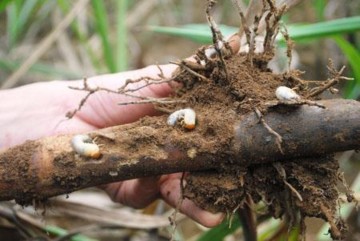
Figure 4.1: Sugarcane root borer
d) White fiber aphid Ceratoracuna lanigera
Family Aphididae - Order Homoptera
Adults have 2 types: winged, wingless. The body is covered with white cotton wax fibers. Aphids give birth and reproduce strongly. They gather on the back of sugarcane leaves, along the leaf veins to suck the sap of the plant, directly affecting the growth of sugarcane. On the other hand, the secretions of aphids are a good environment for sooty mold to develop on leaves and sugarcane stems, affecting the photosynthesis of the plant. Makes the plant grow stunted, reduces productivity and sugar content. If severely damaged, the top may lose the ability to germinate, and the base will not sprout. They gather on both sides of the leaf to suck the sap of the plant, causing the leaves to turn yellow. The plant grows stunted and is of poor quality.
Thrives in drought, dry season (winged aphids)
e) Yellow-headed planthopper Eoeurysa flavocapitata Muir
English name: Black Leafhopper, Yellow Headed Planthopper Family Delphacidae - Order Homoptera
Yellow-headed planthopper (YHB) is also found on sugarcane in neighboring countries such as Thailand, China, Taiwan, etc. This is a pest that has less significant economic impact on sugarcane than other pests and is easy to prevent and control.
In the Summer-Autumn crop of 2001, BPH also appeared on a small number of sugarcane areas in Tay Ninh but did not develop into an epidemic and cause serious damage. In the Mekong Delta region, BPH began to appear since 2005.
* Morphological characteristics
Adult planthoppers are 4-5 mm long, with dark brown bodies, yellow heads and backs, dark brown eyes, and small red borders. Antennae are conical, with black segments and long, lighter-colored hairs. Forewings are nearly rectangular, black, with a very clear light yellow horizontal streak at the end of the quarter of the wing.
Females measure 4.05 mm X 1.11 mm, males are smaller.
Eggs are small, about 0.7 mm X 0.18 mm long, sword-shaped, blunt at both ends, smooth surface, milky white when newly laid, later turning light yellow to dark yellow, with two pale red eye spots clearly visible.
The 5-instar nymphs are pale yellow when newly hatched, darker in the 2nd and 3rd instars, and clearly visible in the 4th instar. The 5th instar nymphs are dark yellow, have blunt heads, light brown compound eyes, hindwing buds reach the 4th abdominal segment, and the forewing buds cover the hindwings.
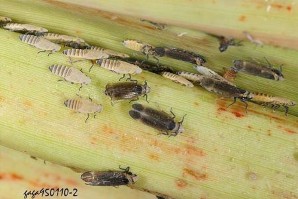
Figure 4.2: Larvae and adults of yellow-headed planthoppers damaging sugarcane
* Biological characteristics and harmful effects
Planthoppers often appear in small, sparsely planted sugarcane fields with poor drainage or near villages or densely planted.
Mainly causes damage to young sugarcane on unopened leaves or newly opened young leaves, often appearing on summer-autumn sugarcane from tillering to 4-6 internodes.
Adult planthoppers are active and phototropic, and visit lights a lot at night. Female planthoppers lay eggs on the two edges of leaf veins.
Newly hatched nymphs crawl along the edge of the leaf veins to the top. Nymphs and adults gather on young leaves or newly opened leaves to suck the sap of the leaves. Damaged sugarcane leaves have yellow spots that later connect to form large yellow spots, on which there is a layer of white foam or a transparent liquid. This liquid attracts flies, ants, bees... and after a while turns into round black dots with a foul odor. Severely infected sugarcane leaves rot, the green leaves decrease and become small and short, affecting the growth and sugar accumulation of the sugarcane.
f) Brown-headed four-line stem borer Chilo tumidicostalis Hampson
Family Pyralidae - Order Lepidoptera Other names:
Argyria tumidicostalis Hampson
Chilo gemininotalis Hampson
Appeared and caused relatively serious damage in Tay Ninh in 2004, concentrated in some localities such as Chau Thanh, Ben Cau, Tan Chau... Stem borer appeared and caused damage mainly on varieties LK92-11, K95-156, K2000-89, K84-2000, K88-92, K94-2, K99-72, Khonkaen 3...
Harmful characteristics:
- In the early stages, larvae bore into the sugarcane from the top leaves down to the 3-5 internodes from top to bottom, stimulating the development of sugarcane girdle roots and internode buds, causing the top leaves to dry.
- In the later period, larvae bore into each internode separately but do not dry the top leaves.
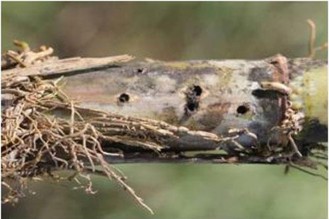
Figure 4.3: Symptoms of damage caused by stem borers
Morphology:
- Adult: light brown, adult male wingspan is 24.58 mm, adult female is 28.84 mm. There are small dots on the wings, no transverse veins.
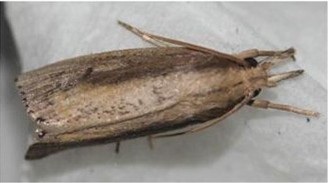
Figure 4.4: Adult stem borer
Eggs: laid in 2-5 rows along leaf veins, oval, flat, stacked on top of each other. Initially white, then turn yellow and black before hatching.
Larvae: Larvae are pale cream in color, with large, faint gray spots on their backs, arranged in four vertical rows. First instar larvae are 1.53 mm long, and final instar larvae are 23.06 mm long .
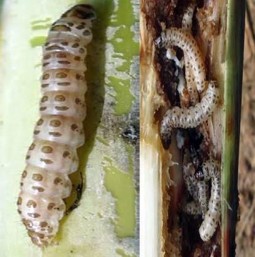
Figure 4.5: Brown-headed four-striped stem borer larvae
Pupae are reddish brown, turning blackish brown when about to emerge. Male pupae are about 13-14 mm long, female pupae are about 17 mm long.
According to some foreign documents , the developmental stages of sugarcane borers are as follows: