
Although in recent years there have been changes in labor structure and significant development of enterprises in economic sectors, the quality and efficiency of operations are still poor, and the number of enterprises is not commensurate with the economic development potential of the locality.
As of December 31, 2016, the whole city had nearly 329,711 people participating in compulsory social insurance; In which, the non-state enterprise sector has changed strongly: if in 2012 there were 1,092 non-state enterprises with 76,928 employees participating in social insurance, then by December 2016 there were 1,995 enterprises with 103,425 employees participating in social insurance, an increase of 82.7% in the number of participating units, corresponding to an increase of 34.4% in the number of employees compared to 2012. In 2012, there were only 894 foreign-invested enterprises with 65,113 employees participating in social insurance, then by December 2016 there were 1,493 enterprises with 111,782 employees participating in social insurance, an increase of 67% in the number of participating units and 71.67% in the number of employees compared to 2012.
The data in the above tables show that: the number of social insurance participants is increasing; the structure of social insurance participation types is changing, non-state enterprises are increasing sharply in both the number of units and employees, while state-owned enterprises are decreasing and the administrative, career, and Party and mass organizations sectors are generally stable, although there is an increase, but not significantly. The main reason is that state-owned enterprises are operating inefficiently, production scale is decreasing, many enterprises are bankrupt, dissolved, merged or transferred from state-owned enterprises to joint-stock enterprises, LLCs... Regarding the labor force in the administrative and career sectors, which has not decreased, it shows that the implementation of public administrative reform still has limitations, not reflecting the Party and State's policy on streamlining the payroll, improving the effectiveness and efficiency of management of the state apparatus.
To evaluate the effectiveness of managing compulsory social insurance participants, we can also use indicators on the rate of units participating in compulsory social insurance.
Table 2.3: Situation of units participating in compulsory social insurance in Hai Phong
period 2012-2016
STT
Target | 2012 | 2013 | 2014 | 2015 | 2016 | |
1 | Number of units participating in social insurance obligatory | 4,262 | 4,579 | 5.006 | 5,563 | 6.214 |
2 | Number of units required to participate Social insurance | 13,747 | 14,529 | 15,018 | 15,729 | 16,542 |
3 | Rate of units participating in compulsory social insurance (3=1/2) | 31.0% | 31.38% | 33.33% | 35.37% | 37.56% |
Maybe you are interested!
-

 Current Status of Compulsory Social Insurance and Retirement Law
 -
 Factors Affecting the Management of Compulsory Social Insurance Collection
 -
 Some Recommendations for Perfecting Legal Regulations on Compulsory Social Insurance and Retirement Insurance
 -
 Limiting social insurance debt of businesses by applying sanctions Case study of businesses in Thanh Xuan district, Hanoi city - 12
 -
 Initial Research Model on Factors Affecting the Internal Control System on Social Insurance Collection
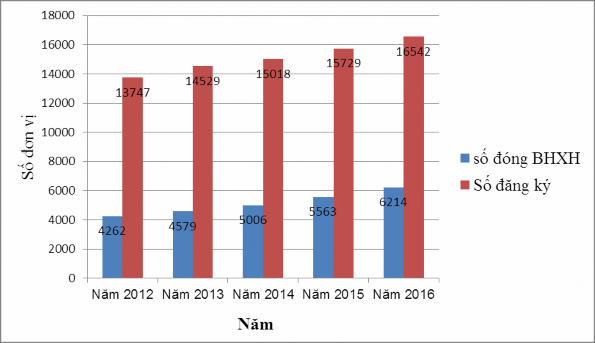
Source: Hai Phong City Social Insurance, Departments and agencies Through the above table, we can see that the rate of units participating in compulsory social insurance tends to increase over the years, but there is still a large difference. Specifically, the number of units participating in social insurance in the area in 2016 was only 37.56% of the number of units required to participate in social insurance. This shows that many units and enterprises in the city have not yet participated in social insurance according to regulations. A large number of employees are not enjoying the full benefits that they should have enjoyed when participating in labor. The management and development of social insurance participants has not yet maximized its effectiveness. We can clearly see this difference through
following chart:
Source: Hai Phong City Social Insurance, Departments and branches
Chart 2.2: Employers participating in social insurance (2012-2016)
From the above analysis, it can be concluded that the Government should soon issue a document directing ministries, branches and localities to strengthen coordination with social insurance agencies in investigating, collecting statistics, identifying and managing subjects participating in compulsory social insurance as prescribed by the Law on Social Insurance to avoid loss of compulsory social insurance revenue. The above situation arises from many different causes:
Regarding objective reasons: in fact, according to a survey by the Investment Management Department of the Department of Planning and Investment of Hai Phong city, after a business is granted a business license, more than 25% of small and medium enterprises and individual business households dissolve themselves or cannot find their address.
For private enterprises, cooperatives and LLCs, there is only one person who is established, the purpose is only to borrow capital for business, work seasonally, hire idle agricultural labor and pay wages according to product contracts. Foreign-invested enterprises are newly licensed or are still in the process of construction, have not recruited workers so have not participated in social insurance. Some enterprises are allowed to register for small-scale business activities, individual business households only do business
handicrafts, small-scale trade, small-scale production using elderly labor, family labor, so it is very difficult to mobilize and organize for enterprises and employees to participate in compulsory social insurance according to the law.
Employers' awareness of compulsory social insurance in the non-state economic sector is still limited. The coordination of state management agencies is not yet synchronous and tight. The low competitiveness of non-state enterprises makes it easy for employees to lose their jobs. On the other hand, this type of enterprise attracts many unskilled, untrained workers, so their jobs are unstable and they often change workplaces.
Regarding subjective causes: The work of checking and reviewing participants in the area still has many shortcomings, and has not been carried out regularly and continuously. The Social Insurance Agency has not yet taken advantage of the direction of the Party Committee and local authorities, and has not really coordinated closely and effectively with relevant functional agencies.
Management of compulsory social insurance collection
Annual revenue results as planned
Table 2.4: Social insurance collection results in Hai Phong city in the period 2012 - 2016
Five Types of Management
2012 | 2013 | 2014 | 2015 | 2016 | |
Plan (million VND) | 1,894,797 | 2,071,483 | 2,900,908 | 3,292,224 | 3,975,301 |
Implementation (million VND) | 1,907,826 | 2,127,893 | 3,014,784 | 3,456,847 | 4,360,659 |
Pass rate (%) | 100.69% | 102.72% | 103.93% | 105.00% | 109.69% |
Source: Hai Phong City Social Insurance
Through the statistical table, it can be seen that the annual social insurance collection results in Hai Phong city have achieved the assigned collection plan. The annual collection plan has increased compared to the previous year because this plan has taken into account the salary increase, increased exploitation of newly-arising units and decentralization of social insurance collection.
Thus, with the achieved social insurance collection results, the social insurance industry has truly formed
Establish a centralized, unified fund that is independent of the state budget, ensuring proactive payment of social insurance benefits for employees, contributing to reducing the burden on the state budget and ensuring social security for the whole society.
Social insurance debt situation
According to current regulations, every month (every quarter, every six months for units that pay social insurance on a quarterly or six-monthly basis), employers are responsible for fully and promptly paying into the social insurance fund immediately after paying salaries and wages to employees. With the above payment method, it ensures that social insurance participants fully perform their obligations to pay social insurance immediately after paying salaries and wages to employees, while helping social insurance agencies manage and monitor in a timely manner, which is the basis for resolving social insurance regimes for employees in case of unfortunate risks.
In recent years, most units have done a good job of implementing social insurance for employees. However, some units have not complied with regulations, leading to social insurance arrears, some units even owe more than 12 months, affecting the rights of employees and the collection plan of the social insurance agency.
To rectify this situation and ensure the legitimate rights of employees, in recent years, state management agencies have applied many measures such as: increasing the level of penalties for violations; strengthening propaganda, raising awareness of employees, helping them protect their own rights; organizing dialogues between enterprises, localities and employees to resolve difficulties in the process of participating in social insurance...
In 2016, Hai Phong Social Insurance coordinated with the City Labor Federation to sign a coordination regulation in suing units violating the law on social insurance, health insurance, and unemployment insurance. By December 31, 2016, the City Social Insurance coordinated with the City Labor Federation to sue 29 units with outstanding social insurance, health insurance, and unemployment insurance in court. Through coordination with the City Inspectorate, 71 units using labor in implementing the law on labor, social insurance, and unemployment insurance were inspected. After announcing the inspection decision, by December 31, 2016, 49/71 units had paid with the amount of outstanding social insurance, health insurance, and unemployment insurance of over 24 billion VND.
Table 2.5: Compulsory social insurance debt situation (2012-2016)
Unit: million VND
Target
2012 | 2013 | 2014 | 2015 | 2016 | |
Total Amount Collected Social insurance during the period | 2,121,409 | 2,468,082 | 3,504,543 | 3,958,570 | 4,924,300 |
Total outstanding debt Social insurance during the period | 213,583 | 340,189 | 489,759 | 501,723 | 563,641 |
Social insurance debt ratio during the period | 10.07% | 13.78% | 13.97% | 12.67% | 11.45% |
Source: Hai Phong City Social Insurance
Table 2.6: Social insurance debt situation by management type (2012-2016)
Unit: million VND
Year
Management type
Year 2012 | Year 2013 | Year 2014 | Year 2015 | Year 2016 | |
HCSN, Party, Union | 6.131 | 18,411 | 10,659 | 8,645 | 10,951 |
Non-public | 527 | 1,221 | 1,524 | 1,668 | 1,986 |
Commune, ward, town | 702 | 709 | 788 | 807 | 1,020 |
State-owned enterprise | 129,220 | 209,694 | 314,462 | 316,697 | 353,075 |
Foreign invested enterprise | 15,655 | 17,183 | 16,803 | 22,387 | 23,982 |
Non-state enterprise | 59,123 | 89,557 | 139,812 | 146,309 | 166,463 |
Cooperative | 808 | 1.151 | 1,617 | 1,078 | 1,543 |
Farmers' Association, individual production and business households, cooperative | 901 | 1,725 | 2,745 | 2,614 | 2,871 |
Other organizations and individuals | 516 | 538 | 1,349 | 1,518 | 1,750 |
Total | 213,583 | 340,189 | 489,759 | 501,723 | 563,641 |
Source: Hai Phong City Social Insurance
Through the above table, we can see that although Hai Phong City Social Insurance has taken active measures to urge and collect debts, the number of debtors is increasing, although the social insurance debt ratio in 2016 has decreased, the debt amount is still increasing. The outstanding debt is mainly concentrated in non-state enterprises, state-owned enterprises, especially Vinashin and Vinaline groups with a debt of over 300 billion VND, in addition, the debt of foreign-invested enterprises also increases every year, the debt in 2012 was 15.6 billion VND, by 2016 the debt had reached nearly 24 billion VND. The outstanding debt
Social insurance due to the following reasons:
- First of all, it is due to the awareness of business owners in complying with the Law on Social Insurance, then due to weak financial capacity, the production and business situation of many businesses, especially businesses in the plastics and garment industries... is difficult due to dependence on foreign markets. On the other hand, there are businesses that appropriate social insurance money to use as working capital during the economic recession.
- The current regulations on penalties for late payment and violations of social insurance policies are not strong enough or deterrent enough. Social insurance agencies that organize the implementation of social insurance policies detect violations but do not have the authority to impose penalties, but must do so by the State labor management agency. Therefore, handling violations of social insurance policies is not implemented promptly, causing losses to the social insurance fund.
- The form of suing units that are late in paying social insurance in court still has many problems due to lack of guidance, the People's Court of the town does not have a specific legal framework for implementation, so it is not effective.
- Information between departments in the Social Insurance Agency, Social Insurance at all levels, Social Insurance with state agencies is not timely, information is not accurate, so when new units arise, move, change, late payment, long-term debt is not detected and handled promptly. The Social Insurance industry does not have regulations to coordinate with the Tax Agency, the Department of Investment when enterprises have gone bankrupt, dissolved, had their tax codes revoked but the Social Insurance Agency does not have timely information.
2.2.4. Evaluation of the current status of compulsory social insurance collection management at Hai Phong City Social Insurance in the period 2012-2016
2.2.4.1. Achievements
Firstly, the subjects participating in social insurance have been expanded to all economic sectors to develop the social insurance fund: The number of units and employees participating in social insurance has increased day by day, social insurance has been expanded to all wage earners, commune (ward) officials, and households. According to the reported data, in 2012, there were only 4,262 units with 263,589 employees participating in compulsory social insurance. By 2016, the number of units participating in compulsory social insurance reached 6,214 units and the number of employees was 329,711 people.
increased by 45.8% in number of units and 25.09% in number of employees compared to 2012. Workers' rights have been given more attention.
Second, doing a good job of collecting and managing social insurance participants : Although the number of social insurance participants is large, Hai Phong City Social Insurance has managed units according to types, fields of operation and each social insurance participant, initially creating favorable conditions for the subjects. The number of units, employees, and salary funds participating in social insurance increases every year. The social insurance collection to the fund is higher the following year than the previous year.
Third, applying and fully exploiting the role of information technology: By 2016, all activities of the Social Insurance agency have been implemented uniformly from the City to the district level using software programs provided by Vietnam Social Insurance; specifically, the collection management program, the policy settlement program, the accounting program... and are being connected nationwide. The application of information technology in management has achieved good results, ensuring the requirements of accuracy in content, consistency, and continuity in management.
Fourth, implementing administrative reform, transforming administrative working style into service style. In recent years, along with strengthening training and fostering professional skills, Hai Phong City Social Insurance has paid great attention to training and fostering to improve the spirit and awareness of service towards promoting administrative reform in all aspects of activities, creating favorable conditions for participants and beneficiaries of social insurance policies. Implementing Decision No. 93/QD-TTg dated June 22, 2007 of the Prime Minister promulgating the regulations on implementing "one-stop shop", at state administrative agencies, Hai Phong City Social Insurance has organized a one-stop shop department since June 2012. The unit only goes to the Social Insurance agency once to submit documents and once to receive results, the remaining work is handled by the professional departments of the city Social Insurance in coordination with each other, this has reduced hassle, creating favorable conditions for participants and beneficiaries.
In 2015, Hai Phong City Social Insurance implemented electronic transaction declaration throughout the system, which helps reduce errors in declaration; reduces travel, transaction and waiting time for businesses, especially businesses can