
• Time series graph,
• Script profile
• Pipeline cross-section according to terrain.
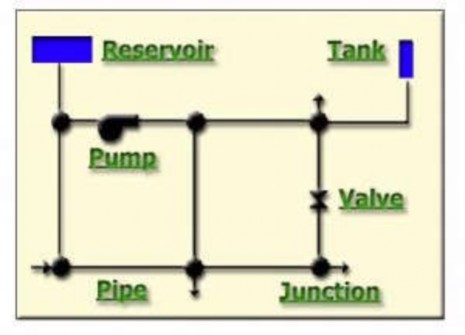
EPANET offers a fully equipped, phased hydraulic analysis package that can:
• Simulate systems of any network size
• Calculate friction loss using the Hazen-Williams, Darcy Weisbach, or Chezy-Manning methods
• Includes flow and pressure losses at cones, pipe bends, and other connection points.
• Modeling for fixed and variable speed pumps.
• Calculate pump energy and cost.
• Models by valve type: shut-off valve, check valve, pressure regulating valve, and flow control valve
• Applicable to any type of tank (e.g. surface area may vary with height)
• Represents multiple water demands at nodes that change over time.
• Calculate pipeline pressure and flow according to sprinkler or fire hydrant needs.
• Basic tank operation, timer control or control based on both principles.
Additionally, EPANET water quality analysis can:
• Analyze chemical movement in non-chemically reactive tubes through the network over time.
47
• Analyze chemical movement and reactions in the tube (e.g., a disinfectant by-product, or degradation (e.g., residual chlorine) over time).
• Analyze the age of the water sample online.
• Track the percentage of flow from one node to all other nodes over time.
• Analyze chemical reactions of water flowing in pipes and on pipe walls.
• Analysis of chemical release reactions based on limiting concentrations.
• Use of a global reaction rate coefficient that can be modified based on pipe material and pipe roughness
• Analyze the volume of additional disinfectant added at a location on the network.
• Model mixing between tanks, inlet and outlet flows, or both.
c. Application of Epanet software to simulate hydraulics in My Tu district
48
EPANET helps Water Supply Centers maintain and improve the quality of water supplied to consumers. It can be used to:
• Design sampling programs,
• Study of water loss and composition of commercial water.
• Water quality assessment to consumers.
• Evaluate alternative strategies to improve water quality, such as changing source use in multi-source systems,
• Modify pump and tank fill/empty schedule to reduce water age,
• Enhanced disinfection stations are used at critical locations to maintain water quality targets.
• Effective programs plan for pipe cleaning or replacement.
• Planning and improving hydraulic performance of the system,
• Determine the installation location and size of pipes, pumps and valves.
• Reduce energy,
• Fire flow analysis,
• Vulnerability studies, and operator training.
Total length of pipeline 13,630 m (Detailed hydraulic calculation - Appendix 1 ).
49
Table 12: Length of clean water transmission pipeline
STT
DN | Quantity | PN | Thick | Condition in | Total length of water supply pipe | Sub-pipe | Pipe joints | Belt starting to connect to the household | ||
2 | 32 | 0.00 | 0.00 | PN8 | 3.6 | 25 | - | 201 | - | 27 |
3 | 40 | 1.30 | 1.30 | PN8 | 4.5 | 31 | - | 2,970 | - | 164 |
4 | 50 | 3.39 | 3.39 | PN8 | 3 | 44 | - | 1.825 | - | 300 |
5 | 63 | 7.04 | 7.04 | PN8 | 3.8 | 55 | - | - | - | - |
6 | 75 | 1.37 | 1.37 | PN8 | 4.5 | 66 | 7,051.9 | - | 141 | 110 |
7 | 90 | 2.22 | 2.22 | PN8 | 5.4 | 79 | - | - | - | - |
8 | 110 | 4.05 | 4.05 | PN8 | 6.6 | 97 | - | - | - | |
9 | 125 | 0.00 | 0.00 | PN8 | 7.4 | 110 | - | - | - | |
10 | 140 | 0.00 | 0.00 | PN8 | 8.3 | 123 | - | - | - | |
11 | 160 | 10.93 | 10.93 | PN8 | 9.5 | 141 | 1,144.5 | - | 10 | |
12 | 180 | 0.00 | 0.00 | PN8 | 10.7 | 159 | - | - | - | |
13 | 200 | 0.00 | 0.00 | PN8 | 11.9 | 176 | - | - | - | |
14 | 225 | 46.28 | 46.28 | PN8 | 13.4 | 198 | 4,276.6 | - | 51 | |
15 | 250 | 57.23 | 57.23 | PN8 | 14.8 | 220 | 425.3 | - | - | |
16 | 280 | 71.76 | 71.76 | PN8 | 16.6 | 246.8 | 150.0 | - | - | |
17 | 315 | 90.79 | 90.79 | PN8 | 18.7 | 277.6 | - | - | - | |
18 | 355 | 115.27 | 115.27 | PN8 | 21.1 | 312.8 | 205.7 | - | - | |
19 | 400 | 146.47 | 146.47 | PN8 | 23.7 | 352.6 | - | - | - | |
20 | 450 | 185.30 | 185.30 | PN8 | 26.7 | 396.6 | 375.9 | - | - | |
21 | 500 | 228.70 | 228.70 | PN8 | 29.7 | 440.6 | - | - | - | |
13,629.9 | 4,996 | 662 | ||||||||
Maybe you are interested!
-

 Proposing Solutions for West Lake Ecosystem Management
 -
 Proposing Solutions for Water Transportation and Distribution
 -
 Research proposes sustainable water supply solutions for My Tu district in saline intrusion conditions - 10
 -
 Proposing Solutions for Effective Management and Exploitation of Tourism Resources at Nhat Nhi Tam Thanh Tourist Site
 -
 Proposing Solutions for Training Management of Bachelor of Information Technology to Meet Social Needs at Vietnamese Universities
d. Calculating the price of domestic water consumption
Based on the capacity of the treatment plant, the length of the pipeline and according to Joint Circular No. 75/2012/TTLT-BTC-BXD-BNNPTNT dated December 15, 2012 of the Ministry of Finance, the Ministry of Construction and the Ministry of Agriculture and Rural Development on Guiding principles,
50
Method of determining and authority to decide on clean water consumption price in urban areas, industrial zones and rural areas, Thesis calculates the clean water consumption price for daily life is 5,800 VND/m3 ( Details in Appendix 4 ).
3.2 Proposal for non-engineering solutions
3.2.1 Communication solutions
- Agree with local authorities to have an approach to communicate to people about the benefits of using clean water from the water supply system.
- Plan to propagate and mobilize on district and commune media about the current status of water sources that people are using and provide information about water supply plans from the centralized water supply system.
- Propaganda about the benefits of using clean water. Through meetings in villages and hamlets to propagate to people; distribute leaflets to each household about the advantages of using clean water from the centralized water supply system.
- Propagating the plan for connecting to clean water from the water supply system, the commitments of the Provincial Center for Clean Water and Rural Environmental Sanitation to customers when using clean water from the system on clean water consumption prices in accordance with the State's regulations, and providing water that ensures quality and safety in both services and products.
- Coordinate with relevant sectors to effectively carry out Information - Education - Communication activities. Focus on communication goals from raising awareness to changing the behavior of rural communities through communication activities, especially direct communication.
- Develop communication and training materials, disseminate types of clean water supply suitable for each specific condition.
- Disseminate and provide State policies and regimes for the field of rural clean water supply, especially socialization policies.
- One issue that needs attention is the low connection rate compared to the expectation after the construction is completed. To increase the connection rate, it is necessary to promote communication work before construction so that farmers enthusiastically participate in the connection, the bank
51
Policy banks also focus on lending to areas that are investing in centralized water supply systems. Water price policies should also be low in the first few years to stimulate consumption. Finally, the State needs to support poor households, policy households, and ethnic minority households in initial investment.
3.2.2 Proposing solutions for management and operation
Proposed solutions for management and operation of centralized rural water supply works in My Tu district include 02 contents: (i) Organizational management; (ii) Operation and maintenance of works;
a. Water supply network operation management
* Technical management:
- Manage the current status of the water supply network on the map. Including regular updates of changes in the network and statistics of assets on the network.
- Plan network division to manage leakage and loss.
- Coordinate with units with underground works to ensure project implementation safety for the water supply network.
* Pressure management: Collect and update daily water pressure on the water supply network.
* Flow management: Collect and update daily water flow on the water supply network.
* Management of pipes and devices on the network:
- Plan to inspect pipelines and equipment such as valve locks, valves, manholes, and meters.
- Daily check of assets, operating status of pipes and equipment on the water supply network. Detect and repair to prevent incidents.
* Network operation:
- Propose operating plan based on pressure and flow data.
52
- Operate according to approved plan.
- Update operating plan on file.
* Water quality management:
- On the transmission line: Take samples to test water quality at connection points from the transmission network to the water distribution network, at the end of the water supply source of factories or at the line close to drainage works that are susceptible to pollution.
- On distribution lines and service networks: Take samples to test water quality at the end of the source, high-altitude areas, hourly water supply areas, or at customers' homes.
*Network Management
- For district pipeline networks of less than 100km, only one general management team needs to be organized.
- Management zoning is based on the following:
+ The distance between the two farthest points of the area is not more than 8 - 10 km
+ Pipe length in each area is not more than 60 - 80 km
- The pipe management team is responsible for:
+ Maintain good network performance.
+ Research the working regime of each region, the entire network and predict the points that need development.
+ Detect areas that need repair or replacement.
+ Supervise the construction of new pipelines and take them into management.
+ Install pipes into the house.
+ Statistics of equipment works on the network.
53
+ In special cases, be responsible for maintaining the entire pipe system in the house or each separate area.
- The management team is divided into management teams and repair teams with the number of workers depending on the assigned workload.
- The management team is responsible for maintaining the pipe network well to continuously supply water to the consumer. The number of people in each team is at least 3, including 1 team leader and 2 mechanics.
- The management team must regularly inspect the routes outlined in the network management plan, taking into account the volume and characteristics of each day's work.
- The management team must have necessary technical documents such as network diagrams, itinerary diagrams, logbooks, etc. and necessary working equipment such as water pumps, working tools, fast and compact means of transport, etc.
- After completing the work, a record must be made and kept in the pipe network file.
- The repair team is responsible for detecting and quickly handling damage on the network.
- At the request of the on-duty dispatcher, the repair team must have fast transportation and timely implementation of the work. There must be a team on duty day and night, including holidays.
- When there are large and complicated repairs, the team leader can mobilize manpower for the repair team.
- The diagram of the distribution pipe network for each management team must have a scale of 1:200 to 1:500, recording the diameter, length of pipe, depth of pipe burial, pipe material, pipe grooving material and date of pipe installation. In addition, the location and characteristics of the pipe leading into the house, valve pits, etc. must also be recorded.
54