
by 2020, with a vision to 2050; Program No. 31-CTr/TU dated August 28, 2013 and Program No. 38-CTr/TU dated December 13, 2019 of the Provincial Party Committee on continuing to implement Resolution No. 24-NQ/TW of the 7th Central Committee, Session XI, on proactively responding to climate change, strengthening resource management and environmental protection by 2030 with a vision to 2050.
In 2012, the Provincial People's Committee implemented 02 projects to assess the level of climate change and develop climate change scenarios for the period 2010 - 2020, actions to respond to climate change in the province for the period 2015 - 2020 and the following years until 2100, the project was completed at the end of 2014; Decision No. 2309/QD-UBND dated August 27, 2015 on approving the action plan to respond to climate change in the province for the period 2015 - 2020, the plan assessed the impact of climate change on fields, sectors and localities in each period, and developed specific measures to respond to climate change. It can be said that this is the time when the Dak Lak Provincial People's Committee has initially built awareness, viewpoints and concerns about the issue of responding to climate change in the province.
In addition, many related and supportive documents in responding to climate change have been issued, typically:
- Decision No. 2643/QD-UBND dated November 11, 2014 of Dak Lak Provincial People's Committee approving the Environmental Protection Strategy to 2020.
- Decision No. 459/QD-UBND dated February 13, 2015 of Dak Lak Provincial People's Committee promulgating the action plan on green growth for the period 2015-2020 of Dak Lak province.
- Plan No. 5475/KH-UBND dated July 14, 2017 of the Dak Lak Provincial People's Committee on implementing Directive No. 25/CT-TTg dated August 31, 2016 of the Prime Minister on a number of urgent tasks and solutions on environmental protection and Resolution No. 06-NQ/TU dated April 17, 2017 of the Provincial Party Executive Committee on strengthening environmental protection work in the province.
- Plan No. 10067/KH-UBND dated December 6, 2019 of Dak Lak Provincial People's Committee on environmental protection in Dak Lak province in 2020.
- Decision No. 1806/QD-UBND dated August 11, 2020 of the People's Committee of Dak Lak province on the decision to promulgate the Implementation Plan of Program No. 31-CTr/TU dated August 28, 2013 and Program No. 38-CTr/TU dated December 13, 2019 of the Provincial Party Committee on
continue to implement Resolution No. 24-NQ/TW of the 7th Central Committee, Session XI, on proactively responding to climate change, strengthening resource management and environmental protection to 2030 with a vision to 2050.
- Decision No. 759/QD-UBND dated March 30, 2009 of the Provincial People's Committee on implementing the Action Program to implement the National Strategy for Natural Disaster Prevention and Mitigation to 2020.
- Decision No. 02/2016/QD-UBND dated January 13, 2016 of Dak Lak Provincial People's Committee regulating water resources management in Dak Lak province.
- Decision No. 12/2017/QD-UBND dated March 16, 2017 of Dak Lak Provincial People's Committee regulating the management of domestic solid waste in Dak Lak province.
- Decision No. 2167/QD-UBND dated August 9, 2021 promulgating the Implementation Plan according to Resolution No. 06-NQ/CP dated January 21, 2021 "Issuing the Action Program to continue implementing Resolution No. 24-NQ/TW of the 11th Party Central Committee on proactively responding to climate change, strengthening resource management and environmental protection according to Conclusion No. 56-KL/TW dated August 23, 2019 of the Politburo".
2.3.2. Organizing the apparatus and developing human resources to respond to climate change
2.3.2.1. Organizing the apparatus to implement climate change response work
- At Central:
+ The Committee on Science, Technology and Environment is an agency of the National Assembly responsible for supervising, examining and recommending issues in the fields of science, technology, resources, environmental protection, climate change response, natural disaster prevention and control, etc. assigned by the National Assembly and the National Assembly Standing Committee.
On January 9, 2012, the Prime Minister issued Decision No. 43/QD-TTg on the establishment of the National Committee on Climate Change consisting of 22 members chaired by the Prime Minister (the organizational structure is described in Figure 2.1). The National Committee on Climate Change has the function of advising and assisting the Government and the Prime Minister in researching, proposing, directing, coordinating and implementing national strategies and programs on climate change, and directing and organizing international cooperation on climate change. The Ministry of Natural Resources and Environment is the standing body of the Committee. The Office of the National Committee on Climate Change is an agency assisting the National Committee on Climate Change located at the Ministry of Natural Resources and Environment.
Figure 2.1: Organizational chart of the National Committee on Climate Change
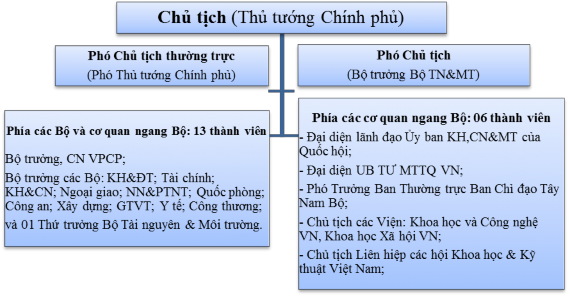

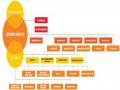
Figure 2.2: Diagram of the state management model on climate change from central to local levels
NATIONAL ASSEMBLY
GOVERNMENT | ||
National Committee on Climate Change | ||
Maybe you are interested!
-
 Identify Rating Levels and Rating Scales
zt2i3t4l5ee
zt2a3gstourism,quan lan,quang ninh,ecology,ecotourism,minh chau,van don,geography,geographical basis,tourism development,science
zt2a3ge
zc2o3n4t5e6n7ts
of the islanders. Therefore, this indicator will be divided into two sub-indicators:
a1. Natural tourism attractiveness a2. Cultural tourism attractiveness
b. Tourist capacity
The two island communes in Quan Lan have different capacities to receive tourists. Minh Chau Commune is home to many standard hotels and resorts, attracting high-income domestic and international tourists. Meanwhile, Quan Lan Commune has many motels mainly built and operated by local people, so the scale and quality are not high, and will be suitable for ordinary tourists such as students.
c. Time of exploitation of Quan Lan Island Commune:
Quan Lan tourism is seasonal due to weather and climate conditions and festivals only take place on certain days of the year, specifically in spring. In Quan Lan commune, the period from April to June and from September to November is considered the best time to visit Quan Lan because the cultural tourism activities are mainly associated with festivals taking place during this time.
Minh Chau island commune:
Tourism exploitation time is all year round, because this is a place with a number of tourist attractions with diverse ecosystems such as Bai Tu Long National Park Research Center, Tram forest, Turtle Laying Beach, so besides coming to the beach for tourism and vacation in the summer, Minh Chau will attract research groups to come for tourism combined with research at other times of the year.
d. Sustainability
The sustainability of ecotourism sites in Quan Lan and Minh Chau communes depends on the sensitivity of the ecosystems to climate changes.
landscape. In general, these tourist destinations have a fairly high level of sustainability, because they are natural ecosystems, planned and protected. However, if a large number of tourists gather at certain times, it can exceed the carrying capacity and affect the sustainability of the environment (polluted beaches, damaged trees, animals moving away from their habitats, etc.), then the sustainability of the above ecosystems (natural ecosystems, human ecosystems) will also be affected and become less sustainable.
e. Location and accessibility
Both island communes have ports to take tourists to visit from Van Don wharf:
- Quan Lan – Van Don traffic route:
Phuc Thinh – Viet Anh high-speed boat and Quang Minh high-speed boat, depart at 8am and 2pm from Van Don to Quan Lan, and at 7am and 1pm from Quan Lan to Van Don. There are also wooden boats departing at 7am and 1pm.
- Van Don - Minh Chau traffic route:
Chung Huong high-speed train, Minh Chau train, morning 7:30 and afternoon 13:30 from Van Don to Minh Chau, morning 6:30 and afternoon 13:00 from Minh Chau to Van Don.
f. Infrastructure
Despite receiving investment attention, the issue of infrastructure and technical facilities for tourism on Quan Lan Island is still an issue that needs to be resolved because it has a direct impact on the implementation of ecotourism activities. The minimum conditions for serving tourists such as accommodation, electricity, water, communication, especially medical services, and security work need to be given top priority. Ecotourism spots in Minh Chau commune are assessed to have better infrastructure and technical facilities for tourism because there are quite complete and synchronous conditions for serving tourists, meeting many needs of domestic and foreign tourists.
3.2.1.4. Determine assessment levels and assessment scales
Corresponding to the levels of each criterion, the index is the score of those levels in the order of 4, 3, 2, 1 decreasing according to the standard of each level: very attractive (4), attractive (3), average (2), less attractive (1).
3.2.1.5. Determining the coefficients of the criteria
For the assessment of DLST in the two communes of Quan Lan and Minh Chau islands, the students added evaluation coefficients to show the importance of the criteria and indicators as follows:
Coefficient 3 with criteria: Attractiveness, Exploitation time. These are the 2 most important criteria for attracting tourists to tourism in general and eco-tourism in particular, so they have the highest coefficient.
Coefficient 2 with criteria: Capacity, Infrastructure, Location and accessibility . Because the assessment area is an island commune of Van Don district, the above criteria are selected by the author with appropriate coefficients at the average level.
Coefficient 1 with criteria: Sustainability. Quan Lan has natural and human-made ecotourism sites, with high biodiversity and little impact from local human factors. Most of the ecotourism sites are still wild, so they are highly sustainable.
3.2.1.6. Results of DLST assessment on Quan Lan island
a. Assessment of the potential for natural tourism development
For Minh Chau commune:
+ Natural tourism attractiveness is determined to be very attractive (4 points) and the most important coefficient (coefficient 3), so the score of the Attractiveness criterion is 4 x 3 = 12.
+ Capacity is determined as average (2 points) and the coefficient is quite important (coefficient 2), then the score of Capacity criterion is 2 x 2 = 4.
+ Exploitation time is long (4 points), the most important coefficient (coefficient 3) so the score of the Exploitation time criterion is 4 x 3 = 12.
+ Sustainability is determined as sustainable (4 points), the important coefficient is the average coefficient (coefficient 1), so the score of the Sustainability criterion is 4 x 1 = 4 points
+ Location and accessibility are determined to be quite favorable (2 points), the coefficient is quite important (coefficient 2), the criterion score is 2 x 2 = 4 points.
+ Infrastructure is assessed as good (3 points), the coefficient is quite important (coefficient 2), then the score of the Infrastructure criterion is 3 x 2 = 6 points.
The total score for evaluating DLST in Minh Chau commune according to 6 evaluation criteria is determined as: 12 + 4 + 12 + 4 + 4 + 6 = 42 points
Similar assessment for Quan Lan commune, we have the following table:
Table 3.3: Assessment of the potential for natural ecotourism development in Quan Lan and Minh Chau communes
Attractiveness of self-tourismof course
Capacity
Mining time
Sustainability
Location and accessibility
Infrastructure
Result
Point
DarkMulti
Point
DarkMulti
Point
DarkMulti
Point
DarkMulti
Point
DarkMulti
Point
DarkMulti
CommuneMinh Chau
12
12
4
8
12
12
4
4
4
8
6
8
42/52
Quan CommuneLan
6
12
6
8
9
12
4
4
4
8
4
8
33/52
b. Assessment of the potential for humanistic tourism development
For Quan Lan commune:
+ The attractiveness of human tourism is determined to be very attractive (4 points) and the most important coefficient (coefficient 3), so the score of the Attractiveness criterion is 4 x 3 = 12.
+ Capacity is determined to be large (3 points) and the coefficient is quite important (coefficient 2), then the score of the Capacity criterion is 3 x 2 = 6.
+ Mining time is average (3 points), the most important coefficient (coefficient 3) so the score of the Mining time criterion is 3 x 3 = 9.
+ Sustainability is determined as sustainable (4 points), the important coefficient is the average coefficient (coefficient 1), so the score of the Sustainability criterion is 4 x 1 = 4 points.
+ Location and accessibility are determined to be quite favorable (2 points), the coefficient is quite important (coefficient 2), the criterion score is 2 x 2 = 4 points.
+ Infrastructure is rated as average (2 points), the coefficient is quite important (coefficient 2), then the score of the Infrastructure criterion is 2 x 2 = 4 points.
The total score for evaluating DLST in Quan Lan commune according to 6 evaluation criteria is determined as: 12 + 6 + 6 + 4 + 4 + 4 = 36 points.
Similar assessment with Minh Chau commune we have the following table:
Table 3.4: Assessment of the potential for developing humanistic eco-tourism in Quan Lan and Minh Chau communes
Attractiveness of human tourismliterature
Capacity
Mining time
Sustainability
Location and accessibility
Infrastructure
Result
Point
DarkMulti
Point
DarkMulti
Point
DarkMulti
Point
DarkMulti
Point
DarkMulti
Point
DarkMulti
Quan CommuneLan
12
12
6
8
9
12
4
4
4
8
4
8
39/52
Minh CommuneChau
6
12
4
8
12
12
4
4
4
8
6
8
36/52
Basically, both Minh Chau and Quan Lan localities have quite favorable conditions for developing ecotourism. However, Quan Lan commune has more advantages to develop ecotourism in a humanistic direction, because this is an area with many famous historical relics such as Quan Lan Communal House, Quan Lan Pagoda, Temple worshiping the hero Tran Khanh Du, ... along with local festivals held annually such as the wind praying ceremony (March 15), Quan Lan festival (June 10-19); due to its location near the port and long exploitation time, the beaches in Quan Lan commune (especially Quan Lan beach) are no longer hygienic and clean to ensure the needs of tourists coming to relax and swim; this is also an area with many beautiful landscapes such as Got Beo wind pass, Ong Phong head, Voi Voi cave, but the ability to access these places is still very limited (dirt hill road, lots of gravel and rocks), especially during rainy and windy times; In addition, other natural resources such as mangrove forests and sea worms have not been really exploited for tourism purposes and ecotourism development. On the contrary, Minh Chau commune has more advantages in developing ecotourism in the direction of natural tourism, this is an area with diverse ecosystems such as at Rua De Beach, Bai Tu Long National Park Conservation Center...; Minh Chau beach is highly appreciated for its natural beauty and cleanliness, ranked in the top ten most beautiful beaches in Vietnam; Minh Chau commune is also home to Tram forest with a large area and a purity of up to 90%, suitable for building bridges through the forest (a very effective type of natural ecotourism currently applied by many countries) for tourists to sightsee, as well as for the purpose of studying and researching.
Figure 3.1: Thenmala Forest Bridge (India) Source: https://www.thenmalaecotourism.com/(August 21, 2019)
3.2.2. Using SWOT matrix to evaluate Quan Lan island tourism
General assessment of current tourism activities of Quan Lan island is shown through the following SWOT matrix:
Table 3.5: SWOT matrix evaluating tourism activities on Quan Lan island
Internal agent
Strengths- There is a lot of potential for tourism development, especially natural ecotourism and humanistic ecotourism.- The unskilled labor force is relatively abundant.- resource environmentunpolluted, still
Weaknesses- Poorly developed infrastructure, especially traffic routes to tourist destinations on the island.- The team of professional staff is still weak.- Tourism products in general
quite wild, originalintact
general and DLST in particularalone is monotonous.
External agents
Opportunity- Tourism is a key industry in the socio-economic development strategy of the province and Van Don economic zone.- Quan Lan was selected as a pilot area for eco-tourism development within the framework of the green growth project between Quang Ninh province and the Japanese organization JICA.- The flow of tourists and especially ecotourism in the world tends toincreasing
Challenge- Weather and climate change abnormally.- Competition in tourism products is increasingly fierce, especially with other localities in the province such as Ha Long, Mong Cai...- Awareness of tourists, especially domestic tourists, about ecotourism and nature conservation is not high.
Through summary analysis using SWOT matrix we see that:
To exploit strengths and take advantage of opportunities, it is necessary to:
- Diversify products and service types (build more tourism routes aimed at specific needs of tourists: experiential tourism immersed in nature, spiritual cultural tourism...)
- Effective exploitation of resources and differentiated products (natural resources and human resources)
div.maincontent .p { color: black; font-family:"Times New Roman", serif; font-style: normal; font-weight: normal; text-decoration: none; font-size: 14pt; margin:0pt; } div.maincontent p { color: black; font-family:"Times New Roman", serif; font-style: normal; font-weight: normal; text-decoration: none; font-size: 14pt; margin:0pt; } div.maincontent .s1 { color: black; font-family:"Times New Roman", serif; font-style: normal; font-weight: normal; text-decoration: none; font-size: 13pt; } div.maincontent .s2 { color: black; font-family:"Times New Roman", serif; font-style: normal; font-weight: normal; text-decoration: none; font-size: 13pt; } div.maincontent .s3 { color: #0D0D0D; font-family:"Times New Roman", serif; font-style: normal; font-weight: bold; text-decoration: none; font-size: 14pt; } div.maincontent .s4 { color: black; font-family:"Times New Roman", serif; font-style: italic; font-weight: normal; text-decoration: none; font-size: 14pt; } div.maincontent .s5 { color: black; font-family:"Times New Roman", serif; font-style: italic; font-weight: bold; text-decoration: none; font-size: 14pt; } div.maincontent .s6 { color: black; font-family:"Times New Roman", serif; font-style: italic; font-weight: normal; text-decoration: none; font-size: 14pt; vertical-align: -3pt; } div.maincontent .s7 { color: black; font-family:"Times New Roman", serif; font-style: italic; font-weight: normal; text-decoration: none; font-size: 14pt; vertical-align: -2pt; } div.maincontent .s8 { color: black; font-family:"Times New Roman", serif; font-style: italic; font-weight: normal; text-decoration: none; font-size: 14pt; vertical-align: -1pt; } div.maincontent .s9 { color: black; font-family:"Times New Roman", serif; font-style: normal; font-weight: normal; text-decoration: none; font-size: 14pt; } div.maincontent .s10 { color: black; font-family:"Times New Roman", serif; font-style: normal; font-weight: bold; text-decoration: none; font-size: 14pt; } div.maincontent .s11 { color: black; font-family:"Times New Roman", serif; font-style: normal; font-weight: normal; text-decoration: none; font-size: 14pt; } div.maincontent .s12 { color: black; font-family:Symbol, serif; font-style: normal; font-weight: normal; text-decoration: none; font-size: 14pt; } div.maincontent .s13 { color: black; font-family:Wingdings; font-style: normal; font-weight: normal; text-decoration: none; font-size: 14pt; } div.maincontent .s14 { color: black; font-family:"Times New Roman", serif; font-style: normal; font-weight: normal; text-decoration: none; font-size: 9pt; vertical-align: 5pt; } div.maincontent .s15 { color: black; font-family:"Times New Roman", serif; font-style: normal; font-weight: normal; text-decoration: none; font-size: 9pt; vertical-align: 5pt; } div.maincontent .s16 { color: black; font-family:Cambria, serif; font-style: italic; font-weight: normal; text-decoration: none; font-size: 14pt; } div.maincontent .s17 { color: #080808; font-family:"Times New Roman", serif; font-style: normal; font-weight: bold; text-decoration: none; font-size: 14pt; } div.maincontent .s18 { color: #080808; font-family:"Times New Roman", serif; font-style: normal; font-weight: normal; text-decoration: none; font-size: 14pt; } div.maincontent .s19 { color: black; font-family:"Times New Roman", serif; font-style: normal; font-weight: normal; text-decoration: none; font-size: 11pt; } div.maincontent .s20 { color: black; font-family:"Times New Roman", serif; font-style: normal; font-weight: normal; text-decoration: none; font-size: 10pt; } div.maincontent .s21 { color: black; font-family:"Times New Roman", serif; font-style: normal; font-weight: bold; text-decoration: none; font-size: 11pt; } div.maincontent .s22 { color: black; font-family:"Times New Roman", serif; font-style: normal; font-weight: normal; text-decoration: none; font-size: 11pt; } div.maincontent .s23 { color: black; font-family:"Times New Roman", serif; font-style: italic; font-weight: normal; text-decoration: none; font-size: 14pt; } div.maincontent .s24 { color: #212121; font-family:"Times New Roman", serif; font-style: normal; font-weight: normal; tex
Identify Rating Levels and Rating Scales
zt2i3t4l5ee
zt2a3gstourism,quan lan,quang ninh,ecology,ecotourism,minh chau,van don,geography,geographical basis,tourism development,science
zt2a3ge
zc2o3n4t5e6n7ts
of the islanders. Therefore, this indicator will be divided into two sub-indicators:
a1. Natural tourism attractiveness a2. Cultural tourism attractiveness
b. Tourist capacity
The two island communes in Quan Lan have different capacities to receive tourists. Minh Chau Commune is home to many standard hotels and resorts, attracting high-income domestic and international tourists. Meanwhile, Quan Lan Commune has many motels mainly built and operated by local people, so the scale and quality are not high, and will be suitable for ordinary tourists such as students.
c. Time of exploitation of Quan Lan Island Commune:
Quan Lan tourism is seasonal due to weather and climate conditions and festivals only take place on certain days of the year, specifically in spring. In Quan Lan commune, the period from April to June and from September to November is considered the best time to visit Quan Lan because the cultural tourism activities are mainly associated with festivals taking place during this time.
Minh Chau island commune:
Tourism exploitation time is all year round, because this is a place with a number of tourist attractions with diverse ecosystems such as Bai Tu Long National Park Research Center, Tram forest, Turtle Laying Beach, so besides coming to the beach for tourism and vacation in the summer, Minh Chau will attract research groups to come for tourism combined with research at other times of the year.
d. Sustainability
The sustainability of ecotourism sites in Quan Lan and Minh Chau communes depends on the sensitivity of the ecosystems to climate changes.
landscape. In general, these tourist destinations have a fairly high level of sustainability, because they are natural ecosystems, planned and protected. However, if a large number of tourists gather at certain times, it can exceed the carrying capacity and affect the sustainability of the environment (polluted beaches, damaged trees, animals moving away from their habitats, etc.), then the sustainability of the above ecosystems (natural ecosystems, human ecosystems) will also be affected and become less sustainable.
e. Location and accessibility
Both island communes have ports to take tourists to visit from Van Don wharf:
- Quan Lan – Van Don traffic route:
Phuc Thinh – Viet Anh high-speed boat and Quang Minh high-speed boat, depart at 8am and 2pm from Van Don to Quan Lan, and at 7am and 1pm from Quan Lan to Van Don. There are also wooden boats departing at 7am and 1pm.
- Van Don - Minh Chau traffic route:
Chung Huong high-speed train, Minh Chau train, morning 7:30 and afternoon 13:30 from Van Don to Minh Chau, morning 6:30 and afternoon 13:00 from Minh Chau to Van Don.
f. Infrastructure
Despite receiving investment attention, the issue of infrastructure and technical facilities for tourism on Quan Lan Island is still an issue that needs to be resolved because it has a direct impact on the implementation of ecotourism activities. The minimum conditions for serving tourists such as accommodation, electricity, water, communication, especially medical services, and security work need to be given top priority. Ecotourism spots in Minh Chau commune are assessed to have better infrastructure and technical facilities for tourism because there are quite complete and synchronous conditions for serving tourists, meeting many needs of domestic and foreign tourists.
3.2.1.4. Determine assessment levels and assessment scales
Corresponding to the levels of each criterion, the index is the score of those levels in the order of 4, 3, 2, 1 decreasing according to the standard of each level: very attractive (4), attractive (3), average (2), less attractive (1).
3.2.1.5. Determining the coefficients of the criteria
For the assessment of DLST in the two communes of Quan Lan and Minh Chau islands, the students added evaluation coefficients to show the importance of the criteria and indicators as follows:
Coefficient 3 with criteria: Attractiveness, Exploitation time. These are the 2 most important criteria for attracting tourists to tourism in general and eco-tourism in particular, so they have the highest coefficient.
Coefficient 2 with criteria: Capacity, Infrastructure, Location and accessibility . Because the assessment area is an island commune of Van Don district, the above criteria are selected by the author with appropriate coefficients at the average level.
Coefficient 1 with criteria: Sustainability. Quan Lan has natural and human-made ecotourism sites, with high biodiversity and little impact from local human factors. Most of the ecotourism sites are still wild, so they are highly sustainable.
3.2.1.6. Results of DLST assessment on Quan Lan island
a. Assessment of the potential for natural tourism development
For Minh Chau commune:
+ Natural tourism attractiveness is determined to be very attractive (4 points) and the most important coefficient (coefficient 3), so the score of the Attractiveness criterion is 4 x 3 = 12.
+ Capacity is determined as average (2 points) and the coefficient is quite important (coefficient 2), then the score of Capacity criterion is 2 x 2 = 4.
+ Exploitation time is long (4 points), the most important coefficient (coefficient 3) so the score of the Exploitation time criterion is 4 x 3 = 12.
+ Sustainability is determined as sustainable (4 points), the important coefficient is the average coefficient (coefficient 1), so the score of the Sustainability criterion is 4 x 1 = 4 points
+ Location and accessibility are determined to be quite favorable (2 points), the coefficient is quite important (coefficient 2), the criterion score is 2 x 2 = 4 points.
+ Infrastructure is assessed as good (3 points), the coefficient is quite important (coefficient 2), then the score of the Infrastructure criterion is 3 x 2 = 6 points.
The total score for evaluating DLST in Minh Chau commune according to 6 evaluation criteria is determined as: 12 + 4 + 12 + 4 + 4 + 6 = 42 points
Similar assessment for Quan Lan commune, we have the following table:
Table 3.3: Assessment of the potential for natural ecotourism development in Quan Lan and Minh Chau communes
Attractiveness of self-tourismof course
Capacity
Mining time
Sustainability
Location and accessibility
Infrastructure
Result
Point
DarkMulti
Point
DarkMulti
Point
DarkMulti
Point
DarkMulti
Point
DarkMulti
Point
DarkMulti
CommuneMinh Chau
12
12
4
8
12
12
4
4
4
8
6
8
42/52
Quan CommuneLan
6
12
6
8
9
12
4
4
4
8
4
8
33/52
b. Assessment of the potential for humanistic tourism development
For Quan Lan commune:
+ The attractiveness of human tourism is determined to be very attractive (4 points) and the most important coefficient (coefficient 3), so the score of the Attractiveness criterion is 4 x 3 = 12.
+ Capacity is determined to be large (3 points) and the coefficient is quite important (coefficient 2), then the score of the Capacity criterion is 3 x 2 = 6.
+ Mining time is average (3 points), the most important coefficient (coefficient 3) so the score of the Mining time criterion is 3 x 3 = 9.
+ Sustainability is determined as sustainable (4 points), the important coefficient is the average coefficient (coefficient 1), so the score of the Sustainability criterion is 4 x 1 = 4 points.
+ Location and accessibility are determined to be quite favorable (2 points), the coefficient is quite important (coefficient 2), the criterion score is 2 x 2 = 4 points.
+ Infrastructure is rated as average (2 points), the coefficient is quite important (coefficient 2), then the score of the Infrastructure criterion is 2 x 2 = 4 points.
The total score for evaluating DLST in Quan Lan commune according to 6 evaluation criteria is determined as: 12 + 6 + 6 + 4 + 4 + 4 = 36 points.
Similar assessment with Minh Chau commune we have the following table:
Table 3.4: Assessment of the potential for developing humanistic eco-tourism in Quan Lan and Minh Chau communes
Attractiveness of human tourismliterature
Capacity
Mining time
Sustainability
Location and accessibility
Infrastructure
Result
Point
DarkMulti
Point
DarkMulti
Point
DarkMulti
Point
DarkMulti
Point
DarkMulti
Point
DarkMulti
Quan CommuneLan
12
12
6
8
9
12
4
4
4
8
4
8
39/52
Minh CommuneChau
6
12
4
8
12
12
4
4
4
8
6
8
36/52
Basically, both Minh Chau and Quan Lan localities have quite favorable conditions for developing ecotourism. However, Quan Lan commune has more advantages to develop ecotourism in a humanistic direction, because this is an area with many famous historical relics such as Quan Lan Communal House, Quan Lan Pagoda, Temple worshiping the hero Tran Khanh Du, ... along with local festivals held annually such as the wind praying ceremony (March 15), Quan Lan festival (June 10-19); due to its location near the port and long exploitation time, the beaches in Quan Lan commune (especially Quan Lan beach) are no longer hygienic and clean to ensure the needs of tourists coming to relax and swim; this is also an area with many beautiful landscapes such as Got Beo wind pass, Ong Phong head, Voi Voi cave, but the ability to access these places is still very limited (dirt hill road, lots of gravel and rocks), especially during rainy and windy times; In addition, other natural resources such as mangrove forests and sea worms have not been really exploited for tourism purposes and ecotourism development. On the contrary, Minh Chau commune has more advantages in developing ecotourism in the direction of natural tourism, this is an area with diverse ecosystems such as at Rua De Beach, Bai Tu Long National Park Conservation Center...; Minh Chau beach is highly appreciated for its natural beauty and cleanliness, ranked in the top ten most beautiful beaches in Vietnam; Minh Chau commune is also home to Tram forest with a large area and a purity of up to 90%, suitable for building bridges through the forest (a very effective type of natural ecotourism currently applied by many countries) for tourists to sightsee, as well as for the purpose of studying and researching.
Figure 3.1: Thenmala Forest Bridge (India) Source: https://www.thenmalaecotourism.com/(August 21, 2019)
3.2.2. Using SWOT matrix to evaluate Quan Lan island tourism
General assessment of current tourism activities of Quan Lan island is shown through the following SWOT matrix:
Table 3.5: SWOT matrix evaluating tourism activities on Quan Lan island
Internal agent
Strengths- There is a lot of potential for tourism development, especially natural ecotourism and humanistic ecotourism.- The unskilled labor force is relatively abundant.- resource environmentunpolluted, still
Weaknesses- Poorly developed infrastructure, especially traffic routes to tourist destinations on the island.- The team of professional staff is still weak.- Tourism products in general
quite wild, originalintact
general and DLST in particularalone is monotonous.
External agents
Opportunity- Tourism is a key industry in the socio-economic development strategy of the province and Van Don economic zone.- Quan Lan was selected as a pilot area for eco-tourism development within the framework of the green growth project between Quang Ninh province and the Japanese organization JICA.- The flow of tourists and especially ecotourism in the world tends toincreasing
Challenge- Weather and climate change abnormally.- Competition in tourism products is increasingly fierce, especially with other localities in the province such as Ha Long, Mong Cai...- Awareness of tourists, especially domestic tourists, about ecotourism and nature conservation is not high.
Through summary analysis using SWOT matrix we see that:
To exploit strengths and take advantage of opportunities, it is necessary to:
- Diversify products and service types (build more tourism routes aimed at specific needs of tourists: experiential tourism immersed in nature, spiritual cultural tourism...)
- Effective exploitation of resources and differentiated products (natural resources and human resources)
div.maincontent .p { color: black; font-family:"Times New Roman", serif; font-style: normal; font-weight: normal; text-decoration: none; font-size: 14pt; margin:0pt; } div.maincontent p { color: black; font-family:"Times New Roman", serif; font-style: normal; font-weight: normal; text-decoration: none; font-size: 14pt; margin:0pt; } div.maincontent .s1 { color: black; font-family:"Times New Roman", serif; font-style: normal; font-weight: normal; text-decoration: none; font-size: 13pt; } div.maincontent .s2 { color: black; font-family:"Times New Roman", serif; font-style: normal; font-weight: normal; text-decoration: none; font-size: 13pt; } div.maincontent .s3 { color: #0D0D0D; font-family:"Times New Roman", serif; font-style: normal; font-weight: bold; text-decoration: none; font-size: 14pt; } div.maincontent .s4 { color: black; font-family:"Times New Roman", serif; font-style: italic; font-weight: normal; text-decoration: none; font-size: 14pt; } div.maincontent .s5 { color: black; font-family:"Times New Roman", serif; font-style: italic; font-weight: bold; text-decoration: none; font-size: 14pt; } div.maincontent .s6 { color: black; font-family:"Times New Roman", serif; font-style: italic; font-weight: normal; text-decoration: none; font-size: 14pt; vertical-align: -3pt; } div.maincontent .s7 { color: black; font-family:"Times New Roman", serif; font-style: italic; font-weight: normal; text-decoration: none; font-size: 14pt; vertical-align: -2pt; } div.maincontent .s8 { color: black; font-family:"Times New Roman", serif; font-style: italic; font-weight: normal; text-decoration: none; font-size: 14pt; vertical-align: -1pt; } div.maincontent .s9 { color: black; font-family:"Times New Roman", serif; font-style: normal; font-weight: normal; text-decoration: none; font-size: 14pt; } div.maincontent .s10 { color: black; font-family:"Times New Roman", serif; font-style: normal; font-weight: bold; text-decoration: none; font-size: 14pt; } div.maincontent .s11 { color: black; font-family:"Times New Roman", serif; font-style: normal; font-weight: normal; text-decoration: none; font-size: 14pt; } div.maincontent .s12 { color: black; font-family:Symbol, serif; font-style: normal; font-weight: normal; text-decoration: none; font-size: 14pt; } div.maincontent .s13 { color: black; font-family:Wingdings; font-style: normal; font-weight: normal; text-decoration: none; font-size: 14pt; } div.maincontent .s14 { color: black; font-family:"Times New Roman", serif; font-style: normal; font-weight: normal; text-decoration: none; font-size: 9pt; vertical-align: 5pt; } div.maincontent .s15 { color: black; font-family:"Times New Roman", serif; font-style: normal; font-weight: normal; text-decoration: none; font-size: 9pt; vertical-align: 5pt; } div.maincontent .s16 { color: black; font-family:Cambria, serif; font-style: italic; font-weight: normal; text-decoration: none; font-size: 14pt; } div.maincontent .s17 { color: #080808; font-family:"Times New Roman", serif; font-style: normal; font-weight: bold; text-decoration: none; font-size: 14pt; } div.maincontent .s18 { color: #080808; font-family:"Times New Roman", serif; font-style: normal; font-weight: normal; text-decoration: none; font-size: 14pt; } div.maincontent .s19 { color: black; font-family:"Times New Roman", serif; font-style: normal; font-weight: normal; text-decoration: none; font-size: 11pt; } div.maincontent .s20 { color: black; font-family:"Times New Roman", serif; font-style: normal; font-weight: normal; text-decoration: none; font-size: 10pt; } div.maincontent .s21 { color: black; font-family:"Times New Roman", serif; font-style: normal; font-weight: bold; text-decoration: none; font-size: 11pt; } div.maincontent .s22 { color: black; font-family:"Times New Roman", serif; font-style: normal; font-weight: normal; text-decoration: none; font-size: 11pt; } div.maincontent .s23 { color: black; font-family:"Times New Roman", serif; font-style: italic; font-weight: normal; text-decoration: none; font-size: 14pt; } div.maincontent .s24 { color: #212121; font-family:"Times New Roman", serif; font-style: normal; font-weight: normal; tex -
 Human resource development in Ho Chi Minh City in the context of Vietnam's accession to the World Trade Organization in the period 2006 - 2020 - 5
 -
 Strengthening the Organization and Enhancing the Capacity of the Management Team, Implementing Human Resource Development
 -
 High Quality Human Resource Development Solutions
 -
 Recommendations to Shb Human Resource Development Board
Provincial and municipal People's Committees
District People's Committee
Department of Natural Resources and Environment
Subordinate units assigned tasks
Ministry of Natural Resources and Environment
Ministry, branch
Department of Climate Change
Departments
Central level
Local level
Source: Author's synthesis
+ The Department of Climate Change (established under Decision No. 1266/QD-BTNMT dated May 25, 2017 of the Minister of Natural Resources and Environment) is a unit under the Ministry of Natural Resources and Environment with the function of advising and assisting the Minister in performing the function of State management on climate change and ozone layer protection; performing public services on climate change and ozone layer protection in accordance with the provisions of law.
+ In some ministries, sectors and localities, the organization of the climate change apparatus continues to be improved, gradually operating stably and becoming more professional. Up to now, most ministries and sectors have had specialized agencies and units on climate change. In localities, some provinces and cities across the country have established provincial-level Steering Committees for climate change response and assigned district-level Departments of Natural Resources and Environment to be responsible for advising on climate change response. (The diagram of the state management organization model on climate change from the central to local levels is described in Figure 2.2).
- Locally:
+ Steering Committee for climate change response in Dak Lak province:
The structure of the steering committee includes: Head of the committee (Vice Chairman of the Provincial People's Committee); Permanent Deputy Head of the committee (Director of the Department of Natural Resources and Environment); Deputy Heads of the committee (Deputy Director of the Department of Natural Resources and Environment (in charge of water resources - hydrometeorology and climate change), Deputy Director of the Department of Planning and Investment, Deputy Director of the Department of Finance) and members (Representatives of the leaders of the Departments: Department of Industry and Trade, Department of Transport, Department of Science and Technology, Department of Agriculture and Rural Development, Department of Information and Communications, Department of Culture, Sports and Tourism, Department of Construction, Department of Health, Provincial Radio and Television, Center for Hydrometeorology and Chairmen of the People's Committees of districts, cities and towns).
The Steering Committee for Climate Change Response in Dak Lak Province was established under Decision No. 1320/QD-UBND dated June 12, 2020 with the task of directing, urging, and guiding departments, branches, and localities to effectively implement climate change response activities according to the plan issued by the Provincial People's Committee. Research, advise, and propose the Provincial People's Committee to adjust and supplement the action plan to respond to climate change in the province in each period to suit the local situation.
+ Department of Natural Resources and Environment:
The Department of Natural Resources and Environment is the standing body of the Steering Committee for Climate Change Response, responsible for ensuring the operating conditions of the Steering Committee for Climate Change Response in Dak Lak Province. The leaders of the Department of Natural Resources and Environment use their support apparatus to organize the implementation of the Steering Committee's tasks, including participating in developing and updating the Action Plan for Climate Change Response, proposing measures to minimize the impacts of climate change and reduce greenhouse gas emissions. The Department of Natural Resources and Environment advises the Provincial People's Committee to direct departments, branches, districts, cities and towns to effectively respond to climate change; presides over, guides and coordinates with departments, branches, district and commune People's Committees to develop and organize the implementation of climate change response plans.
+ Department of Information and Communications:
The Department of Information and Communications shall preside over, guide and coordinate with mass media agencies in the province and relevant units to regularly and promptly disseminate and improve the quality of news, articles and propaganda on climate change-related contents to raise awareness, enhance capacity and knowledge of authorities at all levels, organizations, society and local communities on climate change and natural disasters.
+ Department of Finance:
The Department of Finance is annually responsible for basing on the central budget, the provincial budget capacity; funding sources for the National Target Program, other project programs; other legal funding sources to balance and allocate funding based on the estimates of construction units in accordance with regulations, inspect, synthesize, advise the Provincial People's Committee to consider and arrange funding according to the current budget management decentralization to implement climate change response work according to the province's plan; coordinate with relevant sectors to synthesize the province's counterpart capital plan, plan to attract funding for the implementation of climate change programs and projects.
+ Department of Planning and Investment:
The Department of Planning and Investment shall preside over and coordinate with units to develop medium-term public investment plans in stages, implement the Plan in accordance with the provisions of the Law on Public Investment, submit to competent authorities for approval; mobilize, allocate and arrange appropriate resources for climate change response tasks in the province.
Guide and review socio-economic development plans and projects, propose policies and solutions to integrate and incorporate climate change adaptation tasks for sectors, fields and localities.
+ Department of Agriculture and Rural Development:
The Department of Agriculture and Rural Development coordinates with the Department of Natural Resources and Environment to monitor, evaluate, and proactively provide information on the level of impact and damage of climate change on the agricultural sector in the province. Research and develop integrated solutions to improve the ability to adapt to climate change, research and develop agriculture towards high-tech agriculture with the goal of clean production and green growth. Promote the application of biotechnology to increase the value of agricultural production towards high quality and sustainability, contributing to climate change adaptation. Develop livestock farming associated with environmental protection, proactively control and contain epidemics; develop concentrated and biosafety livestock and poultry. Manage and protect sustainable forests to prevent deforestation and forest degradation, develop and sustainably use forest resources, promote afforestation and forest restoration. Strengthen and perfect the irrigation system to serve multiple production purposes and prevent natural disasters and respond to climate change.
+ Department of Science and Technology:
The Department of Science and Technology shall preside over and coordinate with relevant departments and branches to review and allocate resources, organize and implement scientific and technological tasks related to climate change response; transfer research results for practical application; participate in consulting and introducing scientific and technological applications in production to adapt to climate change; coordinate with relevant units to inspect and examine enterprises on production technology and machinery and equipment to limit the use of old and outdated production lines and equipment that consume a lot of energy but have low efficiency and are not environmentally friendly.
+ Department of Construction:
The Department of Construction reviews, advises, and adjusts urban construction plans in the province to adapt to climate change, promotes the implementation of solutions for synchronous development of urban infrastructure to ensure landscape and environmental sanitation to withstand the impacts of climate change; strictly manages the exploitation of natural resources.
Resources used for construction and construction-related activities have negative impacts on the environment and cause GHG emissions. Encourage design consultants and contractors to apply new technologies, alternative materials, and new environmentally friendly products.
+ Department of Transport:
The Department of Transport increases investment, renovation and upgrading of the road traffic system to ensure economic efficiency, resilience to climate change, meeting the requirements of travel, production, business, and transportation of passengers and goods between Dak Lak province and other provinces and cities in the region; improves the quality of technical safety inspection and environmental protection for road motor vehicles participating in traffic; ensures emission standards according to current regulations; encourages and mobilizes vehicle owners to use clean, environmentally friendly energy sources and fuels.
+ Department of Health:
Develop a medical and health care network to meet the requirements of disease prevention and control and new diseases arising from climate change, ensure environmental sanitation conditions; implement preventive and treatment solutions for diseases increasing due to climate change. Strengthen the monitoring and early warning system for the impacts of climate change on public health to adapt to climate change.
+ Department of Foreign Affairs:
The Department of Foreign Affairs is responsible for proactively seeking international support in technology, finance and consultancy to call for and attract financial and investment funding sources for projects to build infrastructure to prevent natural disasters and respond to climate change in Dak Lak province.
+ Department of Labor, War Invalids and Social Affairs:
Integrate climate change response into job creation programs, solve and transform jobs associated with migration, enhance women's capacity, and develop female human resources to participate in economic activities. Issue policies to encourage training institutions to cooperate with businesses to apply new technical advances and technologies into production.
+ Department of Culture - Sports and Tourism:
Enhance the resilience of structures, tourist sites, cultural heritages, and historical relics in the context of climate change. Promote the preservation of traditional culture, especially indigenous culture, to adapt to climate change.
+ Department of Education and Training:
Develop training plans and participate in training courses, workshops, and specialized studies to raise awareness among teachers and managers about climate change response and disaster prevention. Implement and integrate knowledge and skills on disaster prevention and climate change adaptation into subjects for all levels and grades in the province.
+ District and commune People's Committees:
District level: Department of Natural Resources and Environment (from 02 to 03 people in charge of the fields of environment, minerals, water resources); commune level (specialized department of the People's Committee at the commune level): 01 person in charge of all fields: land, environment, water resources, minerals and construction.
The People's Committees of districts, cities and towns are responsible for perfecting the mechanism and organization of climate change response at the district/city/town level; reviewing the planning and development plans of local sectors and fields to integrate with the activities of the Climate Change Response Plan in the province, ensuring synchronous linkages between the planning and plans; organizing the implementation of the goals and tasks assigned by the Provincial People's Committee; proactively arranging funding and resources to organize the implementation of the contents of the Plan in the management area to ensure suitability with the actual conditions of the locality; mobilizing, attracting participation, and enhancing the role of organizations and communities in implementing the Climate Change Response Plan.
2.3.2.2. Human resources to respond to climate change in Dak Lak province
According to current assessment, the staff, civil servants, public employees, and workers in the environmental and climate change sector in Vietnam still do not meet practical requirements. In general, the training and use of talents still have many shortcomings and limitations; the staff of the Natural Resources and Environment sector has not met the requirements in both quantity and quality. In fact, statistics show that Dak Lak province has a labor force