
Dynamic comparative advantage ensures high competitiveness for producers and goods. Dynamic comparative advantage determines the RCA index [44, p.36].
It can be said that the criteria for evaluating the competitiveness of goods still have unclear points, but are mostly based on the experience and observations of the authors. Many qualitative criteria are intertwined with quantitative criteria, with little systematicity and logic.
From the nature of commodity competition and the concept of "commodity competitiveness", the author of this thesis believes that the top criteria for evaluating the competitiveness of goods are: commodity value and commodity use value . Of course, each different commodity has its own criteria with different levels of importance due to the specificity of each commodity market, but the two basic, common criteria for all highly competitive commodities are: low-value commodities and high-use value . However, those abstract criteria need to be concretized into visible external manifestations to evaluate the competitiveness of commodities.
The value criterion is expressed externally as the price of goods. Therefore, in stable economic conditions, low value will be expressed externally as a lower price of goods compared to similar goods. At that time, goods will be attractive to customers, creating conditions for them to access goods at a lower cost than when buying similar goods. Thus, low prices will help goods have a higher competitiveness in the competition to meet customer needs.
High utility value is shown in many aspects: First , good quality: the uses of goods have long-term durability, stability, and meet customer needs. Second, attractive appearance: Customers often believe that goods with beautiful appearance will have good quality.
Maybe you are interested!
-

 Accounting for production costs and product pricing of P&G Advertising and Trading Company Limited - 1
 -
 Corresponding Techniques for Task Type T 1 Μ , T 1 P , T 1 2
 -
 Details of the General P&I Premium Increase of the Associations
 -
 Enhancing the Role and Responsibility of the Media in Preventing and Detecting "Immoral" Manifestations in Banking Business, Detecting and Reporting
 -
 Manifestations of Observation Skills of 5-6 Year Old Preschool Children in Puzzle Activities
Good, can meet their needs. Third, suitable for the consumption conditions of customers, especially the value of use based on cultural identity, unique characteristics, and level of customers. To best satisfy the needs of users, goods (especially high-tech goods: phones, computers, multimedia devices, etc.) must be liked by customers, must be convenient, easy to use, easy to preserve, and must be suitable for the personality of each subject. Goods that are suitable for one person may not be suitable for another, therefore, those goods have high value of use for this group of people but may not have value of use for another group of people. For example, a shirt with a famous star printed on it, funny words, etc. is very attractive to young people, teenagers, but is not suitable for middle-aged people who prefer seriousness and maturity. Fourth, pre-, during-, and after-sales services are attached to the goods, such as: fast, safe shipping, convenient payment, advice on proper use of goods, warranty, repair of goods when problems occur, etc. For example, Marinella ties are always popular all over the world not because Marinella products have superior quality compared to ties of other brands, but because this company always welcomes all customers with respect, advises the most suitable products depending on the needs for use in entertaining guests, going out, going to parties, etc. [94]. Thus, pre-, during-, and after-sales services not only bring short-term satisfaction but also help meet the long-term needs of customers by optimally exploiting the uses and features of the goods. Fifth, the brand of the goods, the reputation of the brand stimulates customers to choose and accept, increasing the competitiveness of the goods.
The general criterion for evaluating the competitiveness of goods in terms of value and use value is the market share of goods in the market (how to calculate market share depends on the specific characteristics of each type of market). Goods with a large market share mean that the use value meets the needs of the majority of users and the value is low enough for the majority of consumers to accept.
On the contrary, goods that hold a small market share are limited in use value or value.
The factors that determine value and use value are the factors that determine the competitiveness of goods. Meanwhile, value is determined by abstract labor, use value is determined by concrete labor. Thus, abstract labor and concrete labor are factors that affect the competitiveness of goods, in turn, the labor process is determined by the productivity of labor. In short, the higher the productivity of labor, the more goods can be produced, with diverse types in a unit of time, at the same time, the value of goods also decreases. Thus, increasing the productivity of labor will increase the competitiveness of goods. The productivity of labor is determined by: the average skill level of the worker, the level of development of science and the level of application of science to the technological process, the social combination of the production process, the scale and efficiency of the means of production, and natural conditions [6, p.69]. The above five factors have different effects on value and use value, thus playing different roles in the formation of the competitiveness of goods. Among them, the factors related to people have the strongest influence: the competitiveness of goods is directly proportional to the level of labor, the level of research and application of science and technology in production, the level of organization and management of production. In addition, the scale and efficiency of means of production, the scale and availability of natural resources will support producers to create more competitive goods. For example, the area of fertile land in Japan is very limited, making the individual value of Japanese agricultural products, especially rice, very high. Therefore, Japanese rice cannot compete in price with Vietnamese and Thai rice. The scarcity of resources can be overcome by importing resources, but this always faces major barriers from transportation costs and
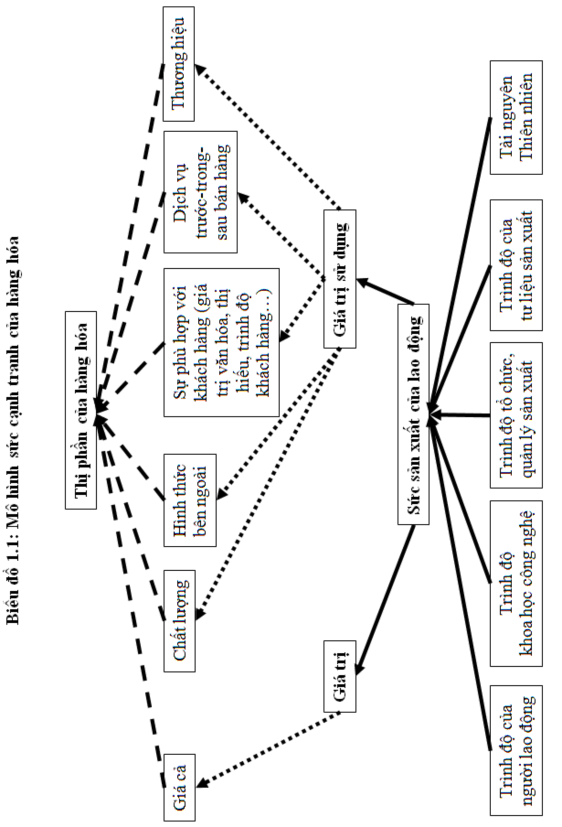
Figure 1.1: Model of competitiveness of goods
high exploitation, non-cooperation of the resource-owning country, risks in transportation and exploitation…
1.2 New manifestations of use value and value in the process of improving the competitiveness of goods in the modern market
1.2.1 New manifestations of use value
The modern economy is a market economy with a trend of globalization and strong development of science and technology, approaching the knowledge economy. In this production, the increased productivity increases the types of use values, at the same time, the social needs for use values are also increasingly diverse, expressed in the following points:
First, the richness and diversity of use values
The diversity of use values is reflected in the increasingly rich variety of goods appearing on the market. For example, compared to before Doi Moi, the Vietnamese economic sector system has become much more diverse, divided into 5 levels, 21 level 1 sectors, 88 level 2 sectors, 242 level 3 sectors, 437 level 4 sectors, 642 level 5 sectors. Each level 5 sector includes many different fields of activity, for example, level 5.29100 sector produces motor vehicles including: passenger cars, commercial motor vehicles (trucks, trailers, etc.), buses, vehicle engines, motor vehicle chassis, etc. [47, p.171].
As the market economy develops, use values are diversified due to: First, the division of social labor becomes more and more detailed, from which, general concrete labor will be divided into smaller, separate concrete labors and create new, separate use values. Second, the effort to create technology creates more new concrete labors. As a result, many new goods appear on the market for the first time: touch-screen mobile phones that can be used by touching the screen with your finger, solar-powered cars, etc.
The richness of use values reflects increasingly diverse customer needs, at the same time, this creates new opportunities: Producers have more opportunities to compete, have more choices to provide the use values they have.
the best production capacity. On the other hand, the specific division of labor will make goods that are closely related to each other appear on the market. For example, when mobile phones appear on the market, it will promote the development of other manufacturing and service industries: phone repair services, providing components and accessories for mobile phones, producing mobile phone software, value-added services for mobile phones, etc. When entering the Vietnamese market, the BlackBerry phone manufacturer does not sell individual phones but cooperates with the Viettel telecommunications service company to provide a group of BlackBerry phone products - Viettel mobile services [71]. Thus, there is always an opportunity for cooperation between manufacturers of complementary use values. This cooperation will increase competitiveness and ensure the survival of the companies in the market.
In the new group of use values, fast moving consumer goods (FMCG) are increasingly popular. Fast moving consumer goods are goods with low prices, used only for a short period of time from a few days to a few weeks. Therefore, fast moving consumer goods are exchanged with great frequency in the market. Popular fast moving consumer goods are: cosmetics, food, cleaning and hygiene products, health care products, consumer electronics... provided by large companies in the world such as Coca-Cola, Pepsi, Nestlé food and beverage company, Unilever group... [117]. In Vietnam, typical fast moving consumer goods manufacturers are Kinh Do Foods food company, Nutifood nutrition company, Vinacafe Bien Hoa company [72]... According to research by market research company TNS Vietnam, Vietnamese consumers tend to increase their use of fast-moving consumer goods, especially products that serve health and improve the quality of life [96]. In 2008, the growth in consumption of fast-moving consumer products in Vietnam reached
fastest in Asia at 19% compared to China (16%), Thailand (10%)..., by the first quarter of 2009, this growth rate reached 7.7% [83].
Second, meet the specific needs of each target group (by gender, age, ethnicity, religion, etc.).
Due to competition, many producers will have difficulty providing identical use values. To survive, some producers focus on creating use values that are suitable for specific needs according to gender, age, ethnicity, religion, etc. instead of just providing a few types of use values for all customers. In this way, producers will better satisfy customers' needs because the use values are closely following those needs. For example, in the fashion market, consumer tastes play an extremely important role because people only wear clothes that suit their preferences. Therefore, fashion products on the market become very diverse: fashion for men/women, age groups, especially fashion for teenagers - young people, fashion for ethnic groups based on the cultural characteristics of that ethnic group. For example, Vietnamese ao dai is stylized and transformed for different customers from different countries, used in different events.
On the other hand, the increasingly one-sided division of labor makes the needs of producers increasingly diverse. Therefore, the difference between customers' needs increases, which causes social needs to be deeply differentiated and requires social production to respond by creating specific use values suitable for each need. For example, the needs of each individual for using cars are increasingly different because each customer has different requirements for: fuel economy, environmental friendliness, luxurious interior, good acceleration, beautiful design, long usage time... Therefore, cars must be personalized to suit the above individual needs. This poses an urgent requirement for flexibility in production capacity.
Third, standardize products in terms of quality, appearance, and requirements to ensure hygiene and environment of use value.
In a highly developed market economy, goods are standardized in terms of quality, design, packaging, hygiene requirements, environmental friendliness requirements, etc. The quality of goods is clearly quantified by technical standards depending on the characteristics of each type of goods [99]. The standardization of goods is to ensure that manufacturers have provided good and stable use value to users through the application of qualified production processes.
The market has stricter requirements for the safety of goods for human health, the environmental friendliness of the production process... of goods. For example, in the textile market in the EU, in addition to the criteria for product quality, this market also requires goods to ensure requirements such as: not containing azo dyes suspected of causing cancer, limiting blue dyes, limiting the use of cadmium in pigments, stabilizers for plastics, electroplating agents, limiting the use of flame retardants in textile products... [78]. If the use value does not meet the above requirements, the goods cannot penetrate and compete in the market.
Due to the requirement to provide qualified goods, standard processes for producing those goods have also been formed. Thus, in order to create standard use value, the processes that create that use value also need to be standardized. For example, in the production of vegetables, flowers, and fruits, to provide high-quality agricultural products, food safety, and production that causes little harm to the environment, producers must apply the "Good Agriculture Practices" (GAP) process. Although it has not appeared for long, the GAP process has been popularized in the world, typically the GlobalGAP process (applied in over 80 countries, more than 94,000 agricultural producers).