
Banks reduce costs, increase profits and thereby increase profitability. On the contrary, with a cumbersome apparatus and inefficient operating mechanisms, it will be one of the reasons for increasing costs but low efficiency, leading to low profitability of commercial banks.
1.3.2.3 Application of scientific and technological advances
Science and technology are increasingly showing their importance in today's life. Rapid advances in science and technology always bring opportunities as well as challenges for commercial banks. Shortcuts and pioneering in applying new technology will help banks attract customers and create more profits. On the contrary, if they do not keep up with the development trend of science and technology, the bank's profitability will be negatively affected due to not saving costs while revenue is low.
1.3.2.4 Qualifications and quality of workers
Maybe you are interested!
-

 Factors affecting the debt repayment ability of corporate customers at Vietnam Joint Stock Commercial Bank for Investment and Development - Long An Branch - 1
 -
 Factors affecting customer satisfaction with the quality of international money transfer services at Dong A Commercial Joint Stock Bank - 1
 -
 Factors affecting customer loyalty to international payment services at Asia Commercial Joint Stock Bank - 12
 -
 Factors affecting card acceptance of Kien Long Joint Stock Commercial Bank - 18
 -
 Factors affecting the decision of customers to deposit savings at Asia Commercial Joint Stock Bank - 1
Employees always play an important role in the operations of commercial banks. The continuous development in quantity and quality of banking products and services provided along with the increasing demands of customers are requiring the banking staff to constantly improve their qualifications and professional ethics.
Based on the theoretical system of factors affecting the profitability of commercial banks and the study of previous studies, as well as due to information limitations, the topic will focus on determining the relationship between profitability and the group of factors of financial capacity and the state of the economy.
1.4 METHODS TO ASSESS FACTORS AFFECTING THE PROFITABILITY OF COMMERCIAL BANKS
1.4.1 Qualitative analysis method
To assess the influence of financial capacity factors as well as the economic situation on the profitability of commercial banks, one of the traditional methods applied is analysis through financial indicators reflecting the scale of equity capital, scale and quality of assets.
1.4.1.1 Group of indicators related to commercial bank assets
Assessing the profitability of commercial banks cannot fail to mention the size of commercial banks' assets because there is a close relationship between total assets and profits. In addition, because the assets of commercial banks are financial assets, with high potential risks, asset quality is also a decisive factor in the bank's sustainable profitability. If a bank has high credit quality, collects principal in full and on time, preserves loan capital, has a low overdue debt ratio, and a low bad debt ratio, then that bank is basically assessed as operating safely and effectively. On the contrary, a bank with a bad credit level and a high bad debt ratio will cause asset losses and reduce the operational efficiency of commercial banks.
- Outstanding loans on total assets:
Outstanding debt
Outstanding loans to total assets = ———————
Total assets
Commercial banks that focus on developing credit activities will have a high ratio. If this ratio is not high, combined with the bank's asset structure, it can help us realize that the bank is diversifying its investment portfolio or is not using its assets effectively.
- Customer deposit/total outstanding loan ratio (DLR)
The ratio of customer deposits/total outstanding loans reflects the bank's ability to use mobilized capital to generate income through lending, helping to assess the ability to use mobilized capital, thereby assessing the bank's profitability.
- Bad debt ratio:
Bad debt
Bad debt ratio = ———————
Total outstanding debt
The bad debt ratio is a commonly used index to assess the quality of loans and the level of risk of assets that banks have to bear. The higher the bad debt ratio, the more it shows that the commercial bank is having problems with credit risk management.
1.4.1.2 Group of indicators reflecting the ability to ensure capital:
As a financial intermediary, the equity capital of a commercial bank often accounts for a small proportion but plays an important role in the bank's operations. Equity capital is considered the basis for creating public trust and a guarantee to creditors about the bank's financial strength. In addition, equity capital is also a basis for the bank to enhance its reputation and operational capacity in the market such as deploying new services, purchasing new equipment, etc. Therefore, assessing the level of capital safety is one of the criteria that needs to be considered to evaluate the performance of the bank. To measure the level of capital safety, the following indicators are included:
- Charter capital
Charter capital is the initial capital, stated in the bank's charter, committed by the owners to contribute to the bank. The minimum charter capital must be equal to the legal capital prescribed by the Government and is gradually supplemented during the operation. This is a highly stable source of capital and is an important and essential part of the bank's total equity. This source of capital is important to ensure safety in operations, enhance competitiveness and expand the bank's business capabilities.
Equity/total assets ratio:
Equity
Equity ratio/total assets = ————————————
Total assets
This ratio shows how much of a bank's assets are financed by equity, from which we can assess the level of dependence on the bank's liabilities. Thus, traditional analysis partly reflects the correlation between subjective factors and the profitability of commercial banks. However, the analysis of factors affecting the profitability of commercial banks by traditional methods is still limited. Specifically, the synthesis of many independent indicators to get an overall picture of the bank's profitability can easily lead to confusion or contradiction. At the same time, the analysis of financial indicators does not only reveal the correlation between indicators reflecting subjective factors and the profitability of the banks.
commercial banks. In order to overcome the above limitations of the traditional analysis method through indicators, researchers have recently used the GMM regression method to quantify the factors affecting the profitability of commercial banks.
1.4.2 Quantitative method
In order to determine the factors affecting the profitability of Vietnamese joint stock commercial banks in the period 2007 - 2012, the thesis applies the GMM regression method to determine the factors affecting the profitability of commercial banks.
Based on the selection of dependent and independent variables as well as the research sample, the research modeling is based on panel data techniques. Panel data includes two elements:
(1) cross-sectional data – factors in cross-sectional data are reflected by different Vietnamese commercial banks; (2) time series data – the research period is from 2007 – 2012. Panel data is more commonly used than time-series data and pure cross-sectional data because it can control well the phenomenon of autocorrelation and control the phenomenon of multicollinearity between independent variables.
To estimate the model on panel data, a review of previous studies shows that studies evaluating factors affecting bank profitability can use the OLS method (research by Pasiouras and Kosmidou (2007)) and the GMM method (Athanasoglou et al. (2008), Dietrich and Wanzenried (2011)).
In which, the OLS method has some disadvantages that distort the estimated coefficients in the model:
(1) Observations should follow a standard normal distribution. However, in the banking and finance sector, observations are not symmetrically distributed (usually heavier towards the tail), so this would be contrary to the initial assumption.
(2) All explanatory variables are exogenous variables. However, in the economic model presented, there are explanatory variables that are exogenous but there are also explanatory variables that are
endogenous variables. In a study by Berger (1995), he raised the question of whether the equity/total assets variable will affect the profitability of banks or the opposite will happen.
To overcome this drawback, in recent studies on the topic of profitability in the banking system, researchers mainly use the GMM method for estimation. Unlike the OLS method, the GMM method does not make any assumptions about the distribution of observations. Therefore, whether the data are normally distributed or not does not affect the regression results. Moreover, the GMM method also solves the endogeneity problem of variables as well as the serial correlation problem in the regression model (according to Pasiouras and Kosmidou 2007, Athanasoglou et al. 2008, Dietrich and Wanzenried, 2011).
The GMM method is divided into two types: Difference GMM (D-GMM) and System GMM (S-GMM). In which, the D-GMM method has the advantage of eliminating autocorrelation and endogeneity problems in the regression model. However, the disadvantage of this method is that the regression results will have a low level of significance when the correlation between the lagged value and the value of the endogenous variable is quite low. In addition, the use of dummy variables will make the panel data more unbalanced when using dummy variables as observations in the model. And the above problems will make the regression results less meaningful, especially when the observation sample is small. Therefore, the S-GMM method was born to overcome the above problems by using variables in the model as instrumental variables with its own first-order differences. In addition, S-GMM can also regress variables that do not change over time. With such outstanding advantages, the topic will use the S-GMM method to estimate the model.
CONCLUSION OF CHAPTER 1
In this chapter, the topic has systematized and clarified issues related to the profitability of commercial banks including: what is a bank, the profitability of a bank; factors affecting the profitability of commercial banks. And to serve as a basis for analyzing and evaluating factors affecting the profitability of
In chapter 2, the topic introduced the methods commonly applied in the world as well as in Vietnam such as the traditional analysis method using financial indicators, the GMM regression method to determine the factors affecting the profitability of Vietnamese commercial banks.
In summary, in chapter 1, the topic has presented the basic theoretical bases related to the profitability of commercial banks to serve as an objective and scientific basis for studying the current situation in chapter 2 and proposed solutions in chapter 3.
CHAPTER 2:
FACTORS AFFECTING PROFITABILITY OF VIETNAMESE JOINT STOCK COMMERCIAL BANKS IN THE PERIOD 2007 - 2012
2.1 CURRENT STATUS OF PROFITABILITY OF VIETNAMESE JOINT STOCK COMMERCIAL BANKS IN THE PERIOD 2007 - 2012
2.1.1 General introduction to the Vietnamese joint stock commercial banking system
period 2007 - 2012
Since the formation of the two-tier banking system: the Central Bank and Commercial Banks, in which commercial banks conduct monetary business activities and have been increasingly expanded in both quantity and quality, they have increasingly met the capital and banking service needs of the economy.
As of June 2013, the credit institution system in Vietnam includes 06 state-owned commercial banks (of which 3 have been equitized), 35 joint-stock commercial banks, 04 joint-venture banks, 05 100% foreign-owned banks, 01 policy bank, 50 foreign bank branches and many financial leasing companies, finance companies, and credit funds. However, due to limitations in information collection, the thesis only focuses on analyzing joint-stock commercial banks, including: 03 state-owned joint-stock commercial banks (VCB, BIDV, Vietinbank); 26 joint-stock commercial banks (Appendix 01). The data used for analysis are annual reports of 29 banks in the period 2007 - 2012.
With rapid development, the Vietnamese joint stock commercial banking system in the recent period has made a great contribution to the State budget through the implementation of tax obligations and profits to the State budget each year of billions of VND, with welfare funds and contributions from officials, employees, the Banking sector also participates in many other social activities such as: hunger eradication and poverty reduction, supporting charity funds, overcoming the consequences of natural disasters... In terms of State management of currency, it has also been constantly improved, the operation of monetary policies according to the market mechanism with State management is applied more and more effectively. Foreign affairs and cooperation activities
The international banking system has also been constantly developing, helping to exploit significant capital from abroad for the country's development. Up to now, bilateral relations on banking cooperation between Vietnam and other countries have been constantly developing and expanding. Currently, the Vietnamese banking system has had transaction relations with over 2,000 banks and financial institutions of more than 100 countries in the world.
2.1.2 Return on total assets (ROA)
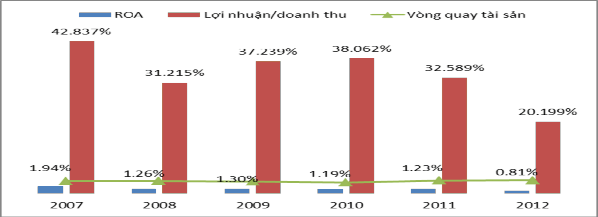
Chart 2.1: Average return on assets (ROA) of 29 joint stock commercial banks in the period 2007 - 2012
Source: Compiled from annual reports of 29 joint stock commercial banks
Looking at graph 2.1, we can see that the ability to generate net profit from assets of banks tends to decrease in the period 2007 - 2012. If in 2007, the (ROA) index reached 1.94%, then by 2011, this number decreased to 1.23% and by 2012 it was only 0.81%. One of the factors affecting (ROA) is the total asset turnover. In 2007, the total asset turnover of banks reached 0.034 times, by 2010, this index decreased to only 0.030 times. Commercial banks used assets more effectively in 2011 when asset turnover reached 0.036 times and continued to increase slightly to 0.037 times in 2012. This proves that the reason for the decrease in (ROA) of Vietnamese joint stock commercial banks is due to the net profit/revenue target. Specifically, in 2007, the net profit of Vietnamese joint stock commercial banks