
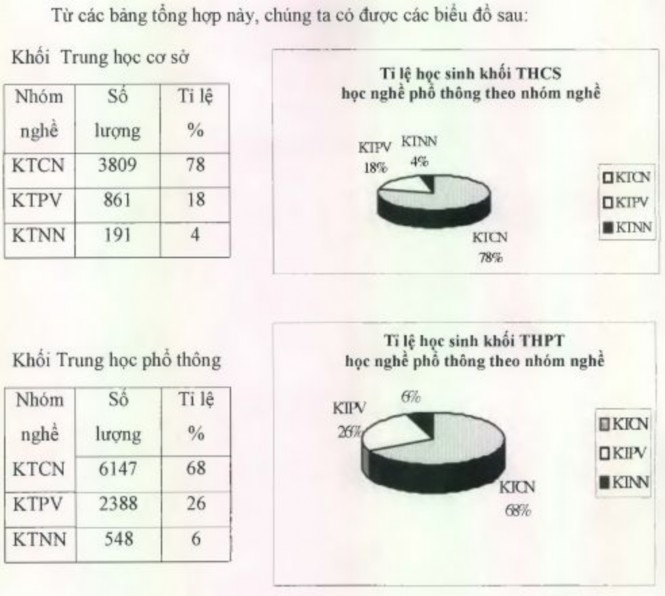
According to the above synthesis results, currently, the occupations in the Industrial Engineering group are favored by students, especially the IT profession; the Agricultural Engineering group currently only teaches Silviculture, the occupations in processing and aquaculture are not yet included in the curriculum. In particular, traditional local occupations such as making fine art stones, growing flowers and ornamental plants, growing mushrooms... are not yet included in the occupation list of vocational guidance units.
The vocational structure organized to guide students' careers reveals some unreasonable issues: Da Nang is a city with a strong sea position, with a tendency to change its economic structure to "Industry - Services - Agriculture", and needs a quality workforce to serve industrial parks and export processing zones; it is necessary to orient students towards careers in the industrial sector.
Electrical, mechanical, processing industry, tourism services, seafood processing, agriculture, and traditional local handicrafts.
Maybe you are interested!
-

 Professional Training for Management Staff and Teachers to Organize Creative Experiential Activities on Educational Themes for Students at Thai Nguyen High School
 -
 Summary Table of Results After Inspecting the Management of Staff, Teachers, and Employees of Public Kindergartens, Primary Schools, and Secondary Schools
 -
 Organizing Professional Training for Managers and Teachers to Organize Experiential Activities and Career Guidance for High School Students
 -
 Professional Qualification Structure of Teachers and Management Staff of Thai Nguyen City Kindergarten
 -
 Training, Professional Development and Pedagogical Methods on Distance Education for Management Staff and Teachers
Quality of general vocational education and training:
The quality of general vocational teaching and learning is considered a criterion to evaluate the results of implementing the career guidance path through general vocational training at vocational guidance units in Da Nang city. The evaluation of the quality of general vocational teaching and learning is carried out during the teaching and learning process, but according to the regulations of the Ministry of Education and Training, the evaluation results recorded on the certificate are the results of the general vocational exam (carried out through two exams of students: the theoretical exam with coefficient Ì and the practical exam with coefficient 3). Below are the statistics of the general vocational exam results of students through the vocational exams in the school years 2000 - 2001 and 2001 - 2002.
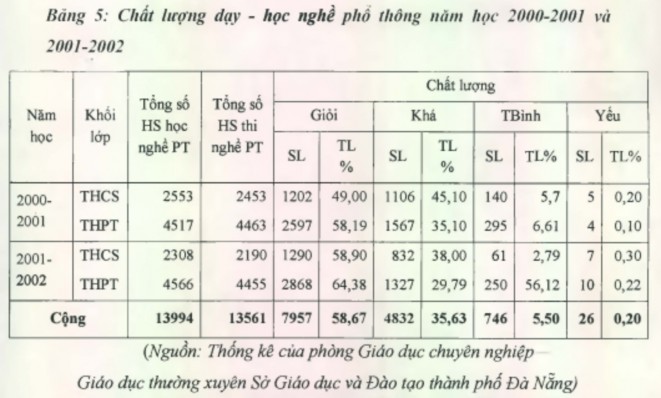
In general, the quality of vocational training of high school students was relatively good in the two school years 2000-2001 and 2001-2002, the number of students achieving excellent results accounted for 58.67%, the rate of students achieving poor results accounted for only 0.20%.
The above results were achieved thanks to the regular and timely guidance of the Department of Education and Training through documents guiding the organization of general vocational training activities in each area.
semester, each school year. These documents have been specified by the leaders of the Continuing Education Centers and the professional departments in charge of general occupations into plans for each month, each semester and deployed to each teacher. At the same time, the centers also make plans to periodically check professional activities: check the progress of program implementation, lesson plans, observe classes and give feedback to improve the quality of teaching and learning. In addition, the part of the budget collected from tuition fees, although small, is also allocated a certain percentage to purchase equipment and materials for students to practice, so the results of students' practical exams are quite good, the products made have use value.
2.2.3. Management staff and teachers doing career guidance work
Managers and teachers are the forces that play a decisive role in the quality of career guidance work. Therefore, to conduct research on the current situation of managers and teachers doing career guidance work at Continuing Education Centers, we collected data and talked and discussed directly with some of the subjects being investigated. The results are summarized in Tables 6 and 7:
a. About management staff
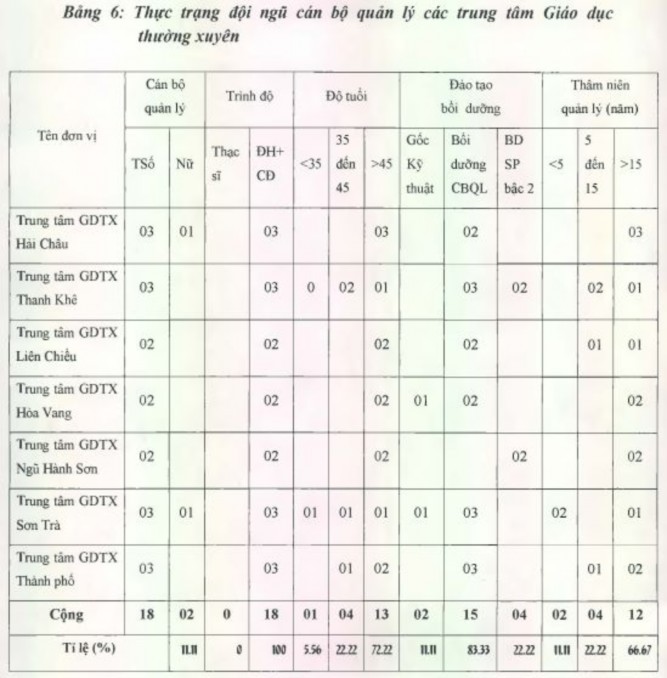
From the above statistical results, it shows that:
- The structure of the number of managers of the centers is relatively suitable for the operational needs: each center has a Director and from 01 to 02 Deputy Directors, 100% of the managers have university or college degrees. However, the proportion of women is still too low, only 02 people (accounting for 11.11%).
- All Directors and Deputy Directors of the centers have participated in short-term or long-term educational management courses. This is a great advantage for organizing and directing educational activities (including career guidance) at the centers.
- The age of the management staff in the centers is relatively high, with the highest percentage being over 45 years old (72.22%) and at the same time the percentage of staff with over 15 years of management experience is a large proportion (66.67%). This data shows that the current management staff has a lot of experience but at the same time also reveals the weakness of not promptly training the next generation and rejuvenating the team. If there are more young staff participating in management work, it will increase the dynamism and creativity in the operation of the centers.
- An important point that needs to be mentioned is that currently, there are only 02 people who are originally technical teachers (accounting for 11.11%), up to 88.89% of management staff graduated from non-technical faculties of pedagogical schools, so the problem of professional management of career guidance work still faces many difficulties.
b. About the teaching staff
To effectively carry out career guidance tasks, it is necessary to have a team of teachers with sufficient quantity, structure, and qualifications that meet or exceed the standards. In addition, it is also necessary to take into account the age and teaching experience of the teaching staff to have appropriate development orientation. The survey results are shown in Table 7:
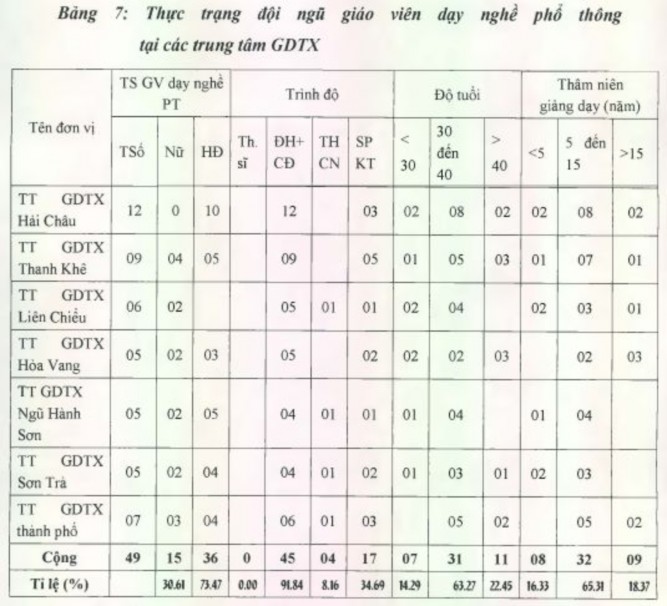
- The total number of general vocational teachers and career guidance staff is currently 49, of which 15 are female (accounting for 30.61%), and 36 are contract teachers (accounting for 73.47%).
- Regarding expertise: currently there are no teachers with a master's degree; university and college: 45 people (91.84%); Vocational high school and technical workers: 4 people (8.16%). According to the regulations on standards for technical and vocational teachers (Regulations on organization and operation of the General Technical and Vocational Guidance Center issued on July 1, 2000), technical and vocational teachers must have a university degree, general vocational teachers must have a college degree in technical education or technical college, be artisans, workers.
The high-level staff have been trained in pedagogical skills. Reality shows that: there are still 04 teachers (accounting for 8.16%) who have not met professional standards, the rate of teachers who graduated from Technical Pedagogical Schools participating in general vocational training at Continuing Education Centers is still very low, only 17 people (accounting for 34.69%). The remaining force is general teachers with college and university degrees, with skills invited by Continuing Education Centers to give lectures and contracts to teach general vocational training. This team has low skills, and has not been trained in technical teaching methods, so there are many limitations in the teaching process.
- The centers do not have a team of leading teachers who are the core for improving the quality of research and teaching in the centers and participating in compiling documents and textbooks for teaching and learning. There is no participation of artisans in career orientation for students in traditional local occupations.
- Regarding age and teaching experience: the majority of teachers working in career guidance and general vocational training are between 30 and 40 years old (63.27%), this team has many conditions to access advances in science and technology, and has many creative abilities in organizing career guidance activities. The majority of teachers have teaching experience from 10 to 15 years (65.31%), this is also the stage when they can best demonstrate their pedagogical capacity, bringing high efficiency in education and teaching.
2.2.4. Facilities and equipment for career guidance
In 1997, the whole city of Da Nang had only 3 centers with premises and some construction areas (although still small and old), which were: Da Nang City Continuing Education Center, Thanh Khe District Continuing Education Center (formerly Thanh Khe Vocational Training and General Technical Center), Hoa Vang District Continuing Education Center (formerly Hoa Vang Vocational Training and General Technical Center), the rest had to rent premises and classrooms for teaching. By the time of the investigation (October 2002), most of the centers had premises with increasing construction areas, the system of classrooms, functional rooms, and practice rooms had been and were being gradually built, but there were still many shortcomings compared to the needs of teaching and learning in general and vocational education in particular.
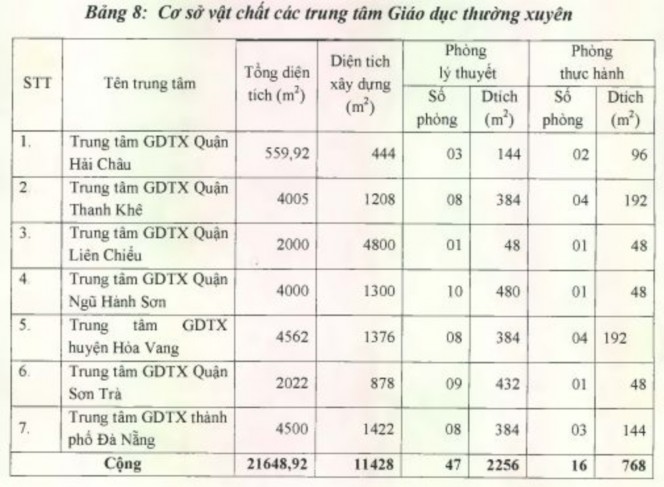
Up to the time of investigation, the vocational training rooms of the units were mostly just computer rooms serving the teaching of Information Technology, the rooms were designed and built according to vocational training standards to teach subjects such as: Civil Electricity, Electronics, Home Economics, Sewing... were almost non-existent. The electricity, water, and lighting systems serving teaching and learning were therefore very unreasonable.
Along with the construction of rooms, the units have also been equipped with equipment for career guidance work.