
economy and society in general. Everyone needs to exchange and buy and sell to have goods and services to meet their needs, and then to meet the needs of their family and organization. Thus, it can be seen that consumers are everyone, regardless of age, composition, ethnicity, gender, social status. Moreover, consumers are present everywhere, from urban to rural areas, remote areas, islands... Protecting consumers is not only a social task but also has a clear economic and political nature. Once consumers, the largest social force, including all people, are respected, protected, and have their material and spiritual life improved, they will become a huge driving force for social development, contributing to the cause of social development in general. Infringement of consumers' rights will hinder the development of society. Consumer protection is a broad and profound social task that is of interest to many people around the world.
- Consumer protection is an important task of the State and State management agencies, and is the task of organizations and individuals who do business honestly. In fact, in a market economy, the market is mainly regulated by consumption. Consumers have a great influence on economic decisions, whether in the state or private sector, and consumers are also the subjects most affected by economic decisions. Governments in all countries are very concerned about consumer issues, and if this issue is resolved well, it will lead to economic development and social and political stability. On the contrary, it will lead to slow economic development, even social crisis, disorder and political instability. Consumer protection is one of the activities aimed at realizing a fair, democratic and civilized society, and at the same time maintaining and nurturing an important economic driving force. As the market economy develops, the issue of consumers and consumer protection needs to be raised and implemented more seriously.
3.2.2. For economy
- Consumer protection helps strengthen consumer confidence in goods and services, thereby encouraging consumption. Consumer confidence is the desire of all manufacturers.
production and supply of goods and services. It ensures the stability and development of that business. When there is no trust in the product or service, consumers will limit or even stop consuming that product. Consumer reactions not only make it difficult for the existence and development of that particular business, but if that reaction occurs on a large scale, challenging many businesses at the same time, the entire economy is at risk of being affected.
Maybe you are interested!
-

 Defense organization and protection activities of the central coastal region under the Nguyen Dynasty in the period 1802 - 1885 - 25
 -
 Competitiveness of Vietnam's international travel businesses after Vietnam joins the World Trade Organization WTO - 2
 -
 Hospital Quality Scale of the International Hospital Quality Assessment Organization (Jcaho)
 -
 International Cooperation in Management and Enforcement of Copyright Protection
 -
 Practical Enforcement of the Law on Consumer Rights Protection in the Field of Food Hygiene and Safety in Binh Duong
- Protecting consumer rights helps ensure fairness for consumers. While performing consumer behavior, consumers have certain legitimate rights. Protecting those rights is an objective requirement to ensure fairness for consumers, and also contributes to social justice. From there, protecting consumer rights contributes to market management, helping the market operate healthily and fairly. Protecting consumer rights is essentially preventing acts of infringement of consumer rights by manufacturers and suppliers of goods and services.
4. International Consumer Organization and United Nations guidelines on consumer protection
4.1. Consumers International
Although the issue of consumer protection has been raised for a long time, the world consumer protection movement only really began in the 1950s when some developed countries established consumer associations and especially since 1960, when an international consumer organization was established.
Consumers International was founded in 1960 by a number of national consumer organisations, who recognised that individual consumer movements could be strengthened through international action. It was originally known as the International Organisation of Consumer Unions (IOCU). It has grown rapidly and is recognised as the voice of the international consumer movement, particularly on important issues such as food and product standardisation, health and patient rights, the environment and sustainable consumption, the regulation of international trade and public services, etc.
In 1994, the International Consumer Congress held in Montpellier (France) decided to change the name of the organization to Consumers International (CI). CI supports, gathers and represents consumer organizations worldwide. As of 2003, CI has over 250 member organizations in 119 countries and territories around the world.
CI strives to promote a fair and honest society by protecting the rights of all consumers, the poor, the marginalized and the disadvantaged, through its main activities: Supporting and strengthening the capacity of member organizations and the consumer movement in general; Fighting internationally for consumer-related policies.
CI is headquartered in London, UK. CI is an independent, non-profit organization, funded by contributions from member organizations, support from organizations, governments and multilateral organizations.
In protecting consumers, in addition to making consumer issues an international activity, the organization also pays special attention to the following areas:
- Standardization work
- Food policy
- Propose that the UN issue a list of banned products
- Building a model consumer protection law
- Information and education of consumers
- Commerce
- Health and medicine
- Environmental protection
- Public services
- Social responsibility of business manufacturers
Over 70% of CI members are in developing countries, in which organizing and mobilizing resources to serve the cause of consumer protection is very important.
difficulties. CI has been proactive in helping these countries establish consumer protection organizations, building them into strong organizations that can have a strong voice in policy making, for the benefit of consumers both nationally and internationally. CI has developed many training programs, financial assistance, technical assistance, information, exchange of programs and action linkages to improve the understanding and operational skills of member countries.
Along with economic development, the issue of consumers is no longer limited to a single country but has become a global concern. In many countries, there are consumer groups operating in different fields. CI is currently the world's largest consumer organization, operating comprehensively for the benefit of consumers. CI is especially concerned with poor consumers, disadvantaged consumers and consumers in developing countries.
4.2. United Nations Guidelines for Consumer Protection
4.2.1. Introduction
In 1985, the UN Consumer Protection Guidelines were officially adopted by the UN General Assembly. This is a basic and comprehensive document on consumer protection. This guideline helps governments, especially developing countries, in formulating policies and laws to protect consumer rights.
The guidelines have been sent to UN member governments, including the Vietnamese government.
After 10 years of promulgation, in 1996, the UN sent an official document to member governments requesting a review of the implementation of the guidelines on consumer protection. After 1999, the UN added the environmental protection section to the guidelines. Recently, in the context of globalization of the world economy, the UN has again solicited opinions from consumer organizations around the world to revise and supplement the guidelines on consumer protection in the new situation.
4.2.2. Objectives
In order to take into account the interests of consumers in all countries, particularly developing countries; to recognise that consumers often suffer from disparities in economic, educational and bargaining power in purchasing; and to recognise that consumers have a right to safe products and to promote just, equitable and sustainable economic and social development, the Consumer Protection Guidelines aim to achieve the following objectives:
- Help countries implement and maintain adequate protection for their citizens as consumers;
- Encourage the improvement of ethical qualities for those who produce and distribute goods and services. In addition, create favorable conditions for production and distribution organizations to meet the needs and aspirations of consumers;
- Help countries limit abusive practices by national and international businesses that cause damage to consumers;
- Facilitate the development of independent consumer associations and promote international cooperation in the field of consumer protection;
- Encourage the development of market mechanisms, creating conditions for consumers to have more choices at lower prices;
- Encourage sustainable consumption.
4.2.3. General principles
Each government must give priority to consumer protection, in accordance with its own economic, social and environmental circumstances, with the needs of its citizens, and must take into account the consequences and benefits of measures taken to meet legal requirements, including:
- Protect consumers from health and safety hazards;
- Support and protect the economic interests of consumers;
- Provide complete information to consumers so they can make informed choices according to their individual wishes and needs;
- Consumer education, including education about the economic, social and environmental impacts of consumer choices;
- Effectively compensate consumers;
- Allow the freedom to form appropriate consumer groups or organizations and enable such organizations to present their views in decision-making processes that affect them.
- Promote sustainable consumption.
CHAPTER 2: CURRENT STATE OF CONSUMER RIGHTS PROTECTION IN VIETNAM
1. Situation of consumer rights violations in Vietnam
1.1. Current status of consumer rights violations in Vietnam
Currently in our country, the situation of serious infringement of consumer rights is becoming more and more common and has become one of the burning issues of public concern.
1.1.1. The increasing appearance of unfair competition and competition restriction behaviors affecting consumer rights
Anti-competitive and unfair competition behaviors have appeared and caused significant impacts on consumers. Unfair competition behaviors of enterprises are becoming more sophisticated and have a larger scope of influence.
1.1.1.1. Monopoly problem
In Vietnam, the development of the economy according to the market mechanism has been going on for more than 20 years. However, until now, the monopoly of the subsidy period in some areas such as electricity, water, petrol, etc. is still quite strong. Meanwhile, the Competition Law has not yet been effective in fighting monopoly. Although the Competition Law has stipulated prohibited acts that restrict competition such as: price fixing agreements, market division, abuse of monopoly position, dominant market position (over 30% market share)... to impose unreasonable purchase and sale prices of goods or services... but in reality, in 2008, there were consecutive quite typical cases of the above violations such as the case of the Vietnam Steel Association issuing a resolution to fix the selling price (13.7-14 million VND/ton of steel), the case of the Vietnam Insurance Association agreeing to raise the insurance premium to 3.95%/year for all customers... (Vietluat.vn March 8, 2009)
Monopoly problem for petroleum products
There are currently 11 key units participating in the petroleum business but
More than 60% of the distribution volume is in the hands of the Vietnam National Petroleum Corporation (Petrolimex). Therefore, the increase or decrease of gasoline prices depends on them after the decision to allow gasoline businesses to be proactive in selling prices from December 15, 2009. Since then, in just over two months, gasoline prices have increased four times and are currently at 16,990 VND/liter while in the US, it is only 15,300 VND/liter (calculated according to the exchange rate on the free market). This has made consumers worried and therefore, consumers' rights cannot be guaranteed (Thesaigontimes.vn March 12, 2010)
The rapid increase and slow decrease in gasoline prices have caused consumers unnecessary expenses. When the world crude oil price increased, domestic gasoline prices also jumped, but when crude oil prices fell sharply, even lower than before the oil fever, gasoline prices in Vietnam remained sky-high and only decreased slightly. Only after many price reductions were consumers able to buy gasoline at the price before the increase. However, even with this price, Vietnamese consumers still suffered a significant loss because this price was considered too high compared to the input crude oil price. The unreasonableness of domestic gasoline prices after the oil fever can be seen through the chart below:
Chart 1: Gasoline and crude oil prices in Vietnam from November 2007 to November 2008
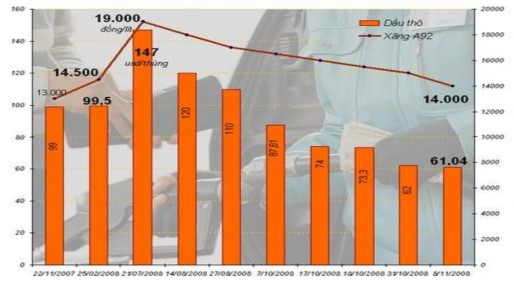
(Source: Vnexpress.net November 8, 2008)