
practical field. The problem can be the task of applying knowledge to various practical situations that students do not know or having to explain a psychological phenomenon, research and explain the causes of a psychological phenomenon, or express one's own opinions, viewpoints, attitudes, and decisions about a practical situation that requires creative application of practical knowledge.
- TLHDL practice exercises are close to the learner's experience, the more they contain rich and diverse real-life situations, the more they stimulate learners to actively participate in solving problems creatively [82]. Practice exercises that are unfamiliar to the learner's experience are not problematic, do not stimulate, and do not attract them to care about solving them.
- TLHDL practice exercises are not purely reproducible, requiring learners to remember, understand, and use the model. They need to be euristic, stimulating learners' exploration and discovery.
- The selection, design, and construction of practice exercises have many different forms, but usually a practice exercise is structured with the following 3 basic elements: 1/ A real context; 2/ Information and data content; 3/
An open ending containing problems, associated with training content of learning skills as a foundation for forming and developing self-study capacity.
3.3.1.2. Principles of constructing exercises
According to modern teaching theory [49], there are 3 main principles in teaching: 1/ Interaction; 2/ Participation and cooperation; 3/ Problematization of teaching. From these 3 principles and the nature of self-study, we can identify the basic requirements when designing exercises in practical lessons to develop learning skills as follows .
a) Select or design exercises that are appropriate to your level of knowledge and life experience.
Learning is only highly effective when learners actively and proactively participate in the learning process, relying on their own experiences and knowledge along with the support of teachers to transform and personalize the knowledge received.
In the process of solving practical exercises, students are directly working with objects and practical problems related to their own experiences, thus being able to develop skills to apply their own and others' experiences in learning and that helps students gain educational experiences for their future careers. Practical exercises also encourage students to study independently, apply knowledge, practice skills and have a greater sense of self-awareness and responsibility for their studies.
Practical exercises in tourism emphasize students' problem solving and decision making abilities; emphasize students' learning methods. Learning through practical exercises requires students to prepare carefully both before and during the study, students must work directly, so they can experience and accumulate better experience. Learning through practical exercises in tourism means: students' learning activities through applying knowledge of tourism to solve practical problems in tourism activities to carry out learning tasks and develop self-study capacity.
b) Must practice basic learning skills: receiving learning information; practicing; evaluating.
Learning through TLH L practice exercises creates opportunities for students to comprehensively develop learning skills such as: Receiving learning information; applying knowledge to handle real-life situations; communicating and working in groups; reviewing; debating, presenting arguments and defending opinions; critical thinking and reflection skills; evaluating and self-evaluating.
Guiding students through practical exercises during self-study or in class practice hours can bring outstanding advantages such as: Increasing the practicality of the subject; enhancing students' initiative, creativity and interest; providing new experiences, perspectives and solutions for both teachers and students.
c) Organize group activities, individual activities and necessary interactions during the learning process.
Practical exercises in LLM include different types, such as exercises containing paradoxical situations; exercises containing choice situations; exercises containing “Why” situations ; exercises containing real-life situations that require finding solutions and using LLM knowledge to solve them; exercises requiring expressing opinions and evaluations; exercises requiring the use of measuring and experimental tools to understand tourists’ psychological phenomena and draw necessary conclusions, etc. They are organized from individual activities taking place in a short period of time to group activities taking place over a longer period of time. Performing LLM practical exercises can take place in a class period or a lesson. Learning activities through practical exercises can take place over several days or even several weeks.
d) Organize learning through independent research and self-study
Learning instructions through practical exercises TLH L essentially helps students learn in a research, experiential, collaborative, and individualized manner. Therefore, students must spend more time on self-study and self-research to prepare.
Respond to the requirements set by the teacher during practical lessons.
In the process of guiding learning through practical exercises, teachers need to select and apply appropriate teaching strategies, methods and techniques. Organize learning activities to promote students' ability to conduct independent research, work in cooperative groups and self-study.
3.3.2. Guide learning through doing exercises
3.3.2.1. Assign individual homework to be done within self-study time
- Before, during and after each chapter, the teacher assigns exercises and a time limit for students to complete. Students study the materials themselves to solve the exercises during self-study time.
- Instruct students to do exercises according to the following steps:
a) c 1: write n study exercises
Analyze practice exercises, identify the type of practice exercise, analyze and determine the given data and requirements to solve, the operations and actions needed to solve each type of practice exercise, find the relationship between the requirements of the exercise and the given conditions.
b) c 2: plan to solve exercises
Main components of the ao gm practice problem solving plan: Time, work content, measures/techniques, implementation sequence, reference documents, products.
c) c 3: Proceed to solve the exercises
This is the requirement for students to independently apply knowledge, operations, and actions to solve the requirements of the exercises.
d) c 4: Check results (products)
Students need to review, check, and evaluate the results of practical exercises to make additions, corrections, and complete the product before reporting to the class and teacher.
3.3.2.2. Assign group assignments within practical study time
a) c 1: divide into groups and assign tasks.
During practice hours, the teacher divides the class into different groups, group size from 6 - 8 students with different academic abilities and genders, with a group leader to manage group activities.
Teachers prepare study guides that fully demonstrate the content of the practice exercises, requirements to be solved, completion time, and assign study guides to groups to implement.
b) part 2: discuss the content and solutions of the exercises
Identify data and personal reactions to the practice exercise, and organize discussion, group work, and comparison of solutions.
exercises and to come to a decision on choosing the most suitable solution for the exercise solving process.
To encourage active participation of students in learning activities, it is necessary to create a suitable time for students to prepare individually. After individual preparation, students can discuss and reflect with the larger group. If the group has more than 6 people, it is advisable to divide into 2 small groups or divide into pairs to discuss. Then report and reflect to the larger group.
Start with the problems posed in the practice exercises that have been developed by everyone in a personalized way. This is a rich source of ideas and discoveries. After the problems and ideas have been linked, move on to sharing reflections. Then, have students discuss the questions that the presenter has brought up.
c) Exercise 3: Summary, comments, instructions on methods and conditions for solving exercises.
The teacher assigns a representative student to present the group's opinion on how to solve the practice problem, the other groups receive comments and supplement. The teacher concludes and points out how to solve the exercise. Based on the teacher's instructions, each group adjusts, supplements, compares the solutions and decides on the final solution for their group's practice problem.
3.3.3. Evaluation of learning products
3.3.3.1. Lecturer assessment
Determine standards for evaluating learning products through appropriate standards and criteria, focusing on forming and developing students' self-study capacity through forming learning skills and learning attitudes of learners.
3.3.3.2. Student self-assessment
This activity is mainly carried out by learners to clearly perceive their learning results and experience their successes and shortcomings. This is a very strong motivating factor for the learning process, especially active learning. Assessment must focus on behavior and learning results, not just on attitudes and personalities of each person. From the assessment results and post-assessment experiences, learners need to carry out additional activities that have the effect of practicing, improving skills and consolidating knowledge, thanks to which the learning process and results are viewed by learners with a new, more complete and perfect perspective.
3.3.4. illustrative example
Corresponding to specific exercises, teachers can guide students to practice the following issues. These practice exercises effectively support the general learning of TLHDL and directly help students practice learning skills - one of the basic and important components of self-study ability.
* example 1
Practical exercise: "Draft a questionnaire to find out the level of satisfaction of tourists with accommodation, food and beverage products, and tourism programs of travel companies in the city".
1 guide to solve practice exercises during self-study time
a) c 1: write n study exercises
This is a type of exercise that applies knowledge about psychological research methods in tourism, specifically using questionnaire techniques to survey the level of satisfaction of tourists with services provided by tourism businesses.
The exercise provided data, such as: Collecting tourists' feedback information about the services they have consumed and requiring the design of a questionnaire to collect this data. During the exercise, students must perform operations and actions, such as: Analyzing the psychological characteristics of tourists, designing a questionnaire (structure, form, content, etc.)
b) c 2: plan to solve exercises
The structure and content of the exercise plan are described in the table below.
TT
Time | Job Description | technical measures | References | Product | |
1 | 12/5/2015 | Design questionnaires to collect information about tourists' satisfaction with the products and services they use. | Use all kinds closed questions, multiple choice questions | Vu Cao Dam (2002). Scientific research methodology . Science and Technology Publishing House. Art, Hanoi. | Customer satisfaction questionnaire system L customers for products and services |
2 | . | . | . | ||
3 | . |
Maybe you are interested!
-

 Select the exercise system, instructions for solving and solving Physics exercises (chapter "Alternating Current" grade 12 advanced program) - 19
 -
 Select the exercise system, instructions for solving and solving physics exercises on alternating current - 12
 -
 Training creative thinking for high school students through solving some Algebra - Analysis exercises in many ways - 6
 -
 Training creative thinking for high school students through solving some Algebra - Analysis exercises in many ways - 3
 -
 Car body electrical practice - 8
zt2i3t4l5ee
zt2a3gs
zt2a3ge
zc2o3n4t5e6n7ts
If the voltage is out of specification, replace the wire or connector.
If the voltage is within specification, install the front fog light relay and follow step 5.
Step 5 Check the front fog light switch
- Remove the D4 connector of the fog light switch
- Use a multimeter to measure the resistance of the front fog light switch.
Measurement location
Condition
Standard
D4-3 (BFG) -D4-4 (LFG)
Light switchFront Fog OFF
>10kΩ
D4-3 (BFG) -D4-4 (LFG)
Front fog light switchON
<1 Ω
- Standard resistor
D4 connector is located on the combination switch assembly.
If the resistance is out of specification, replace the combination switch (the fog light switch is located in the combination switch).
If the resistance is within specification, follow step 6.
Step 6 Check wiring and connectors (front fog light relay-light selector switch)
- Disconnect connector D4 of the combination switch assembly
- Use a voltmeter to measure the voltage value of jack D4 on the wire side.
Measurement location
Control modecontrol
Standard
D4-3 (BFG) - (-) AQ
TAIL
11 to 14 V
D4 connector for the wiring of the combination switch assembly
If the voltage does not meet the standard, replace the wire or connector.
If the voltage is within standard, there may have been an error in the previous measurements.
Step 7 Check the front fog lights
- Remove the front fog light electrical connector.
- Supply battery voltage to the fog lamp terminals
Jack 8, B9 of front fog lamp on the electrical side
blind first.
Power supply location
Terms and Conditions
Battery positive terminal - Terminal 2Battery negative terminal - Terminal 1
Fog lightsbefore morning
- If the light does not come on, replace the bulb.
If the light is on, re-plug the jack and continue to step 8.
Step 8 Check wiring and connectors (relay and front fog lights)
- Disconnect the B8 and B9 connectors of the front fog lights.
- Use a voltmeter to measure voltage at the following locations:
Measurement location
Switch location
Terms and Conditions
B8-2 - (-) AQ
Electric lock ON TAIL size switchFog switch ON
11 to 14 V
B9-2 - (-) AQ
Electric lock ONTAIL size switch Fog switch ON
11 to 14 V
B8 and B9 connectors on the front fog lamp wiring side
Voltage is not up to standard, repair or replace the jack. If up to standard, there may have been an error in the measurement process.
2.2.4. Procedure for removing, installing and adjusting fog lights 1. Procedure for removing
- Remove the front inner ear pads
Use a screwdriver to remove the 3 screws and remove the front part of the front inner ear liner
-Remove the fog light assembly
+ Disconnect the connector.
+ Use a screwdriver to remove 3 screws to remove the fog light cover
2. Installation sequence
-Rotate the fog lamp bulb in the direction indicated by the arrow as shown in the figure and remove the fog lamp from the fog lamp assembly.
-Rotate the fog light bulb in the direction indicated by the arrow as shown in the figure and install the light into the fog light assembly.
- Use a screwdriver to install the fog light cover
-Install the electrical connector
Attention: Be careful not to damage the plastic thread on the lamp assembly.
- Install the front inner ear pads
Use a screwdriver to install the front inner bumper with 3 screws.
3. Prepare the vehicle to adjust the fog light convergence. Prepare the vehicle:
- Make sure there is no damage or deformation to the vehicle body around the fog lights.
- Add fuel to the fuel tank
- Add oil to standard level.
- Add engine coolant to standard level.
- Inflate the tire to standard pressure.
- Place spare tire, tools and jack in original design position
- Do not leave any load in the luggage compartment.
- Let a person weighing about 75 kg sit in the driver's seat.
4. Prepare to check the fog light convergence
a/ Prepare the vehicle status as follows:
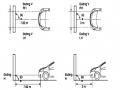
- Place the car in a dark enough place to see the lines. The lines are the dividing line, below which the light from the fog lights can be seen but above which it cannot.
- Place the car perpendicular to the wall.
- Keep a distance of 7.62 m between the center of the fog lamp and the wall.
- Park the car on level ground.
- Press the car down a few times to stabilize the suspension.
Note: A distance of approximately 7.62 m is required between the vehicle (fog lamp center) and the wall to adjust the convergence correctly. If the distance of 7.62 m cannot be achieved, set the correct distance of 3 m to check and adjust the fog lamp convergence. (Since the target area varies with the distance, please follow the instructions as shown in the figure.)
b/ Prepare a piece of thick white paper about 2 m high and 4 m wide to use as a screen.
c/ Draw a vertical line through the center of the screen (line V).
d/ Set the screen as shown in the picture. Note:
- Keep the screen perpendicular to the ground.
- Align the V line on the screen with the center of the vehicle.
e/Draw the reference lines (H, V LH and V RH lines) on the screen as shown in the figure.HINT:
Mark the center of the fog lamp on the screen. If the center mark cannot be seen on the fog lamp, use the center of the fog lamp or the manufacturer's name mark on the fog lamp as the center mark.
H line (fog light height):
Draw a line across the screen so that it passes through the center mark. Line H should be at the same height as the center mark of the fog light bulb.
Line V LH, V RH (center mark position of left fog lamp LH and right fog lamp RH):
Draw two lines so that they intersect line H at the center marks.
5. Check the fog light convergence
a/ Cover the fog lamp or remove the connector of the other side fog lamp to prevent light from the unchecked fog lamp from affecting the fog lamp convergence test.
b/ Start the engine.
c/ Turn on the fog lights and make sure that the dividing line is outside the standard area as shown in the drawing.
6. Adjust the fog light convergence
Use a screwdriver to adjust the fog light to the standard area by turning the toe adjustment screw.
Note: If the screw is adjusted too far, loosen it and then tighten it again, so that the last rotation of the light adjustment screw is clockwise.
3. Self-study questions
1. Describe the operating principle of the lighting system with automatic headlight function
2. Describe the operating principle of the lighting system with the function of rotating headlights when turning
3. Draw diagram and connect lighting system on Hyundai Porter car
4. Draw diagram and connect lighting system on Honda Accord 1992
5. Draw the lighting circuit on a 1993 Toyota Lexus
LESSON 3 MAINTENANCE AND REPAIR OF SIGNAL SYSTEM
I. IMPLEMENTATION GOAL
After completing this lesson, students will be able to:
- Distinguish between types of signals on cars
- Correctly describe common symptoms and suspected areas causing damage.
- Connecting signal circuits ensures technical requirements
- Disassemble, install, check, maintain and repair the signal system to ensure technical requirements.
- Ensure safety in work and industrial hygiene
II. LESSON CONTENT
1. General description
The signal system equipped on cars aims to create signals to notify other vehicles participating in traffic about the vehicle's operating status such as: stopping, parking, braking, reversing, turning...
Signals are used either by light such as headlamps, brake lights, turn signals….. or by sound such as horns, reverse music….
Just like the lighting system. A signal system circuit usually consists of: battery, fuse, wire, relay, electrical load and control switch. Only some switches of the signal system are on the combination switch. The switches of other signals are usually located in different locations such as in the gearbox or brake pedal……
2. Maintenance and repair
2.1. Turn signals and hazard lights
The installation location of the turn signal is shown in Figure 3.1. The turn signal control switch is located in the combination switch under the steering wheel. Turning this switch to the right or left will make the turn signal turn right or left.
The hazard light switch is used when the vehicle has a problem while participating in traffic. When the hazard light switch is turned on, all the turn signals on the vehicle will light up at a certain frequency. The hazard light switch is usually placed separately from the turn signal switch (some old cars integrate the hazard and turn signal switches on the same combination switch cluster).
Figure 3.1 Turn signal switch Figure 3.2 Hazard switch
The part that generates the flashing frequency for the lights is called a turn signal relay. The turn signal relay usually has 3 terminals: B (positive power supply); E (negative power supply); L (providing the turn signal switch to distribute to the
lamp)
2.1.1. Circuit diagram
To generate the frequency for the turn signal, a turn signal relay is used in the turn signal circuit. The current from the turn signal relay will be sent to the turn signal switch assembly to distribute the current to the turn signal lights for the driver's purpose.
Figure 3.3. Schematic diagram of a turn signal circuit without a hazard switch
1. Battery; 2. Electric lock; 3. Turn signal relay; 4. Turn signal switch; 5. Turn signal lamp; 6. Turn signal lamp; 7. Hazard switch
Figure 3.4 Schematic diagram of turn signal circuit with hazard switch
1. Battery; 2. Combination switch cluster; 3. Turn signal;
4. Turn signal light; 5. Turn signal relay
Today's cars no longer use three-pin turn signal relays (B, L, E) but use eight-pin turn signal relays (figure 3.5) (pin number 8 is used for hazard lights).
For this type, the current supplying the turn signal lights is supplied directly from the turn signal relay to the lights.
div.maincontent .p { color: black; font-family:"Times New Roman", serif; font-style: normal; font-weight: normal; text-decoration: none; font-size: 14pt; margin:0pt; } div.maincontent p { color: black; font-family:"Times New Roman", serif; font-style: normal; font-weight: normal; text-decoration: none; font-size: 14pt; margin:0pt; } div.maincontent .s1 { color: black; font-family:"Times New Roman", serif; font-style: normal; font-weight: normal; text-decoration: none; font-size: 13pt; } div.maincontent .s2 { color: black; font-family:"Times New Roman", serif; font-style: italic; font-weight: normal; text-decoration: none; font-size: 14pt; } div.maincontent .s3 { color: black; font-family:"Times New Roman", serif; font-style: normal; font-weight: normal; text-decoration: none; font-size: 14pt; } div.maincontent .s4 { color: black; font-family:"Times New Roman", serif; font-style: normal; font-weight: normal; text-decoration: none; font-size: 13pt; } div.maincontent .s5 { color: black; font-family:"Times New Roman", serif; font-style: normal; font-weight: normal; text-decoration: none; font-size: 13pt; vertical-align: 1pt; } div.maincontent .s6 { color: black; font-family:"Times New Roman", serif; font-style: normal; font-weight: normal; text-decoration: none; font-size: 11pt; } div.maincontent .s7 { color: black; font-family:"Times New Roman", serif; font-style: normal; font-weight: normal; text-decoration: none; font-size: 14pt; vertical-align: -9pt; } div.maincontent .s8 { color: black; font-family:"Times New Roman", serif; font-style: normal; font-weight: normal; text-decoration: none; font-size: 11pt; } div.maincontent .s9 { color: #008000; font-family:"Times New Roman", serif; font-style: normal; font-weight: normal; text-decoration: none; font-size: 14pt; } div.maincontent .s10 { color: black; font-family:"Times New Roman", serif; font-style: italic; font-weight: normal; te
Car body electrical practice - 8
zt2i3t4l5ee
zt2a3gs
zt2a3ge
zc2o3n4t5e6n7ts
If the voltage is out of specification, replace the wire or connector.
If the voltage is within specification, install the front fog light relay and follow step 5.
Step 5 Check the front fog light switch
- Remove the D4 connector of the fog light switch
- Use a multimeter to measure the resistance of the front fog light switch.
Measurement location
Condition
Standard
D4-3 (BFG) -D4-4 (LFG)
Light switchFront Fog OFF
>10kΩ
D4-3 (BFG) -D4-4 (LFG)
Front fog light switchON
<1 Ω
- Standard resistor
D4 connector is located on the combination switch assembly.
If the resistance is out of specification, replace the combination switch (the fog light switch is located in the combination switch).
If the resistance is within specification, follow step 6.
Step 6 Check wiring and connectors (front fog light relay-light selector switch)
- Disconnect connector D4 of the combination switch assembly
- Use a voltmeter to measure the voltage value of jack D4 on the wire side.
Measurement location
Control modecontrol
Standard
D4-3 (BFG) - (-) AQ
TAIL
11 to 14 V
D4 connector for the wiring of the combination switch assembly
If the voltage does not meet the standard, replace the wire or connector.
If the voltage is within standard, there may have been an error in the previous measurements.
Step 7 Check the front fog lights
- Remove the front fog light electrical connector.
- Supply battery voltage to the fog lamp terminals
Jack 8, B9 of front fog lamp on the electrical side
blind first.
Power supply location
Terms and Conditions
Battery positive terminal - Terminal 2Battery negative terminal - Terminal 1
Fog lightsbefore morning
- If the light does not come on, replace the bulb.
If the light is on, re-plug the jack and continue to step 8.
Step 8 Check wiring and connectors (relay and front fog lights)
- Disconnect the B8 and B9 connectors of the front fog lights.
- Use a voltmeter to measure voltage at the following locations:
Measurement location
Switch location
Terms and Conditions
B8-2 - (-) AQ
Electric lock ON TAIL size switchFog switch ON
11 to 14 V
B9-2 - (-) AQ
Electric lock ONTAIL size switch Fog switch ON
11 to 14 V
B8 and B9 connectors on the front fog lamp wiring side
Voltage is not up to standard, repair or replace the jack. If up to standard, there may have been an error in the measurement process.
2.2.4. Procedure for removing, installing and adjusting fog lights 1. Procedure for removing
- Remove the front inner ear pads
Use a screwdriver to remove the 3 screws and remove the front part of the front inner ear liner
-Remove the fog light assembly
+ Disconnect the connector.
+ Use a screwdriver to remove 3 screws to remove the fog light cover
2. Installation sequence
-Rotate the fog lamp bulb in the direction indicated by the arrow as shown in the figure and remove the fog lamp from the fog lamp assembly.
-Rotate the fog light bulb in the direction indicated by the arrow as shown in the figure and install the light into the fog light assembly.
- Use a screwdriver to install the fog light cover
-Install the electrical connector
Attention: Be careful not to damage the plastic thread on the lamp assembly.
- Install the front inner ear pads
Use a screwdriver to install the front inner bumper with 3 screws.
3. Prepare the vehicle to adjust the fog light convergence. Prepare the vehicle:
- Make sure there is no damage or deformation to the vehicle body around the fog lights.
- Add fuel to the fuel tank
- Add oil to standard level.
- Add engine coolant to standard level.
- Inflate the tire to standard pressure.
- Place spare tire, tools and jack in original design position
- Do not leave any load in the luggage compartment.
- Let a person weighing about 75 kg sit in the driver's seat.
4. Prepare to check the fog light convergence
a/ Prepare the vehicle status as follows:
- Place the car in a dark enough place to see the lines. The lines are the dividing line, below which the light from the fog lights can be seen but above which it cannot.
- Place the car perpendicular to the wall.
- Keep a distance of 7.62 m between the center of the fog lamp and the wall.
- Park the car on level ground.
- Press the car down a few times to stabilize the suspension.
Note: A distance of approximately 7.62 m is required between the vehicle (fog lamp center) and the wall to adjust the convergence correctly. If the distance of 7.62 m cannot be achieved, set the correct distance of 3 m to check and adjust the fog lamp convergence. (Since the target area varies with the distance, please follow the instructions as shown in the figure.)
b/ Prepare a piece of thick white paper about 2 m high and 4 m wide to use as a screen.
c/ Draw a vertical line through the center of the screen (line V).
d/ Set the screen as shown in the picture. Note:
- Keep the screen perpendicular to the ground.
- Align the V line on the screen with the center of the vehicle.
e/Draw the reference lines (H, V LH and V RH lines) on the screen as shown in the figure.HINT:
Mark the center of the fog lamp on the screen. If the center mark cannot be seen on the fog lamp, use the center of the fog lamp or the manufacturer's name mark on the fog lamp as the center mark.
H line (fog light height):
Draw a line across the screen so that it passes through the center mark. Line H should be at the same height as the center mark of the fog light bulb.
Line V LH, V RH (center mark position of left fog lamp LH and right fog lamp RH):
Draw two lines so that they intersect line H at the center marks.
5. Check the fog light convergence
a/ Cover the fog lamp or remove the connector of the other side fog lamp to prevent light from the unchecked fog lamp from affecting the fog lamp convergence test.
b/ Start the engine.
c/ Turn on the fog lights and make sure that the dividing line is outside the standard area as shown in the drawing.
6. Adjust the fog light convergence
Use a screwdriver to adjust the fog light to the standard area by turning the toe adjustment screw.
Note: If the screw is adjusted too far, loosen it and then tighten it again, so that the last rotation of the light adjustment screw is clockwise.
3. Self-study questions
1. Describe the operating principle of the lighting system with automatic headlight function
2. Describe the operating principle of the lighting system with the function of rotating headlights when turning
3. Draw diagram and connect lighting system on Hyundai Porter car
4. Draw diagram and connect lighting system on Honda Accord 1992
5. Draw the lighting circuit on a 1993 Toyota Lexus
LESSON 3 MAINTENANCE AND REPAIR OF SIGNAL SYSTEM
I. IMPLEMENTATION GOAL
After completing this lesson, students will be able to:
- Distinguish between types of signals on cars
- Correctly describe common symptoms and suspected areas causing damage.
- Connecting signal circuits ensures technical requirements
- Disassemble, install, check, maintain and repair the signal system to ensure technical requirements.
- Ensure safety in work and industrial hygiene
II. LESSON CONTENT
1. General description
The signal system equipped on cars aims to create signals to notify other vehicles participating in traffic about the vehicle's operating status such as: stopping, parking, braking, reversing, turning...
Signals are used either by light such as headlamps, brake lights, turn signals….. or by sound such as horns, reverse music….
Just like the lighting system. A signal system circuit usually consists of: battery, fuse, wire, relay, electrical load and control switch. Only some switches of the signal system are on the combination switch. The switches of other signals are usually located in different locations such as in the gearbox or brake pedal……
2. Maintenance and repair
2.1. Turn signals and hazard lights
The installation location of the turn signal is shown in Figure 3.1. The turn signal control switch is located in the combination switch under the steering wheel. Turning this switch to the right or left will make the turn signal turn right or left.
The hazard light switch is used when the vehicle has a problem while participating in traffic. When the hazard light switch is turned on, all the turn signals on the vehicle will light up at a certain frequency. The hazard light switch is usually placed separately from the turn signal switch (some old cars integrate the hazard and turn signal switches on the same combination switch cluster).
Figure 3.1 Turn signal switch Figure 3.2 Hazard switch
The part that generates the flashing frequency for the lights is called a turn signal relay. The turn signal relay usually has 3 terminals: B (positive power supply); E (negative power supply); L (providing the turn signal switch to distribute to the
lamp)
2.1.1. Circuit diagram
To generate the frequency for the turn signal, a turn signal relay is used in the turn signal circuit. The current from the turn signal relay will be sent to the turn signal switch assembly to distribute the current to the turn signal lights for the driver's purpose.
Figure 3.3. Schematic diagram of a turn signal circuit without a hazard switch
1. Battery; 2. Electric lock; 3. Turn signal relay; 4. Turn signal switch; 5. Turn signal lamp; 6. Turn signal lamp; 7. Hazard switch
Figure 3.4 Schematic diagram of turn signal circuit with hazard switch
1. Battery; 2. Combination switch cluster; 3. Turn signal;
4. Turn signal light; 5. Turn signal relay
Today's cars no longer use three-pin turn signal relays (B, L, E) but use eight-pin turn signal relays (figure 3.5) (pin number 8 is used for hazard lights).
For this type, the current supplying the turn signal lights is supplied directly from the turn signal relay to the lights.
div.maincontent .p { color: black; font-family:"Times New Roman", serif; font-style: normal; font-weight: normal; text-decoration: none; font-size: 14pt; margin:0pt; } div.maincontent p { color: black; font-family:"Times New Roman", serif; font-style: normal; font-weight: normal; text-decoration: none; font-size: 14pt; margin:0pt; } div.maincontent .s1 { color: black; font-family:"Times New Roman", serif; font-style: normal; font-weight: normal; text-decoration: none; font-size: 13pt; } div.maincontent .s2 { color: black; font-family:"Times New Roman", serif; font-style: italic; font-weight: normal; text-decoration: none; font-size: 14pt; } div.maincontent .s3 { color: black; font-family:"Times New Roman", serif; font-style: normal; font-weight: normal; text-decoration: none; font-size: 14pt; } div.maincontent .s4 { color: black; font-family:"Times New Roman", serif; font-style: normal; font-weight: normal; text-decoration: none; font-size: 13pt; } div.maincontent .s5 { color: black; font-family:"Times New Roman", serif; font-style: normal; font-weight: normal; text-decoration: none; font-size: 13pt; vertical-align: 1pt; } div.maincontent .s6 { color: black; font-family:"Times New Roman", serif; font-style: normal; font-weight: normal; text-decoration: none; font-size: 11pt; } div.maincontent .s7 { color: black; font-family:"Times New Roman", serif; font-style: normal; font-weight: normal; text-decoration: none; font-size: 14pt; vertical-align: -9pt; } div.maincontent .s8 { color: black; font-family:"Times New Roman", serif; font-style: normal; font-weight: normal; text-decoration: none; font-size: 11pt; } div.maincontent .s9 { color: #008000; font-family:"Times New Roman", serif; font-style: normal; font-weight: normal; text-decoration: none; font-size: 14pt; } div.maincontent .s10 { color: black; font-family:"Times New Roman", serif; font-style: italic; font-weight: normal; te

c) c 3: print out the exercise
Based on the collected data, students design a questionnaire according to the following structure: 1/ Name of the survey form; 2/ Introduction; 3/ Tourist information; 4/ Survey content; 5/ Acknowledgements.
dc 4: Check results (product)
This is a test for students to review and complete all stages of the practice process. The product of this exercise is a questionnaire used to collect information about the level of satisfaction of tourists after using the services provided.
2 learning product reviews
* Teacher's assessment
- Learning product: Survey form
- Rating scale: 04 levels (Good; Fair; Average; Unsatisfactory)
- Evaluation criteria:
+ Structure: ensure all components of the survey form
+ Content: using a variety of questions, can collect practical information.
* Student self-assessment
Evaluate the positive aspects of learning and practicing, the level of application of technical knowledge of questionnaire design to solving practical exercises, successes and failures in the practice process, such as: the process of collecting information and documents; choosing types of questions; question design techniques; determining and designing structural components of the survey form.
*) example 2
Exercise: "Learn the main contents in the steps of serving tourists"
1/ Guide students to solve practice exercises in groups during real class hours.
onion
a) c 1: divide into groups and assign tasks
- The teacher divides the class into small groups of 8 students/group.
Members in the group have different academic levels and genders. Each group has a student as group leader to manage the group's activities.
- Group practice exercises are prepared by the teacher in the form of worksheets and sent to the groups. The worksheets are designed according to the following template.
NH M PRACTICE SHEET
* Exercise: practice the main content in the steps of serving tourists (visitors)
* Group mission:
1/ Build a practice scenario
2/ Record and study the process of serving tourists
3 Identify the operations and actions to be performed during the exercise.
* References:
1/ Nguyen Van Dinh (editor), Nguyen Van Manh (1996), Psychology and art of communication, response in tourism business, TK Publishing House, Hanoi.
2/ Nguyen Trong Dang, Nguyen Oan Thi Lieu, Vu Duc Minh, Tran Thi Phung (2000), Hotel and Tourism Business Administration, National University Publishing House, Hanoi.