
friendly and mutually developing relationship between Vietnam and Laos.
2.1.2 Objectives of OFDI implementation of Vietnamese enterprises in the industrial sector in Laos
2.1.2.1 Business objectives
+ Profit target : Is the most fundamental and consistent target of enterprises. In theory, enterprises only choose projects with IRR greater than the average profit rate of the enterprise. In general, the profit rate of the investment project must be at least greater than the medium-term deposit interest rate in Vietnam. When the above expectation is achieved, OFDI enterprises will make investments. Except for some socio-economic projects of defense and security enterprises, the profit target is still the top priority for other projects.
+ The goal of exploiting cheap input materials for production of enterprises in Vietnam: Many manufacturing industries in Vietnam need input materials that have origin or have price and quality advantages when imported from Laos (such as wood, gypsum). Creating sources and being proactive about raw materials is necessary and urgent to serve the internal production of enterprises or enterprises in Vietnam.
+ Risk dispersion goal : Operating in a single industry, in a single market, always carries risks in terms of market, investment and human resources. Investing in Laos aims to expand more industries and take the initiative in input and output markets for the production and business process of the enterprise. Specifically, when business activities in Vietnam encounter difficulties in consumption of goods, fluctuating exchange rates, they can switch to Laos to avoid risks in exchange rates and payment methods... On the other hand, Vietnamese OFDI enterprises in Laos often invest in multiple industries (construction investment, mineral exploitation, industrial crop planting, hydropower...)
This has reduced investment risks right in Laos. This feature is quite different from the investment activities of other FDI enterprises in the world (usually investing in a single industry, investing in depth in a specific industry such as automobile, motorbike, electronics, mining industry).
+ The goal of developing the consumer market and using cheap local labor : In FDI theory, this is a quite important reason to promote OFDI capital flows. However, the Lao market capacity is small, so businesses investing in market development mainly focus on producing essential consumer goods such as food, modern medicine, plastic products, bottled water, etc.
The goal of using low-cost labor is also set by enterprises in the overall factors attracting investment in the Lao market. Exploiting local labor to reduce Vietnamese workers working in Laos; making better use of incentives from the Lao State when implementing OFDI.
2.1.2.2 Goals of the Vietnamese and Lao States
These are macro-level goals for the long-term economic, political and strategic development of both countries, including:
+ Political goals , specifically:
- Create conditions to maintain stability and sustainable development of the border between the two countries. The length of the border between Vietnam and Laos is about 2,067 km, so the activities of each country in the border area between the two countries greatly affect the environment, political stability and national security of the other country. The implementation of OFDI by Vietnamese enterprises will be the premise to combine economy with national defense, protecting peace in both Laos and Vietnam.
- OFDI of Vietnamese enterprises brings bilateral benefits to both States, thereby the two States have a common voice in international and regional relations; avoiding third-party intervention that affects the economic and political interests of Vietnam and Laos.
+ Socio-economic goals. These goals include:
- Increase revenue for the Vietnamese and Lao state budgets from taxes, fees and charges.
- Exploiting low-cost raw materials, energy and resources to serve production in both Laos and Vietnam.
- Create jobs for Lao and Vietnamese workers
2.1.3 Negative impacts of direct investment of Vietnamese enterprises in Laos' industrial sector on Vietnam's economy
Firstly , OFDI activities cause Vietnam's investment capital to flow into Laos. Currently, Vietnam is encouraging FDI capital to be attracted to projects and localities, so when Vietnamese enterprises carry out OFDI in Laos, it will reduce domestic investment capital. A negative impact is that when Vietnamese enterprises carry out OFDI, it will put pressure on the foreign exchange rate (increase the exchange rate) due to increased demand for foreign currency for investment. If OFDI activities increase, the foreign investment capital flow will increase, the foreign exchange rate will increase sharply, which will have a negative impact on the Vietnamese economy such as: limiting imports, increasing production costs of enterprises with imported raw materials, increasing foreign debt of the State when converted to domestic currency.
Second , when Vietnamese enterprises are licensed to invest in Laos, they have complied with the laws of Vietnam and Laos on investment procedures, but some enterprises have taken advantage of the preferential policies of the two States to do business in industries prohibited by law such as smuggling of timber, drugs, weapons, etc.; evading taxes in both Laos and Vietnam, colluding with reactionary forces to sabotage the Vietnamese State. In addition, the phenomenon of Vietnamese individuals and OFDI enterprises in Laos taking advantage of the policy of temporary import and re-export of cars from Laos to Vietnam to falsify documents, evade taxes, etc. to legalize them when circulating in Vietnam has also caused a loss of tax money to the Vietnamese State.
Third , OFDI activities of Vietnamese enterprises in Laos still have high potential risks. Obviously, if OFDI is not implemented, enterprises will only be limited to doing business in Vietnam, a legal environment with a clear understanding of business culture and business practices... On the contrary, when participating in investment and business in Laos, they will be affected by many factors in the business environment of the neighboring country. When investment activities in Laos fail, it will cause capital loss for Vietnamese enterprises, reduce production results of enterprises, and the Vietnamese State will not collect taxes from OFDI activities.
Fourth , some Vietnamese OFDI enterprises investing in Laos to exploit timber and minerals in the border areas with Vietnam may cause environmental pollution in Vietnam, deforestation in the upstream areas causing floods in Vietnam. Hydropower investment in Laos on the Mekong River leads to water shortages, reduced alluvium, reduced fishery production in the rivers, etc., negatively affecting tens of millions of Vietnamese people in the basin.
2.2 Direct investment of Vietnamese enterprises in the industrial sector in Laos in the period 2005-2010
2.2.1 Investment status of Vietnamese enterprises in Laos
Since 1989, Vietnam has started implementing OFDI in the Japanese market. In 1993, the first Vietnamese tin mining project registered for investment in the Lao market. However, in the period 1993-1998, the number of Vietnamese projects registered for investment in Laos was small (only 4 projects with a total registered capital of 2.8 million USD). Since 1999, investment projects in Laos have grown rapidly in both quantity and quality (scale). In particular, the industrial sector is the sector with rapid growth in investment by Vietnamese enterprises in Laos in the period 2005-2010 (reaching 88 investment projects). Vietnam's OFDI activities in Laos in terms of value and number of projects in the period 2005-2010 are as follows:
Table 2.1: Registered investment value of Vietnamese enterprises in Laos during the period
2005-2010
Unit: Million USD
Field
2005 | 2006 | 2007 | 2008 | 2009 | 2010 | Total | |
Agriculture and Forestry | |||||||
career | 122.08 | 44.46 | 217.69 | 254.81 | 98.81 | 6.22 | 744.06 |
Build | 1.44 | 5.58 | 32.11 | 39.12 | |||
Labour | |||||||
career | 328.37 | 9.93 | 472.48 | 259.06 | 180.46 | 40.15 | 1,290.45 |
Service | 0.77 | 2.56 | 119.79 | 1,017.57 | 53.63 | 1,194.33 | |
Total | 450.45 | 55.16 | 692.72 | 635.10 | 1,302.42 | 132.11 | 3,267.96 |
Maybe you are interested!
-
 Ensuring the interests of the Vietnamese side in attracting and managing foreign direct investment in Vietnam Posts and Telecommunications Corporation - 27
 -
 Ensuring the interests of the Vietnamese side in attracting and managing foreign direct investment in Vietnam Posts and Telecommunications Corporation - 19
 -
 Research on developing direct investment of Vietnamese enterprises in the technology sector in Lao PDR - 25
 -
 Research on developing direct investment of Vietnamese enterprises in the technology sector in Lao PDR - 4
 -
 List of Vietnamese Commercial Banks with Foreign Direct Investment Activities
Source: Compiled from FIA statistics
Table 2.2: Number of investment projects registered by Vietnamese enterprises in Laos during the period
2005-2010
Field
Year | Total | ||||||
2005 | 2006 | 2007 | 2008 | 2009 | 2010 | ||
Agriculture and Forestry | |||||||
career | 5 | 6 | 8 | 11 | 3 | 2 | 35 |
Build | 1 | 2 | 5 | 8 | |||
Industrial | 12 | 7 | 22 | 29 | 11 | 7 | 88 |
Service | 1 | 3 | 10 | 7 | 12 | 33 | |
Total | 17 | 14 | 33 | 51 | 23 | 26 | 164 |
Source: Compiled from FIA statistics
Through Table 2.1 and Table 2.2, we can see that the investment situation of Vietnamese enterprises in Laos has seen strong growth in both the number of projects and total registered investment. If in 2005 there were only 17 projects registered with an investment capital of 450.45 million USD, then by 2007 there were 33 projects with 692.72 million USD registered investment, by 2009 the number of registered investment projects reached 23.
projects with a total registered investment capital of 1,302.42 million USD. In the period 2005-2009, the value of registered investment capital increased 2.89 times, the average growth rate of total registered investment capital reached 30.3%/year. In 2010 alone, the number of investment projects increased to 26 projects. However, the total investment decreased to only 132.11 million USD.
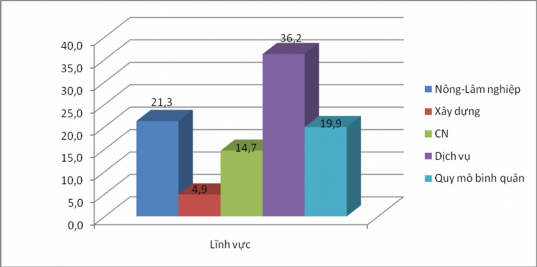
Source: Compiled from FIA statistics
Figure 2.1: Average scale of investment projects in Laos during the period
2005-2010
In terms of the number of registered projects, the industrial sector has 88 projects with the highest total registered capital of 1,290.45 million USD; the agricultural and forestry sector has 35 projects with a total registered investment of 744.06 million USD; the service sector has 33 projects with a total registered investment of 1,194.33 million USD; the construction sector has only 8 projects with a total investment of 39.12 million USD.
According to the graph above, it can be seen that:
- The average investment level in the service industry reached 36.2 million USD/project, which is very high but does not reflect the true nature of investment in the service industry in the period 2005-2010, because in this period most of the projects were small in scale. In 2009 alone, there was only 1 project of the Investment and Trading Joint Stock Company.
Long Thanh Golf invested in the golf course and real estate sector in Vientiane and registered to invest 1 billion USD, increasing the average investment scale.
- Investment projects in the Agriculture - Forestry sector have an average scale of 21.3 million USD/project, which is a relatively high investment level. Because most projects in the Agriculture - Forestry sector are rubber tree planting projects that require large-scale investment, organizing industrial production to ensure industrial production efficiency.
- The industrial sector has an average investment scale of 14.7 million USD/project. This is an industry with a lower investment level than the average (19.9 million USD).
- The construction industry has the lowest average investment project scale because large enterprises are not very interested in this field because of low investment efficiency. When receiving a construction project, not only do they not receive advance capital, they do not receive partial payments, but they also have to pay a long debt, and it is often very difficult to collect the debt.
The average scale of registered investment projects in the period 2005-2010 reached 19.9 million USD/project, which is quite high for investment projects of Vietnamese enterprises in Laos. If the investment is implemented on schedule and reaches this registered value, it will create favorable conditions for Vietnamese enterprises to operate in Laos, increase business efficiency and make good use of the advantage of scale.
2.2.2 Overview of Vietnamese enterprises implementing OFDI in the industrial sector in Laos
In the period 2005-2010, 88 Vietnamese enterprises have invested in Laos. Among them, the author sent survey questionnaires to 20 enterprises with large registered investment capital and many projects. The survey results obtained from 16 enterprises responded as follows :
3 Within the scope of this thesis, a survey in the form of a sociological investigation was conducted in March 2010 with 20 Vietnamese enterprises that have invested in Lao industry. Of these, 16/20 surveyed enterprises responded (accounting for 80% of the total number of surveyed enterprises). Those 16 enterprises have registered for new investments 22
+ The time that enterprises have been implementing OFDI in Laos is over 5 years (8 enterprises), accounting for 50% of the enterprises responding to the survey. The number of enterprises doing business in Laos from 3-5 years is 5 enterprises, accounting for 31%, and there are 3 enterprises that have just done business in Laos from 1-3 years, accounting for 19%.
+ Regarding charter capital as of December 31, 2009: Most Vietnamese enterprises investing in Laos have a fairly large charter capital. Specifically, there are 6 enterprises with capital of 500 billion VND (accounting for 37.5%); 3 enterprises with charter capital of 200-500 billion VND (accounting for 18.75%), 4 enterprises with charter capital of 50-200 billion VND (accounting for 25%) and 3 enterprises with less than 50 billion VND (accounting for 18.75%). Thus, the number of enterprises with charter capital of over 50 billion VND accounts for 81.25% of the total number of enterprises surveyed investing in Laos.
+ Regarding total number of employees: as of December 31, 2009, there were 3 enterprises employing less than 300 employees (18.75%), 4 enterprises with 300-500 employees (25%), 1 enterprise with 501-1,000 employees (6.2%), 3 enterprises with 1,001 to 2,000 employees (18.75%); 5 enterprises with over 2,000 employees (31%).
+ Revenue of most surveyed enterprises increased: 13 enterprises (81.25% of enterprises providing information) said their revenue increased, only 3 enterprises (18.75%) said their revenue decreased.
+ Regarding business lines in Vietnam: Most businesses operate in multiple industries: Out of 16 surveyed businesses, 11 businesses (68.75%) said they operate in multiple industries.
Projects in the 2005-2009 period with a total registered investment of 981.637 million USD (accounting for 76% of total registered capital in the 2005-2010 period)