
growth, and milk production of first calf heifers sired by seven breeds and raised on different levels of nutrition”, J. Anim. Sci, 76, pp. 1511 – 1522.
95. Gompertz (1825), Gompertz function , Retrieved May 25, 2007 http://en.wikipedia.org/wiki/Gompertz_curve
96. Gottardo F., Ricci R., Preciso S., Ravarotto L. and Cozzi. G (2004), “Effect of the manger space on welfare and meat quality of beef cattle”. Livestock Production Science, 89, pp. 277 – 285.
97. Hocquette JF, Graulet B., Castiglia Delavaud., Bornes F., Lepetis N. and Ferre P. (1996), Insulin- sentive glucose transport transcript levels in culf muscules assessed with bovine GLUTT4 cDNA fracmen
Maybe you are interested!
-
 Reproductive performance of Brahman crossbred cows bred with Droughtmaster, Charolais, Red Angus and meat production of offspring in Quang Ngai province - 2
 -
 The influence of father and mother weight and intensive farming on weight, growth and meat production of buffalo - Nguyen Cong Dinh - 18
 -
 Production and Business Performance Results of La Nga Forestry Company Limited
 -
 Production and Business Performance Results for the Period 2017 - 2019
 -
 Expanding Production Capacity, Promoting Economic Growth and Development
98. Hofmann K. (1988), “pH - A quality criterion for meat”,
Fleischwirtsch, 68, pp. 65 – 69.
99. Honikel KO (1997), “Reference methods supported by OECD and their use in Mediterranean meat products”, Food Chemistry, Vol, 59, pp. 573 – 592.
100. Holroyd (1988), “Reproductive performance of 50% Bos indicus cattle grazing the Mitchell grasslands of north Queensland 1973 – 80”, Proc. Aust, Rangle, Soc, 5, pp. 49 – 53.
101. Jaturasitha S., Norkeaw R., Vearasilp T., Wicke M. and Kreuzer M. (2009), “Carcass and meat quality of Thai native cattle fattened on Guinea grass ( Panicum maxima ) or Guinea grass – Legume ( Stylosanthes guianensis ) pastures”, Meat Science, 81, pp. 155 – 162.
102. Johansson I. (1968), Genetics and animal breeding , Oliver and Goyd, Edinburgh, London, pp. 364 – 367.
103. Kearl LC (1982), Nutrien Requirements of Ruminants in Developing Countries. International Feedstuff Institute, Utah Agricultural Experiment Station. Utah State University, Logan, USA.
104. Kenneth Luvenberg (1944), “A method for the Solution of certain Non – Linear Problems in Least Square” The Quartly of the Applied Methematics, 2, pp. 164 – 168.
105. Kohn F., Sharifi AR and Simianer H. (2007), “Modeling the growth of Goettingen Minipig”, Journal of Animal Science , 85, pp. 84 – 92.
106. Koots KR, Gibson JP Smith C. and Wilton JW (1994), “Analyses of published genetic parameter estimates for beef production traits. 1. Heritability”, Animal Beeding abstracts, 62, pp. 309 – 388.
107. Koots KR, Gibson JP and Wilton JW (1994), “Analyses of published genetic parameter estimates for beef production trait. 2. Phenotypic and Genetic correlations”, Animal Breeding abstracts, 62, pp. 825 – 853.
108. Lambe NR, Navajas., Simm G. and Bunger (2006), “A genetic investigation of various growth models of lambs of two constrasting breeds”, J. Anim Sci , 84, pp. 2642 – 2654.
109. Lawrence RW, Doyle J., Eliott R., Loxton I. and Mc Meniman JP (2006), “The efficacy of a vitamin D3 metabolite for improving the myofibrillar tenderness of meat from Bos indicus cattle”, J. Meat. Sci, 72, pp. 69 – 78.
110. Li CB, Chen YJ, Xu XL, Huang M., Hu TJ and Zhou GH (2006), “Effects of lawvoltage electrical stimulation and rapid chilling on meat quality characteristics of Chinese Yellow crossbred bulls”, J. Meat Sci, 72 , pp. 9 – 17.
111. Mandell IB, Buchanan – Smith JG and Campbell CP (1998), “Effect of forage vs grain feeding on carcass characteristics, fatty acid composition, and beef quality in Limousin – cross steers when time on feed is controlled”, J. Anim Sci, 76, pp. 2619 – 2630.
112. NRC (2002), The nutrient requirements of beef cattle , Washington DC.
113. Ouali A. (1991), “Sensory quality of meat as affected by muscle biochemistry and modern technologie”, In, LO Fiems, BG Cottyn et DI Demeyer (eds), Animal biotechnology and the quality of meat production (Elsevier, Amstecdam ), pp. 85 - 105.
114. Page. J.K., Wulf. DM and Schwotzer (2001), “A survey of beef muscle color and pH”, J. Anim. Sci, 76, pp. 678 – 687.
115. Peacock FM, Koger M., Palmer AZ, Carpenter JW and Olson TA (1982), “Additive breed and heterosis effects for individual and maternal influence on feedlot gain and carcass traits of Angus, Brahman, Charolais and cross steers”, Journal of Animal Science, 55, pp. 797.
116. Perry TW (1990), “Dietary nutrient allowance for beef cattle”.
Feedstuffs – Reference issue, 62, 31, pp. 46 – 56.
117. Phocas F. and Laloe. D. (2004), “Genetic parameters for birth and weaning traits in french specialized beef cattle breeds”, Livestock production Science, 89, pp. 121 – 128.
118. Preston TR, Willis MB and Elias A. (1967), Intensive Beef Production from Sugar cane.
119. Rao MK, Nagarcenkar R. and Sharma KNS (1977), “Evaluation of performance of Brownswiss × Zebu crosses for early trait, Indian, J.Anim. Sci, 45, pp. 514-520.
120. Realini CE, Duckett SK, Brito GW, Dalla Rizza. M. and De Mattos
D. (2004), “Effect of pasture vs concentrate feeding with or without antioxidants on carcass characteristics, fatty acid composition, and quality of Uruguayan beef”, Meat Science, 66, pp. 567 – 577.
121. Realini CE, Duckett SK, Hill NS, Hoveland CS, Lyon BG, Sackmann JR and Gillis MH (2005), “Effect of endophyte type on carcass traits, meat quality, and fatty acid composition of beef cattle grazinh tall fescue”, J. Anim. Sci, 83, pp. 430 – 439.
122. Sansory R., Aart G. and Leng RA (1998), “ MUB as a multinutrient supplement for ruminants”, Sugar cane as feed , Editors, Sosoucy. R; Aart. G; Preston TR Rome, pp. 263 – 279.
123. Setthakul J., Opatpatanakit Y., Sivapirunhep P. and Intrapornudom P. (2008), “Beef quality under production systems in Thailand”, Preliminary remarks.
124. Shakelford SD, Koohmaraie M., Wheeler TL, Cundiff LV and Dileman ME (1994), “Effect of biological type of cattle on the incidence of the dark, firm, and dry condition in the longissimus muscle”. J. Anim. Sci , 72, pp. 337 – 343.
125. Shakelford SD, Wheeler TL and Koohmaraie M. (1997), “Tenderness classification of beef: I. Evaluation of beef longissimus shear force at 1 or 2 days as a predictor of aged beef tendness”, J. Anim. Sci , 75, pp. 2417 – 2422.
126. Shull GH (1952), Beginnings of the heterosis concept , Iowa State College Press.
127. Silva AT, Greenhalgh JDF and Orskov ER (1989), “Influence of ammonia treatment and supplementation on the intake, digestibility and weight gain of sheep and cattle on barley straw diet”, Anim. Prod , 48, pp. 99-108.
128. Simm G. (1998), Genetics improvement of cattle and sheep, Farming press, Ipswich.
129. Smith GC, Duston TR, Hostetler RL and Carpenter ZI (1976), “Fatner, rate chilling and tenderness of lamb”, J. Food. Sci , 41, pp. 748 - 756
130. Splan RK, Cundiff LV, Dikeman ME and Van Vleck LD (2002), “Estimates of parameters between direct and maternal genetic effects for weaning weight and direct effects for carcass genetic traits in crossbred cattle”, J. Anim. Sci , 80, pp. 3107 – 3111.
131. Nguyen Van Thuong (1995), “Some results of study of beef and dairy cattle in Vietnam”, Exploring approaches to research in the animal sciences in Viet Nam , pp. 46 – 49.
132. Tyler (1998), “Liveweight gain of Brahmnan cross heifers supplemented during the dry season with fortified molasses”, Beef cattle performance in northern Australia (a summerry of recent research), Department of Primari industries, Queensland, Brisbane, pp. 100.
133. Williamson G. and Payner WJA (1978), An introduction to animal husbandry in the tropics, Third edition, Longman, London and New York, pp. 210 – 215.
134. Wood JD, Kempster AJ and David PJ (1987), “Observation on carcass and meet quality in pigs”, Animal Prod , 44, pp. 448.
135. Wulf DM, Emnett RS, Leheska JM and Moeller SJ (2002), “Relationships among glycolytic potention, dark, cutting (dark, firm and dry) beef, and cooked beef palatability”, J. Anim. Sci, 80, pp. 1895 - 1903
136. Yang 3251 – 3258.
137. Zhou GH, Liu L., Xiu XL, Jian, Wang LZ, Sun BZ and Tong B.
S. (2001), “Productivity and carcass characteristics of pure and crossbred Chinese Yellow cattle”, Meat Science 58, pp. 359 -362.
C French, German
138. Alder D. (1980), Estimattion des volumes et accroisement des peulements foresties , Vol 2, FAO, Rome, pp. 30 – 40.
139. Cabaraux JF, Hornick JL, Dufransne I., Clinquart A. and Istasse L. (2003), “Enrissement de la femelle de forme Blanc – Bleu Belge cularde: performances zootechnicques, caratéristiques de la carcasse et qualité de la viande”, Ann, Méd, Ved , 147, pp. 423 – 431.
140. Clinquar A., Leroy B., Dotreppe. O., Hornick JL, Dfrasne I. and Istasse L. (2000), Les facteurs de production qui influence la qualité
de la viande des bovines Blanc Bleu belge .
141. Dufrasne I. (1994), “Contribution à l'étude de différents paramètres influencant l'utilisation de la prairie permanente par la vache traite, la vache allaitante et le taurillon”, Thèse présentée envue de l'obtention du grade d' Agrégée de l'Enseignement Supérieur , Université de Liège, pp. 272.
142. Honikel KO (1998), “Physikalische MeBmethoden zur Erfassung der Fleischqualitat”, Qualitat von Fleisch und Fleischwaren, Band 2, pp. 696 – 700.
143. Institus de l'Elevage (2006), “La composante structurelle et l'acidification du muscle (pH)”, Le point sur la couleur de la viande bovine, Fiche 3, pp. 1-5.
144. Monin G. (1988), “Stress d'abattage et qualite's de la viande”, Rec, Me'd, Ved, 164, pp. 835 – 842.
APPENDIX
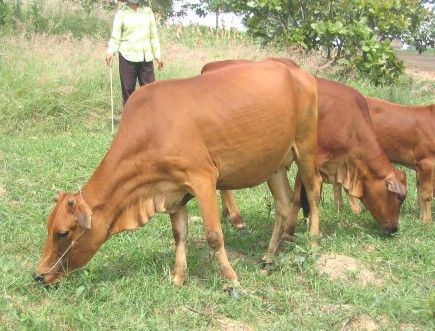
SIND HYBRID COW
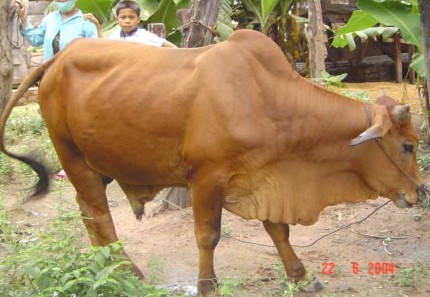
SIND HYBRID BULLY
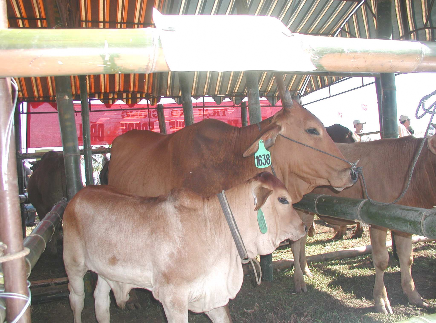
LAISIND BELT (BRAHMAN × LAISIND), AT THE COW FAIR IN EAKAR DISTRICT, DAK LAK PROVINCE
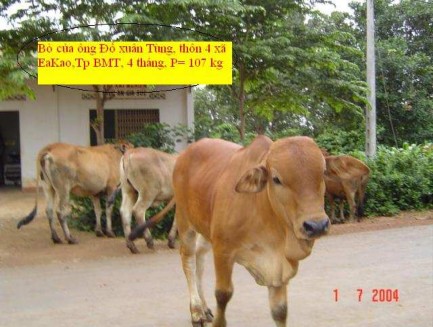
BRAHMAN × LAISIND CALF , 4 MONTHS OLD, WEIGHT 107 KG