
except for state-owned enterprises (there is only one company with foreign investment).
As for the outsourced logistics activities, the top five outsourced activities include domestic transportation (accounting for 100%), delivery services, warehousing, customs clearance, and domestic transportation. This result is consistent with the global outsourcing trend, reflected in the 12th edition of the Annual Report on the World Logistics Outsourcing Situation in 2007. Domestic transportation requires large capital investment and good management such as investment in vehicle fleet, driver management, and fleet maintenance; therefore, all customers outsource to domestic transportation companies.
Figure 15: Group of five outsourced logistics activities
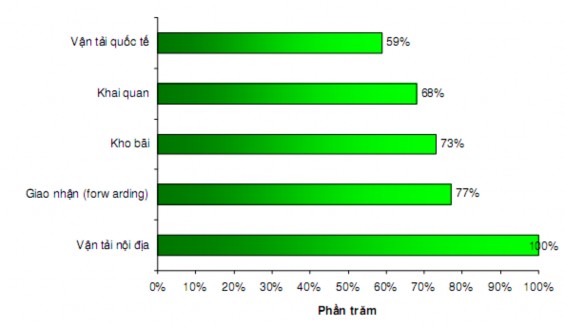
(Source: SCM) More complex logistics activities such as order management, cross-docking, consolidation, payment services and freight management, etc. were not selected. Information related to these services is sensitive and companies do not want to share it with outsiders. Moreover, only third-party logistics service providers (3PLs) with expertise and technology systems
Maybe you are interested!
-
 Current Status of Logistics Services Business Activities at I Trading Joint Stock Company I
 -
 General Assessment of the Current Development Situation of Electronic Banking Services in Vietnam
 -
 Legal issues of Logistics services in Vietnam - 2
 -
 Business development strategy of Logistics services of Vietfracht Transport and Chartering Joint Stock Company in the integration process - 13
 -
 Experience in developing Logistics services in some ASEAN countries and lessons for Vietnam - 2
Only modern information technology has the capacity to take over these services. However, in the future, participating companies are considering the possibility of outsourcing some complex activities such as Vendor Managed Inventory (WMI), reverse logistics, and supply chain consulting.
But there are also some companies that do not choose to outsource because they cannot reduce costs or control logistics operations and the quality of service is not as promised. Of these companies that do not outsource, 50% said they plan to outsource in the future; most of them are companies in the consumer packaged goods group. 38% said they will consider outsourcing, the remaining 12% will not outsource.
Regarding the criteria for selecting suppliers, companies ranked 11 criteria according to their importance when choosing a logistics service provider. The first place was price and service. This is not surprising because these two criteria are always discussed when signing a contract. However, all other criteria such as experience, human resources, continuous improvement ability, etc. are equally important when customers evaluate their suppliers overall.
In summary, the industries that are outsourced are still mainly consumer packaged goods, consumer electronics, and seafood. Traditional logistics activities such as transportation, warehousing, customs clearance, and delivery are still outsourced the most. And price and service quality are still the first and foremost factors when signing service contracts.
3.3 Logistics service provider
Although logistics has been developing strongly in the world, it is still quite new in Vietnam, most logistics services are performed by freight forwarding companies. Along with the integration process, logistics and logistics services have followed foreign investors to Vietnam. Recently, there have been remarkable developments in this field.
According to the Vietnam Freight Forwarders Association (VIFFAS), up to now, there are about 800-900 enterprises operating in the field of providing logistics services in Vietnam. In terms of development level, there are freight forwarding enterprises participating at all levels. However, currently, most Vietnamese enterprises providing logistics services in the field of maritime transport only play the role of satellite service providers for foreign logistics companies (only undertaking a part of the logistics chain). Therefore, enterprises operating in the field of logistics are mostly traditional freight forwarding agents, a very small number are freight forwarding agents playing the role of goods collectors and issuing house bills of lading. As we can see, logistics management is the regulation of a set of activities of many industries, many stages in a complete process, any enterprise that is entrusted to perform all the work related to supply, transportation, production monitoring, warehousing, distribution procedures... is recognized as a logistics service provider. According to this criterion, currently in Vietnam there is no enterprise capable of organizing and operating the entire logistics process. However, there are 25 leading logistics service providers in the world present in Vietnam in many different forms. This has forced Vietnamese logistics enterprises to strive to develop to compete with them. And through the services associated with them, we can learn many things from them to develop logistics services in Vietnam more professionally and systematically. The benefits that logistics brings to Vietnamese enterprises are saving costs in transportation business activities, increasing flexibility in business activities, improving the quality of services provided by enterprises and increasing revenue and profits for enterprises.
However, Vietnamese logistics enterprises still face many difficulties as follows:
- Vietnamese logistics enterprises are mostly latecomers compared to many foreign companies with a long history of developing transportation business such as APL with over 100 years of experience, Maersk with nearly 100 years of experience...
- The coverage of Vietnamese logistics service companies is only within the domestic scope or a few countries in the region. While the coverage of foreign companies such as APL is nearly 100 countries, Maersk is 60 countries...
- Most Vietnamese logistics enterprises only focus on exploiting small segments in the entire supply chain.
- Human resources are both lacking and weak, the whole country does not have any specialized schools for logistics training. The knowledge that employees have is learned from abroad, some from specialized universities in the country with limited knowledge and lack of updates.
- Information infrastructure is still weak. Although businesses have been conscious of applying information technology to their business operations, they are still far behind foreign companies.
- Most businesses in the industry operate separately, lack mutual cooperation and support, and even compete unfairly.
III. GENERAL ASSESSMENT OF LOGISTICS SERVICES IN VIETNAM
To develop logistics services effectively in Vietnam, we need to understand what we have and what is lacking in order to come up with the most appropriate policies and solutions.
Through analyzing the current situation of the logistics service industry in Vietnam, we can draw out the strengths and weaknesses of Vietnam's logistics service industry as follows:
1. Advantages of logistics activities in Vietnam
1.1 Vietnam has been implementing integration policies.
Vietnam is accelerating the process of economic integration through reforms in mechanisms, policies, administrative procedures, and building an economic and financial legal system in line with international practices. Becoming an official member of the WTO will make Vietnam an open country in terms of trade in goods, services, and investment.
In the past 20 years, our country's diplomatic strategy has had some successes such as: the state has had many policies and laws that have been reformed and issued such as the Law on Domestic Investment Encouragement, the Law on Foreign Investment Encouragement, Tax Policy, etc. Administrative reform has freed Vietnamese enterprises to promote their initiative and creativity, contributing to the restoration and development of the country's economy; at the same time, attracting foreign investors to invest in Vietnam. Foreign policy has begun to be linked with the revival of the country's economy and gradually integrating the Vietnamese economy into the international economy. In the 20 years of renovation, Vietnam has established diplomatic relations with 57 more countries, bringing the total number of countries with official relations with Vietnam to 169 countries, and trade relations with 224/255 markets of countries and territories .
Orientation of foreign policy in the following years until 2020, especially diplomacy serving the economy and international integration, such as strengthening leading partnerships with major countries such as the US, Japan, Russia, Korea, China...; Creating all favorable conditions in terms of policies, and transparent administrative procedures to truly open up and attract investment from the above partners. In addition, marketing should be strengthened to seek and expand markets for Middle Eastern, African and Indian countries; through cultural exchanges, tourism, seminars on Vietnam's open-door policy is a point
full of potential and promise for developing countries.
1.2 Convenient geographical location
Vietnam has a very favorable geographical position for international transport, located in a strategic area in Southeast Asia. Vietnam is located in the East of the Indochina peninsula, bordering Laos and Cambodia to the West, and facing the East and South Seas and the Pacific Ocean to the East and South. Vietnam is also a traffic hub from the Indian Ocean to the Pacific Ocean. Vietnam is located in the center of the East Sea, where there are busy sea routes, so the flow of goods and trade within the region and between the region and the world is very large, creating opportunities for logistics development. The land border is 3,730 km long, the coastline stretches over 3,260 km, there are many deep-water ports, international airports, a transnational railway system and a transportation network, which are favorable premises for logistics development and Vietnam is also assessed to have great potential for logistics service development.
1.3 Foreign investment in Vietnam is increasing
Specifically, ODA capital for infrastructure development and capital from non-governmental organizations supporting Vietnam are increasing.
For example, on March 31, 2009, in Hanoi, Japanese Ambassador to Vietnam Sakaba Matsuo and Minister of Planning and Investment Vo Hong Phuc signed an exchange of notes related to the first four ODA loan projects that were resumed with a total value of 83.2 billion Yen (equivalent to 900 million USD). According to Mr. Tsuno Motonori, Chief Representative of JICA in Vietnam, the projects signed this time include: The project to build the first railway line in Hanoi (Nam Thang Long - Tran Hung Dao section going into the city center) is 11 km long, including 8.5 km underground. The project is worth 14.688 billion Yen. It is expected to start construction at the end of 2011 and be completed in 2014, officially operating in January 2016. This project applies the conditions of using Japanese technology. The second project is the Transport Sector Credit to improve the national road network in the period
Phase 2. Project value 17,918 billion Yen. Through the repair and replacement of weak bridges in rural areas, the project will promote the local economy and reduce the gap between rural and urban areas. The third project is Hai Phong City Environmental Improvement Project with a value of 21,306 million Yen. The fourth project is Hanoi Environmental Improvement Drainage Project Phase 2. Value 29,289 billion Yen, interest rate 0.55%/year, payment period 40 years, grace period 10 years [28]. Therefore, Vietnam's transport infrastructure will be greatly improved, providing an open network to create momentum for logistics development.
1.4 The strong development of information technology
The development of information technology has brought many benefits to logistics activities in general and port operations in particular. The Internet has become an effective tool for conducting e-commerce activities.
On the basis of the Internet, the Government, represented by the port authority, together with the port operators, has developed and completed the Electronic Data Interchange (EDI) system. This system allows connection between ports with each other, and between ports and their trading partners, including management agencies such as Customs, statistical agencies, etc.
This system helps seaports simplify paperwork, reduce the possibility of errors (caused by humans), and save a lot of time and costs in port operations. In July 2005, we began piloting electronic customs clearance in some localities.
In addition, container loading and unloading and transportation activities at seaports are also fully automated to optimize loading and unloading and transportation. Container loading and unloading operations at the wharves of major ports are mostly computerized. Shore cranes located at the wharves are controlled by computers and will automatically perform loading and unloading operations.
containers from ships to container trailers and vice versa. Electronic sealing technology (e-seal) will help to minimize the time for container inspection and container transportation procedures, while creating a more transparent process at the seaport.
With the continuous advancement of science and technology, companies specializing in research and providing solutions and equipment for the supply chain have successfully applied radio frequency identification (RFDI) technology and are gradually commercializing this technology. When widely applied, this technology promises to create a revolution in the field of supply chain management. VICT is the first port in Vietnam to apply this system. This system is a timely and practical solution that has helped VICT make the most of warehouse space, avoid unreasonable container movement, and take advantage of equipment downtime. This also helps reduce port costs, help determine the exact location of containers and save loading and unloading time.
This is one of the prerequisites for the development of Vietnam's logistics industry to meet the needs of international economic integration.
2. Weaknesses in logistics activities in Vietnam
2.1 Logistics infrastructure in Vietnam is still poor, small-scale and unsynchronized.
Vietnam's transport infrastructure system includes over 17,000 km of asphalt roads, nearly 3,200 km of railways, 41,000 km of waterways, 126 seaports and 135 airports. However, the quality of this system is uneven, poor, and in some places not technically guaranteed. Currently, only about 20 seaports can participate in international cargo transportation. The ports are in the process of containerization but can only receive small fleets and are not equipped with modern container handling equipment, and lack experience in container handling operations. Logistics companies themselves will