
F a2 = F t1 =
2 T 1
d 1
The force F a1 acting on the screw has a very large value, easily causing the screw to become unstable.
6.3. Calculating the durability of screw transmission
6.3.1. Failure modes and calculation criteria of screw transmission
During operation, the worm gear - worm gear can appear in various forms.
following failure:
- Surface scratches, often occur in transmissions with large contact surface pressure and relatively large working speed . On the screw thread surface, there are metal particles stuck, which are broken off from the worm gear. The thread surface becomes rough. At the same time, the worm gear tooth surface is scratched . The surface quality is significantly reduced, the transmission no longer works well.
Cause: due to high stress and high temperature, the material of the worm gear at the contact point reaches a plastic flow state. The metal is pulled out and sticks to the screw thread surface, forming lugs, these lugs scratch the worm gear tooth surface.
- Worm gear teeth and screw shaft threads wear, due to very high sliding velocity, so the wear rate is high.
Worm gear materials have low mechanical properties, so they wear more. Wear weakens the tooth roots and sharpens the teeth. Wear often occurs in transmissions with medium pressure and inadequate lubrication .
- Deformed tooth surface, there are convex and concave spots on the worm gear teeth, the tooth shape is changed , the transmission does not mesh well anymore. This type of failure often appears in transmissions with large contact surface pressure and low working speed.
- Broken gear teeth, one or several teeth separated from the gear. Broken teeth are a dangerous form of failure.
Tooth fracture can be caused by overloading, or by fatigue, when the bending stress on the root cross-section
teeth exceed the allowable value.
- Pitting of the tooth surface, on the screw shaft thread surface and worm gear teeth there are small and deep holes, damaging the tooth surface, the transmission no longer works well. Pitting often occurs in worm gear transmissions made of bronze with high anti-stick strength, low contact stress and full lubrication.
- Working temperature is too high. When the temperature exceeds the allowable value, it will reduce the quality of the lubricating oil. It will change the properties of the joints, which can lead to stuck bearings. It will cause the shafts to lengthen, which can increase the secondary load.
- The screw shaft is bent, due to instability. For drives with image screw shafts , the ratio between the distance l 1 and the diameter d f1 is too large. The axial force F a1 compresses the screw shaft, causing the screw shaft to become unstable.
To avoid the above mentioned types of failures, the screw transmission is calculated according to the following
target:
(6-1)σ F2 ≤ [ σ F2 ] | (6-2) |
θ lv ≤ [θ] | (6-3) |
F a1 ≤ [F a ] | (6-4) |
Maybe you are interested!
-

 Criteria for Evaluating the Efficiency of Deposit Mobilization Activities of Commercial Banks
 -
 Criteria for Assessing the Sustainability of Tourism Activities
 -
 Divergence of Land Use Criteria in the Planning of Van Yen District in 2014 and Forecast for 2015 (Unit: %)
 -
 Resource Accessibility Criteria Assessment
 -
 Present the Definition, Diagnostic Criteria According to International Convention and State the Epidemiological Characteristics of Nephrotic Syndrome
σ H ≤ [σ H2 ]
In there:
σ H is the contact stress at the critical point on the tooth surface,
[σ H2 ] is the allowable contact stress of the worm gear tooth surface.
σ F2 is the bending stress at the dangerous point on the cross-section of the worm gear tooth, [σ F2 ] is the allowable bending stress of the worm gear tooth, calculated according to fatigue strength. θ lv is the working temperature of the worm gear.
[θ] is the allowable operating temperature of the transmitter.
[F a ] is the allowable axial force of the screw shaft.
Calculation of screw transmission according to criterion ( 6-1), is based on contact strength.
Calculated according to index (6-2), called calculated according to bending strength.
Calculate according to index (6-3), called calculation according to heat resistance conditions.
Calculated according to index (6-4), called calculated according to screw shaft stability.
If the worm drive is subjected to an overload for a short period of time, it is necessary to
static strength test, called overload load transmission test .
6.3.2. Calculation of screw transmission based on contact strength
q n . E
The contact stress generated on the tooth surface is determined by the Hertz formula.
In there:
H 0.418.
(6-5)
E is the equivalent elastic modulus of the screw and worm gear material, MPa.
E = 2.E 1 .E 2 /(E 1 +E 2 )
E 1 , E 2 are the elastic modulus of the screw and worm gear materials,
q n is the load intensity on the tooth contact line, N/m m,
n
q F n . K l H
Hv . KH
K Hv is the coefficient taking into account the dynamic load used to calculate the contact stress,
K Hβ is the coefficient taking into account the uneven load distribution over the tooth length,
l H is the contact length of the tooth pairs. Approximately l H ≈ 1,2d 1 /cosγ,
ρ is the equivalent radius of curvature of the two surfaces at the point of contact,
1 . 2
1 2
ρ 1 is the curvature radius of the screw thread profile, ρ 1 = ∞,
ρ 2 is the curvature radius of the center point of the worm gear tooth, with ρ 2 = d 2 .sinα/(2.cosγ).
Substitute F n = F t2 /(cosγ.cosα), along with other parameters into the Hertz formula. Using common values , E 1 ≈ 2.15.105 MPa; E 2 ≈ 0.9.105 MPa; α = 20 0 ; and γ≈10 0 ; we have the formula for calculating contact stress:
T 2 . KHv . KH
d 1
H
480 .
(6-6)
d 2
The allowable contact stress [σ H ] is determined experimentally, depending on the material of the worm gear, the lubrication method, the importance of the transmission and the number of stress cycles during the life of the transmission. It can be looked up directly from tables, or calculated by empirical formulas.
The problem of testing the durability of screw transmission according to contact strength is carried out.
as follows:
- Calculate the contact stress generated at the dangerous point of the worm gear tooth surface, the tooth midpoint is on the rolling circle, according to formula (6-6).
- Determine the allowable contact resistance [ σ H2 ] of the worm gear.
- Compare the values of σ H and [σ H2 ], and conclude. If σ H ≤ [σ H2 ], the transmission has sufficient contact strength.
The problem of designing screw transmission based on contact strength, performing the following contents:
Main content:
- Select material and heat treatment. Determine allowable stress [ σ H2 ].
- Assuming that the criterion σ H ≤ [σ H2 ] is satisfied, use formula 8-6 , with the following notes:
d 1 = mq; d 2 = z 2 .m; and m = 2.a w /(q+z 2 ). We have the formula for calculating the axial distance as follows:
170 2 T . K . K
z
H 2
a w z 2q . 3
2.
2 Hv H
q
(6-7)
6.3.3. Calculation of screw drive based on bending strength
Determining the exact stress σ F2 on the tooth root of a worm gear is relatively complicated, because the tooth root is curved and the tooth cross-section changes along the tooth length. An approximate calculation is used, considering the worm gear as a helical gear with a helical angle β = γ. The stress σ F2 is calculated according to the formula for helical gears. With the commonly used angle γ equal to 10 0 , we have the formula for calculating σ F2 :
F 2
1.4. T 2 . K Fv . K F . Y
(6-8)
d
F 2
2
. B 2 . m n
In which, the modulus m n = m.cosγ; the tooth form factor Y F2 is looked up according to x 2 and the equivalent number of teeth z 2tđ = z 2 /cos 3 γ.
The value of [σ F ] is selected depending on the material of the worm gear, the number of bending stress cycles, and the size of the teeth .
The problem of testing the durability of screw transmission according to bending strength is performed as follows:
- Determine the allowable stress [σ F2 ] of the worm gear, from the lookup tables, or calculate according to
empirical formula
- Determine the tooth form factor Y F2 of the worm gear.
- Calculate the bending stress σ F2 on the cross-section of the worm gear tooth root according to formula (6-8).
- Compare σ F2 with [σ F2 ], and conclude:
If σ F2 ≤ [σ F2 ], gear 2 is strong enough.
The tooth modulus on the end plane is calculated by the formula m = 2a w /(q+z 2 ), taking m according to the standard series. Then calculate the tooth modulus on the normal plane m n = m.cos γ.
6.3.4. Screw shaft calculation under stability conditions
Screw shafts are usually manufactured as a single shaft, and the shaft strength will be calculated accurately according to the safety factor (see the Shaft chapter). Here , we only present the method of checking the shaft stiffness by calculating an axial compression bar. Usually, we only carry out the test on thin shafts with length l 1 ≥ 25.d f1 .
Screw compression force F a1 is determined by the formula:
F a 1
F t 2
2. T 2
d
2
The allowable axial force [F a ] is determined by Euler's formula:
1
In there:
F a
2 . E . JS .( . l ) 2
E is the elastic modulus of the shaft material,
J is the moment of inertia of the screw thread cross section,
S is the safety factor for stability. S can be taken as 2.5÷4.
. d 4
f 1
J
64
µ is the linkage coefficient. The screw has two bearings, so µ can be taken as 1.
l 1 is the distance between the two screw bearings.
To check the stability of the screw, we compare the force value F a1 and the force [F a ], and draw a conclusion. If F a1 ≤ [F a ], the screw is stable. If F a1 > [F a ], then we must find a solution. We can increase the diameter d f1 , or shorten the distance l 1 .
6.3.5. Check the screw drive for overload load
If the transmission is subjected to a load P max for a short time, we determine the coefficient value
overload K qt = P max /P. Check the transmission for static strength, based on the following criteria: σ Hqt ≤ [σ Hqt ]
σ Fqt ≤ [σ Fqt ]
K qt
In which, contact stress and overload bending stress are calculated according to the formula:
Hqt
H 2 .
, Fqt
F 2 . K qt
6.4. Materials and allowable stresses
Materials for manufacturing screws and worm gears can be selected as follows:
- When transmitting small power (under 3kW), use unground Archimedes or Covolut screws. Screws are made of steel C35, C45, C50, C35CrCu, improved hardening with surface hardness under 350 HB.
- When transmitting medium and large power, people use ground screw shafts. Usually use steel C40Cr, 40CrNi, 12CrNi3Al, 20CrNi3Al, 30CrMnPb Al, hardened to achieve surface hardness of 45÷50HRC. After cutting the thread, harden the thread surface, then grind the thread and polish. I often use screw shafts that mesh with bronze worm gears.
- Worm wheels in closed transmissions with sliding velocity v tr ≤ 5 m/s, are made of tin-free bronze, such as: BCuAl9Fe4, BCuAl10Fe4Ni4; or brass LCu66Al6Fe3Mg2, LCu58Mg2Pb2.
If the sliding speed is in the range of 5÷12 m/s, the worm gear is made of bronze.
Tin-less bars , such as : BCuSn6Zn6Pb3, BCuSn5Zn5Pb5.
If the sliding velocity is even greater, tin-rich bronze can be used, such as:
BCuSn10P1, BCuSn10NiP.
- In manual transmissions or small capacity, the worm gear is made of cast iron, for example : GX10, GX15, GX18, GX20. In this case, use a screw shaft made of steel C35, C40, C45, improved tempering to achieve a roughness of 300 HB÷350 HB.
The allowable contact stress can be selected as follows:
N
4
N 0
- For bronze screw wheels, with σ b < 300 MPa, take: [σ H ] = (0.75÷0.9) σ b .K NH ,
In which: K NH is the coefficient taking into account the number of stress cycles. K NH
- For tin-free bronze worm gears, with σ b > 300 MPa, take [σ H ] = 250 MPa, when velocity v tr = 0.5 m/s,
[σ H ] = 210 MPa, when velocity v tr = 2 m/s, [σ H ] = 160 MPa, when velocity v tr = 4 m/s, [σ H ] = 120 MPa, when velocity v tr = 6 m/s,
- For cast iron worm gears, take [σ H ] = 120 MPa, when velocity v tr = 0.5 m/s, [σ H ] = 110 MPa, when velocity v tr = 1 m/s,
The allowable bending stress can be taken as follows:
- For unidirectional rotating bronze worm gear, take
[σ F ] = (0.25σ ch + 0.08σ b )K NF
bidirectional rotation, take [σ F ] = 0.16σ b .K NF
N
9
N 0
K NF is a coefficient taking into account the number of stress cycles K NF
- For cast iron worm gear, rotating in one direction, take [σ F ] = 0.12σ bu; for rotating in two directions, take [ σ F ] = 0.075σ bu
The contact stress and the allowable overload bending stress can be selected as follows:
Tin bronze screw, take [σ Hqt ] = 4σ ch , [σ Fqt ] = 0.8σ ch ,
For tin-free bronze worm gear, take [σ Hqt ] = 4σ ch , [σ Fqt ] = 0.8σ ch , For cast iron worm gear, take [σ Hqt ] = 1.5[σ H2 ], [σ Fqt ] = 0.6σ b .
6.5. Calculation of heat, cooling and lubrication
The heat generated in the screw transmission is very large, due to the sliding on the contact surface.
contact. All the lost power will be converted into heat energy to heat the transmission.
After working for a period of time, about 20' to 40', the temperature of the screw drive stabilizes. This temperature is called the working temperature θ lv , which is calculated according to the heat balance equation.
For example, for a worm gear in a gearbox, the heat balance equation is written as follows:
Ω = Ω 1 + Ω 2
Where Ω is the heat generated in one hour, kCal/h, Ω = 860(1 - η)P 1
Ω 1 is the heat released to the surrounding environment in one hour, kCal/h,
Ω 1 = A t .K t (θ lv - θ 0 )
Ω 2 is the heat load to the outside through the cooling device, kCal/h. The value of Ω 2 is written on the cooling device.
A t is the surface area of heat dissipation to the surrounding environment, m 2 . Area
The heat dissipation surface includes the surface area in contact with circulating air and
25% of the area of the walls and bottom of the box.
K t is the heat transfer coefficient, kCal/(hm 2 . 0 C). K t can be taken as 7.5÷15 depending on the air circulation speed .
θ 0 is the ambient temperature. We can take θ 0 = 30 0 C÷40 0 C. From the above equation, we can derive the formula:
lv
860 1 . P 1 2
A . K0
(6-9)
tt
The allowable temperature value [ θ] is selected according to the type of transmission lubricating oil, calculated
working temperature of the transmission. Normally it can be taken in the range of 75 0 C÷90 0 C. The problem of checking the heat resistance condition is performed as follows:
- Calculate the operating temperature of the transmission θ lv , using formula 6-9.
- Determine the allowable temperature [θ].
- Compare θ lv and [θ], conclude . If θ lv ≤ [θ], the transmitter satisfies the tolerance condition.
heat. If θ lv > [θ], then a solution must be found to make the transmitter satisfy the heat resistance condition.
Possible treatments:
- If the temperature difference is not much, you can choose the lubricant again to increase the price.
value of [θ] up.
- Make heat sink fins to increase heat dissipation area A t .
- Can use fan, water spray to increase heat transfer coefficient K t .
- If necessary, use a cooling device to transfer heat to the outside, increasing
value Ω 2 .
6.6. Screw drive design sequence
The design of the screw drive can be done in the following sequence:
1- Select screw material, heat treatment insulation. Predict vsb sliding velocity, select material
Worm gear material. Select machining method, select machining accuracy level.
2- Determine the allowable stress [σ H2 ], [σ F2 ], if there is an overload load, it needs to be determined
add [σ Hqt ], [σ Fqt ]. Determine [F a ] and [θ].
3- Select the number of threads z 1 , calculate the number of teeth z 2 = uz 1 . Select the screw diameter coefficient q
according to the standard. Calculate the angle of elevation γ = arctg(z 1 /q). Choose a preliminary value of the efficiency η sb .
4- Calculate the axial distance a w according to formula 8-7. Calculate the modulus m = 2a w /(z 2 +q), take the value of m according to the standard. Calculate the legal modulus m n = m.cos γ.
5- Calculate the main dimensions of the transmission: Screw shaft pitch ring diameter, d 1 = md; Screw gear pitch ring diameter, d 2 = mz 2 ;
Worm wheel rim width B 2 = 0.75d a1 , when z 1 = 1 or 2.
B 2 = 0.67d a1 , when z 1 = 4.
The length of the screw thread machining part can be taken as:
B 1 ≥ (1 1 +0.07z 2 )m, when z 1 = 1 or 2.
B 1 ≥ (12.5+0.09z 2 )m, when z 1 = 4.
6- Check the sliding velocity v tr , check the efficiency value η. If it differs from the value
If the initial preliminary value is more than 5%, the value v sb must be re-selected , or η sb must be re-selected and recalculated.
7- Check the bending strength of the worm gear. If not satisfied, must adjust.
size of the transmission
8- Check the stability condition of the screw shaft. If not satisfied, the size of the transmission must be adjusted.
9- Check the heat resistance condition of the transmission. If not satisfied, find a way to handle it.
10- Draw the structure of screw shaft and worm gear. 11- Calculate the force acting on the shaft and bearing.
6.7. Screw drive
The toroidal screw differs from the cylindrical screw in that the thread is formed on the toroidal surface,
hug the worm gear with a certain arc. Because there are many threads that mesh with the worm gear teeth and the conditions for forming an oil film between the contact surfaces are better (because the contact line makes a large angle with the direction of the sliding velocity, figure 6-8), compared to the cylindrical screw transmission, the load capacity of the concave screw transmission increases by 1.4÷1.5 times. However, the concave screw transmission has some disadvantages such as: quite sensitive to errors in assembly, complicated manufacturing.
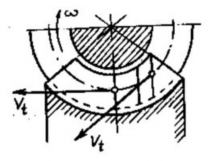
Figure 6-8
6.8. Example
Design the worm transmission in the two-stage worm gear reducer according to the following data: power on the worm N = 75kW; number of revolutions per minute of the worm n1 = 1460 rpm, number of revolutions per minute of the worm n2 = 80 rpm. The transmission rotates in one direction, the load changes insignificantly, the transmission is required to work for 5 years, 300 days a year, 6 hours a day. The error in speed is not more than ±3%.
Prize:
1. Choose material.
Preliminary calculation of sliding velocity
v 8,8.10 3 3 P . u . n
3.28( m / s ) 5( m / s )
S 1 1
We choose the material for the screw gear as tin-free bronze and brass. Specifically, we use aluminum-iron-nickel bronze. The load is average, so we choose the material for the screw shaft as C45 steel, with a surface hardness of HRC=45.
2. Determine the allowable stress.
Because the worm gear made of bronze has much lower mechanical properties than the steel worm shaft, to design it is only necessary to determine the allowable contact stress and allowable bending stress for the worm gear material. We proceed to test the worm gear.
Allowable contact stress [σ H ].
Because the worm gear is made of tin-free bronze, [σ H ] is looked up according to (table 7.2/p146). With the sliding velocity of the screw shaft calculated according to the formula
v 8,8.10 3 3 P . u . n
3.28( m / s ) 5( m / s )
S 1 1
→[σ H ]=212(MPa).
Allowable bending stress [σ F ].