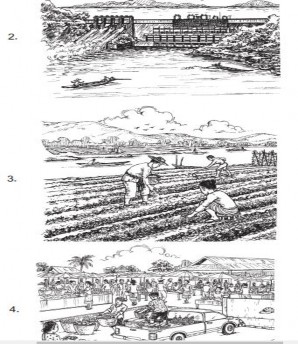
- However, some other opinions say that teaching Reading is more difficult than teaching other sub-subjects of Lao language for specific reasons:
+ To understand the content of the Reading lesson, students must have good reading skills.
+ Many lessons have long content, teachers cannot guide students to understand the content and art of the reading in too short a time (35 minutes).
- Commenting on students' attitudes when learning Reading, teachers all agree that students quite love and are passionate about the subject.
7) What do you understand by reading comprehension?
- Reading comprehension is a complex cognitive process of decoding symbols to create meaning.
- Reading comprehension is the ability to perceive, understand, interpret, create, communicate, calculate and use written or printed materials in combination with different contexts.
- Reading comprehension is reading to understand the content of the work (mainly).
8) In your opinion, how important is reading comprehension in the Reading subject in particular and Lao language in general?
Very important. Reading comprehension helps students increase their ability to receive information; learn about and evaluate life, and perceive natural and social relationships...
9) Evaluate the reading comprehension ability of students in your class in particular and students in your school in general.
- Some students do not like reading, read slowly, read softly.
- Some students cannot read new words, read with incorrect grammar, are not interested in reading, and do not understand the meaning of the lesson content.
* Student survey (Appendix 1.2)
In general, the 4th grade students participating in the survey agreed:
1) Measures teachers used in reading lessons for grade 4
STT
Content | Number quantity | Ratio | |
1 | Guide students to read the text before coming to class | 146 | 85.6% |
2 | Practice reading skills for students: reading correctly, reading expressively, reading creative | 180 | 93.2% |
3 | Building a system of supplementary questions for the teaching process reading comprehension | 68 | 35.2% |
4 | Arouse students' passion, positivity and initiative in the process of reading and understanding the text | 162 | 83.9% |
5 | Building a system of literary appreciation exercises | 90 | 46.6% |
6 | Diversify teaching methods for Reading class 4 | 135 | 70% |
8 | Teaching Reading integrated with other subjects Lao language | 164 | 84.9% |
Maybe you are interested!
-
 Research Projects Related to Reading Comprehension and Developing Students' Competency in Teaching Reading Comprehension in High Schools
 -
 Fostering students' self-study ability in teaching some knowledge of Mechanics and Electromagnetism in high school Physics with the support of social network Facebook - 21
 -
 Hoang Thanh Phuc (2009), "Research on Current Status and Solutions for Developing Scattered Forestry Planting in Thai Nguyen Province", Master's Thesis,
 -
 Research on theoretical and practical basis of developing high-quality human resources to form a knowledge-based economy in Vietnam - 27
 -
 Applying integrated pedagogical thinking in teaching some knowledge about "gases" and "basics of thermodynamics" (physics 10 - basic) to develop students' interest and ability to apply knowledge - 15
2) Other measures used by teachers during Reading lessons
Students list some measures teachers use in reading lessons:
- Use movies, pictures, and video tapes to explain words.
- Let students collect pictures to serve the lesson.
- Expressive reading contest.
- Let students go on field trips to the school yard, school garden or around the school to learn about content related to the lesson.
- Connecting to reality, integrating life skills education, environmental education, traffic safety, etc.
3) Measures that students are interested in and want teachers to use during Reading class
- Group reading, reading competition groups.
- Use mind maps.
- Teachers teach with electronic lesson plans.
- Teachers organize learning games.
- Students study the lesson in groups.
4) Comments on reading exercises in the 4th grade program
Students gave some reasons why they liked the reading exercises in the program:
- The reading has familiar content, easy to remember, easy to read, easy to learn.
- The lesson learned from the reading has profound meaning.
Students also gave specific reasons to explain why they thought some reading exercises in the program were difficult:
- The content is not really close.
- The article is difficult to read and remember because it has many difficult words and long sentences.
- The questions are difficult for students to understand.
- Some articles are too long.
Overall rating:
Through a survey of the practice of teaching reading comprehension to 4th grade students, we found that:
- Teachers are enthusiastic, passionate about their work and work with a high sense of responsibility. After each Reading lesson, teachers want to improve the quality of teaching.
learning to read for students. Most teachers have good reading voices, solid knowledge, and the ability to express emotions through reading. Another advantage is that teachers have many years of teaching in grade 4, have experience in training reading skills in general and reading comprehension skills in particular.
Some teachers, when teaching reading comprehension, do not have a clear direction, goal, or plan, and have not determined the content that needs to be guided for students. Another reason is that teachers do not have a suitable method for teaching reading comprehension, and there are incorrect understandings and explanations of some reading exercises in grade 4, which does not help students grasp the essential requirements in the reading text. Furthermore, the time spent reading aloud often takes up half of the lesson, including expressive reading, which means that guiding the understanding of the lesson takes up little time in the current Reading lesson in grade 4. This practice has formed in teachers' awareness that "teaching Reading is mainly teaching reading aloud", teachers are not familiar with emphasizing reading comprehension, with a system of different reading comprehension activities to help students understand the text, develop reading comprehension skills and interest in reading. Teachers themselves have difficulty guiding students to determine the content of reading exercises because in reality, for the same reading exercise, each teacher guides students to state different content.
Through observing some lessons, we found that most teachers teach Reading according to the guided process: reading samples, reading paragraphs in succession, reading the whole lesson, practicing reading in groups, answering questions, etc. They are not bold enough to innovate and flexibly apply the teaching process - activities that students are already very familiar with through many lessons and can easily find monotonous and boring. Moreover, through observation, there are still teachers who do not take Reading lessons seriously. Therefore, the quality of reading, especially reading comprehension skills of 4th grade students, has not really achieved the desired results.
- On the students' side: reading skills and life experiences of 4th grade students are still limited, which affects their ability to receive and understand texts. Their vocabulary and life experiences are still limited, so many students do not understand the meaning of words, sentences, and contexts, and therefore do not understand the content of the lesson. Many students are not interested in the Reading lesson.
In general, the quality of reading in general and reading comprehension skills in particular are still not high. Students are still too dependent on the text, often only paraphrasing each sentence of the text.
When answering questions about the text, the lack of creativity in answering the questions about the text, many students still answer incorrectly or have a wrong understanding of the text being read. Through research, I found that the reasons for this situation are: due to the uneven quality of students, some students still read poorly, still have slurred speech and do not pronounce correctly; due to some students' slow perception, which affects the learning efficiency; due to some students not being diligent and not preparing lessons before coming to class... That is why the efficiency of learning to read is not high.
Chapter 1 Summary
In chapter 1, we presented an overview of research on reading comprehension and reading comprehension teaching as well as research on competence and competence development in teaching and education.
Based on comparison, analysis, and synthesis of theoretical viewpoints of a number of researchers, we have contributed to clarifying theoretical issues on teaching reading comprehension in the direction of developing capacity for primary school students. From there, we have determined the factors that make up the reading comprehension capacity of 4th grade students.
Also in this chapter, we present the results of a survey on the practical teaching of reading comprehension of students and teachers teaching grade 4 on two levels: interviews, questionnaires, observations, and class observation to have a practical basis for proposing some measures to teach reading comprehension to grade 4 students in Laos according to the orientation of developing capacity.
Chapter 2
ORIENTATION FOR DEVELOPING READING COMPREHENSION ABILITY FOR GRADE 4 STUDENTS IN LAOS PDR
2.1. Developing the ability to master knowledge of texts
Reading comprehension researchers have affirmed the active participation of background knowledge in the process of decoding and constructing meaning for texts. According to Pardo (2004), “ the concept of “comprehension” is often defined in a popular way as a process in which readers construct meaning by interacting with a text through a combination of factors such as background knowledge, previous experience, information in the text and the reader’s position, stance, and perspective in relation to the text ” [31, 272-280].
Langer (1995) also emphasized that each reader with different background knowledge will bring different visualizations and imaginations about the same text. Therefore, the more the reader's background knowledge is connected to the text being read, the more likely the reader is to be aware of what will be read [31, 272-280].
Background knowledge is important because it helps students absorb new knowledge faster, more deeply, and more accurately. Background knowledge includes:
- Life experience, previous experiences, previous work.
- Environment, lifestyle, culture, family.
- Knowledge gained from reading books or traveling.
To help children have rich background knowledge, teachers should pay attention to the following:
- Equip students with background knowledge by talking and adding insights about life surrounding the students' lessons.
- Create opportunities for children to be exposed to many different experiences (learning through experience).
Children can make the following requests:
- Read more related books (read extensively or find books to read yourself).
- Practice before reading the story
- Watch the movie (if available) before reading the story.
2.1.1. Knowledge about nature and society
By grade 4, students have accumulated knowledge about nature and society through learning and practical experience. Teachers need to respect and promote this knowledge in the process of guiding students in learning in general and reading comprehension in particular.
Exploiting and promoting knowledge about nature and society is very important, supporting students' reading comprehension. Teachers need to exploit students' knowledge about nature and society by organizing warm-up activities well (through games, questions, stories, songs, video clips, pictures, real objects, etc.), building a system of questions and exercises to help students reproduce knowledge related to the content of the reading text. To organize warm-up activities well, teachers need to carefully study the content of the reading text, put the content of the reading in relation to the knowledge that students have previously formed to choose the appropriate warm-up form. A good warm-up not only creates a good mindset for students to enter the class, but also awakens their basic abilities.
For example, when you study the text Frangipani [30, 40], your knowledge of nature and society will help you understand why Frangipani (Champa flower) is considered the national flower of Laos by the people. If Vietnam chooses for itself the noble lotus flower as its symbol, the Netherlands captivates the world with fragrant tulips, Japan is associated with elegant cherry blossoms, then Laos chooses for itself the pure and familiar Champa flower. No one knows since when this flower has become so close and important to this land that when mentioning Laos, people immediately think of it. This is a flower with pure color and a gentle, elegant scent, and its fragrance spreads and captivates people's hearts. Champa flowers bloom in April and May every year, right on the occasion of the traditional Lao New Year. During this time, all over Laos, from forests, gardens, streams, to villages... are filled with the scent of Champa. Although Laos is a land of fragrant flowers, there are many flowers more beautiful and fragrant than Champa flowers, but for Laos, Champa is like an unforgettable symbol. This is a flower that converges noble and profound philosophies of life. Champa flowers have the meaning of Buddhism, showing the gentle and kind personality, representing the character of the people here.
Every year, when the Bupimay festival takes place, Lao people often weave Champa flower wreaths into their hair to pray for peace and luck in the coming year. In Laos, couples in love often give each other pure Champa flowers to show their devotion and loyalty. And so, Champa flowers have become deeply embedded in the lives of Lao people, simple yet familiar.
Historical knowledge greatly supports students in the process of learning texts composed in connection with historical events of the nation. Many texts such as Beautiful Champa, Vientiane People, Vegetarian Festival, National Day Spirit, Two Sides of Ngum River, Lao Homeland, Golden Land, Lao New Year Festival … historical knowledge has created interest, helping students have deeper feelings about the content of the reading.
For example : When reading the text The Lenten Festival [29, p.60], you have learned history and attended the Okphansa Festival, the biggest festival of the year, which takes place in three months called Lent. It starts on the 15th day of the 8th lunar month and ends with the Lenten Festival. During the three months of Lent, monks focus on meditation, studying Buddhism or teaching, while people during this time usually do not engage in activities such as building houses, getting married, drinking alcohol, smoking... A few days before the festival, people prepare things to worship Buddha. The festival starts on the night of November 15, people hold ceremonies at the temple, participate in alms-giving ceremonies and will end immediately after.
Similarly, when students read the text Lao New Year Festival, they have learned and experienced the New Year, so it will be easy to understand the custom of splashing water for good luck. Lao New Year ( Lao: ປີ ໃຫມ່ ລາວ ; transliteration: Bunpimay ) takes place from April 14 to 16.
every year. This is the New Year according to the Buddhist calendar because in Laos, Buddhism has long been the national religion. People splash water to pray for luck and peace for the whole year. To show respect, young people splash water on the elderly to wish them longevity and prosperity. Friends splash water on each other. They splash water not only on people but also on houses, worship objects, animals and production tools. Lao people believe that water will help wash away evil, diseases and wish for a long, clean and healthy new year. Whoever gets wet the most is the happiest. The custom of splashing water on Lao New Year is also partly due to the hot weather (April is the hottest time in Laos). Before splashing water on each other, people often give each other good wishes.
Or when reading the text The Formation of That Luang, historical knowledge about the country will help students understand and love the unique architectural works of Laos. That Luang was built in 1566 under the reign of King Setthathirat, in the shape of a wine bottle, on the ruins of a 13th-century Indian temple. This is also the largest ancient temple in Laos. That Luang was destroyed by the Thai invasion in the 19th century but was later restored to its original state. That Luang is considered a cultural architectural work .
has a special religious character, is a symbol of intelligence and creativity. Every year, on
On the full moon day of November, the That Luang festival is held for three days and three nights withsolemn rituals such as Buddha bathing ceremony, Rice Offering ceremony, Blessing ceremony..... in the depths
In the hearts of Lao people, That Luang is seen as a golden flame, always burning to light them up.enthusiasm, faith in life and historical pride.
Geographical knowledge helps students read and understand texts about regions with very unique characteristics such as the Central region of our country [30, p.92], beautiful Champa [30, p.94], Two banks of Ngum River [30, p.100]...
For example: When reading and understanding the text The Two Banks of the Ngum River [30, p.100]..., thanks to geographical knowledge about alluvial deposition and hydroelectric power generation thanks to flowing water, students will find it interesting to learn more about fishing, crop cultivation and water transport of people on both banks of the Ngum River, explaining why the lives of people on both banks of the river have changed and developed as they do today.
|