
MINISTRY OF EDUCATION AND TRAINING MINISTRY OF HEALTH
NATIONAL INSTITUTE OF HYGIENE AND EPIDEMIOLOGY
Maybe you are interested!
-
 HIV infection status and care and ARV treatment for children under 18 months of age born to infected mothers in Vietnam, 2010-2013 - 19
 -
 Assessing the current status and proposing a community-based mangrove conservation model in Le Loi commune, Hoanh Bo district, Quang Ninh province - 15
 -
 Assessing the current status and proposing a community-based mangrove conservation model in Le Loi commune, Hoanh Bo district, Quang Ninh province - 14
 -
 HIV-STI infection status, some related factors and effectiveness of preventive intervention among Dao ethnic group in 3 communes of Yen Bai province, 2006-2012 - 18
 -
 Current Status of Building a Team of Provincial Administrative Civil Servants in the Lao People's Democratic Republic
PHAM THO DUOC
STATUS OF HIV INFECTION, AFB (+) AND TUBERCULOSIS
ASSESSMENT OF INTERVENTION EFFECTIVENESS
PREVENTION IN INJECTION DRUG ADDICTION GROUP
IN DAK LAK PROVINCE
DOCTORAL THESIS IN PUBLIC HEALTH
Scientific instructor:
1. Associate Professor, Dr. Bui Duc Duong
2. Associate Professor, Dr. Nguyen Thi Thu Yen
HANOI - 2014
PROBLEM STATEMENT
HIV/AIDS and tuberculosis are two important public health problems that have been and are of concern worldwide. Although these two diseases have different pathogens, transmission mechanisms, and risk groups, they have interacted to increase the disease burden in many countries around the world. HIV has caused tuberculosis prevention strategies in many countries to fail, and conversely, tuberculosis is the leading cause of death in people infected with HIV [115] .
According to the World Health Organization (WHO) report in 2012, about one-third of the 34 million people infected with HIV worldwide had tuberculosis [115]. In 2011, an estimated 8.7 million people had tuberculosis and 1.1 million people (13%) with HIV had new tuberculosis cases; 1.4 million people died from tuberculosis, of which an estimated 430,000 million people (24%) were co-infected with HIV [89], [113]. Tuberculosis always accompanies HIV infection, being one of the opportunistic infections. Over 30% of people infected with HIV are at high risk of tuberculosis 21
- 34 times more than people without HIV and nearly 50% of people infected
HIV/AIDS deaths due to tuberculosis [71], [115].
Despite strong commitments and implementation of prevention programs, the spread of HIV remains complex in Vietnam, especially in high-risk populations. According to statistics from the Ministry of Health, since the first HIV case was detected in 1990 until December 31, 2012, the number of HIV-infected people alive was 208,866, AIDS patients were 59,839 and AIDS-related deaths were 62,183. According to sentinel surveillance data, the HIV infection rate among injecting drug users was 13.4% (2011) and 11.6% (2012), which is still a high-risk group for HIV transmission [8], [10], [14]. In addition to HIV, tuberculosis remains a burden on health, medicine and society. According to the survey data of the National Tuberculosis Prevention and Control Project, over 40% of Vietnam's population is infected with tuberculosis. Vietnam ranks 12th out of 22 countries with the highest number of tuberculosis patients in the world and 14th out of 27 countries with multidrug-resistant and super-resistant tuberculosis.
highly resistant [89]. Every year, it is estimated that there are 180,000 more TB patients, including about 6,000 MDR-TB patients and about 7,400 HIV/TB patients. However, we have only detected about 60% of the estimated number of patients in the range of about 100,000 patients per year [3], [6].
The Central Highlands region, including Dak Nong, Dak Lak, Gia Lai and Kon Tum provinces, detected the first 5 cases of HIV infection in 1993. As of December 31, 2012, the number of current HIV infections was 3,395, AIDS patients were 1,400 and 765 cases had died of AIDS. The HIV distribution among IDUs was 38.2% (2011), 37.6% (2012), and the HIV-infected tuberculosis patients were 3.5% (2011).
3.4% (2012) [17], [37].
Dak Lak is a mountainous province in the Central Highlands, also meeting and potentially having characteristics of HIV and tuberculosis in HIV-infected people. Accumulated from 1993 to December 31, 2012, the number of reported HIV-infected cases alive was 1,520 people, of which 623 people turned to AIDS and 351 people died of AIDS. The distribution of HIV infection in the IDU group was 43.55%, tuberculosis patients was 3.1% [17], [35].
Factors related to HIV infection and tuberculosis have an interaction between these two conditions. HIV infection causes the body to be immunocompromised, immunocompromised people are susceptible to infection and tuberculosis [58], especially in high-risk subjects. Identifying related factors is a scientific basis for providing evidence for the development of prevention and control plans for the HIV/AIDS and tuberculosis pandemics in accordance with the context of each locality and each country. To have an overall picture of the two public health issues, along with proactive interventions to reduce morbidity and mortality, it is important to understand the risk factors of high-risk groups to prioritize preventive and control measures.
Based on scientific knowledge about HIV and tuberculosis, prevention and control strategies as well as intervention models have been applied, but the results are still limited due to many reasons such as human resources, material resources and lack of coordination.
difficulties in access, as well as the specific characteristics of the locality with many ethnic groups and low economic level. Furthermore, the Central Highlands region has not had any research on HIV/TB in the IDU group, so the study "The current status of HIV infection, AFB (+) tuberculosis and evaluation of the effectiveness of preventive interventions in the IDU group in Dak Lak province" was conducted with the following 3 objectives:
1. Determine the rate of HIV infection and AFB (+) tuberculosis among drug addicts in Dak Lak province in 2011.
2. Describe some factors related to HIV and tuberculosis co-infection in drug addicts.
3. Evaluation of the effectiveness of community prevention interventions to limit HIV and tuberculosis infection among drug addicts in the period 2011-2012
Chapter 1
OVERVIEW
1. Current status of HIV/AIDS and tuberculosis
1.1. HIV/AIDS situation
1.1.1. Concept of HIV/AIDS
HIV is the abbreviation of the English “Human Immunodeficiency Virus” which means (human immunodeficiency virus). HIV when entering the body is called HIV-infected person, the international classification code ICD-10 is B20B24 [3], [117], causing secondary immunosuppression due to the loss of CD4+ T lymphocytes (helper). These helper T cells normally support both humoral and cellular immune responses [117].
AIDS is the English abbreviation for “Acquired Inmunodeficiency Syndrome” which means acquired immunodeficiency syndrome in humans due to HIV infection. AIDS is not a disease but a syndrome, AIDS is the final stage of HIV infection. Due to the damaged immune system, the body cannot protect itself against opportunistic infections or cell mutations that a normal person can resist [117].
1.1.2. Pathogens
Two types of HIV are known, HIV-1 and HIV-2. HIV-1 is the dominant type in the world, HIV-2 is found mainly in West Africa. HIV-1 has a short incubation period, a higher risk of transmission, and a more severe course of the disease. In Vietnam, the HIV-1 virus group has been identified, and the presence of HIV-2 group has not been recorded [86].
The structure of HIV has a diameter of 1/10,000nm and is divided into two main layers: The envelope is a lipid membrane, on which there are glycoprotein (GP) spikes, especially GP120 and GP41 with high antigenicity. The core layer contains several main components such as: Core protein, reverse transcriptase and RNA which is the genetic material of HIV [81].
1.1.3. Propagation
HIV is transmitted through three routes: sex, blood and mother-to-child transmission.
to the child during pregnancy, birth or breastfeeding [113].
1.1.3.1. Sexual route
HIV is abundant in genital fluids. Therefore, the virus can enter the bloodstream through the genitals. Sexual activity, whether involving intercourse or just contact with the genitals, carries the risk of infection. Penile-anal intercourse is the easiest way to transmit HIV, because the anus and rectum do not have lubricants like the vagina, so they are easily scratched, making it easy for HIV to be transmitted from one person to another [14].
1.1.3.2. Blood sugar
HIV virus is abundant in the blood, so injecting drug users (IDUs) have a higher risk of HIV infection than others because they often share needles with friends or at drug sales points. Studies in countries around the world show that the group of injecting drug users (IDUs) always has a high rate of HIV infection due to unsafe behaviors such as sharing needles and having promiscuous sex. A study by Venkatesan Chakrapani in India published in 2011 on the group of IDUs showed that up to 38% were infected with HIV, 33.3% shared needles and syringes. The study also found factors related to the behavior of sharing needles and syringes such as reluctance to go to pharmacies to buy needles and syringes, low coverage of free clean needle and syringe supply programs, lack of availability of needles and syringes in prisons and rehabilitation camps, and fear of being detected as addicts by police and drug prevention programs [14], [25], [52].
Blood transfusion is receiving a large amount of blood into the recipient's body, so if you receive blood from someone infected with HIV, you will definitely be infected. Our country has mandatory regulations for testing blood units and removing blood containing HIV.
1.1.3.3. Mother to child transmission
For every hundred HIV-infected women who give birth, about 25-30 children are born with
HIV can be transmitted to the fetus through the placenta while the baby is still in the womb.
mother, through the mother's blood and fluids during birth, or through breast milk when the mother feeds her baby
HIV-infected infants usually do not survive beyond three years [14].
Women infected with HIV also have the natural need to become mothers, not to mention the wishes of their husbands and other relatives in the family, and the possibility of infection is not 100%. Therefore, it is the woman and her husband who decide whether to have children or not [9], [14].
1.1.4. HIV/AIDS developments in the world
Since the first discovery of HIV in the world (1981), it can be roughly divided into
HIV/AIDS epidemic into 3 stages [27]:
1.1.4.1. Quiet period
In 1981, a new disease called Acquired Immune Deficiency Syndrome, or AIDS, was first identified among homosexual men in the United States. In 1983, the causative agent, the human immunodeficiency virus (HIV), was identified. There is evidence that the average incubation period is 8-10 years, so HIV has been “silent” during the incubation period. Thus, HIV has been infecting humans since the 1970s and before and has completely escaped medical attention [3], [27].
1.1.4.2. AIDS discovery period (1981 – 1985)
The first cases of AIDS in 1981 marked the beginning of the second period of AIDS history. During this period, the mode of transmission of the disease was determined, the virus was isolated, and testing techniques for detecting HIV antibodies in the blood were developed.
1.1.4.3. The period of global mobilization against AIDS
Since 1985, due to the unstable international situation regarding AIDS, in early 1986 an assessment of HIV infection rates and the number of AIDS cases showed that developing countries lacked the technical capacity to assess the extent of HIV/AIDS infection... WHO saw the need to guide and coordinate international health activities in AIDS prevention. The Global HIV/AIDS Prevention Program was established on February 1, 1987 with three goals [111]:
(1) Prevent HIV infection. (2) Reduce the personal and social impact of HIV infection
and (3) Unite national and international efforts to combat AIDS.
1.1.5. HIV/AIDS situation
Faced with the increasingly serious situation of the HIV/AIDS pandemic, in December 1994 the United Nations Programme on AIDS Prevention and Control (UNAIDS) was established with the participation of WHO, the United Nations Children's Fund (UNICEF), the United Nations Educational, Scientific and Cultural Organization (UNESCO), the World Population Fund (UNPPA), the United Nations Development Programme (UNDP) and the World Bank (WB) [106], [111].
1.1.5.1. HIV/AIDS situation in the world
Despite global efforts to combat HIV/AIDS, HIV/AIDS continues to increase in both severity and scale. According to WHO statistics, in 2011, the number of new HIV infections was 2.5 (2.2-2.8) million people, bringing the total number of people currently infected to 34 (31.4-35.9) million. Of which, the number of new infections in children < 15 years old was 330 thousand (280-390 thousand), bringing the number of children < 15 years old currently infected with HIV to 3.3 (3.1-3.8) million. The number of AIDS-related deaths in 2011 was 1.7 (1.5-1.9) million people, of which the number of deaths in children < 15 years old was 230,000 (200,000-270,000) [113]. Thus, HIV/AIDS is still a serious public health problem [106].
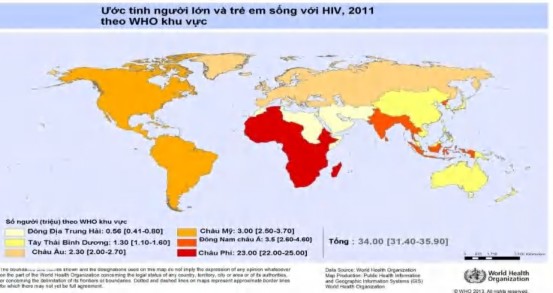
Map 1.1. HIV prevalence in the world, 2011