
c. Cronbach's Alpha coefficient test results of Service Competency scale
Table 2.7: Results of Cronbach's Alpha coefficient test of the Ability scale
service force
Observation variable
Coefficient total variable correlation | Coefficient Cronbach's Alpha if variable is excluded | |
Service capacity: Cronbach's Alpha = 0.839 | ||
PV1: Staff has extensive product knowledge and is qualified to answer questions of the customer. | 0.649 | 0.806 |
PV1: Staff serve customers attentively. | 0.768 | 0.757 |
PV2: As long as the customer requests, the staff can come. on site to consult and discuss products. | 0.575 | 0.849 |
PV3: Service staff are fair to all. client. | 0.731 | 0.775 |
Maybe you are interested!
-

 Results of Testing Cronbach's Alpha Coefficient of Independent Variable
 -
 Summary of Results of Cronbach'S Alpha Coefficient of Impact Factors Scale
 -
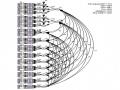 Summary of Cronbach'S Alpha Coefficient Results (See Appendix 4)
 -
 Cronbach'S Alpha Test Results of Service Competency Round 1
 -
 Cronbach's Alpha Reliability Coefficient of Components of the Scale of Factors Affecting Investment Capital Attraction for Tourism in Ba Ria Vung Tau Province

(Source: SPSS processed data)
The component "Service capacity" has a Cronbach's Alpha coefficient of 0.839 (>0.6), this coefficient is significant; The total item correlation coefficients (Cronbach'Item - Total Correlation) of the variables measuring this component are all >0.3 (greater than the allowable standard of 0.3). Although the Alpha coefficient if Item Deleted of the variable "Customers only need to request, staff can come to the place to consult and discuss products" is 0.849 (>Cronbach's Alpha coefficient), this is also an important variable to evaluate customer satisfaction with the group of variables "Service capacity" and the total item correlation coefficient (Cronbach'Item - Total Correlation) of the variable >0.3, so I decided to keep this variable. If it is not suitable in the EFA exploratory factor analysis, I will proceed to remove this variable.
d. Cronbach's Alpha coefficient test results of the empathy scale
Table 2.8: Results of Cronbach's Alpha coefficient test of the satisfaction scale
empathetic
Observation variable
Variable correlation coefficient total | Cronbach's Alpha coefficient if variable type | |
Empathy: Cronbach's Alpha = 0.745 | ||
DC1: Company employees remember customers' names. row. | 0.632 | 0.630 |
DC2: Employees always take responsibility for themselves, do not shirk responsibility and blame customers when they have grievances, complaints | 0.472 | 0.722 |
DC3: Staff regularly calls mind, ask about my satisfaction with the quality Company services. | 0.516 | 0.699 |
DC4:Employees always start with a greeting and end with a by thanking customers. | 0.539 | 0.686 |
(Source: SPSS processed data)
In the table, we see that the total Cronbach's Alpha coefficient is 0.745 and the variables in the group all have a corrected item-total correlation coefficient greater than 0.3, so it can be said that the reliability of this scale is quite high.
e. Cronbach's Alpha coefficient test results of tangibles scale
Table 2.9: Results of Cronbach's Alpha coefficient test of tangibles scale
Observation variable
Variable correlation coefficient total | Cronbach's Alpha coefficient if variable type | |
Tangibles: Cronbach's Alpha = 0.756 | ||
HH1: Staff have polite uniforms. | 0.510 | 0.678 |
HH2: Reference documents on company products and services The company is beautifully designed and attractive. | 0.488 | 0.694 |
HH3: Facilities, customer transaction space goods at the company widely. | 0.611 | 0.622 |
HH4: Transaction records, contracts and supporting documents Get insurance with clear customers. | 0.489 | 0.689 |
(Source: SPSS processed data)
The component "Tangibles" has a Cronbach's Alpha coefficient of 0.756 (>0.6), this coefficient is significant; The total correlation coefficients (Cronbach'Item - Total Correlation) of the variables measuring this component are all >0.3 (greater than the allowable standard of 0.3). In addition, the Alpha coefficient if Item Deleted of the variables is smaller than the Cronbach's Alpha coefficient, so the variables measuring this component are all used in the following analyses.
f. Cronbach's Alpha coefficient test results of dependent variable group scale
Table 2.10: Cronbach's Alpha coefficient test results of group scales
dependent variable
Observation variable
Total variable correlation coefficient | Cronbach's Alpha coefficient if variable type | |
Satisfaction: Cronbach's Alpha = 0.761 | ||
HH1: Completely satisfied with the quality of care services individual customers of Dai-chi Life Vietnam Co., Ltd._ Hue 1 Office. | 0.556 | 0.720 |
HH2: Will introduce insurance services of BHNT company Dai-chi Life Vietnam _ Hue 1 Branch Office for others. | 0.655 | 0.605 |
HH3: Will continue to use the services of the insurance company Dai-chi Life Vietnam _ Hue 1 Branch Office | 0.566 | 0.707 |
(Source: SPSS data processing)
The dependent variable group has a Cronbach's Alpha coefficient of 0.761 (>0.6), this coefficient is significant; The item-total correlation coefficients (Cronbach's Item - Total Correlation) of the variables measuring these components are all >0.3 (greater than the allowable standard of 0.3). In addition, the Alpha coefficient if Item Deleted of the variables is smaller than the Cronbach's Alpha coefficient, so the variables measuring these components are all used in the following analyses.
Thus, after the process of testing the reliability of the scale, there are 5 research groups with low reliability: "Level of trust", "Level of assurance", "Level of empathy", "Tangible means" and the dependent variable group with the corresponding total correlation coefficients of 0.706; 0.742; 0.745; 0.756; 0.761 respectively and there is a group with quite high scale reliability, which is the "Service capacity" group with the total correlation coefficient of 0.839.
2.3.2.2. Exploratory factor analysis EFA
Exploratory factor analysis is used to reduce and summarize the research variables into concepts. In this study, we can collect a fairly large number of variables and most of these variables are related to each other and their number must be reduced to a usable amount (Hoang Trong & Chu Mong Ngoc, 2008).
Factor analysis is only used when the KMO (Kaiser-Meyer-Olkin) coefficient has a value of 0.5 or higher, variables with factor loading <0.5 will be eliminated. The Eigenvalue (representing the portion of variation explained by each factor) is greater than 1 and the total variance extracted (Cumulative % Extraction Sum of Squared Loadings) is greater than 50%.
The factor analysis method of this study is “Principal Components Analysis” with Eigenvalue greater than 1. This means that only extracted factors with Eigenvalue greater than 1 are retained in the analysis model.
a. KMO test
Before conducting factor analysis, it is necessary to check whether this method is suitable or not. The check is done by calculating the KMO coefficient and Bartlett's Test. The KMO coefficient is used to check whether the sample size we have is suitable for factor analysis or not (According to Hoang Trong & Chu Mong Ngoc, 2008).
Table 2.11: KMO test results
Group of independent variables | Dependent variable group | ||
Kaiser-Meyer-Olkin Measure of Sampling Adequacy. | 0.791 | 0.677 | |
Bartlett's Test of Sphericity | Approx. Chi-Square | 1037,270 | 113,140 |
Df | 190 | 3 | |
Sig. | 0.000 | 0.000 | |
(Source: SPSS processed data)
With the test results of table ... , the test results give a KMO value of 0.791 (>0.5), thus meeting the requirements for factor analysis. The Bartlett's Test of Sphericity test result has Sig = 0 (<0.05) showing that the observed variables are correlated with each other and are completely suitable for factor analysis. Bartlett's Test is used to test the hypothesis H 0 that the variables are not correlated with each other in the population, that is, the overall correlation matrix is a unit matrix. The Sig value of Bartlett's Test is less than 0.05, allowing the rejection of the hypothesis H 0 and the KMO value between 0.5 and 1 is meaningful for appropriate factor analysis.
b. Factor analysis
Factor analysis for independent variable groups
Factor rotation aims to create a clearer and simpler picture of the relationship between the observed variables and the extracted factors. As a result, the observed variables will be clearly grouped, each group will have high loading factors on one factor and low loading factors on the remaining factors.
Variable type
Some criteria for variable elimination
- Eliminate variables according to the criterion of convergent validity: Each observed variable should have a high loading factor (>0.5) on at least one factor, otherwise it should be eliminated from the model. It is recommended to start with the variable with the lowest loading factor, and rerun the factor analysis after each variable elimination until there are no more variables violating this.
- Type of variable according to the criterion of discriminant validity: Each important variable
should have a high loading factor on one and only one factor. If any observed variable
Violating this should be eliminated from the model. In case of multiple variables
If there are violations, you should eliminate each variable in turn and rerun the factor analysis after each variable elimination.
- Variables are classified according to the criterion that each variable cannot form a factor by itself.
Variables that form a factor by themselves should be removed from the model because they will not be reliable.
After eliminating inappropriate variables from the model, the study will rename the new factors and calculate the value for each factor using the Compute Variable method in SPSS 20.0 software.
Table 2.12: EFA running results
Factor rotation matrix
Variable code | Factor loadings of component factors | ||||
1 | 2 | 3 | 4 | 5 | |
NLPV2 | 0.860 | ||||
NLPV4 | 0.844 | ||||
NLPV3 | 0.768 | ||||
NLPV1 | 0.724 | ||||
SDB3 | 0.747 | ||||
SDB1 | 0.745 | ||||
SDB2 | 0.727 | ||||
SDB4 | 0.661 | ||||
DTC2 | 0.800 | ||||
DTC4 | 0.799 | ||||
DTC1 | 0.623 | ||||
DTC3 | 0.534 | ||||
HH3 | 0.776 | ||||
HH1 | 0.704 | ||||
HH4 | 0.694 | ||||
HH2 | 0.684 | ||||
DC1 | 0.819 | ||||
DC4 | 0.806 | ||||
DC2 | 0.553 | ||||
DC3 | 0.543 | ||||
Value | 5,308 | 2,091 | 1,726 | 1,639 | 1,382 |
Extracted Variance % | 26,540 | 10,453 | 8,632 | 8,197 | 6,909 |
Cumulative variance % | 26,540 | 36,993 | 45,625 | 53,822 | 60,732 |
(Source: SPSS processed data)
- Based on the investigation results, we see that at the Eigenvalue level greater than 1, the analysis
EFA factor exploration extracted 5 factors from 20 observed variables with variance
The largest cumulative extraction is 60.732% (greater than 50%) which meets the requirement. All of the above factors meet the requirement because their loading factors are greater than 0.5, so they are retained.
+ The first group of factors is "Service capacity" (NLPV2, NLPV4, NLPV3, NLPV1): Eigenvalue is 5.308, this factor includes 4 observed variables that are closely correlated with each other and this is the factor that explains 26.540% of the variation in survey data.
+ The second group of factors is “Assurance” (SDB3, SDB1, SDB2, SDB4): Eigenvalue is 2.091, this factor includes 4 observed variables that are closely correlated with each other and this is the factor that explains 10.453% of the variation in the survey data.
+ The third factor group is "Reliability" (DT2, DTC4, DTC1, DTC3): Eigenvalue is 1.726, this factor includes 4 observed variables that are closely correlated with each other and this is the factor that explains 8.632% of the variation in the survey data.
+ The fourth factor group is "Empathy" (DC1, DC4, DC2, DC3): Eigenvalue is 1.639, this factor includes 4 observed variables that are closely correlated with each other and this is the factor that explains 8.197% of the variation in survey data.
+ The fifth factor group is "Tangibles" (HH1, HH2, HH3, HH4): Eigenvalue is 1.382, this factor includes 4 observed variables that are closely correlated with each other and this is the factor that explains 6.909% of the variation in survey data.
Determine the number of factors
Next, to determine the number of factors, this study uses two criteria:
- Kaiser Criterion is used to determine the number of factors extracted from the scale. Less important factors are eliminated, only important factors are retained by considering the Eigenvalue. The Eigenvalue represents the variation explained by each factor, only factors with Eigenvalue greater than 1 are retained in the analysis model. The EFA analysis results in the table show 5 factors with Eigenvalue > 1.
- Variance Explained Criteria: Factor analysis
is appropriate if the total extracted variance is not less than 50%. Based on the results in
table, the extracted variances of the factors are all greater than 50%. Therefore, factor analysis
is appropriate, the five factors identified in the table ... .
Naming the factor
Factor 1: Name it “Trust Level”
Eigenvalue = 1.726> 1, this factor is related to the customer's assessment of the Company's reputation in transactions such as the Company always fulfills its promises on time, the staff guides the procedures and conducts transactions with customers fully,... This factor includes 4 observed variables
TC1: The company always cares about my complaints and questions when using the company's services.
TC2: The company always keeps its promises on time.
TC3: Staff guides procedures and conducts transactions with customers one by one.
full way
TC4: The waiting time to complete an insurance transaction with a customer is short.
Factor 2: Named “Level of Assurance”
Eigenvalue = 2.091> 1, this factor is related to the customer's assessment of the characteristics of the customer care service provided by the company such as using the company's insurance service is a form of savings, safe investment and financial security, helping customers avoid the temptation of arbitrary spending and focus on future plans,... This factor includes 4 observations:
DB1: Using the company's insurance services is a form of savings, safe investment and financial security.
DB2: I am assured of the safety of myself and my family when using the company's insurance services.
DB3: I am assured of the following possible health and illness risks:
This.