
In 2020, Tay Ninh City People's Court applied the Penal Code to decide on penalties for 628 MBTPCMT cases with 985 defendants; of which, 100% of the defendants were sentenced to fixed-term imprisonment (285 defendants were sentenced to fixed-term imprisonment from 07 years to 15 years, accounting for 45.5%; 343 defendants were sentenced to fixed-term imprisonment up to 07 years, accounting for 54.6%).
Conducting research on 100 judgments on the crime of MBTPCMT with 207 defendants, the most common MBTPCMT crime brought to trial was the case of committing the crime twice or more, accounting for 55%. The basic penalty frame applied to defendants committing the crime of MBTPCMT was 34/100 cases, the remaining 66 cases were all cases subject to the application of the increased penalty frame according to Point g, Clause 1, Article 52 of the Penal Code (when there is no sign of conviction or penalty frame - Clause 2, Article 52).
Maybe you are interested!
-

 Current Status of Human Rights Protection Through Measures to Prevent Restrictions on Freedoms as Prescribed by the Criminal Procedure Code
 -
 Car body electrical practice - 8
zt2i3t4l5ee
zt2a3gs
zt2a3ge
zc2o3n4t5e6n7ts
If the voltage is out of specification, replace the wire or connector.
If the voltage is within specification, install the front fog light relay and follow step 5.
Step 5 Check the front fog light switch
- Remove the D4 connector of the fog light switch
- Use a multimeter to measure the resistance of the front fog light switch.
Measurement location
Condition
Standard
D4-3 (BFG) -D4-4 (LFG)
Light switchFront Fog OFF
>10kΩ
D4-3 (BFG) -D4-4 (LFG)
Front fog light switchON
<1 Ω
- Standard resistor
D4 connector is located on the combination switch assembly.
If the resistance is out of specification, replace the combination switch (the fog light switch is located in the combination switch).
If the resistance is within specification, follow step 6.
Step 6 Check wiring and connectors (front fog light relay-light selector switch)
- Disconnect connector D4 of the combination switch assembly
- Use a voltmeter to measure the voltage value of jack D4 on the wire side.
Measurement location
Control modecontrol
Standard
D4-3 (BFG) - (-) AQ
TAIL
11 to 14 V
D4 connector for the wiring of the combination switch assembly
If the voltage does not meet the standard, replace the wire or connector.
If the voltage is within standard, there may have been an error in the previous measurements.
Step 7 Check the front fog lights
- Remove the front fog light electrical connector.
- Supply battery voltage to the fog lamp terminals
Jack 8, B9 of front fog lamp on the electrical side
blind first.
Power supply location
Terms and Conditions
Battery positive terminal - Terminal 2Battery negative terminal - Terminal 1
Fog lightsbefore morning
- If the light does not come on, replace the bulb.
If the light is on, re-plug the jack and continue to step 8.
Step 8 Check wiring and connectors (relay and front fog lights)
- Disconnect the B8 and B9 connectors of the front fog lights.
- Use a voltmeter to measure voltage at the following locations:
Measurement location
Switch location
Terms and Conditions
B8-2 - (-) AQ
Electric lock ON TAIL size switchFog switch ON
11 to 14 V
B9-2 - (-) AQ
Electric lock ONTAIL size switch Fog switch ON
11 to 14 V
B8 and B9 connectors on the front fog lamp wiring side
Voltage is not up to standard, repair or replace the jack. If up to standard, there may have been an error in the measurement process.
2.2.4. Procedure for removing, installing and adjusting fog lights 1. Procedure for removing
- Remove the front inner ear pads
Use a screwdriver to remove the 3 screws and remove the front part of the front inner ear liner
-Remove the fog light assembly
+ Disconnect the connector.
+ Use a screwdriver to remove 3 screws to remove the fog light cover
2. Installation sequence
-Rotate the fog lamp bulb in the direction indicated by the arrow as shown in the figure and remove the fog lamp from the fog lamp assembly.
-Rotate the fog light bulb in the direction indicated by the arrow as shown in the figure and install the light into the fog light assembly.
- Use a screwdriver to install the fog light cover
-Install the electrical connector
Attention: Be careful not to damage the plastic thread on the lamp assembly.
- Install the front inner ear pads
Use a screwdriver to install the front inner bumper with 3 screws.
3. Prepare the vehicle to adjust the fog light convergence. Prepare the vehicle:
- Make sure there is no damage or deformation to the vehicle body around the fog lights.
- Add fuel to the fuel tank
- Add oil to standard level.
- Add engine coolant to standard level.
- Inflate the tire to standard pressure.
- Place spare tire, tools and jack in original design position
- Do not leave any load in the luggage compartment.
- Let a person weighing about 75 kg sit in the driver's seat.
4. Prepare to check the fog light convergence
a/ Prepare the vehicle status as follows:
- Place the car in a dark enough place to see the lines. The lines are the dividing line, below which the light from the fog lights can be seen but above which it cannot.
- Place the car perpendicular to the wall.
- Keep a distance of 7.62 m between the center of the fog lamp and the wall.
- Park the car on level ground.
- Press the car down a few times to stabilize the suspension.
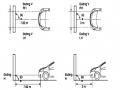
Note: A distance of approximately 7.62 m is required between the vehicle (fog lamp center) and the wall to adjust the convergence correctly. If the distance of 7.62 m cannot be achieved, set the correct distance of 3 m to check and adjust the fog lamp convergence. (Since the target area varies with the distance, please follow the instructions as shown in the figure.)
b/ Prepare a piece of thick white paper about 2 m high and 4 m wide to use as a screen.
c/ Draw a vertical line through the center of the screen (line V).
d/ Set the screen as shown in the picture. Note:
- Keep the screen perpendicular to the ground.
- Align the V line on the screen with the center of the vehicle.
e/Draw the reference lines (H, V LH and V RH lines) on the screen as shown in the figure.HINT:
Mark the center of the fog lamp on the screen. If the center mark cannot be seen on the fog lamp, use the center of the fog lamp or the manufacturer's name mark on the fog lamp as the center mark.
H line (fog light height):
Draw a line across the screen so that it passes through the center mark. Line H should be at the same height as the center mark of the fog light bulb.
Line V LH, V RH (center mark position of left fog lamp LH and right fog lamp RH):
Draw two lines so that they intersect line H at the center marks.
5. Check the fog light convergence
a/ Cover the fog lamp or remove the connector of the other side fog lamp to prevent light from the unchecked fog lamp from affecting the fog lamp convergence test.
b/ Start the engine.
c/ Turn on the fog lights and make sure that the dividing line is outside the standard area as shown in the drawing.
6. Adjust the fog light convergence
Use a screwdriver to adjust the fog light to the standard area by turning the toe adjustment screw.
Note: If the screw is adjusted too far, loosen it and then tighten it again, so that the last rotation of the light adjustment screw is clockwise.
3. Self-study questions
1. Describe the operating principle of the lighting system with automatic headlight function
2. Describe the operating principle of the lighting system with the function of rotating headlights when turning
3. Draw diagram and connect lighting system on Hyundai Porter car
4. Draw diagram and connect lighting system on Honda Accord 1992
5. Draw the lighting circuit on a 1993 Toyota Lexus
LESSON 3 MAINTENANCE AND REPAIR OF SIGNAL SYSTEM
I. IMPLEMENTATION GOAL
After completing this lesson, students will be able to:
- Distinguish between types of signals on cars
- Correctly describe common symptoms and suspected areas causing damage.
- Connecting signal circuits ensures technical requirements
- Disassemble, install, check, maintain and repair the signal system to ensure technical requirements.
- Ensure safety in work and industrial hygiene
II. LESSON CONTENT
1. General description
The signal system equipped on cars aims to create signals to notify other vehicles participating in traffic about the vehicle's operating status such as: stopping, parking, braking, reversing, turning...
Signals are used either by light such as headlamps, brake lights, turn signals….. or by sound such as horns, reverse music….
Just like the lighting system. A signal system circuit usually consists of: battery, fuse, wire, relay, electrical load and control switch. Only some switches of the signal system are on the combination switch. The switches of other signals are usually located in different locations such as in the gearbox or brake pedal……
2. Maintenance and repair
2.1. Turn signals and hazard lights
The installation location of the turn signal is shown in Figure 3.1. The turn signal control switch is located in the combination switch under the steering wheel. Turning this switch to the right or left will make the turn signal turn right or left.
The hazard light switch is used when the vehicle has a problem while participating in traffic. When the hazard light switch is turned on, all the turn signals on the vehicle will light up at a certain frequency. The hazard light switch is usually placed separately from the turn signal switch (some old cars integrate the hazard and turn signal switches on the same combination switch cluster).
Figure 3.1 Turn signal switch Figure 3.2 Hazard switch
The part that generates the flashing frequency for the lights is called a turn signal relay. The turn signal relay usually has 3 terminals: B (positive power supply); E (negative power supply); L (providing the turn signal switch to distribute to the
lamp)
2.1.1. Circuit diagram
To generate the frequency for the turn signal, a turn signal relay is used in the turn signal circuit. The current from the turn signal relay will be sent to the turn signal switch assembly to distribute the current to the turn signal lights for the driver's purpose.
Figure 3.3. Schematic diagram of a turn signal circuit without a hazard switch
1. Battery; 2. Electric lock; 3. Turn signal relay; 4. Turn signal switch; 5. Turn signal lamp; 6. Turn signal lamp; 7. Hazard switch
Figure 3.4 Schematic diagram of turn signal circuit with hazard switch
1. Battery; 2. Combination switch cluster; 3. Turn signal;
4. Turn signal light; 5. Turn signal relay
Today's cars no longer use three-pin turn signal relays (B, L, E) but use eight-pin turn signal relays (figure 3.5) (pin number 8 is used for hazard lights).
For this type, the current supplying the turn signal lights is supplied directly from the turn signal relay to the lights.
div.maincontent .p { color: black; font-family:"Times New Roman", serif; font-style: normal; font-weight: normal; text-decoration: none; font-size: 14pt; margin:0pt; } div.maincontent p { color: black; font-family:"Times New Roman", serif; font-style: normal; font-weight: normal; text-decoration: none; font-size: 14pt; margin:0pt; } div.maincontent .s1 { color: black; font-family:"Times New Roman", serif; font-style: normal; font-weight: normal; text-decoration: none; font-size: 13pt; } div.maincontent .s2 { color: black; font-family:"Times New Roman", serif; font-style: italic; font-weight: normal; text-decoration: none; font-size: 14pt; } div.maincontent .s3 { color: black; font-family:"Times New Roman", serif; font-style: normal; font-weight: normal; text-decoration: none; font-size: 14pt; } div.maincontent .s4 { color: black; font-family:"Times New Roman", serif; font-style: normal; font-weight: normal; text-decoration: none; font-size: 13pt; } div.maincontent .s5 { color: black; font-family:"Times New Roman", serif; font-style: normal; font-weight: normal; text-decoration: none; font-size: 13pt; vertical-align: 1pt; } div.maincontent .s6 { color: black; font-family:"Times New Roman", serif; font-style: normal; font-weight: normal; text-decoration: none; font-size: 11pt; } div.maincontent .s7 { color: black; font-family:"Times New Roman", serif; font-style: normal; font-weight: normal; text-decoration: none; font-size: 14pt; vertical-align: -9pt; } div.maincontent .s8 { color: black; font-family:"Times New Roman", serif; font-style: normal; font-weight: normal; text-decoration: none; font-size: 11pt; } div.maincontent .s9 { color: #008000; font-family:"Times New Roman", serif; font-style: normal; font-weight: normal; text-decoration: none; font-size: 14pt; } div.maincontent .s10 { color: black; font-family:"Times New Roman", serif; font-style: italic; font-weight: normal; te
Car body electrical practice - 8
zt2i3t4l5ee
zt2a3gs
zt2a3ge
zc2o3n4t5e6n7ts
If the voltage is out of specification, replace the wire or connector.
If the voltage is within specification, install the front fog light relay and follow step 5.
Step 5 Check the front fog light switch
- Remove the D4 connector of the fog light switch
- Use a multimeter to measure the resistance of the front fog light switch.
Measurement location
Condition
Standard
D4-3 (BFG) -D4-4 (LFG)
Light switchFront Fog OFF
>10kΩ
D4-3 (BFG) -D4-4 (LFG)
Front fog light switchON
<1 Ω
- Standard resistor
D4 connector is located on the combination switch assembly.
If the resistance is out of specification, replace the combination switch (the fog light switch is located in the combination switch).
If the resistance is within specification, follow step 6.
Step 6 Check wiring and connectors (front fog light relay-light selector switch)
- Disconnect connector D4 of the combination switch assembly
- Use a voltmeter to measure the voltage value of jack D4 on the wire side.
Measurement location
Control modecontrol
Standard
D4-3 (BFG) - (-) AQ
TAIL
11 to 14 V
D4 connector for the wiring of the combination switch assembly
If the voltage does not meet the standard, replace the wire or connector.
If the voltage is within standard, there may have been an error in the previous measurements.
Step 7 Check the front fog lights
- Remove the front fog light electrical connector.
- Supply battery voltage to the fog lamp terminals
Jack 8, B9 of front fog lamp on the electrical side
blind first.
Power supply location
Terms and Conditions
Battery positive terminal - Terminal 2Battery negative terminal - Terminal 1
Fog lightsbefore morning
- If the light does not come on, replace the bulb.
If the light is on, re-plug the jack and continue to step 8.
Step 8 Check wiring and connectors (relay and front fog lights)
- Disconnect the B8 and B9 connectors of the front fog lights.
- Use a voltmeter to measure voltage at the following locations:
Measurement location
Switch location
Terms and Conditions
B8-2 - (-) AQ
Electric lock ON TAIL size switchFog switch ON
11 to 14 V
B9-2 - (-) AQ
Electric lock ONTAIL size switch Fog switch ON
11 to 14 V
B8 and B9 connectors on the front fog lamp wiring side
Voltage is not up to standard, repair or replace the jack. If up to standard, there may have been an error in the measurement process.
2.2.4. Procedure for removing, installing and adjusting fog lights 1. Procedure for removing
- Remove the front inner ear pads
Use a screwdriver to remove the 3 screws and remove the front part of the front inner ear liner
-Remove the fog light assembly
+ Disconnect the connector.
+ Use a screwdriver to remove 3 screws to remove the fog light cover
2. Installation sequence
-Rotate the fog lamp bulb in the direction indicated by the arrow as shown in the figure and remove the fog lamp from the fog lamp assembly.
-Rotate the fog light bulb in the direction indicated by the arrow as shown in the figure and install the light into the fog light assembly.
- Use a screwdriver to install the fog light cover
-Install the electrical connector
Attention: Be careful not to damage the plastic thread on the lamp assembly.
- Install the front inner ear pads
Use a screwdriver to install the front inner bumper with 3 screws.
3. Prepare the vehicle to adjust the fog light convergence. Prepare the vehicle:
- Make sure there is no damage or deformation to the vehicle body around the fog lights.
- Add fuel to the fuel tank
- Add oil to standard level.
- Add engine coolant to standard level.
- Inflate the tire to standard pressure.
- Place spare tire, tools and jack in original design position
- Do not leave any load in the luggage compartment.
- Let a person weighing about 75 kg sit in the driver's seat.
4. Prepare to check the fog light convergence
a/ Prepare the vehicle status as follows:
- Place the car in a dark enough place to see the lines. The lines are the dividing line, below which the light from the fog lights can be seen but above which it cannot.
- Place the car perpendicular to the wall.
- Keep a distance of 7.62 m between the center of the fog lamp and the wall.
- Park the car on level ground.
- Press the car down a few times to stabilize the suspension.
Note: A distance of approximately 7.62 m is required between the vehicle (fog lamp center) and the wall to adjust the convergence correctly. If the distance of 7.62 m cannot be achieved, set the correct distance of 3 m to check and adjust the fog lamp convergence. (Since the target area varies with the distance, please follow the instructions as shown in the figure.)
b/ Prepare a piece of thick white paper about 2 m high and 4 m wide to use as a screen.
c/ Draw a vertical line through the center of the screen (line V).
d/ Set the screen as shown in the picture. Note:
- Keep the screen perpendicular to the ground.
- Align the V line on the screen with the center of the vehicle.
e/Draw the reference lines (H, V LH and V RH lines) on the screen as shown in the figure.HINT:
Mark the center of the fog lamp on the screen. If the center mark cannot be seen on the fog lamp, use the center of the fog lamp or the manufacturer's name mark on the fog lamp as the center mark.
H line (fog light height):
Draw a line across the screen so that it passes through the center mark. Line H should be at the same height as the center mark of the fog light bulb.
Line V LH, V RH (center mark position of left fog lamp LH and right fog lamp RH):
Draw two lines so that they intersect line H at the center marks.
5. Check the fog light convergence
a/ Cover the fog lamp or remove the connector of the other side fog lamp to prevent light from the unchecked fog lamp from affecting the fog lamp convergence test.
b/ Start the engine.
c/ Turn on the fog lights and make sure that the dividing line is outside the standard area as shown in the drawing.
6. Adjust the fog light convergence
Use a screwdriver to adjust the fog light to the standard area by turning the toe adjustment screw.
Note: If the screw is adjusted too far, loosen it and then tighten it again, so that the last rotation of the light adjustment screw is clockwise.
3. Self-study questions
1. Describe the operating principle of the lighting system with automatic headlight function
2. Describe the operating principle of the lighting system with the function of rotating headlights when turning
3. Draw diagram and connect lighting system on Hyundai Porter car
4. Draw diagram and connect lighting system on Honda Accord 1992
5. Draw the lighting circuit on a 1993 Toyota Lexus
LESSON 3 MAINTENANCE AND REPAIR OF SIGNAL SYSTEM
I. IMPLEMENTATION GOAL
After completing this lesson, students will be able to:
- Distinguish between types of signals on cars
- Correctly describe common symptoms and suspected areas causing damage.
- Connecting signal circuits ensures technical requirements
- Disassemble, install, check, maintain and repair the signal system to ensure technical requirements.
- Ensure safety in work and industrial hygiene
II. LESSON CONTENT
1. General description
The signal system equipped on cars aims to create signals to notify other vehicles participating in traffic about the vehicle's operating status such as: stopping, parking, braking, reversing, turning...
Signals are used either by light such as headlamps, brake lights, turn signals….. or by sound such as horns, reverse music….
Just like the lighting system. A signal system circuit usually consists of: battery, fuse, wire, relay, electrical load and control switch. Only some switches of the signal system are on the combination switch. The switches of other signals are usually located in different locations such as in the gearbox or brake pedal……
2. Maintenance and repair
2.1. Turn signals and hazard lights
The installation location of the turn signal is shown in Figure 3.1. The turn signal control switch is located in the combination switch under the steering wheel. Turning this switch to the right or left will make the turn signal turn right or left.
The hazard light switch is used when the vehicle has a problem while participating in traffic. When the hazard light switch is turned on, all the turn signals on the vehicle will light up at a certain frequency. The hazard light switch is usually placed separately from the turn signal switch (some old cars integrate the hazard and turn signal switches on the same combination switch cluster).
Figure 3.1 Turn signal switch Figure 3.2 Hazard switch
The part that generates the flashing frequency for the lights is called a turn signal relay. The turn signal relay usually has 3 terminals: B (positive power supply); E (negative power supply); L (providing the turn signal switch to distribute to the
lamp)
2.1.1. Circuit diagram
To generate the frequency for the turn signal, a turn signal relay is used in the turn signal circuit. The current from the turn signal relay will be sent to the turn signal switch assembly to distribute the current to the turn signal lights for the driver's purpose.
Figure 3.3. Schematic diagram of a turn signal circuit without a hazard switch
1. Battery; 2. Electric lock; 3. Turn signal relay; 4. Turn signal switch; 5. Turn signal lamp; 6. Turn signal lamp; 7. Hazard switch
Figure 3.4 Schematic diagram of turn signal circuit with hazard switch
1. Battery; 2. Combination switch cluster; 3. Turn signal;
4. Turn signal light; 5. Turn signal relay
Today's cars no longer use three-pin turn signal relays (B, L, E) but use eight-pin turn signal relays (figure 3.5) (pin number 8 is used for hazard lights).
For this type, the current supplying the turn signal lights is supplied directly from the turn signal relay to the lights.
div.maincontent .p { color: black; font-family:"Times New Roman", serif; font-style: normal; font-weight: normal; text-decoration: none; font-size: 14pt; margin:0pt; } div.maincontent p { color: black; font-family:"Times New Roman", serif; font-style: normal; font-weight: normal; text-decoration: none; font-size: 14pt; margin:0pt; } div.maincontent .s1 { color: black; font-family:"Times New Roman", serif; font-style: normal; font-weight: normal; text-decoration: none; font-size: 13pt; } div.maincontent .s2 { color: black; font-family:"Times New Roman", serif; font-style: italic; font-weight: normal; text-decoration: none; font-size: 14pt; } div.maincontent .s3 { color: black; font-family:"Times New Roman", serif; font-style: normal; font-weight: normal; text-decoration: none; font-size: 14pt; } div.maincontent .s4 { color: black; font-family:"Times New Roman", serif; font-style: normal; font-weight: normal; text-decoration: none; font-size: 13pt; } div.maincontent .s5 { color: black; font-family:"Times New Roman", serif; font-style: normal; font-weight: normal; text-decoration: none; font-size: 13pt; vertical-align: 1pt; } div.maincontent .s6 { color: black; font-family:"Times New Roman", serif; font-style: normal; font-weight: normal; text-decoration: none; font-size: 11pt; } div.maincontent .s7 { color: black; font-family:"Times New Roman", serif; font-style: normal; font-weight: normal; text-decoration: none; font-size: 14pt; vertical-align: -9pt; } div.maincontent .s8 { color: black; font-family:"Times New Roman", serif; font-style: normal; font-weight: normal; text-decoration: none; font-size: 11pt; } div.maincontent .s9 { color: #008000; font-family:"Times New Roman", serif; font-style: normal; font-weight: normal; text-decoration: none; font-size: 14pt; } div.maincontent .s10 { color: black; font-family:"Times New Roman", serif; font-style: italic; font-weight: normal; te -
 Management Status of Tcm Results Evaluation Through NCBH Form Table 2.9: Current Status of Evaluation of Professional Team Performance Results Through Form
 -
 The current status of diabetes and prediabetes among Khmer people in Hau Giang province and evaluation of the effectiveness of some intervention measures - 22
 -
 Analysis and Evaluation of the Current Status of FDI Attraction in Industrial Parks in Hai Duong Province
The most commonly applied penalty is fixed-term imprisonment, the lightest being 24 months (07 cases) and the heaviest being 15 years (06 cases). The rate of fair and lawful trials is 97/100 cases, accounting for 99.97%, only 3/100 trials have errors and mistakes, accounting for 0.03%. Thus, it can be seen that Tay Ninh City People's Court has effectively applied the provisions of the Penal Code and guiding documents on MBTPCMT, from which the judgments when brought to trial are always in accordance with the law, and this rate is almost absolute. In the majority of MBTPCMT crimes when brought to trial, the defendants who committed this crime often MBTPCMT in large quantities, bought and sold many times, with sophisticated methods and tricks of crime.
In fact, during the trial, the People's Court of Tay Ninh City ADPL still encountered some difficulties in determining the crime, thereby causing difficulties in deciding on the punishment.

For example: On December 9, 2016, at house number 02, alley 27, Tran Hung Dao street, Quarter 1, Ward 1, Tay Ninh city, Tay Ninh province, the Investigation Police Agency of Tay Ninh Provincial Police searched and urgently arrested Ms. Tran.
Thi TA was hiding 3 bags of synthetic drugs in a cardboard box. During the investigation and at the trial, Tran Thi TA confessed: An started to be addicted to synthetic drugs since 2013, had feelings for T, TA was given drugs by T many times to use. TA divided them into many small packages to use and sell to others. The Trial Panel had sufficient grounds to conclude that the defendant Tran Thi TA committed the crime of MBTPCMT and the penalty is prescribed in Point b, Clause 2, Article 194 of the Penal Code. When deciding on the sentence, the Trial Panel also considered aggravating and mitigating circumstances such as the defendant's honest testimony, showing remorse, and confessing to her actions before they were discovered.
Thus, the above case shows that Ms. TA should only be prosecuted for the crime of MBTPCMT with the mitigating circumstance of "self-confession". It is very difficult to determine the buyer and seller, only the offender confesses, so there is enough basis to determine that the defendant committed the crime of MBTPCMT. If in the above case the defendant did not confess, then the defendant should only be prosecuted for the crime of "illegal possession and use of narcotics".
Due to the complicated situation of MBTPCMT crimes in Tay Ninh city in recent years, the provincial and city levels and sectors have directed that the decision on penalties for MBTPCMT crimes must be commensurate with the criminal acts, ensuring deterrence and general prevention.
Through the annual evaluation of the trial work, it shows that the judgments on the crime of MBTPCMT tried by the People's Court of Tay Ninh city in recent years have always ensured the right person, the right crime , and the right law, especially in compliance with the provisions of the Penal Code to apply punishment.
For example: Judgment No. 44/2017/HSST, dated August 30, 2017 of the People's Court of Tay Ninh city applied point b, clause 2, Article 194, points o, p, clause 1, Article 46 of the Penal Code to sentence defendant Than Van C to 07 years in prison; Applying point b, clause 2, Article 194, points o, p, clause 1, clause 2, Article 46; Article 47 of the Penal Code to sentence defendant Than Van C to 07 years in prison.
Sentenced defendant Than Van B to 05 years in prison, for the crime of MBTPCMT for the following acts: On November 29, 2016, at the Petro gas station in Quarter 7, Ward 3, Tay Ninh City, Tay Ninh Province, defendant Than Van C sold to Than Van B 01 packet of heroin weighing 0.0252 grams, 74.6% content for 200,000 VND. At about 11:40 a.m. on the same day, at the La Do coffee shop in Quarter 7, Tay Ninh City, Tay Ninh Province, defendant Than Van B sold to Tran Quoc H and Mai Trung Ph 02 packets of heroin weighing 0.0426 grams for 400,000 VND, and was caught red-handed with the evidence. The acts of defendants Than Van C and Than Van B had sufficient elements to constitute the crime of MBTPCMT. In addition, before being arrested on November 14, 2016 in front of the hospital gate of Tay Ninh city, Tay Ninh province, defendant Than Van C sold drugs to defendant Than Van B once, 1 pack for 200,000 VND. In this case, when deciding on the main penalty, the Trial Panel also correctly and fully applied the provisions of the Penal Code with clear differentiation of penalties, commensurate with the nature and severity of each criminal act.
In fact, the decision on penalties of the People's Court of Tay Ninh City, Tay Ninh Province for MBTPCMT cases also encountered many violations and shortcomings in the trial work. For example, the verdict did not fully apply the aggravating circumstances of criminal responsibility for the defendant; the verdict did not recover the money obtained from the crime; and did not declare the confiscation of the means used to commit the crime.
For example: Judgment No. 22/2018/HSST of the People's Court of Tay Ninh City tried the defendants Le Van N and Nguyen Tran D for the crime of "Illegal trading of narcotics" under Clause 1, Article 194 of the 1999 Penal Code. On November 10, 2017, N invited D - DOB: September 2, 2000 (at the time of the crime, Dat was only 17 years, 2 months and 8 days old) to illegally trade narcotics and was arrested, but when the trial was held, the People's Court of Tay Ninh City did not apply the aggravating circumstance of criminal responsibility "inciting a minor to commit a crime" under Point n, Clause 1, Article 48 of the 1999 Penal Code to the defendant Ninh, which is incorrect.
Or the Judgment does not recover the money from the crime; does not declare the confiscation of the means used to commit the crime: As in the first instance criminal judgment No. 20/2017/HSST of the People's Court of Tay Ninh city, trying defendant Phung Duc C for the crime of "Illegal trading of narcotics" according to point b, clause 2, article 251 of the 2015 Penal Code. In this case, the Investigation Agency also proved that in addition to being caught red-handed, C also illegally sold narcotics to Nguyen Van A once more on December 5, 2017 for 300,000 VND; at the first instance trial, this content was also leaked, but the Court of First Instance did not declare the recovery of this amount.
2.3. Comments and assessments on the current status of criminal law application to the crime of illegal drug trafficking in Tay Ninh city, Tay Ninh province
2.3.1. Advantages
Over the past 5 years, the People's Court of Tay Ninh City, Tay Ninh Province has made great efforts to resolve all types of cases in general and MBTPCMT cases in particular, achieving a high rate in both quantity and quality, especially without backlogs or cases that are overdue by law. The trial of drug cases has basically ensured the right person, the right crime, and the right law. Many serious cases have been promptly brought to public and strict trial by the People's Court of Tay Ninh City in close coordination with the prosecution agency; the penalties applied to the offenders are strict, appropriate, and have received public approval. The trial of MBTPCMT cases by the People's Court of Tay Ninh City has contributed to the effective implementation of the Action Program of Tay Ninh Province on preventing and combating drug crimes, thereby contributing to educating people to raise their legal awareness, vigilance, and fight against drug crimes.
Also in Tay Ninh, the People's Committee of Tay Ninh province also held a conference to sign a cooperation agreement on controlling drugs, psychotropic substances and drug precursors between Tay Ninh province (Vietnam) and provinces of the Kingdom of Cambodia. There was coordination
The close cooperation between Tay Ninh province and the three provinces of SwayRieng, Thoung Khmum, Prey Veng (Kingdom of Cambodia) in preventing, combating and controlling drugs on the Tay Ninh border has achieved many results, contributing to maintaining stability and security on both sides of the border, promoting the friendly relationship and solidarity between the border provinces to develop more and more.
From 2016 to September 2019, Tay Ninh province's authorities arrested and prosecuted 40 cases, 58 defendants for illegally buying, selling, and transporting drugs across the border, seizing 103.64 kg of synthetic drugs. Typically, in 2017, Tay Ninh province's authorities coordinated with BaVet City Police, SwayRieng Province, Kingdom of Cambodia to expand the investigation of a case, seizing about 63,481 synthetic drug pills (weighing about 17 kg) and handed them over to BaVet City Police for handling.
To achieve better results in the trial of criminal cases in general and the MBTPCMT drug case in particular, in the coming time, the People's Court of Tay Ninh city needs to regularly organize experience sharing for cases that have been seriously annulled or revised for Judges and People's Jurors of the two-level People's Court. Thereby, organizing experience sharing of the Criminal Court and District Court, each unit to reveal the causes of annulled or revised cases, propose effective solutions to minimize annulled or revised cases... in order to judge fairly, the right person, the right crime, and the right law.
2.3.2. Limitations, shortcomings and causes
Besides the results achieved in recent years, the trial of MBTPCMT crimes of Tay Ninh City People's Court still has the following limitations:
- Trial practice has shown that drug crimes in general and MBTPCMT crimes in particular are often investigative in nature. Prosecution agencies mainly rely on the statements of criminals to investigate, prosecute, and prosecute.
crimes of the defendants. However, in many cases the subjects are people who have been tried many times for drug-related crimes, so they have a lot of " experience " in dealing with the prosecution agency.
- The number of drug cases in general and MBTPCMT crimes in particular tends to increase, many large and complicated cases, but the quality of settlement and trial is not really guaranteed; there are still judgments that need to be revised; the time limit for settlement and trial of cases according to the provisions of law in some cases is still violated.
In some cases, when the appeal was heard, the Appeal Court revised the first instance judgment of the Tay Ninh City People's Court and argued that the penalty applied to the defendant was too light. Therefore, the appeal court revised the judgment in the direction of changing the sentence from life imprisonment to death penalty. Although according to the provisions of the law, the appeal judgment was not wrong, but when looking at it objectively and impartially, if taking into account the fact that when investigating complex, transnational cases, the next big cases will encounter difficulties because the defendants will be mentally prepared in advance, that confessing will "die" and not confessing will "die" as well , so there will be cases where criminals do not cooperate with the investigation agency when arrested, causing many difficulties for the investigation process of drug trafficking cases.
- Or in some MBTPCMT cases, the appellate court has revised the judgment in a direction that is not accurate in favor of the defendant, without properly assessing the nature of the crime and the personal characteristics of the defendant, leading to the wrong person being tried for the right crime, and criminals being let go. The prosecution agencies have not researched, consulted, thoroughly grasped and learned from experience in the process of investigation, prosecution and trial of criminal cases.
For example, the following case:
At about 12:30 p.m. on November 18, 2017, the Drug Crime Investigation Police Department of Tay Ninh City Police discovered a car with license plate
70B-057. 81 driven by Tran Van N, Ha Quoc P sitting in the passenger seat showed suspicious signs, so the two subjects and the car were brought to the Tay Ninh City Police headquarters for inspection. The results of the search of the car above discovered and seized 2
White powder cake and 120 pink tablets .
In the Conclusion of the appraisal No. 6589/KLGD-PC54 dated November 28, 2017, the Criminal Techniques Department of Tay Ninh City Police concluded: 2 cakes of white powder were both Heroin drugs, with a total weight of 707.76 grams; 120 pink tablets were all Methamphetamine drugs, with a total weight of 11.25 grams.
Tran Van N stated : On November 15, 2017, a man named K living in Tan Cuong district, Tay Ninh called N and said he had drugs to sell and asked N to find a buyer, Nghi agreed. At about 5:00 a.m. on November 18, 2017, K called and told N to go to the bushes on the side of the road in Tan Cuong district to get 2 cakes of Heroin; K told N to sell them for 160 million VND/cake. After that, N went to the bushes as instructed by K and found 2 cakes of Heroin and 1 bag of opium , so he brought them back and hid them in a car with license plate 70B-057. 81. N planned to bring the drugs to Binh Duong to sell. On the morning of November 18, 2017, N drove a car with Ha Quoc P to drive to Binh Duong. At about 12:30 p.m. the same day, N went to the center of Tay Ninh city and was discovered and caught red-handed with the above drugs.
In the First Instance Criminal Judgment No. 157/2018/HSST dated May 3, 2018, the People's Court of Tay Ninh City applied Point h , Clause 4, Article 194 of the 1999 Penal Code; Point s , Clause 1, Article 51; Article 40 of the 2015 Penal Code, amended in 2017, to sentence Tran Van N to death for the crime of MBTPCMT .
On May 4, 2018, Tran Van N filed an appeal to reduce his sentence. In the Criminal Appeal Judgment No. 540/2018/HSPT dated August 15, 2018, the High People's Court in Ho Chi Minh City accepted the appeal of defendant N, amended the first instance judgment, applied point h, clause 4, Article 194 of the 1999 Penal Code; points s, t clause 1, clause 2, Article 51, Article 39 of the 2015 Penal Code, sentenced N to life imprisonment.
on the crime of MBTPCMT .
In the Decision on appeal for review No. 07/QD-VKSTC-V7 dated August 14, 2019, the Chief Justice of the Supreme People's Procuracy appealed the Criminal Appeal Judgment No. 540/2018/HSPT dated August 15, 2018 of the High People's Court in Ho Chi Minh City. Requesting the Supreme People's Court's Judicial Council to conduct a review trial in the direction of
Annul the penalty decision of the above-mentioned appellate criminal judgment, uphold the penalty decision of the First Instance Criminal Judgment No. 157/2018/HSST dated May 3, 2018 of the People's Court of Tay Ninh City, sentencing Tran Van N to death for the crime of MBTPCMT.
In the Final Appeal Decision No. 07/2020/HS-GDT dated June 16, 2020, the Supreme People's Court's Judicial Council decided to annul the Criminal Appeal Judgment No. 540/2018/HSPT dated August 15, 2018 of the High People's Court in Ho Chi Minh City regarding the decision on the penalty for N; to maintain the penalty decision of the First Instance Criminal Judgment No. 157/2018/HSST dated May 3, 2018 of the Tay Ninh City People's Court against Tran Van N.
- The issue of consistency in determining the crime of possession and illegal possession of narcotics according to the provisions of the 2015 Penal Code still faces many shortcomings. In practice, there are cases where: During the entire investigation and prosecution process, the accused confessed to illegally storing narcotics for the purpose of selling to anyone who buys them, but the prosecution agency assessed the evidence and said: In addition to the accused's statement, the specific buyer could not be identified, so there was not enough basis to determine that the accused committed the crime of Buying and Selling, but the accused only committed the crime of Illegal Possession of narcotics. Or in the case where, in addition to 01 completed drug sale, the accused also stored 0.1 gram of Heroine for the purpose of selling to anyone who buys them (the buyer could not be identified), the Procuracy prosecuted 02 crimes of illegal possession of narcotics under Article 251 and illegal possession of narcotics under Article 249. The court held that the accused only committed one crime of illegal possession of narcotics, for 0.1 gram of Heroine for sale.
In real life, usually the seller (of any item)