
Determine the objectives, objects, scope and methods of research
* Secondary information collection and processing process
<— Information collected from interviews
expert advice
F | ||
Building theory on management build a bad foundation | <— | |
T | ||
Collecting bad debt management data information of Lao commercial banks | ||
L | ||
Analyze and evaluate the current situation and draw conclusions. | ||
Suggestions, solutions and experiences | ||
Maybe you are interested!
-

 Basic Issues of Credit Risk Management of Commercial Banks.
 -
 Solutions to Improve Credit Risk Management Capacity, Specialize Bad Debt Handling Activities
 -
 The Impact of Bad Debt on the Operations of Credit Institutions
 -
 General Theories on Bad Debt in Credit Activities of Commercial Banks
 -
 Compare Profit Ratio And Bad Debt Credit Xk
<—
<—
Information from the study has
<—
Figure 1.3 Secondary information collection and processing process
(Source: Illustration by author)
8. New contributions of the thesis
In theory:
Systematize and clarify the theoretical basis of bad debt and bad debt management at commercial banks to suit the changes when commercial banks move towards implementing the regulations in the Basel 2 agreement.
In practice:
Survey on the experience of managing foreign exchange of some Vietnamese commercial banks to draw lessons that can be applied to Lao commercial banks.
Assess the current status of credit risk management, especially pointing out the limitations and causes at Lao commercial banks in the period 2015 - 2020.
Proposing viewpoints and feasible solutions to enhance credit risk management at Lao commercial banks in the period 2021 - 2025
Provide necessary recommendations to the Government and the Bank of Laos to effectively implement solutions to enhance credit risk management at Lao commercial banks.
9. Structural theory
In addition to the introduction, conclusion and list of references, the thesis consists of 3 chapters:
trade
Chapter 1: Theoretical basis
about bad debt
and bad debt management
commercial bank
Chapter 2: Current status of bad debt management at Lao People's Democratic Republic Commercial Bank.
Chapter 3: Solutions to strengthen bad debt management at Lao People's Democratic Republic Commercial Bank.
CHAPTER 1
THEORETICAL BASIS OF BAD DEBT AND BAD DEBT MANAGEMENT AT COMMERCIAL BANKS
1.1. Basic issues on credit, credit risk and bad debt of commercial banks
1.1.1. Concept of Commercial Bank Credit
Currently, there are many concepts and viewpoints on credit and many authors have researched credit in commercial banks, specifically:
Dinh Xuan Hang (Credit Management of Commercial Bank) said that "Credit is the temporary transfer of the right to use an amount of value in the form of money or goods from the owner to the user, after a certain period of time, it is returned with a larger amount of value". [6]
The Law on Credit Institutions of Vietnam stipulates: “Credit granting is an agreement for an organization or individual to use a sum of money or a commitment to allow the use of a sum of money on the principle of repayment through lending, discounting, financial leasing, factoring, bank guarantees and other credit granting operations”. [20]
NCS's point of view, bank credit is a credit relationship between two parties, one party must be a bank, the other party must be an individual, business or other organization. This is essentially a transfer of the right to use capital between the bank credit provider and the credit recipient within a specified period of time. At the end of the agreed term, the credit recipient must repay the credit provider the original principal value and the increased value.
Commercial bank credit has the following characteristics:
Firstly, the basis for deciding on a credit is the bank's confidence in the customer's use of the loan for the right purpose and ability to repay the loan on time. The borrower, on the other hand, believes in the ability to earn money.
in the future to repay principal and interest.
Second, credit is the transfer of the right to use a sum of money (cash) or assets (in kind) from one subject to another, without changing the ownership of them. Credit granted to customers is from the capital mobilized by the bank, mainly deposits from individuals and organizations at home and abroad. Therefore, customers receive loans that are only "temporarily" held and used for the purpose committed to the bank.
Third, credit always has a term and must be repaid unconditionally. Banks perform the function of "borrowing to lend", so all credit
must have a deadline
guarantee for bank repayment
capital raised when
The customer deposits money and needs to withdraw it or the bank uses that capital to lend to another customer. Because the customer is not the real owner of the loan amount, of course, he must commit to unconditionally repay this loan to the bank.
Fourth, the credit value is not only preserved but also enhanced by the credit interest. The repayment value must be greater than the loan value, because the customer must pay for the right to use the loan capital. This interest is always positive to cover operating costs and generate profits for the bank.
Fifth, the most essential characteristic of credit is that it carries high risks. Even if customers have good intentions to repay their debts, if they encounter an unfavorable business environment, fluctuations in economic indicators, or force majeure events, it is easy to cause difficulties in repaying debts and inevitably the bank will face RRTD.
1.1.2. Concept of commercial bank credit risk
Credit risk is always of special concern to commercial banks, because credit activities are the activities that bring the majority of income and profit to banks (accounting for about 80% of total income) and it is also the main activity of banks. Credit activities are closely related to all areas of the economy, each risk arising in these areas affects
and pose risks to the banking system in particular and the economy in general.
There are many concepts of credit risk today.
According to the Basel Committee on Banking Supervision, credit risk is understood as the risk of asset loss that may arise when a counterparty fails to fulfill its financial or contractual obligations to a bank, including failure to make debt payments, whether principal or interest, when the debt is due” [31].
According to this view, RRTD is assessed based on the customer's performance of financial obligations including principal and interest payments.
Thomas P.Fitch in the book "Dictionary of banking systems" defines RRTD as the risk that occurs when the borrower cannot pay the debt according to the agreement.
contract agreement leading to delay in debt payment obligation [100].
Another understanding according to the book Risk Management in Banking (2001) by
According to Joel Bessis, credit risk is understood as losses due to customers not being able to pay their debts or the decline in credit quality of loans" [97].
According to the State Bank of Vietnam, credit risk is understood as follows: "Credit risk in banking activities of credit institutions is the possibility of loss in banking activities of credit institutions due to customers not being able to perform or not being able to perform their obligations according to commitments". [12]
Nguyen Van Tien (Commercial Banking Management Textbook, 2012) said: "Credit risk is a type of risk that arises in the lending process of banks.
goods, the actual manifestation of the customer not paying
owed
or pay off debt
not on time, not fully to the bank". Thus, when the due date comes and the customer does not pay on time or does not pay or does not pay in full, it means that credit risk has occurred. [26]
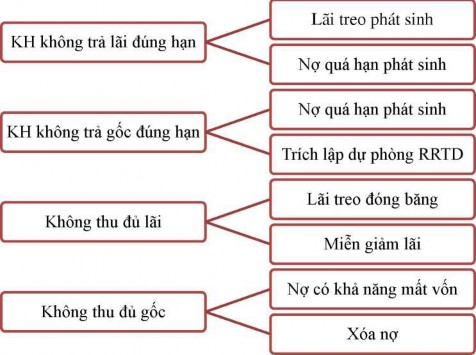
Figure 1.4 Forms of credit risk
(Source: Author's synthesis)
According to the Basel Committee, credit risk is understood as “The risk of asset loss that may arise when a counterparty fails to perform its financial or contractual obligations to a bank, including failure to make debt payments, whether principal or interest, when the debt falls due. In this view, credit risk is assessed based on the customer's performance of financial obligations, including principal and interest payments. [31]
According to the State Bank of Vietnam, RRTD is understood as "A potential loss for the debt of a credit institution or foreign bank branch due to the customer's failure to perform or inability to perform part or all of his/her obligations as committed" [13]
According to NCS's point of view, RRTD will arise in case the bank
Failure to collect the full principal and/or interest of a loan or when a customer fails to pay on time. RRTD is not limited to lending activities, but also includes many other credit activities such as: Guarantees, payment commitments, co-financing loans, interbank loans, credit
lease purchase, finance
trade, mail order
L/C credit'...In banking,
RRTD is inevitable, it always exists with the development of commercial banks.
1.1.3. Bad debt of commercial banks
1.1.3.1. Concept of bad debt of commercial banks
According to previous studies by individuals and organizations, the concept and definition of bad debt are diverse and complex.
Terminology
"in debt
bad"
by sound
You are “bad debt”, you are “nonperforming
loan”, or “doubtful debt”. This is a loan that is considered bad debt when the principal and interest payments are 90 days or more overdue (Rose, 2009; Miskin, 2010).
At the 18th meeting of the International Monetary Fund on the balance of payments in 2005, it was stated that nonperforming loans include (EighteentMeeting of the IMF Committee on Balance of Payments Statistics: The Treatment of Nonperforming Loans, 2005): “A loan is considered nonperforming when interest and/or principal payments are 90 days or more past due, or interest payments of 90 days or more have been restructured or extended, or payments are less than 90 days past due but there are reasons to doubt that repayment will be made in full . ” [91]
Basically, bad debt (according to IMF) is defined based on two factors: (i): overdue for more than 90 days, or (ii:) the ability to repay is doubtful. With this perspective, bad debt is approached based on the time of overdue payment and the ability of the customer to repay.
IAS standards focus on the ability to repay loans regardless of whether they are overdue for less than 90 days or not overdue. Methods for assessment
ability
ability to pay
Customer debt is often the cash flow analysis method.
discount future or customer credit rating. This system is considered correct in theory, but in practice it is difficult to apply. Therefore, it is still being revised by the International Accounting Standards Board in IFRS 9.
According to AEG (2004), “loans are considered nonperforming when payments of interest and/or principal are 90 days or more past due, or when interest payments that are 90 days or more past due have been capitalized, restructured, or delayed by agreement; or when payments are less than 90 days due, but there are reasons to doubt that payments will be made in full”.
According to the Basel Committee, which guides common practices in many countries on Credit Risk Management, a debt is considered to be in default when one of the following two conditions occurs: (i) The bank finds that the borrower is unable to repay the debt in full when the bank has not taken any action to try to collect; (ii) The borrower is more than 90 days overdue on payment.
According to the State Bank of Vietnam, bad debt is debt classified into group 3 (Substandard debt), group 4 (Doubtful debt) and group 5.
(In debt
able
loss of capital). In which:
(i) Based on the overdue time of the
debt (Group 3: overdue period from 91 to 180 days, Group 4: overdue period from 181 to 360 days, Group 5: overdue period over 360 days); (ii) Based on the customer's ability to repay. (Group 3: Debts assessed by credit institutions as
able
partial loss of debt
Principal and Interest, Group 4: Debts
Okay
Credit institutions assess as having high loss potential, Group 5: Debts assessed by credit institutions
assessed as no longer recoverable, accepting the loss of capital). Thus, bad debt, according to the viewpoint of the State Bank of Vietnam, is also determined based on two factors: (i): overdue for more than 90 days or (ii): worrying ability to repay debt. [13]
According to NCS, bad debt is a loan that is overdue for payment and/or principal according to the agreement for more than 90 days and the borrower's ability to repay is doubtful. Bad debt includes substandard debt, doubtful debt, and debt with the possibility of losing capital.
1.1.3.2. Classification of bad debt
Loan classification is the process by which banks monitor their loans on a regular basis to place them into different groups based on their ability to repay.