
Research Overview
Keywords: Bad debt, bad debt management Detecting gaps in research
Maybe you are interested!
-

 Solutions to Improve Credit Risk Management Capacity, Specialize Bad Debt Handling Activities
 -
 The Impact of Bad Debt on the Operations of Credit Institutions
 -
 Compare Profit Ratio And Bad Debt Credit Xk
 -
 Basic Issues of Credit, Credit Risk and Bad Debt of Commercial Banks
 -
 Bad Debt Ratio of Vietnam's Credit Institution System
Identify the research problem Bad debt management

Identify research objectives and questions
Systematizing CSLL Analysis of current situation Complete solution
Systematization and development of CSLL
Theory of bad debt and bad debt management
Data Collection
Secondary data Primary data
- Review and collect data
- Check data
- Data analysis
- Expert Interview (In-Depth)
Synthesis, analysis and research report
Proposed directions and solutions
Figure 1.1 Thesis research process
(Source: Illustration by author)
This process begins with an overview of previous research to identify research gaps. Based on that, the author identifies the research problem of the thesis, which is: “Bad debt management in credit activities of Vietnam Joint Stock Commercial Bank for Industry and Trade”. To clarify this problem, the author has clearly identified the objectives, research tasks and specific questions that the thesis needs to find answers to in order to achieve these objectives and tasks.
The next steps of the research process will carry out each research task of the thesis in turn. First of all, it is to systematize the theoretical bases of bad debt and bad debt management presented in previously published studies, thereby building a theoretical framework of bad debt and bad debt management in commercial banks. Then, the author proceeds to collect secondary and primary data reflecting the current situation of bad debt and bad debt management at Vietnam Joint Stock Commercial Bank for Industry and Trade. Finally, based on the synthesis of collected data, the author analyzes, evaluates the current situation, proposes solutions and recommendations to strengthen bad debt management at Vietnam Joint Stock Commercial Bank for Industry and Trade.
* Primary information collection and processing process
Prepare for research
Identify the research sample
Prepare Interview Questions
Conduct an interview
Collect interview results
Analysis of current situation and evaluation of QLNX in credit activities at Vietinbank
Proposed solution
Figure 1.2 Primary information collection and processing process
(Source: Illustration by author)
Analyze and evaluate the current situation and draw conclusions.
Collecting bad debt management data information of Viettinbank and some commercial banks
* Secondary information collection and processing process
Determine the objectives, objects, scope and
research method
Information collected from expert interviews
Building a theoretical basis for bad debt management
Information from the study has
available, announced
Suggestions, solutions and experiences
Figure 1.3 Secondary information collection and processing process
(Source: Illustration by author)
CHAPTER 1 SUMMARY
In chapter 1, the thesis presents an overview of research works related to the thesis topic, including domestic and foreign studies with 3 groups of issues: (i) Studies on credit risk management; (ii) Studies on bad debt and factors affecting bad debt; (iii) Studies on bad debt management of commercial banks.
From the research works that have been synthesized in chapter 1, the author has summarized the problems that these studies have solved, pointed out the limitations and gaps that need further research as a basis for finding the research direction of the thesis. In addition, the author also established the research questions of the thesis on bad debt management at commercial banks.
Chapter 1 of the PhD thesis also presents the research methods and processes.
thesis research
Chapter 2
THEORETICAL BASIS OF BAD DEBT AND BAD DEBT MANAGEMENT IN CREDIT ACTIVITIES OF COMMERCIAL BANKS
2.1 General theories on bad debt in credit activities of commercial banks
2.1.1 Concept of bank credit and bad debt
2.1.1.1 Bank credit and credit risk
* Concept of bank credit
There are many concepts of credit:
Pham Ngoc Dung, Dinh Xuan Hang (Finance - Monetary Textbook, 2014) stated that "Credit is the temporary transfer of the right to use an amount of value in the form of currency or goods from the owner to the user, after a certain period of time, it is returned with a larger amount of value".
The National Assembly (Law No. 17/2017/QH14 supplementing a number of articles of the Law on Credit Institutions No. 47/2010/QH12) stipulates: “Credit granting is an agreement for an organization or individual to use a sum of money or a commitment to allow the use of a sum of money on the principle of repayment through lending, discounting, financial leasing, factoring, bank guarantees and other credit granting operations”.
NCS's point of view, bank credit is a credit relationship between two parties, one party must be a bank, the other party must be an individual, business or other organization. This is essentially a transfer of the right to use capital between the bank credit provider and the credit recipient within a specified period of time. At the end of the agreed term, the credit recipient must repay the credit provider the original principal value and the increased value.
* Credit risk
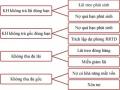
Credit risk is always of special concern to banks, because credit activities are the activities that bring the majority of income and profit to banks (accounting for about 80% of total income) and it is also the main activity of banks. Credit activities are closely related to all areas of the economy, each risk arising in these areas affects and poses risks to the commercial banking system in particular and the economy in general. According to Nguyen Van Tien (Commercial Banking Management Textbook, 2012), " Credit risk is a type of risk that arises in the lending process of banks, manifested in reality through customers not being able to repay their debts or repaying their debts late or incompletely to the bank" . Thus, when the due date comes and the customer does not repay on time or does not repay or repay in full, it means that credit risk has occurred.
Interest accrued
Customer does not pay interest on time
Overdue debt arising
Overdue debt arising
Customer does not pay principal on time
Provision for RRTD
Interest freeze
Not enough profit
Interest waiver
Bad Debt
Not enough principal
Debt forgiveness
Figure 2.1 Forms of credit risk
(Source: Author's synthesis)
According to the Basel Committee, credit risk is understood as “The risk of asset loss that may arise when a counterparty fails to perform its financial or contractual obligations to a bank, including failure to make debt payments, whether principal or interest, when the debt falls due. In this view, credit risk is assessed based on the customer's performance of financial obligations, including principal and interest payments.
According to Clause 1, Article 3 of Circular No. 02/2013/TT-NHNN dated January 21, 2013 of the State Bank of Vietnam, RRTD is understood as "A loss that is likely to occur to the debt of a credit institution or foreign bank branch due to the customer's failure to perform or inability to perform part or all of his/her obligations as committed."
According to NCS, RRTD will arise in case the bank does not collect the full principal and/or interest of the loan or when the customer does not pay on time. RRTD is not only limited to lending activities, but also includes many other credit activities such as: Guarantee, payment commitment, co-financing loans, inter-bank loans, hire purchase credit, trade finance, issuance of letters of credit L/C... In banking, RRTD is inevitable, it always exists with the development of commercial banks.
2.1.1.2 Concept of bad debt
According to previous studies, the concept of bad debt and how to determine bad debt
is complex and diverse.
The term “bad debt” in English is “bad debt”, “non-performing loan”, or “doubtful debt”. This is a loan that is considered bad debt when the principal and interest are overdue for 90 days or more (Rose, 2009; Miskin, 2010).
At the 18th meeting of the International Monetary Fund on the balance of payments in 2005, it was stated that nonperforming loans include (EighteentMeeting of the IMF Committee on Balance of Payments Statistics: The Treatment of Nonperforming Loans, 2005): “A loan is considered nonperforming when interest and/or principal payments are 90 days or more past due, or interest payments of 90 days or more have been restructured or rescheduled, or payments are less than 90 days past due but there are reasons to doubt that repayment will be made in full” .
Basically, bad debt (according to IMF) is defined based on two factors: (i): overdue for more than 90 days, or (ii:) the ability to repay is doubtful. With this perspective, bad debt is approached based on the time of overdue payment and the ability of the customer to repay.
According to AEG (2004), “loans are considered nonperforming when payments of interest and/or principal are 90 days or more past due, or when interest payments that are 90 days or more past due have been capitalized, restructured, or delayed by agreement; or when payments are less than 90 days due, but there are reasons to doubt that payments will be made in full”.
According to the Basel Committee, which guides common practices in many countries on Credit Risk Management, a debt is considered to be in default when one of the following two conditions occurs: (i) The bank finds that the borrower is unable to repay the debt in full when the bank has not taken any action to try to collect; (ii) The borrower is more than 90 days overdue on payment.
According to Circular No. 02/2013/TT – NHNN dated January 21, 2013 of the State Bank of Vietnam, Bad debt is debt classified into group 3 (Substandard debt), group 4 (Doubtful debt) and group 5 (Debt with potential loss of capital). In which:
(i) according to Article 10, it is mainly based on the overdue period of the debts (Group 3: overdue period from 91 - 180 days, Group 4: overdue period from 181 - 360 days, Group 5: overdue period over 360 days); (ii) according to Article 11, it is mainly based on the debt repayment capacity of the customer. (Group 3: Debts assessed by credit institutions as having the possibility of partial loss of principal and interest, Group 4: Debts assessed by credit institutions as having a high possibility of loss, Group 5: Debts assessed by credit institutions as no longer having the possibility of recovery, accepting the loss of capital). Thus, bad debt, according to the viewpoint of the State Bank of Vietnam, is also determined based on two factors: (i): overdue period of more than 90 days or (ii): debt repayment capacity is worrying.
In NCS's view, bad debt is a loan that is overdue and/or
principal according to the agreement over 90 days and doubtful the borrower's ability to repay. Specifically according to Article 6 or Article 7 of Decision 493/2005/QD-NHNN, bad debt is debt in groups 3, 4, 5 including substandard debt, doubtful debt, debt with potential loss of capital.
2.1.2 Classification of bad debt
Loan classification is the process by which banks regularly monitor their loans to place them into different groups based on their ability to repay and the maturity of the loan. Regularly reviewing and classifying loans helps banks to better control credit quality.
2.1.2.1 Classification of bad debt according to overdue debt period and debt recovery ability
Countries with different financial and economic institutions have different ways of classifying debt. However, the classification of bad debt in credit activities is often based on the assessment of the overdue time and the ability to recover the granted credit, including: Substandard debt (i); doubtful debt (ii) and debt with the possibility of losing capital (iii).
SBV (Regulations in Article 10, Circular 02/2013/TT-NHNN) Regulations on asset classification, provision levels, methods of provisioning for reserve funds and use of reserve funds include:
(i) Substandard debt (group 3 debt) includes: Debt overdue from 91 days to 180 days; Debt extended for the first time; Debt exempted or reduced interest due to the customer's inability to pay full interest according to the credit contract; And debt falling into one of the following cases:
Debt of customers or guarantors being organizations or individuals that credit institutions and bank branches are not allowed to grant credit to according to the provisions of law;
Debt secured by shares of a credit institution or a subsidiary of a credit institution or loans used to contribute capital to another credit institution on the basis that the lending credit institution receives collateral in the form of shares of the credit institution receiving the capital contribution;
Debts that are unsecured or granted with preferential conditions or with a value exceeding 5% of the equity capital of a credit institution or foreign bank branch when granted to customers subject to credit restrictions as prescribed by law;
Debts granted to subsidiaries, affiliates of credit institutions or enterprises over which the credit institution holds control have a value exceeding the limits prescribed by law;
It is worth more than the credit limits, unless otherwise permitted.
beyond the limits prescribed by law;
Debts violating the provisions of law on credit granting, foreign exchange management and safety ratios for credit institutions and foreign bank branches;
Debts violating internal regulations on credit granting, loan management, risk provisioning policies of credit institutions and foreign bank branches.
(ii) Doubtful debt (group 4) includes: Debt overdue from 181 to 360 days; Debt with restructured repayment term for the first time overdue less than 90 days according to the first restructured repayment term; Debt with restructured repayment term for the second time; Debt to be recovered according to inspection conclusions that is overdue for recovery up to 60 days and has not yet been recovered;
(iii) Debts with potential loss of capital (group 5) include: Debts overdue for more than 360 days; Debts with restructured repayment terms for the first time overdue for 90 days or more according to the first restructured repayment term; Debts with restructured repayment terms for the second time overdue according to the second restructured repayment term; Debts with restructured repayment terms for the third time or more, whether not overdue or overdue; Debts of customers being credit institutions announced by the State Bank to be placed under special control, and State Bank branches with capital and assets frozen.
2.1.2.2 Classification of bad debt according to accounting principles
Bad debt is divided into two types: on-balance sheet bad debt (i) and off-balance sheet bad debt (ii) :
(i) On-balance sheet bad debts are bad debts that are still being monitored on the balance sheet of credit institutions. These bad debts will directly affect the business performance of the bank in the period because credit institutions must set aside DPRR for these debts according to the rate prescribed by the State Bank from time to time.
(ii) Off-balance sheet bad debts are bad debts that have been handled using the DPRR fund and are monitored off-balance sheet to continue applying recovery measures. The recovery of these debts will increase the extraordinary profits of credit institutions.
2.1.3 Method of determining bad debt
2.1.3.1 By quantitative method
Determining bad debt by quantitative method is used to analyze and evaluate loans mainly based on the customer's repayment time and signs of not paying interest and principal on time. However, the credit institution still has the right to proactively decide to classify any debt into higher risk debt groups corresponding to the risk level if the customer's ability to repay the debt is assessed to have decreased.
According to regulations in Vietnam, with a quantitative approach, bad debts are debts of groups 3, 4 and 5 including substandard debts, doubtful debts, debts with the possibility of losing capital as prescribed in Article 10 of Circular No. 02/2013/TT-NHNN dated January 21, 2013, amended and supplemented by Circular No. 09/2014/TT-NHNN. Specifically, bad debts will include debts overdue for 91 days or more, debts with restructured repayment terms for the first time, debts with interest exempted or reduced because customers are unable to pay full interest according to the credit contract.
According to international practice, bad debt includes not only overdue loans but also