
Spring is yang and grows to summer (extreme yang). Autumn is yin and grows to winter (extreme yin). This is also a manifestation of the laws of nature. Human health and illness also depend on those laws.
5. APPLICATION OF THE THEORY OF YIN AND YANG IN TRADITIONAL MEDICINE
The theory of yin and yang was born more than 30 centuries ago, but until now it has been continuously applied and developed in traditional medicine. Because it has given axiomatic laws. Those laws have been applied by traditional medicine practitioners in their fields, making it increasingly deeper and richer, it is the guideline for all activities of traditional medicine including both medical and pharmaceutical aspects.
a) About body organization
- The five internal organs: heart, liver, spleen, lungs, and kidneys belong to yin.
- Six organs: Stomach, gallbladder, small intestine, large intestine, bladder, triple burner belong to yang.
In each organ, there is a yin part and a yang part. The relative nature of yin and yang is expressed in the organs such as: the heart is a yin organ in yang (the heart is located in the chest and belongs to yang); the liver is a yin organ in yin (the liver is located in the middle burner - the abdomen - belongs to yin).
- The back belongs to yang, the abdomen belongs to yin; the lower abdomen belongs to yin within yin; the chest belongs to yang within yin.
- Also according to the concept of yin and yang, the yang meridians in the body are distributed on the back, the outer sides of the legs, arms and ribs. The yin meridians are distributed on the abdomen, the inside of the arms and legs...
- Qi - the source of energy for the body is the function of the muscles, the function of the internal organs... which belong to yang; blood, essence, body fluids... belong to yin; skin, hair belong to yang, bone marrow belongs to yin...
b) Physiology
When the yin and yang in the body are balanced, the body is healthy. The body itself always adjusts to restore the balance of yin and yang. The imbalance of yin and yang is the root cause of disease.
Therefore, in principle, to maintain health, we must always keep the yin and yang in the body balanced. When the body is not able to self-regulate, we must actively regulate it, which is the treatment method according to traditional medicine.
c) About pathology
Once the yin and yang in the body cannot self-regulate, it leads to disorders and imbalances in the activities of the internal organs. For example: Liver Qi invades the stomach, meaning that the liver Qi affects the activities of the stomach, causing stomach pain (stomach pain, duodenum). Liver and gallbladder dampness and heat cause diseases such as jaundice, hepatitis, and jaundice... these are internal injuries.
Or due to external causes caused by "six lusts" which are caused by evil spirits (wind, cold, dampness, dryness, fire) penetrating the body and causing an imbalance of yin and yang.
Depending on the cause and location of the body, the disease arises accordingly.
In summary, the pathology of yin and yang is very diverse, and must be clearly distinguished in each case. At the same time, it is necessary to monitor its changes and use appropriate treatment methods, in accordance with the motto of "dialectical treatment" or "cubic countermeasures". The preparation and use of drugs in traditional medicine are also very flexible, adjusting and adjusting according to the symptoms to restore the balance of yin and yang in the body.
d) About diagnosis
Diagnosis of disease in traditional medicine also requires distinguishing between yin and yang.
- Based on the four methods of medical examination (four diagnoses): looking (vọng) - listening ( văn) - asking (van) - checking the pulse ( thiet) to exploit the symptoms of cold or heat, deficiency or excess of the internal organs.
- Based on the 8 principles (eight principles) to evaluate the location and depth of the disease, the nature of the disease, the patient's condition, the most general trend of the disease (surface, interior, deficiency, excess, cold, heat and yin, yang) in which yin and yang are the 2 most general principles called the general principles. Usually, diseases in the exterior, excess, heat belong to yang; diseases in the interior, deficiency, cold belong to yin.
e) On treatment and treatment methods.
Treatment is to regulate the imbalance of yin and yang in the body according to the condition of deficiency, excess, cold, and heat of the disease using different methods.
In general, drugs (pharmaceuticals) are divided into 2 groups.
Medicines with cold and cool properties (cold, cool) are called yin medicines and are used to treat heat diseases that belong to yang.
Medicines with hot, warm properties (heat, warmth) are called yang medicines and are used to treat cold diseases belonging to yin.
II. THE THEORY OF THE FIVE ELEMENTS
1. DEFINITION
The Five Elements Theory is a more specific theory of yin and yang in the observation, induction and interrelationship of things in nature.
In medicine, the theory is applied to observe, infer and state the correlation in the physiological and pathological activities of internal organs; to diagnose diseases;
to find the properties and effects of drugs; to prepare drugs...
2. CONTENT OF THE THEORY OF THE FIVE ELEMENTS
a) What are the five elements? The ancients recognized that there are five main types of matter: metal; wood; water; fire; earth; and then classified phenomena in nature and in the human body according to the five types of matter above, calling them the five elements. The five elements also have the meaning of the movement and transformation of forms of matter in nature as well as the activities of internal organs in the body.
b) Classification of the five elements in nature and in the human body
PRESENTLY
STATUE
FIVE ELEMENTS | |||||
Wood | Fire | Earth | Needle | Water | |
Material Color Taste The Five Elements of the Organ System Five senses and will | Wood, Green Tree Spring Winter Liver Gallbladder Eye Muscles Angry | Bitter Red Fire of Xia Nan Xin Small intestine Happy Tongue | Sweet Yellow Land Late Summer Central Spleen Mouth Taste Worry | White Metal Spicy West Scrap Large intestine, nose Sad | Northeast Salty Black Water Kidney Bladder Bones, marrow Ear Scared |
Maybe you are interested!
-
 Obstetrics and Gynecology Traditional Medicine Part 2 - 8
 -
 Traditional Medicine Systems in Countries Around the World
 -
 Characteristics of Activities and Management Organization of Vietnam Academy of Traditional Medicine
 -
 Traditional Medicine - 7
 -
 Oriental Medicine - West Saigon College Used to train Traditional Medicine Doctors - 2
c) The laws of operation of the five elements:
+ In normal or physiological conditions: matter in nature and body activities are closely related to each other, promoting each other to move continuously by mutual generation (this element generates that element, this organ generates that organ), or restraining and inhibiting each other to maintain balance by mutual inhibition (this element, this organ restrains that cave or that organ).
Law of mutual generation
- Wood burns to create fire (fire); fire burns everything to ashes and earth (earth); in the earth, metal (metal) is born, which is solid and when heated, it will melt (water); water nourishes trees (wood). In short: wood creates fire, fire creates earth, earth creates metal, metal creates water, water creates wood.
- In the human body, liver wood produces heart fire, heart fire produces spleen earth, spleen earth produces lung metal, lung metal produces kidney water, kidney water produces liver wood.
Law of mutual inhibition
- Wood overcomes earth, like tree roots growing deep into the ground, earth overcomes water like building dikes and dams to control water, water overcomes fire like using water to put out fire, fire overcomes metal like using fire to melt metal, metal overcomes wood like using metal to saw and cut trees...
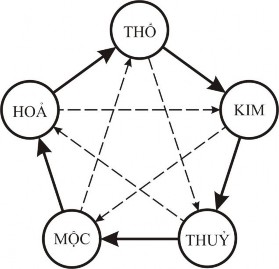
- In the human body, liver wood overcomes spleen earth, spleen earth overcomes kidney water, kidney water overcomes heart fire, heart fire overcomes lung metal, lung metal overcomes liver wood.
Figure 1: The Five Elements generate each other and the Five Elements restrain each other.
- In normal or pathological conditions, there is a phenomenon where one element or organ overcomes another element or organ is too strong, which is called mutual excess. Or when one element or organ cannot overcome another element or organ, this is called mutual conflict.
Example of mutual inheritance: normally, the wood of the liver overcomes the earth of the spleen. If the wood of the liver overcomes the earth of the spleen too strongly, it will cause stomach pain and diarrhea due to nerves. When treating this, it is necessary to calm the liver (reduce the excitement of the liver) and strengthen the spleen (support the activity of the spleen).
Example of mutual conflict: spleen earth overcomes kidney water. If the spleen is weak and cannot overcome kidney water, it will cause water retention, such as in prolonged diarrhea causing nutritional edema. When treating, the spleen must be strengthened (increasing the activity of the spleen) and diuretic (releasing the kidneys to reduce edema).
3. APPLICATIONS IN MEDICINE
a) About physiological relationships
The arrangement of the internal organs according to the five elements and their relation to the five colors, five senses, physical and mental activities help us to understand the physiological phenomena of the internal organs easily and remember easily.
For example, the liver has an external and internal relationship with the gallbladder, which governs the muscles, opens to the eyes, and is a good-natured organ. When depressed, it causes anger...
b) About pathological relationships
Based on the five elements, find the location of a disease in an organ or a system , to propose an appropriate treatment method.
The occurrence of a disease in a certain organ, there are 5 possible cases
happen:
- Righteous: disease caused by the same organ.
- Evil: disease caused by the previous organ to that organ, also called mother disease
passed on to children
- Evil food: Disease caused by the next organ to the next organ, also known as disease transmitted from child to mother.
- Evil: disease caused by an organ that is in conflict with that organ (mutual excess).
- Evil: disease caused by one organ not being able to overcome another organ (correspondingly)
dance).
For example, insomnia is a mental illness that can occur in five different locations:
- Righteousness: the heart itself is weak, causing insomnia: like anemia without nourishment.
be mentally stable. When treating, you must calm your mind and soul.
- Evil: caused by the liver causing illness in the heart, such as high blood pressure causing headaches and insomnia. When treating, the liver must be calmed (lowered blood pressure) and the mind calmed.
- Evil food: due to damaged spleen, it cannot nourish the mind, when treating it, it is necessary to strengthen the spleen and calm the mind.
- Evil taste: due to kidney yin deficiency that cannot control heart fire causing insomnia, when treating, must nourish yin and calm the mind.
- Evil thief: due to lung yin deficiency affecting the heart and blood causing insomnia, when treating, it is necessary to replenish lung yin and calm the mind.
c) About diagnostics
Based on the symptoms of the five colors, five flavors, five senses, and physical condition to find diseases of related organs.
- Five colors: yellow color is related to the spleen; white color is related to the lungs; green color is related to the liver; red color is related to the heart; black color is related to the kidneys.
- Five emotions: anger and irritability are diseases of the liver; fear is a disease of the kidney; laughing and talking nonsense are diseases of the mind; worry is a disease of the spleen; sadness is a disease of the lungs.
- Five orifices and five organs: diseases of the tendons: trembling limbs, cramps, liver diseases; diseases of the nose such as allergic rhinitis, nosebleeds... diseases of the lungs; diseases of the mouth: poor appetite, mouth ulcers... diseases of the spleen and stomach; diseases of the pulse: weak, small pulse... diseases of the heart; diseases of the bone marrow: such as slow walking, slow teething... diseases of the kidneys.
d) About therapeutics
Treatment according to the principle: if it is weak, nourish the mother, if it is strong, relieve the child.
For example: lung qi deficiency, lung tuberculosis... must strengthen the spleen because the spleen earth produces lung metal (when it is deficient, the mother is nourished).
Hypertension caused by excess liver yang must be treated at the heart: calming the mind, because liver wood generates heart fire (which is actually the heart's fire).
e) About medication
- Search and examine the effects of drugs on diseases of internal organs based on the relationship with the five colors and five flavors:
Sour taste, green color enters the liver. Bitter taste, red color enters the heart. Sweet taste, yellow color enters the spleen. Spicy taste, white color enters the lungs. Salty taste, black color enters the kidneys.
- People also use the five flavors to prepare medicines to change their properties and effects, guiding the medicine into the organs according to the treatment requirements. For example, stir-frying with vinegar directs the medicine into the liver; stir-frying with salt directs the medicine into the kidneys; stir-frying with sugar and bile directs the medicine into the spleen; stir-frying with ginger directs the medicine into the lungs...
CHAPTER III
MEDICINAL FEATURES (PHARMACEUTICAL FEATURES)
TARGET
1. Describe the properties and flavors of traditional medicine.
2. Apply the trend of effects and meridians of traditional Chinese medicine, master the compatibility and combination of traditional Chinese medicine.
CONTENT .
Pharmacological properties are the pharmacological effects of a drug used to correct the body's yin-yang imbalance.
The properties of the medicine include qi, taste, rising and falling, and tonifying and purging.
1. FOUR ELEMENTS
Also known as the four properties: cold; hot; warm; cool. These four properties are perceived by the body's reaction when taking the medicine.
Cold and cool belong to yin; heat and warm belong to yang. Medicines with cold and cool properties are called yin medicines, used to clear heat, reduce fire, detoxify... and tend to sink and descend to treat heat and yang symptoms; medicines with warm and hot properties are also called yang medicines, used to warm the middle, disperse cold, and tend to rise and float to treat cold and yin symptoms...
There is also a type of medicine that does not exhibit the above properties, when used it has a neutral property called neutrality.
Therefore, when treating and using medicine, it is necessary to correctly diagnose whether the disease is cold or hot and to have a firm grasp of the properties of the medicine in order to use it correctly. Misdiagnosis and wrong use of medicine can lead to harmful consequences for the patient.
2. FIVE FLAVORS
There are 5 flavors, perceived through the taste buds: spicy (tan), sour (toan), bitter (kho), sweet (cam), salty (ham). In addition, there is also a taste of blandness that has no distinct taste (none of the 5 flavors mentioned above).
- Spicy (tan): characteristic of tending to spread outward (tan), or mobile, often used to treat diseases of the surface, causing sweating or when blood and qi are stagnant. Medicinal herbs such as: perilla to disperse wind and cold to treat colds; moc huong to circulate qi, treat bloating; chuan khung to activate blood, treat blood stasis...
- Sweet taste (orange): has a nourishing effect, used to treat deficiency symptoms; harmonizes to reduce pain; reduces the toxicity of some medicines or detoxifies the body, harmonizes other medicines. Such as codonopsis, astragalus to nourish qi; rehmannia glutinosa, ophiopogon to nourish yin; licorice, malt candy to treat stomach pain...
- Bitter taste: has the effect of purging and removing dampness. Like Coptis chinensis and Phellodendron amurense clear heat, remove dampness and treat dysentery and infectious diarrhea; Atractylodes macrocephala strengthens the spleen and removes dampness and treats diarrhea and phlegm.
- Sour taste (acid): has astringent, astringent, pain-relieving properties, used to treat excessive sweating (spontaneous sweating), diarrhea, spermatorrhea such as goldthread, cornus officinalis astringent sweat, spermatorrhea, astringent urine; kha tu, gallnut treat chronic diarrhea, rectal prolapse; candied fruit treat abdominal pain caused by worms...
- Salty taste (ham): tends to go down (giang), softens hard masses or dissolves stagnant substances (nhuyen kien) often used to treat constipation, tuberculosis, lymphadenitis. Like mang tieu (main ingredient is sodium sulfate) causes laxative, purgative.
- Protein taste: has the ability to overcome dampness, diuretic used to treat diseases caused by dampness (edema). Like barley, talcum has diuretic effect.
+ The five flavors are closely related to the four qi, five organs, and five colors. Based on this, we can determine the effects of the medicine, find the right medicine, and prepare medicine according to treatment requirements.
Qi and taste combine together to form the properties of medicine, and cannot be separated. There are medicines with the same Qi but different tastes, so their therapeutic effects are also different.
For example, there are medicines that have one gas but contain several flavors, such as cinnamon which is warm in nature but sweet and spicy in taste. Rehmannia glutinosa which is cold in nature but bitter and sweet in taste.
Therefore, when using drugs clinically, one must grasp both the qi and taste of a drug. For example, fever; if it is due to heat on the surface, one must use refreshing and cooling drugs to relieve the surface such as mint and safflower; if it is due to real heat, one must use bitter and cold drugs (9kho63, han) such as coptis and rhubarb; if it is due to heat deficiency due to loss of body fluids, one must use sweet and cold drugs such as rehmannia glutinosa and scrophularia glutinosa...
Calculate
Name of medicine | Taste | Effect | |
Warm | Raw ginger Magnolia officinalis Astragalus Apricot | Bitter Sweet Sour | Disperses cold, relieves exterior symptoms, promotes qi circulation, strengthens the spleen Wax (stop diarrhea) |
Cold | Coptis chinensis | Bitter | Clearing heat, removing dampness, refreshing and relieving symptoms. |
Han On | Licorice Root | Sweet Sweet | Cooling, fire-clearing, strengthening the spleen |
Weld Heat | Plaster Mint and Aconite | Spicy Spicy | Cooling and fire-clearing New salary, clear the cold |