
The data to be recorded in this indicator is the cumulative amount arising from the Debit side of Account 511 "Sales revenue and service provision" corresponding to the Credit side of Account 521 "Revenue deductions" in the reporting period.
The indicator "Net revenue from sales and service provision (Code 10)" is the result of indicators Code 01 - Code 02.
1.2.3.1 Presenting cost information on financial statements
Cost of goods sold (Code 11) is presented on the Income Statement and Item 3, Part VII – Additional information for items presented in the Income Statement of the Notes to the Financial Statements.
Maybe you are interested!
-
 Accounting for revenue, expenses and business results at Long Bien Industrial Gas Joint Stock Company - 2
 -
 Accounting for revenue, expenses and business results at An Ngai Mechanical and Construction Joint Stock Company - 3
 -
 Accounting for revenue, expenses and determining business results at Saigon Real Estate Joint Stock Company - 1
 -
 Completing the accounting of revenue, expenses and determining business results at Huong Duong Tourism Development and Service Company - 10
 -
 Accounting for revenue, expenses and determining business results at Hoang An private enterprise - 12
The item “Cost of sales (Code 24)” is presented on the Income Statement and item 8, part VII of the Notes to the financial statements.
Indicator "Business management costs (Code 25)" of the Business performance report and item 8, part VII of the Notes to the financial statements
1.2.3.3 Presenting business results information on financial statements
Business performance: This figure is shown in the indicator “Net profit from business activities (Code 30)” of the Business performance report.
This indicator is the result of Code 20 + (Code 21 – Code 22) – Code 24 – Code 25. In which Code 21 is the Financial Activity Revenue indicator.
1.3. Accounting for revenue, expenses and business results from the perspective of management accounting
1.3.1 Develop accounting estimates for revenue, expenses and business results.
Budgeting is one of the tools widely used by managers in planning and control. Budgeting provides enterprises with information about the entire business plan of the enterprise in a systematic manner and ensures the implementation of the set goals. In addition, budgeting also has other effects as follows: Clearly defining specific goals to serve as a basis for evaluating future implementation.
Basis for budgeting
To make a feasible annual production and business budget for an enterprise, when establishing a management budget system for an enterprise, the following bases must be relied on: The annual production and business system of the enterprise.
Enterprises, production and business estimates of previous business periods, standard cost norms, analysis of specific economic - technical - financial conditions of each enterprise.
Business consumption forecast
Consumption is the final stage of the production and business process, however, when making a consumption budget, this is the origin of the whole system.
The sales budget must address basic objectives such as: estimating planned sales volume in the budget period, estimating planned selling prices to determine planned revenue, and finally estimating the amount of money that can be collected from generated revenue.
To make a consumption estimate, we need to refer to a series of basic information.
about:
- Consumption situation of previous periods and pricing policy of the enterprise
- Market demand and competitors' prices
- Sales method and payment term
Anticipate potential difficulties to have timely and correct solutions.
Integrate all business activities by integrating the plans and goals of different departments.
When making a sales budget, it is necessary to pay attention to the business's sales policy to estimate the cash inflows related to sales in different periods.
Cost estimate
Estimated cost of goods sold and ending inventory:
The budgeted cost of goods sold gives us information about the budgeted cost of goods sold – an item on the budgeted income statement later:
Cost of goods sold is determined by the formula:
Cost of goods sold Cost of goods sold Total cost Cost of goods sold Goods sold = inventory + products - inventory Estimated beginning of period Output in the period End of period
Cost of goods sold budget includes the following indicators:
+ Direct material costs
+ Direct labor costs
+ General production costs
+ Total product cost
+ Cost of finished goods inventory at the beginning of the period
+ Cost of finished goods available for sale
+ Cost of finished goods inventory at the end of the period
+ Cost of goods sold
Estimate selling expenses and business management expenses
The selling and administrative expense budget is a budget that includes the expenses related to the sales process of a business and the general administrative expenses of the entire business.
With this budget, managers can anticipate profits at different revenue levels when they understand the costs of responding to changes in revenue. Sales costs and administrative costs usually include two parts: variable costs and fixed costs. Fixed costs will not change according to the volume of products sold, but variable costs will change. Normally, variable costs will be determined by a certain percentage of revenue such as sales commissions. Determining total sales costs and administrative costs will be calculated in 2 steps: (1) use estimated sales revenue multiplied (x) by the variable cost ratio; (2) fixed costs plus (+) variable costs to determine total sales costs and administrative costs.
Forecast of business results report
Based on the departmental budgets, the management accounting department prepares budgeted business performance reports. The budgeted figures on these financial reports represent the expectations of managers in the enterprise and can be seen as a management tool of the enterprise that allows for management decisions. It is also the basis for evaluating the implementation of the proposed budget.
This budget is prepared based on the revenue budget, cost of goods sold budget, and non-manufacturing expense budgets that have been prepared. This budget can be prepared using the full method or the direct method.
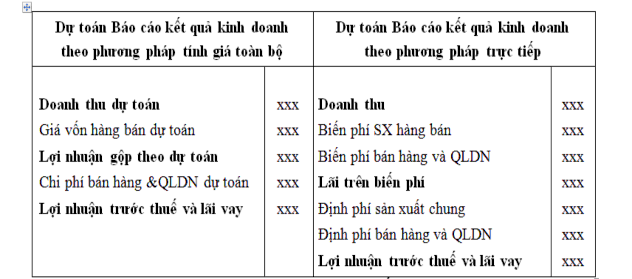
Forecast of business results report
Cash flow forecast
Cash flow forecasting is the estimation of cash inflows and outflows over the course of an accounting period.
Estimated cash receipts are added to the wages at the beginning of the period, then subtracted from the estimated cash outflows to see if there is a surplus or shortage. Normally, the cash flow forecast is made for December, so managers will use it to understand the changes in cash during the entire accounting period of the year to have measures to balance cash flow throughout the year. Cash flow forecasts can also help managers make short-term and long-term decisions about cash management. For example, managers can choose to invest idle money in securities with higher benefits instead of immediately paying off debts that are not yet due.
To prepare a cash flow forecast for this period, the business must determine the cash collection schedule and the cash disbursement schedule based on sales revenue and the value of goods purchased during the period. The accounting principle used to determine the cash flow schedule is the accrual basis principle, which means that the accountant will record the revenue arising from the transaction without basing on the actual time of cash collection.
Financial statement forecast
Including projected financial statements, projected balance sheets, and projected cash flow statements. These projections present the financial results of the business's operations for the forecast period. Forecasted statements
1.3.2. Collect information on revenue, costs and business results
Information users
The subjects using the accounting information of the unit often have direct and indirect economic interests in that unit. The information needs of these subjects will influence the information provision objectives of the unit's accounting system.
Information users:
- Unit manager
Unit managers have direct obligations and rights at the unit. They are the ones who are legally responsible for the use and control of the unit's resources, ensuring the unit's business operations are effective and maintaining the legitimate interests of the parties involved. Therefore, unit managers need to grasp information about the financial situation, cash flow, business results... of the unit in order to perform the functions of planning, organizing the implementation of the plan and controlling the unit's activities. To be able to perform these functions, unit managers need many sources of information, one of the important sources of information is information about revenue, costs and business results.
- Owner
Owners can be the state, government, organizations, individuals, depending on the type of unit such as state-owned enterprise, limited liability company, joint stock company, private enterprise... Unit owners are the ones who provide capital to the unit, their interests depend on the business performance of the unit. Therefore, their information needs are often broader than other subjects such as information on assets, liabilities, equity, business results, cash flow... But one of the information that owners are most interested in is still the revenue, expenses and business performance of the unit.
- Creditor
Creditors are those who provide credit to the unit in the form of loans; or commercial credit... Creditors have legal economic interests in the unit, receive payment when the debt matures, and credit creditors also receive fixed interest from the loan to the unit. The subjects considered as creditors to the unit are very diverse and rich, they can be those who provide currency or goods, services to the unit and accept late payment. Creditors are interested in the unit's ability to pay and make profits. Therefore, revenue, expenses and business results are some of the information that Creditors are very interested in. It partly reflects the unit's ability to make profits and make payments.
- Government
The Government through representative agencies such as the Ministry of Finance, General Department of Taxation... to perform its roles and functions. Information that serves as the basis for decision making, including information on revenue, costs and business results, plays an important role in managing the unit's tax obligations to the state.
- Other objects
Other users of accounting information include employees, trade unions, auditing organizations, the public, etc. Users of information all need information reflecting the financial situation, operating situation and results, cash flow situation and other general information of the unit. Therefore, they need to be provided with, read and understand information reflecting the economic situation of the unit: Revenue, expenses, business performance results.
Request for information
- Honestly, accounting information and data must be recorded and reported on the basis of complete, objective evidence and true to reality about the current status, nature, content and value of the arising economic transactions.
- Objectively, accounting information and data must be recorded and reported accurately, without distortion or falsification.
- Complete, all economic and financial transactions arising in relation to the accounting period must be recorded and reported fully, without omission.
- Timely, accounting information and data must be recorded and reported promptly, on time or before the prescribed deadline, without delay.
- Easy to understand, the information and accounting figures presented in the financial statements (FS) must be clear and easy to understand for users. Users here are understood as people with average knowledge of business, economics, finance, and accounting. Information about complex issues in the FS must be explained in the explanatory section.
- Comparability: Accounting information and figures between accounting periods within an enterprise and between enterprises can only be compared when calculated and presented consistently. In case of inconsistency, it must be explained in the explanatory section so that users of the financial statements can compare information between accounting periods, between enterprises or between implementation information and budget and planning information.
Accounting information design
- Organize the system of accounting documents and initial accounting
This is the job of organizing the collection of information about revenue and expenses arising in the unit and checking the legality, reasonableness and validity of those transactions and operations.
This job is the job of organizing and applying the issued voucher system, regulating internal voucher forms. Organizing the initial accounting of revenue and expenses to ensure that all economic transactions arising from revenue and expenses are accurately, fully and promptly reflected in accounting vouchers according to regulations.
The main tasks of this organization are:
+ Determine the revenue and cost accounting voucher system applied at the unit. Based on the accounting voucher system issued by the State and regulations on internal vouchers.
+ Organize initial accounting of revenue and expenses (establish regulations on document preparation, processing, checking, classifying and summarizing documents)
+ Organize the circulation of documents and accounting records
+ Store and preserve accounting documents after they have been used for accounting entries.
- Organizing the application of accounting system
This job is to apply the issued account system, based on the purpose and detailed management requirements to open detailed accounts to track revenue, expenses and business performance. The design of appropriate account details (opening to many levels, detailing many contents) depends on the information usage requirements.
The main tasks of this organization are:
+ Determine the number of general accounting accounts, detailed accounting accounts of revenue, expenses and business results.
+ Determine the content, structure, and scope of recording in general accounting accounts and detailed accounting accounts of revenue, expenses, and business results.
- Organize accounting system
The organization of the accounting system for revenue, expenses and business results needs to be designed scientifically and reasonably with specific book forms to facilitate the synthesis, management and tracking of information.
The content of the detailed revenue accounting book must reflect detailed revenue (by activity, contract, item, etc.) according to the information requirements for revenue monitoring and management.
The content of the detailed cost accounting book must ensure detailed tracking of each cost item, cost element, etc. Cost analysis by each cost aggregation object must be appropriate to the requirements for providing cost information.
- The accounting reporting system provides information on revenue, expenses, and business performance.
To be able to provide useful information about revenue, costs and business performance to business administrators, a reporting system must be organized.