
According to Table 5.4, the proportion of the elderly working to support themselves is “Absolutely correct” decreased from 29.8% in the 60-64 age group to 15.6% in the 65-69 age group and to 9.4% in the 70 and older age group. Meanwhile, the proportion of working for the reason of being respected by their children and grandchildren in these population groups accounts for a high proportion, corresponding to 34.5%, 41.0% and 33.8%. In parallel, the motive for working for personal reasons, that is, to relieve boredom is “Absolutely correct” also accounts for a proportion quite similar to the motive for working for economic reasons. However, this motive has a clear decline from the 65-69 age group to the 70 and older age group (from 27.2% to 8.6%). This fact reflects that the need for entertainment can greatly influence the age group under 70, but for those aged 70 and above, entertainment no longer has much influence on decisions to participate in the labor market, because for them, working to gain the respect of their children and grandchildren has a higher meaning.
Table 5.3. Work motivation by age ( N=480; Unit = %)
Absolutely right | Mostly true | Partly correct | Incorrect | P | |
Economic factors - Work to support yourself | |||||
60 - 64 | 29.8 | 19.0 | 17.9 | 33.3 | * |
65 - 69 | 15.6 | 25.4 | 28.9 | 30.1 | |
≥ 70 | 9.4 | 6.5 | 30.9 | 53.2 | |
Personal factors - Work to relieve boredom | |||||
60 - 64 | 25.6 | 25.0 | 18.5 | 31.0 | * |
65 - 69 | 27.2 | 32.9 | 13.3 | 26.6 | |
≥ 70 | 8.6 | 20.1 | 23.7 | 47.5 | |
Social factors - Work to gain the respect of your children/grandchildren | |||||
60 - 64 | 34.5 | 25.6 | 36.3 | 3.6 | * |
65 - 69 | 41.0 | 20.2 | 26.0 | 12.7 | |
≥ 70 | 33.8 | 35.3 | 23.7 | 7.2 | |
Note: * = P < 0.05; ** = P< 0.1; *** = P> 0.1 Source: Survey results in Nam Tu Liem District, Hanoi, 2019; | |||||
Maybe you are interested!
-
 Research Model of Factors Impacting Work Motivation of Tour Guide Team in Binh Dinh Province
 -
 Solutions to Promote Work Motivation for Employees at Noi Bai International Airport
 -
 Work Unit: ………………………………………………..
 -
 Current Status of Evaluating Work Motivation Results at the Company
 -
 The problem of creating work motivation in the Vietnamese textile industry: current situation and solutions - 14
Similarly, analysis of work motivation of employed elderly people according to different social groups by gender showed that this variable has an influence on work motivation to support oneself (P < 0.5). But that influence almost does not make a difference.
gender difference, as the gap in the proportion who said “Absolutely True” was only 0.1 points (18.7% vs. 18.8%).
This shows that the economic pressure that the employed elderly bear is similar by gender, because they receive a share from the next generations. Thanks to that, both genders have a fairly similar selection rate.
However, gender creates a different influence on the motivation to work to make life less boring (if P < 0.1 is accepted). Accordingly, up to 25.2% of male elderly people admit that they are influenced by this motivation as "Absolutely true", 7.6 points higher than the rate of 17.6% of female elderly people.
This is because men are often less interested in family care work, as many studies have shown. For example, studies by Phan Dai Doan (2010), Le Thi Quy (2019). That makes them feel the dullness and boredom of life. Therefore, male elderly people have a higher motivation to work to relieve this negative feeling than female elderly people.
Staying at home without anything to do makes me feel bored. My aunt is better because she has things to do, like going to the market, cooking, and looking after the kids. She doesn't know what to do. So she likes to work extra for fun.
Source: Male, 67 years old, good health
However, with the motive of working to gain the respect of children and grandchildren, gender
There was no effect (P > 0.1), although 40.0% of men and 33.6% of women admitted “Absolutely true” for this purpose.
Table 5.4. Work motivation by gender ( N=480; Unit = %)
Completely correct | Correct part much | Partly correct | Incorrect | P | |
Economic factors - Working to support yourself | |||||
Male | 18.7 | 22.6 | 27.0 | 31.7 | * |
Female | 18.8 | 13.2 | 24.4 | 43.6 | |
Personal factors - Work to make life less boring | |||||
Male | 25.2 | 27.0 | 18.7 | 29.1 | ** |
Female | 17.6 | 26.0 | 17.6 | 38.8 | |
Social factors - Work to gain the respect of your children/grandchildren | |||||
Male
40.0 | 23.5 | 29.6 | 7.0 | ** * | |
Female | 33.6 | 29.2 | 28.4 | 8.8 | |
Note: * = P < 0.05; ** = P< 0.1; *** = P> 0.1; Source: Survey results in Nam Tu Liem District, Hanoi, 2019. | |||||
Similarly, analysis of working motivation of employed elderly people according to health status showed that this variable has a heterogeneous effect on working motivation to support oneself (if P < 0.1), working motivation to make life less boring (P
< 0.05) and motivation to work for children and grandchildren to respect (P < 0.05).
Table 5.5. Work motivation according to health status ( N=480; Unit = %)
Absolutely right | Mostly true | Partly correct | Incorrect | P | |
Economic factors - Working to support yourself | |||||
Good | 19.7 | 18.2 | 31.8 | 30.3 | ** |
Normal | 18.1 | 18.9 | 26.1 | 36.9 | |
Weak | 22.2 | 9.3 | 14.8 | 53.7 | |
Personal factors - Work to make life less boring | |||||
Good | 12.1 | 27.3 | 31.8 | 28.8 | * |
Normal | 23.6 | 24.4 | 18.3 | 33.6 | |
Weak | 16.7 | 38.9 | 0.0 | 44.4 | |
Social factors - Work to gain the respect of your children/grandchildren | |||||
Good | 27.3 | 12.1 | 57.6 | 3.0 | * |
Normal | 35.0 | 29.7 | 25.3 | 10.0 | |
Weak | 59.3 | 22.2 | 18.5 | 0.0 | |
Note: * = P < 0.05; ** = P< 0.1; *** = P> 0.1 Source: Survey results in Nam Tu Liem District, Hanoi, 2019; | |||||
Accordingly, the rate of elderly people working to support themselves is "Absolutely correct" decreased from 19.7% in the group with good health to 18.1% in the group with normal health and then increased to 22.2% in the group with poor health (Table 5.5).
This shows a paradox, because according to common logic, people with the worst health are often the ones who are most “protected” by their families. However, this common logic does not fit the case of employed elderly people in Nam Tu Liem District, Hanoi. Here, people with
The people with the worst health are the ones who are most motivated to work to support themselves is “Absolutely true”.
According to the theory of work motivation, this paradox exists because economic factors affect this population group more strongly than other population groups. Moreover, according to research by the World Bank (2016), elderly people with poor health often spend more on medical examination and treatment. Therefore, according to this impact, the economic motivation of this population group is also higher.
However, the influence of social factors on the decision to participate in the labor market of the elderly with poor health is also quite large, up to 16.7%, higher than the 12.1% of the elderly with good health, but lower than the 23.6% of the elderly with normal health (Table 5.5).
According to the explanation of Denis Mannaerts (2016), as well as Ezzedine El Mestiri (2016), when economic pressure decreases, many employed elderly people want to continue working because they have the need to maintain social relationships, the need to feel the positive meaning of life, as well as the need to maintain a stable lifestyle that they have had for many years, which is "going to work in the morning and coming home in the afternoon". Therefore, they still have the motivation to work. Thanks to that motivation, they avoid a lonely and depressed life in old age. This is consistent with the case of employed elderly people in Nam Tu Liem District, Hanoi, regardless of whether they are in poor, normal or good health. However, this need is different between groups, so the proportion of this population group working for the reason of making life less boring has the above difference.
When considering the motivation to work for the reason of being respected by children and grandchildren, we also see that the elderly with poor health are most affected by this factor, accordingly, the rate of admitting that it is "Absolutely true" is up to 59.3% (Table 5.5).
According to the theory of social identity, social position, and social role, this result shows that self-esteem seems to be a strong motivation for the elderly with poor health to participate in TTLĐ. This motivation helps them "get rid" of the image of a person living dependent on the family's protection, helps them strengthen their role, build a "strong" image, know how to overcome difficulties, has educational significance, builds an image, and leaves a deep impression that makes their children/grandchildren respect them.
Table 5.6. Work motivation according to social security beneficiary status ( N=480; Unit = %)
Completely correct | Correct part much | Partly correct | Incorrect | P | |
Economic factors - Working to support yourself | |||||
Have | 19.6 | 25.5 | 28.9 | 26.0 | * |
Are not | 18.1 | 12.0 | 23.2 | 46.7 | |
Personal factors - Work to make life less boring | |||||
Have | 24.0 | 28.4 | 14.7 | 32.8 | *** |
Are not | 19.2 | 25.0 | 20.7 | 35.1 | |
Social factors - Work to gain the respect of your children/grandchildren | |||||
Have | 35.8 | 26.5 | 32.8 | 4.9 | *** |
Are not | 37.3 | 26.4 | 26.1 | 10.1 | |
Note: * = P < 0.05; ** = P< 0.1; *** = P> 0.1 Source: Survey results in Nam Tu Liem District, Hanoi, 2019; | |||||
Unlike health factors, analysis of work motivation of employed elderly people in Nam Tu Liem District, Hanoi according to social security beneficiary status shows that in many cases, the influence of this factor is not statistically significant (P > 0.1).
Specifically, according to the above table 5.6, policy factors do not affect the motivation to work to make life less boring (p > 0.1) or to be respected by children and grandchildren (P > 0.1). However, the observed data in the above table shows that the elderly who benefit from social welfare have a higher rate of working with the motivation to make life less boring as "Completely true" (24.0%) than the corresponding rate of the elderly who do not benefit (19.2%). However, the elderly who benefit from social welfare have a lower rate of working with the motivation to be respected by children and grandchildren as "Completely true" than the corresponding rate of the elderly who do not benefit (35.8% compared to 37.3%).
However, policy factors may influence the motivation to work for self-sufficiency (P < 0.05). This influence creates a difference between groups, although it is not strong enough to create a clear difference in the motivation to work of the employed elderly (19.6% vs. 18.1%). From the perspective of work motivation theory, it seems that in this case, the elderly group benefits or does not benefit
Social workers have similar needs, goals, and motivations.
5.2.2. Need for rest
The need for leisure among employed older persons, that is, the need to withdraw from the labour market, is influenced heterogeneously by economic, personal and social factors.
According to the theory of work motivation, individuals will quit their jobs when there are influencing factors, and in this study, the need for rest, meaning the intention to quit their jobs and withdraw from the labor market of employed elderly people, is analyzed from three perspectives: economic (intention to work until having enough money for retirement), personal (intention to work until not being healthy enough) and social (intention to work until there is no one to hire 25 ).
Similarly, to measure the need for rest of the elderly, the study designed a scale with 4 different levels, in which 1 is "Completely true", 2 is "Mostly true", 3 is "Somewhat true" and 4 is "Not true".
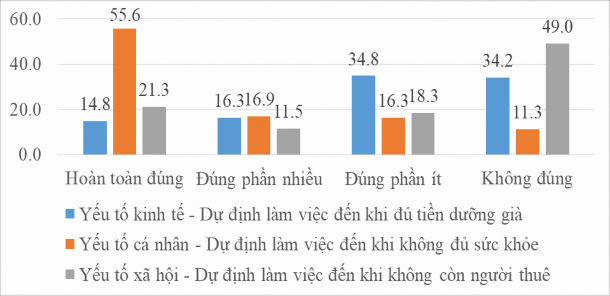
Survey results show that the influence of economic factors accounts for a lower proportion than the influence of personal and social factors on the retirement intentions of employed elderly people (Table 5.5).
Table 5. 5. Rest needs (N = 480; Unit = % )
[Source: Survey results in Nam Tu Liem District, Hanoi, 2019]
According to the survey results above, the number of elderly people with the need for rest is shown through their plans.
25 Including self-employment (in the case of self-employed NCT)
Working until having enough money for retirement is “Absolutely true” with the lowest percentage (14.8%) (Table 5.5).
This fact can be explained through the findings of many different studies. According to Philippe Antoine and Valérie Golaz (2010, pp. 45-50), in countries, localities (and even households) with slow economic development, many elderly people do not have the right to enjoy a comfortable life.
The PVS excerpt in this study shows that “ Retirement age is not the age to rest when you cannot earn enough money to take care of your life. Retirement age is the age to find additional sources of income to take care of your old age ”.
This explains why a group of employed elderly people in Nam Tu Liem District, Hanoi admitted that they would withdraw from the labor market when they had enough money for retirement, which is "absolutely correct", even though this percentage is not large.
My family's situation is also difficult, my uncle passed away early, my son and his wife do not have stable jobs. Luckily, my uncle has a lot of experience so he can still find a job for himself. He has decided to do this job until people no longer hire him, then quit.
Source: Female, 67 years old, normal health
From the perspective of Taylor's (1911) theory of work motivation, or of
Locke (1968) suggests that economic factors may be an important motivator for workers to participate in the labor market, but the influence of economic factors on the need for leisure of the employed elderly seems to be weak. In that sense, this population group may not be concerned much with economic factors when deciding to withdraw from the labor market. This finding is further supported by the intention to work until they are not healthy enough and the intention to work until they are no longer employed.
Also according to the results of the above table 5.5, 55.6% of employed elderly people admitted that they intended to withdraw from the labor force when they felt their health was not good enough to work, which is "Completely correct". Thus, compared to economic factors, personal factors, expressed through health status, have a stronger influence on the need for rest. Based on the percentage of complete agreement, this difference is up to 3.8 times.
Now that I am healthy, I will continue working. But when I feel I am not healthy enough, I will retire. The economy is not as difficult as before, so I cannot work any more.
health care. Uncle is old, do not try to do anything to make yourself sick.
Source: Male, 65 years old, good health
Similarly, the proportion of employed older adults who admit to intending to work until retirement
while the tenants are “Absolutely correct” up to 21.3% (Table 5.4). This once again shows that the influence of economic factors on the need for rest is lower than the influence of other factors. The difference in the influence of social factors compared to economic factors is up to 6.5 percentage points.
According to Weber. D et al. (2016), many elderly people in the world continue to work because they want to maintain good health. For the elderly, health is a fundamental factor that helps them have a happy old age, save on medical examination/treatment costs, and reduce the time spent in bed. Therefore, many elderly people do not want to give up their jobs when their health is still good. However, when their health declines, their labor capacity also decreases, which does not allow them to continue working, but forces them to withdraw from the labor market. Also during this period, employers and users of goods/services gradually reduce their demand for the labor of the elderly and turn to finding other alternative sources of supply. This dual impact strongly affects the decision of the elderly to "rest" in old age.
Thus, according to the above research, as well as from the perspective of work motivation theory, it seems that the economy does not occupy an important position in the "retirement" intention of the employed elderly, but the health of this population group plays a key role, because health reasons already include in it a part of economic reasons and affect the decision to use labor of social subjects. Therefore, the influence of economic factors on the need for rest of the employed elderly is the lowest.
Table 5.7. Rest needs by age ( N=480; Unit = %)
Completely correct | Correct part much | Partly correct | Incorrect | P | |
Economic factors - Intend to work until retirement | |||||
60 - 64 | 11.3 | 16.7 | 31.0 | 41.1 | * |
65 - 69 | 23.7 | 16.2 | 31.2 | 28.9 | |
≥ 70 | 7.9 | 15.8 | 43.9 | 32.4 | |
Personal factors - Intend to work until incapacitated | |||||