
nominal adjustment and unified adjustment, these two forms still belong to the dynamic component
Extrinsic motivation is also known as extrinsic motivation (Mitchell, Schuster, and Jin, 2020; Ryan and Deci, 2020). IM and extrinsic motivation in work are considered to be related but distinct concepts (Sok et al., 2016).
Some results show that extrinsic (reward-related) motivation or the role of extrinsic motivation affects employee PERF (Kuvaas Buch, Weibel, Dysvik, and Nerstad, 2017; Srivastava and Barmola, 2011). However, previous studies also show that support tools can influence the perception of autonomy and can lead to PERF outcomes through internal transformation processes, which is still very limited (Homburg et al., 2019). The results of the synthesis of studies in the sales field show that extrinsic and endogenous motivation affect employees' sales PERF (Cerasoli et al., 2014; Delpechitre et al., 2020). In addition, the authors also suggested that the extent to which perceived autonomy can lead to work outcomes through pursuing desires, achieving work goals, and expressing work interests within each employee should be considered (Homburg et al., 2019). Supporting this view, some other research results also show that employees under a lot of work pressure will self-regulate their behavior towards work commitment, positive feelings towards work (Vujčić et al., 2017) and PERF (WongOn Wing, Guo, Lui, 2010). In fact, sales employees can show different combinations of job enjoyment (IM) and motivation towards achieving work goals (Sok et al., 2016).
The results of the one-on-one discussion also revealed that motivation has an impact on PERF (see Appendix 4). Because the employees also agreed that, to ensure the achievement of life goals and personal development, and to demonstrate passion in work, employees will strive and make efforts to achieve personal and organizational goals. According to the above discussion, the author believes that:
H6. Extrinsic motivation has a positive impact on work performance.
Maybe you are interested!
-
 Research Model of Factors Impacting Work Motivation of Tour Guide Team in Binh Dinh Province
 -
 Solutions to Promote Work Motivation for Employees at Noi Bai International Airport
 -
 Current Status of Evaluating Work Motivation Results at the Company
 -
 The problem of creating work motivation in the Vietnamese textile industry: current situation and solutions - 14
 -
 The problem of creating work motivation in the Vietnamese textile industry: current situation and solutions - 2
Sok et al.'s (2016) study identified IM and EM in work.
are considered to be related but distinct concepts. IM is motivation that refers to performing an activity in order to satisfy the inner self of the action itself.
74
that aims to accommodate a person's different values and needs.
(Gagné and Deci, 2005). IM is the strongest predictor of overall PERF of salespeople (Miao et al., 2007; Román and Iacobucci, 2010). However, this is not enough to motivate salespeople effectively, especially salespeople who are prone to job switching and looking for new attractive products and projects (Homburg et al., 2019).
For sales, sales effectiveness is defined as the perception of
salespeople on the number of sales achieved, the quality of customer relationships they maintain, and the knowledge they possess about their products, competitor product differentiation, and customer needs (Krishnan et al., 2002).
Previous research results in the sales field also show that IM directly affects sales PERF (Cerasoli et al., 2014; Delpechitre et al., 2020). However, other authors also suggest that the extent of IM's influence on PERF needs to be further examined (Homburg et al., 2019). Therefore, the authors suggest that:
H7. Intrinsic motivation has a positive impact on work performance.
2.3.5. The relationship between work motivation and individual behavior
According to the SDT theory of Ryan and Deci (2000), extrinsic motivation plays an important role in the completion of employees' tasks. Extrinsic motivation is created through external control factors and specifically for sales employees, it can be bonuses. The attractiveness of bonuses strongly affects employees' EPL, which is shown by the fact that employees will mobilize all their knowledge, experience, skills and abilities.
existing relationships to enhance PERF towards the given reward.
From a behavioral perspective, an individual may be motivated by a variety of factors, including work enjoyment (IM) and/or the desire to pursue personal interests or pleasures (Judge et al., 2005). However, in a business-oriented environment,
In the motivational direction, employees will self-regulate (internal regulation) their behavior.
facing difficult and challenging contexts such as EPL and EPR
(Caniëls and van Assen, 2019; Kao and Chen, 2016). Therefore, employees' extrinsic motivations have a positive impact on EPL and EPR (Jasmand et al., 2012) and support employees'
pills that satisfy the need for
psychological, support
support
enhance IM and individual behavioral intentions
(Mitchell et al., 2019). Therefore, the author argues that employees' extrinsic motivation
Sales impact on EPR and EPL.
H8. Extrinsic motivation has a positive effect on (a) exploration behavior and (b) exploitation behavior.
Intrinsic motivation reflects interest in work and extrinsic motivation
explains behavior through the desire to achieve rewards (Ryan and Deci, 2000). IM motivates employees to spend more time performing a task, thereby improving
skills and help employees work creatively and effectively (Amabile and
Kramer, 2007). Individuals with IM will find enjoyment in their work, which in turn motivates them to explore and discover new tasks. Enjoyment becomes the main factor leading to behaviors such as seeking out different ways of working or taking initiative.
learning to perform tasks most effectively. Many studies have been
practice and argue that IM is a necessary condition for discovering solutions and reasons.
new theory – manifestation of EPR (Caniëls et al., 2017). On the other hand, the work environment will encourage employees to have a sense of responsibility to implement EPRs because employees themselves will be responsible for their PERF (Oldham and Cummings, 1996). Employees with self-determined motivation will perform their work proactively, confidently and perform behaviors to improve, find the best methods to perform the work because employees see their tasks in the organization as important and valuable to the organization.
function, this will
positively affects PERF as well as the
creative
(Amabile and
Kramer, 2007). In addition, employees will self-evaluate their role in the task and actively strive to improve PERF (Arnold, Collier, Leech and Sutton, 2000). When salespeople enjoy and love their work, they will build relationships that develop
with customers better, with more creative thinking and coping well with stress (Graves, Ruderman, Ohlott and Weber, 2012).
Salespeople who are able to “enjoy their work” find their tasks
The task of performing EPLs and EPRs is intrinsically fun, enjoyable, and interesting. This leads to autonomous and voluntary task performance (Aman et al., 2021; Graves et al., 2012). Unlike employees who are motivated by finding enjoyment in their work, employees who are “driven to do
76
they complete tasks to avoid shame, guilt, and failure. As a result, these individuals
This achievement is a result of the obligations, pressures, anxiety, and stress faced while pursuing the task (Aman et al., 2021).
Thus, the two aspects of self-determination theory are somewhat consistent with the focus of regulation to promote and prevent individual behaviors. The focus of motivation and job enjoyment are both aimed at opportunities for self-development. In contrast, the focus of prevention and the orientation towards work motivation are associated with avoiding negative outcomes. The frequent focus of the above two aspects, the interaction between job enjoyment and job promotion are also positively related to EPL and EPR of salespeople (Sok et al., 2016).
Thus, the above views and discussion results show that IM has a direct impact on employees' EPR and EPL. In addition, the results of the combined one-on-one discussions also found that when employees are motivated, they will perform EPL and EPR before JD to achieve efficiency (see Appendix 4). Therefore, the author proposes:
H9. Endogenous motivation positively affects (a) exploratory behavior and (b) exploitative behavior.
waterfall
2.3.6. The relationship between individual behavior and work performance
Organizations and researchers have been interested in how employees can easily cope with change and flexibility in work by using their knowledge and using new ideas to promote work output from employees. Therefore, researchers need to increase research on ambidexterity. However, most studies have focused mainly on the ambidexterity of behavior in organizations without paying attention to the factors that determine the level of ambidexterity of behavior at the individual level (AffumOsei et al., 2020).
Studies have found that exploitation activities have caused employees to expend more energy to achieve PERF including both individuals and organizations (Gibson and Birkinshaw, 2004; Kang and Snell, 2009). In addition, studies by Hong et al. (2018), Kobarg et al. (2017), Lubatkin et al. (2006), Yu et al. (2013) found that the exploitation process increased PERF. Other studies have shown that EPL increases creative performance (Zacher et al., 2016) and service sales performance (Jasmand et al., 2012; Rapp
et al., 2017; Sok and Chen, 2016; Zacher et al., 2016). In addition, the
EPLs reduce conflicting tasks during task performance (Smith and Tshman, 2005). Therefore, EPLs also demonstrate high integration during task performance (Cron, Marshall, Singh, Spiro, and Sujan, 2005).
Based on the above discussion, the author believes that in a sales environment, employees need to be highly focused and use all their current capabilities to achieve sales PERF. Therefore, the author believes that the EPL of sales employees will contribute to increasing PERF.
H10a. Exploitation behavior has a positive impact on work performance.
Similar,
Hong et al. (2018) also confirmed that employee EPR has
image
influence PERF. The behavior of increasing or making efforts to perform activities to search for methods, procedures or ideas will help employees achieve the task sooner but it is also costly and risky in completing the task (Yu et al., 2013). In addition, Cron et al. (2005) also suggested that implementing EPRs can lead to high adaptability of business employees in the process of contacting
and sell to customers.
Studies involving service salespeople also show that EPR increases employees' PERF (Jasmand et al., 2012; Rapp et al., 2017; Sok and Chen, 2016; Zacher et al., 2016). In addition, employees' exploratory activities
in the organizations
also helps increase the organization's PERF.
function
(Kobarg et al.,
2017;
Lubatkin et al., 2006; Yu et al., 2013) and creative work performance (Zacher
et al.,
2016). Therefore, the author believes that when employees
increase activities
discovery will increase employee sales PERF. Therefore, the author proposes the following hypothesis:
H10b. Exploratory behavior has a positive impact on job performance.
2.3.7. Proposed research model
The proposed model is built on the basis of integrating JDR and SDT theories. In addition, based on the research gaps discovered, the author proposes a research model on the relationship between JD, self-determination motivation, and individual behavior affecting PERF of real estate brokers in Vietnam. Specifically, the research model uses the concept of JD,
78
PR in the JDR theoretical model. In which, the research model has focused on the difference
JD by using two separate components including CD and hindrance as proposed by Bakker and Demerouti (2017). The variable POS represents PR with the role of a moderator variable on the relationship between JD and self-determined motivation in the model. POS in the model represents a positive orientation that can reduce employee stress and support increasing employee motivation to work under work pressure.
Because the JDR model has not clearly shown the different components of motivation and has not explained why employees perform behaviors in the process of achieving PERF. Therefore, this research model uses self-determined motivation with two separate components including IM and extrinsic motivation in SDT theory to explain why employees perform individual behaviors (EPL and EPR) to achieve PERF before JD. In addition, the synthesis results of previous studies only stop at the view that JD is related to EPR and EPL without conducting research on it, so it is necessary to explore this relationship in the model affecting PERF.
Regarding work motivation from a psychological perspective, SDT theory suggests that job characteristics can satisfy basic psychological needs and form IM and EM and thereby influence PERF. On the other hand, corresponding to the characteristics
of each job the employee will tend to perform
show activities
discover, find
acquire new knowledge and skills to complete tasks in the best way. On the contrary, for routine, simple and time-pressured jobs, employees will
focus on exploiting all knowledge and skills
existing capacity to
perform the task
(Mom et al., 2007). In addition, these behaviors are also influenced by employees' work motivation. Depending on employees' perceptions of the meaning of work and the effectiveness of work, it will lead to the corresponding EPL - EPR and thereby determine PERF.
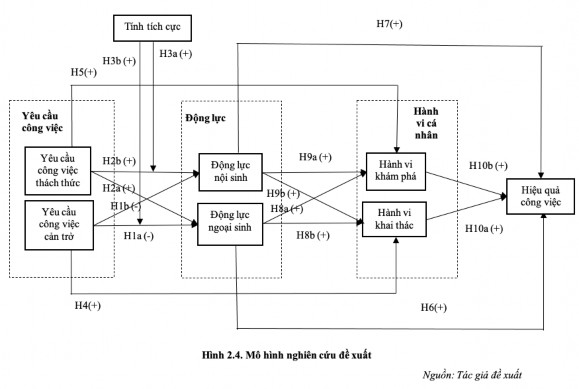
Thus, based on the JDR theory, SDT and the gaps synthesized from previous research works, the author proposes a research model as shown in Figure 2.4 and the research hypotheses are summarized as follows:
H1a. Inhibitory job demands have a negative impact on extrinsic motivation. H1b. Inhibitory job demands have a negative impact on intrinsic motivation.
H2a. Challenging job demands positively affect extrinsic motivation.
H2b. Challenging job demands positively affect intrinsic motivation.
H3a. Positivity and the interaction between positivity and challenging job demands positively affect intrinsic motivation.
H3b. Positivity and the interaction between positivity and job demands have a positive impact on extrinsic motivation.
H4. Inhibitory job demands positively affect exploitation behavior. H5. Challenging job demands positively affect exploration behavior. H6. Extrinsic motivation positively affects job performance.
H7. Endogenous motivation has a positive impact on work performance. H8a. Exogenous motivation has a positive impact on exploratory behavior. H8b. Exogenous motivation has a positive impact on exploitative behavior. H9a. Endogenous motivation has a positive impact on exploratory behavior.
H9b. Endogenous motivation has a positive impact on exploitation behavior. H10a. Exploitation behavior has a positive impact on work performance. H10b. Exploration behavior has a positive impact on work performance.
80
CHAPTER 2 SUMMARY
Chapter 2 presented the theoretical basis of JR and JD and self-determination theory. Based on the combination of the two theories above, the author presented related concepts including CD and HD representing JD, POS representing PR, IM and extrinsic motivation representing self-determination motivation, EPL and EPR representing individual dual behavior, PERF of employees and referring to previous studies, the author proposed to build a theoretical model with 16 corresponding research hypotheses. Next, in chapter 3, the author will present the contents related to the research design of the thesis.
CHAPTER 3. RESEARCH DESIGN
In Chapter 3, the author presents some contents related to research methods including research process, qualitative research methods, quantitative research methods, preliminary quantitative research results, and official quantitative research scales.
3.1. Research process
The research process is built up in two main stages including preliminary research and official research (Figure 3.1).
3.1.1. Preliminary research
3.1.1.1. Preliminary qualitative research
Qualitative research used the traditional method of Churchill (1979)
and COARSE (scale concept, respondent classification, attribute classification,
Rossiter (2002) used the respondent identification, scale format and reporting checklist to adapt the existing scale to the Vietnamese context. This adaptation