
on management training. Only 50% of directors have received training in management training. This is one of the main reasons for the limitation in the management decision-making capacity of directors of current enterprises [20].
c. Professional competence
In terms of professional qualifications, most Vietnamese enterprises still lack basic knowledge of management. According to the survey results of Project KX-07-14, about 65% of state enterprise managers were trained in the period before 1989, much of which is outdated compared to the new mechanism. 20-50% of the staff do not meet job requirements; most managers are promoted from those with good expertise, but very few of them are trained in business management science. The rather superficial understanding of the law is one of the causes of illegal business phenomena today.
The situation has improved significantly for private enterprises. Because they have to do business on their own, without doing business they cannot survive, so most private enterprises have a team of highly qualified and well-trained leaders. Many of them have been trained at famous foreign universities. A recent survey by the Ministry of Planning and Investment of 63,000 enterprises in 36 provinces and cities showed that the number of business owners with a Master's degree or higher accounts for only 2.99%, University 37.82%, College 3.56%, Vocational High School 12.33%, and up to 43.3% of business owners have a cultural level of high school or lower[45].
But most notably, the majority of business owners are people with college and university degrees or higher, and very few have received training in economics and business administration. According to a survey by the Institute for Economic Development Research (IDR), 65% of 2,000 business owners in Ho Chi Minh City come from the class of leaders and civil servants in the State sector, and are promoted and appointed more because of their ability and achievements in running a business. About 15% of CEOs are businessmen whose families have a long tradition of doing business, the remaining 20% are CEOs who have developed from different sources. Research by the Institute for Economic Research
IDR Development once commented: Vietnamese CEOs know everything but do not know anything deeply. This is a reality that if there is no immediate solution to supplement and a long-term training strategy for sustainability, the failure will certainly belong to Vietnamese enterprises. Another comment is that Vietnamese CEOs are very sensitive to changes and impacts, but the ability to turn sensitivity into compatible actions is poor, that is, poor in skills [45].
According to the survey data of Vietnamworks.com in 2007, the human resources of senior managers in Vietnam only meet 30 to 40% of the needs of enterprises [45]. A common problem in Vietnamese enterprises is that management rights and ownership rights are not clearly separated, the leader is both the owner of the enterprise and the CEO, so it is difficult to promote the management role. Meanwhile, those holding the highest positions in State-owned enterprises are only appointed civil servants, not hired professional CEOs. The government has a mechanism allowing 5 corporations to hire General Directors, but so far it has not been effective.
1.2.3. Prestige and personality of Vietnamese leaders
Personality is a basic psychological factor that determines the quality and effectiveness of business operations and business management. A business leader with good personality will be responsible to the employees in the business, to his partners, to his customers and to society. On the contrary, a business leader lacking personality only focuses on profit and may do anything regardless of ethical violations to gain profit.
The personality of Vietnamese managers and leaders has the common characteristics of Vietnamese people. It is a simple, hard-working, diligent lifestyle but also full of the will to strive to improve. The personality and reputation of a businessman are two inseparable factors because a good personality will create reputation and vice versa. The reputation of a businessman includes authority and trust. Authority is shown in the organization, in the enterprise and in social relations. Trust here is the trust of employees, partners and customers. For Vietnamese leaders, trust
The responsibility of workers first of all originates from respect and partly fear of the boss since the subsidy period. But in modern times, the trust of workers in leaders mainly originates from the leadership style and personality as well as the capacity of the leader himself in the enterprise. Besides, the trust of partners and customers in the leader - business manager shows the social relationship of not only the individual leader but also the reputation of the whole enterprise through the quality and efficiency of the product. An effective business with a solid position in the market will bring high prestige to the leader. On the contrary, a prestigious leader will help customers and partners trust more when collaborating and transacting, gradually the enterprise will create a solid position in the market. Thus, the prestige of the leader is always linked to the prestige of the whole enterprise. In modern Vietnamese society, the development of the prestige of Vietnamese business leaders is increasingly focused on because the prestige of leaders not only affects them personally but also affects the position of the entire business in the eyes of partners, customers and society. Our country has more and more successful businessmen and business leaders honored through prestigious business awards such as: Golden Star of Vietnam, Outstanding Leader Award in the retail sector 2008, Promising Young Leader of Vietnam 2007, Outstanding Vietnamese Businessman Award...
2. Employee psychology in Vietnamese enterprises
2.1. General overview of the portrait of Vietnamese workers
The psychological characteristics of Vietnamese workers are imbued with the traditional psychology of Vietnamese people. To objectively and generally comment on the psychology of Vietnamese workers, we will now look at some assessments of some domestic and foreign organizations and researchers on the characteristics of Vietnamese workers (see tables 6 and 7).
Table 6: Summary of research on evaluating Vietnam's human resources in the period of Vietnam's Industrialization - Modernization 9
STT
Characteristics of Vietnamese workers | |
1 | Limited health, especially low endurance, not used to experiencing high intensity, intensive work ( short, light weight ) |
2 | The needs of many people for life and development are still simple and low. to the engine not working strong enough |
3 | Often regretful of money, unfamiliar, less daring to take risks, lingering and hesitating, not compete or drop out of school for big things |
4 | Knowledge is not deep and broad enough; professional expertise is still lacking. basic and limited |
5 | Work is still not serious, not thinking |
6 | Industrial style is still limited and not firmly defined. |
7 | There are many bad habits such as: prying, jealousy, envy, obstruction. destroy each other; depend, passive, free, arbitrary |
Maybe you are interested!
-
 Research Projects Related to Globalization, Impact of Globalization on Personality, Lifestyle, and Ethics of Vietnamese People
 -
 Some solutions to limit risks in international goods trading activities of Vietnamese traders - 10
 -
 The Preposition “Auf” Viewed From a Cognitive Perspective Compared with Vietnamese
 -
 Determining the price of residential land for compensation when the State recovers land according to current Vietnamese law - 2
 -
 Gender issues and feminist resonances in contemporary Vietnamese prose through the works of some typical female writers - 21
The following is a summary of the strengths and weaknesses of workers through the results of Project KX05-07.
Table 7: Research on the personality of Vietnamese workers in the period of industrialization and modernization [23]
STT
Successful worker | The failed worker | |
1 | Balanced mood, less negative emotions extreme, high endurance, less boredom | Inferiority complex, self-consciousness, easily discouraged, have tendency to be anxious, sensitive |
9 The Nghia – “New thinking in business”. Statistical Publishing House 2003
when failed, solved the problem when in trouble | with sarcasm, less likely stress control | |
2 | Have the ability and desire to be self-sufficient present, assert oneself, value relationships, actively participate in activities | Weak average positivity, dislike quickness, urgency, haste |
3 | strong sense of happiness, failure; willing to diversify activities to achieve dreams - experiment with many types of activities, willing to see review social and religious values | Content with certain types of activities, not interested in engaging in new activities or things they have never experienced before |
4 | Believe in your profession, yourself and the majority of others | Suspicious, distrustful of others, likes to protect one's thoughts and feelings from others different |
5 | Strive for success in work | Not passionate about work or career. Have average needs. normal, average effort |
6 | Positive attitude, open-minded, not afraid of difficulties, high self-learning spirit | Negative attitude, no effort overcome difficulties, not willing to learn, self-improvement |
The above studies on the characteristics of Vietnamese workers may not be completely accurate, but they are also a synthesis of assessments from a large part of Vietnamese workers. Through this, workers can look back at themselves and change to bring about higher work efficiency. In addition, business owners and managers can also look at it to come up with appropriate management policies.
suitable to the needs and psychology of workers, to create incentives and promote the productivity of their employees.
2.2. Psychological characteristics of employees in Vietnamese enterprises
In this section, the researcher will approach the psychological situation of Vietnamese workers in the direction mentioned in the previous chapter (ie five psychological factors of workers) - figure 3, page 19.
2.2.1. Needs, desires and interests of workers
Workers' needs
Humans are special creatures, a synthesis of a complex system of psychological and physiological structures. Normally, workers spend most of their time on work, but that does not mean they do not have other needs. The more developed life is, the higher the needs of workers. We can easily recognize this if we compare the needs of Vietnamese workers today with those of the period under the centralized subsidy mechanism. If in the past, during the centralized subsidy mechanism, most Vietnamese workers only wanted to have enough rice, food and daily necessities for a comfortable life - or more specifically, material needs, today people all want to have a more prosperous and comfortable life or "eat well, dress well" - that is, material needs are also pushed to a new level and people's spiritual needs are also increasingly developing.
When the lower-level needs have been relatively fully met, workers will move towards higher-level needs. Normally, workers with good working ability and high qualifications often offer better working conditions than simple manual labor. Especially "talents" will aim to satisfy higher-level needs more. For them, the workplace is not simply a place to earn a living, to have social activities, but more importantly, it is the place where they want to be recognized, to express themselves, and even higher, it is the place where they can develop all their potential, maximize creativity to surpass their inherent abilities.
For domestic enterprises, the needs of workers are quite fully met in terms of material and spiritual aspects. However, in some industrial zones and some small and medium-sized private enterprises, the needs of workers as well as the ability of employers to meet the needs of workers are still at a low level. If we look at Maslow's hierarchy of needs (see Figure 8), the majority of the needs of workers in industrial zones are only at the level of wanting to be "recognized".
Figure 8: Psychologist Abraham Maslow's hierarchy of needs [17]
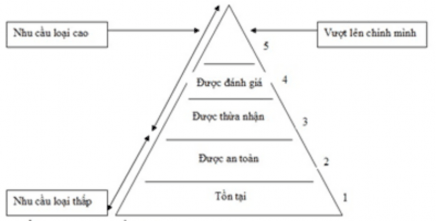
According to the author's research, the needs of workers in industrial zones generally stop at stable salaries, adequate working conditions, good security issues and meeting a small part of entertainment needs. This is partly due to the low cultural level of a class of workers, causing business owners to take advantage of this to meet the needs of workers in the lowest way, especially their spiritual needs. Through the author's research on the activities of Vietnamese enterprises, research and understanding of workers' needs have not been carried out regularly and widely. Most enterprises still carry out these operations through informal channels and are not institutionalized into the enterprise's policies. This makes it difficult for enterprises to know their thoughts and aspirations.
The inevitable consequence is that employees do not feel satisfied with their organization and want to find a new working environment, or still try to maintain but work half-heartedly and ineffectively.
Workers' wishes
Labor efficiency depends not only on the capacity and awareness of the workers but also on the relationship, management mechanism, and working conditions for the workers. If the manager's expectation for the workers is the results of their work, their labor awareness reflects the past, closely following the labor contract, the workers' desire is often for a good working environment, a picture of the future of self-promotion, self-expression and self-affirmation. These are important factors that managers need to pay close attention to. Workers cannot accept that the business will continue to delay their treatment according to their level. The wishes of the workers can be a suggestion for managers to have measures to satisfy their needs, thereby encouraging them to work actively, effectively, enthusiastically, retaining talented people, people with many innovations and creativity.
Below are the three basic desires of Vietnamese workers according to a survey by researchers of several businesses in Hanoi in March 2009:
Firstly, employees want to do a job that suits them, receive a salary commensurate with their efforts, the company is managed well and the working conditions are open . When these factors are satisfied, employees will feel secure and can devote themselves to their work. Enterprises need to have a policy of investing in training to improve the professional qualifications and skills of employees. On the contrary, if this need is not guaranteed, it will limit the ability to contribute, enthusiasm, creativity, and low work results of employees, leading to the situation of employees changing jobs, quitting jobs, working half-heartedly, or not being "enthusiastic" about their jobs. However, in reality, employees are always dissatisfied with the salary they receive. According to statistics from the Ministry of Labor, War Invalids and Social Affairs, up to 31% of employees