
revealed shortcomings and the State adjusted by granting land for people to build their own houses. Once again, when the housing demand of the population was too great and the above policy was ineffective. Thus, in essence, the main reason for the above cases is that the amount of capital sufficient to meet the housing demand has exceeded the State's resources.
Nowadays, in most developing countries, the above approaches have been replaced by new approaches. This approach facilitates the efficient operation of the housing market by creating a competitive environment based on market factors, because the housing finance market is part of the financial market and also the place where households satisfy their housing needs, so this market has become a major concern of policy makers. Financial systems are seen as the lifeblood for allocating investments in a market-oriented economy. But since housing is a social issue for each country, this issue is inconsistent with an efficient financial system.
Source : Author (2007) .
Maybe you are interested!
-

 General Theoretical Basis of Corporate Finance and Corporate Financial Analysis.
 -
 Perfecting Housing Finance Policy to Integrate With Regional and World Economy
 -
 Policy on mobilizing financial resources for technological innovation for small and medium enterprises (case study of Hai Duong province) - 11
 -
 Policy Implications for Enhancing Competitiveness and Strengthening Financial Stability of Vietnamese Commercial Banks in the Context of CPTPP Integration
 -
 Some Basic Issues on Financial Support Policy to Enhance Export Capacity of Small and Medium Enterprises
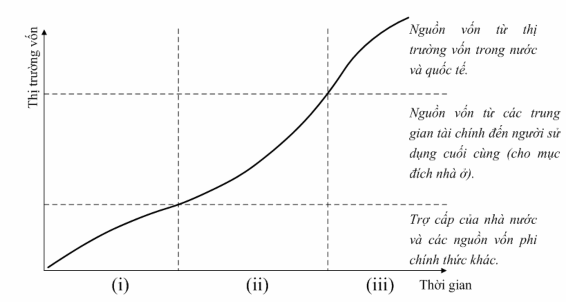
Figure 1.2 Stages of development of the housing finance system
If following the capital market approach, housing finance is developed in 3 main stages (see Figure 1.2 ):
(i) Housing finance from the state and from the informal financial sector;
(ii) Housing finance through financial intermediaries (primary mortgage market); and
(iii) Housing capital from domestic and international capital markets (mobilized through revolving loans in the mortgage market - secondary mortgage market).
When moving from state-subsidized housing finance and from the informal financial sector to a higher stage, a necessary condition is the existence of a mortgage market (with housing mortgage loans), the mortgage market is an important part of the housing finance market. There are two types of mortgage markets: the primary mortgage market and the secondary mortgage market.
The Primary Mortgage Market is the market where mortgage loans are directly lent by financial institutions. This market usually takes place at financial institutions and is provided to borrowers through the products and services of these institutions.
The secondary mortgage market is the market in which mortgages and mortgage-backed securities are bought and sold. This market usually takes place in the capital market or at the commercial bank, this market increases capital mobilization for housing by lending revolving loans in the market.
The primary mortgage market is where residential loans are made to individuals, families, and businesses. The secondary mortgage market is where these loans are bought and sold through mortgage-backed securities. The secondary mortgage market
guarantees the convertibility of mortgages into cash, allowing mortgage lending institutions and mortgage-backed security holders to exit their investments at any time.
The difference between these two markets is that the primary mortgage market's operations add capital to the economy, while the secondary mortgage market's operations only change the ownership of mortgage securities, without adding capital to the economy (except for the first time when the central bank buys back loans from financial institutions).
There is a reciprocal relationship between the primary mortgage market and the secondary mortgage market. The primary mortgage market acts as a basis for the activities of the secondary mortgage market because it is where the goods are created to be bought and sold in the secondary mortgage market. The secondary mortgage market has a reciprocal effect on the primary mortgage market, acting as a driving force for the development of this market.
In most countries around the world, to develop a secondary mortgage market, it is necessary to first develop an effective primary mortgage market. The prerequisites for developing a secondary mortgage market include: (i) a stable macroeconomic environment; (ii) a well-functioning housing and land use rights registration system and a well-functioning real estate credit system; (iii) real estate credit must be an attractive investment; (iv) standardization of real estate credit; (v) standardization of appraisal skills; (vi) standardization of debt collection skills; and (vii) the existence of potential investors.
To develop from the primary mortgage market to the secondary mortgage market, a “special financial institution” was required to purchase mortgages and issue securities against them to continue to raise capital for housing (revolving loans in the market). Initially,
Mortgage Loans
Primary Mortgage Market
Home Buyer
Capital Markets
When there was no participation of “special financial institutions”, subjects with the need to buy or develop housing would go to commercial banks (deposit institutions) to borrow money to invest in housing (this is a large and long-term investment). They used the assets formed in the future (housing) as collateral for the Bank. However, banks were also very hesitant to invest in this field because the lending was long and the long-term mobilized capital was not enough to invest in the housing sector. Meanwhile, the mortgaged assets of the borrowers were simply monitored on the off-balance sheet and were outside the Bank’s balance sheet (off-balance sheet).
Capital
Debt instruments
Debt repayment
Sale of mortgages
Issuance of mortgage-backed securities
Save
Individual, Household
Capital
Commercial Bank
Mortgage Bank Housing Bank
Secondary mortgage market
Mortgage Bank Housing Bank
Source : Author (2007) .
Commercial Bank
Mortgage Bank Housing Bank Finance Company Insurance Company Funds
Investors
Capital
Figure 1.3 Model of capital mobilization for housing finance through mortgage securitization (MBS)
As the economy and finance develop, there will appear “special financial institutions” that create long-term capital and convert mortgage assets into money through the issuance of mortgage-backed securities and sell them on the capital market. Usually, individual financial institutions will gather and sell mortgage assets to “special financial institutions” (which can be companies or banks such as: Mortgage companies, commercial banks, commercial banks).
Housing Bank...). This organization will aggregate loans into a "basket" of larger value and on the basis of this "basket" create a type of security to sell on the stock market called mortgage-backed securities (MBS - Mortgage-Backed-Security) or mortgage securities. Capital mobilization through securitization is described in Figure 1.3 and Figure 1.4 .
Borrower (With collateral)
Mortgage Bank
(1)
Mortgage
(3)
Secured loans
Loan
(4)
Principal and interest payment
Source : [133; p. 29] .
(2)
Investors (bond holders)
Asset
Capital
Buy bonds
Bonds
(5)
Same interest rate, Same term , Principal and interest payment
Figure 1.4 Mortgage-Backed Securitization (MBS) Principle Diagram
Figure 1.4. theoretically describes the principle of mortgage securitization from the balance sheet of the commercial bank. To finance the purchase, repair, or renovation of a house, property owners or commercial banks (borrowers) propose a mortgage (1) to the commercial bank. This mortgage loan request includes the loan amount, term, repayment period, and interest rate. The commercial bank, based on these requests, issues mortgage bonds with the same term, same interest rate, and other specific requirements. Theoretically, these mortgage bonds can be transferred back to the borrowers. But usually the borrowers request the commercial bank to sell these bonds on their behalf in the capital market (2). The proceeds from the sale of these bonds go to the borrowers through the commercial bank (3). Periodically (monthly, quarterly, annually, etc.), the borrower repays the principal, interest, and a fee to the commercial bank (4). The commercial bank transfers the principal and interest to investors holding bonds (5). In total, the total amount of money held by the borrower is equal to the total number of bonds issued.
Thus, with mortgage securitization, NHTC will continue to create capital sources to finance housing in the secondary mortgage market.
Long-term capital in the secondary mortgage market is always linked to the capital market. The capital market is both the premise and the basis for the development of the secondary mortgage market.
In general, developing countries are in the early stage (stage (i)), and begin to move to stage (ii) when private housing ownership is recognized. But to move to stage (iii) is a difficult step, many countries have maintained stage (ii) for a long time, some countries have moved to stage (iii) through the development of an efficient primary market (see Figure 1.2 ).
There are differences between countries in the timing of the various stages of development of the housing finance system, which largely depends on the speed of completion of the basic principles related to land ownership, mortgage registration, mortgage procedures, the legal environment for implementing these issues and the ease of debt recovery through foreclosure. Some developing economies with long-standing and stable land and legal systems and developed financial, banking and capital systems such as India and Malaysia have been able to quickly consolidate their primary mortgage markets and move to the secondary mortgage market stage.
In countries where these factors do not exist, when the economy enters the stage of market economic development, it usually takes a certain amount of time to build a healthy primary mortgage market. This market is the foundation and basis for moving up to the secondary mortgage market. Developing countries, even if they want to catch up with developed countries like the US, cannot jump from a lower stage, skipping a stage to a higher stage (if they lack the foundational factors). Inappropriate land ownership systems, laws and capital markets cannot support a mortgage securitization system.
at a high level regardless of whether the State tries to use economic, administrative or organizational measures to intervene.
1.1.2.4. Basic principles of housing finance
Effective housing finance must adhere to the following principles: First, recognize private ownership of housing. To avoid risks
In order to reduce the legal risks in operation, the existence of an adequate legal environment supporting the housing finance system is a prerequisite. The existence of legal regulations that can guarantee private ownership of housing and allow property rights to be issued as a security for a housing mortgage loan.
Second, information relating to housing and mortgages must be clear and transparent. The land and housing system must be supported by a registry that records the entire history of real estate assets. At the same time, there must be a comprehensive credit information system. This information system provides information on the borrower's credit history as well as (if possible) information on financial capacity and ability to repay the loan during the loan period. In countries with a high level of housing finance development, standard and detailed credit records include evidence of the quality of the collateral as well as the borrower's ability to repay the loan. Lenders often request reports on the borrower's housing loans, which can be obtained from the credit information center. This organization gives the borrower a credit score to assess his ability to repay the loan.
Third, clear foreclosure mechanisms. A good foreclosure system can enable lenders to sell assets when a loan is in default. The introduction of a foreclosure system goes hand in hand with effective foreclosure mechanisms. If the foreclosure regulations are not clear, disputes may arise. Security, if any, is also
There is no real point in recovering a defaulted loan, which is then very difficult to sell for social and political reasons.
Fourth, the source of capital for housing finance must be attractive to attract savers, or in other words, the interest rate on deposits for housing credit and the interest rate on mortgage-backed securities must be attractive enough. Housing finance must compete to mobilize capital sources in the capital market, financial intermediaries must offer attractive instruments to savers and investors.
Fifth, the source of capital mobilized for housing financing must be long-term. One of the characteristics of a housing finance institution is the need to ensure funding for the longest possible period at the lowest possible costs. The banking network is by far the most important representative in the field of savings mobilization. Depositors can open savings accounts or deposit accounts in which funds are retained for a certain period. The key role of commercial banks must be emphasized because of the safety and advantages they bring to depositors, as well as the increasing number of branches and transaction offices.
And finally, housing credit must be appropriate to the target group. Housing finance loans can be classified according to the nature of the borrower, as they will be divided into different loan terms: (i) private/individual loans; (ii) loans to development companies; and (iii) loans to construction companies. Loans to individuals should in principle be granted for a long term. To ensure the borrower's ability to repay, the term should be over 10 years, or preferably 15 to 20 years. These loans are made when the land has been developed and/or the house has been completed. From the lowest to the highest value loans, and loans for locations