
Thus, in order to have a basis for grouping universities with partial or full financial autonomy in regular expenses, there should be future studies when the database is complete to test the differences between groups (For example: in the technical training sector, the group of schools with entrance scores from 19 to 21 points are really capable of autonomy compared to the group with scores from 17 to 19 points or not). However, with the analysis and research of EXPLORATION using correlation coefficients and comparing groups in each factor, the importance is clearly recognized: to achieve the goal of financial autonomy, schools need to have enough conditions as mentioned above to meet the teaching and learning process in accordance with market trends.
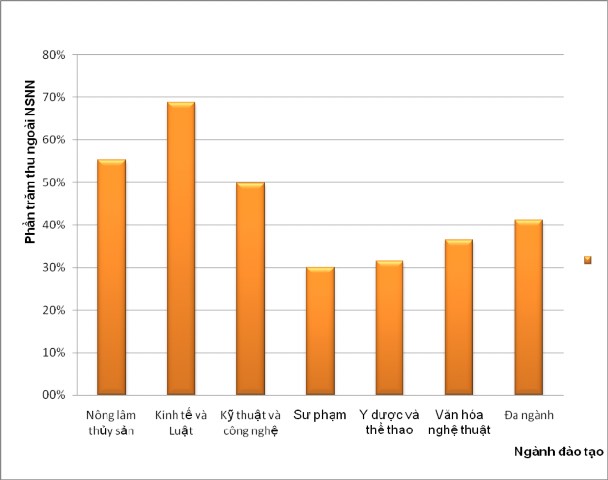
But when we put the database into the software, we get the following chart 3.1:
Maybe you are interested!
-
 Ranking the Level of Impact of Factors on Financial Statements
 -
 Results of the Impact of Factors on the Efficiency of Public Investment Management in Tien Giang
 -
 Analysis of the Current Status of Financial Management in the Direction of Financial Autonomy of Public Universities in Vietnam
 -
 Solution Group on Innovation in Financial Management Mechanism towards Financial Autonomy for Public Universities
 -
 Illustration of Financial Acceleration Theory on the Impact of Macro Factors on Bad Debt
Chart 3.1: Non-state budget revenue ratio by training sector
Source: Data analysis results, using SPSS software - Author synthesized based on the database of Appendix 2
In classifying schools with full financial autonomy, the State should consider the structure of occupations in society. According to chart 3.1, the schools with the highest autonomy at present are the schools training in economics and law, with the non-state budget revenue rate reaching 69%. The second is engineering and technology, with this rate being 50%, in line with the development trend of applied occupations. Two
The cultural, artistic, medical and sports sectors are unlikely to be given full financial autonomy, especially the pedagogy sector, which is very difficult to give financial autonomy to (according to statistics, the pedagogy sector is only capable of 30% autonomy compared to other sectors).
Or with the current financial autonomy status analyzed in chapter 2, autonomous schools can be classified according to existing public assets.
Faced with that situation, schools that want to have good financial autonomy (when the Government requires full financial autonomy) should consider the factors and dependent variables in the research model.
In summary, the study shows that grouping schools with financial autonomy requires a database of many schools and publication over many years so that the grouping according to the following criteria is convincing:
Classify financially autonomous public universities according to the following criteria:
- Input related criteria group
+ Classroom area of all types (for example, schools with total classroom area ≥7500m2 ) can be considered for complete financial autonomy.
+ Entrance exam score
+ Number of Professors, Associate Professors, Doctors
+ Number of permanent lecturers
+ Library area
+ Level of domestic and international training linkage
Synthesizing the research results, the author presents model 3.2 on the level of impact on financial autonomy of the following factors:
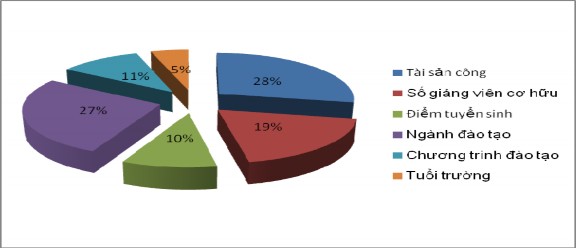
Figure 3.2: Level of impact on autonomy of factors
Source: Data analysis results, using SPSS software - Author synthesized based on the database of Appendix 2
Figure 3.2 shows that the influence of public assets and training sectors on financial autonomy of public universities is the largest, also affected by the age factor of the school but the impact rate is small. From these conclusions, this can be considered a reference factor when developing criteria for classifying schools with full autonomy in regular expenses.
The next conclusion is also given in the thesis, it is necessary to pilot two types of autonomy.
Type 1: Full autonomy in regular expenses. Applied to the Law and Economics, Agriculture, Forestry and Fisheries and Engineering and Technology sectors, while considering other conditions such as: the school has an area ratio per student of 45m2 or more or the classroom area is ≥ 7500m2 , the dormitory area is ≥ 10,000m2 , the library area
≥ 2500m2 ; number of permanent lecturers ≥500 lecturers; number of lecturers with master's degree or higher
≥85% of permanent lecturers; the school applies advanced training programs; the school has international joint training.
Type 2: Partially self-sufficient in regular expenses. Applicable to the remaining sectors: medicine, sports, culture and arts, multidisciplinary and schools not in type 1 above.
- Output-related indicators: The group of indicators mentioned here is the system of financial management assessment indicators associated with output quality (presented in chapter 1) to consider which group of schools effectively uses resources through the results obtained from spending.
Thus, it is necessary to gradually expand autonomy and self-responsibility in training and in financial management of schools.
In fact, in Vietnam, a number of documents have been issued regulating the autonomy and self-responsibility of revenue-generating public service units (including public universities - the subject that the author is researching). Although, after the spirit of Decree 43/2006, sharing the burden with the State budget seems to be very supported, it is still at a very limited level. To improve financial autonomy, better financial management for universities is the basis for better use of the current resources of the schools, thereby improving the quality of training in public universities. The author would like to boldly present his point of view as a solution for financial management of public universities.
The Government should review the main tasks of the Ministry of Education and Training of Vietnam. There should be research projects, surveys of the actual education systems of developed countries such as the UK and the US, learning from experiences that can be inherited for Vietnam. Of course, there are factors that cannot be applied in Vietnam, but on that basis we will have a distillation to suit the situation.
The reality in Vietnam. The task of the Ministry of Education and Training in most developed countries is to focus on implementing quality assessment and quality control according to set standards. Based on the assessment results of the Ministry of Education and Training or the quality assessment results of independent assessment units, the Government will allocate budgets to public schools. The responsibility of schools is to develop training programs, develop plans and implement enrollment, training quality standards, find other sources of income besides the state budget, etc. In Vietnam, the Ministry of Education and Training is too interested and intervenes too deeply in allocating enrollment quotas to schools in training, while the ability to control, review and inspect training quality is too limited, and the method of quality assessment in Vietnam is no longer suitable. We call for financial autonomy so that schools can be more proactive in finding resources and improving training quality. But to be financially autonomous, schools themselves must have prerequisites such as: autonomy in training, autonomy in enrollment, autonomy in recruitment, autonomy in revenue levels and be equipped with essential facilities such as: usable area, number of classrooms, laboratories, etc.
Public universities in particular and public schools in general all believe that if they are not given more autonomy and self-responsibility in training and finance, most schools considered to be financially autonomous will fall into the situation that Ms. Nguyen Thi Nhiep, principal of Phan Huy Chu High School (Dong Da District, Hanoi) said: "As a public school, we have to accept strict constraints but also have to completely fend for ourselves , while not having a clear direction, learning from experience while doing it, and worrying" [82].
Regarding enrollment autonomy: in 2012, the Ministry of Education and Training piloted allowing some schools with sufficient capacity (facilities, number and qualifications of lecturers) to decide on the number of students to enroll. The author's personal opinion is that this draft should be implemented soon. At the same time, there should be regulations on inspection and control to ensure quality, avoiding the situation of chasing profits leading to the commercialization of education affecting the future sustainable development of the country.
Regarding autonomy in tuition fees : The author believes that, in the spirit of Decree 49 of the Government on increasing tuition fees over the years, with a roadmap to 2015 (presented in Chapter 2), however, the
Public schools are still controlled within that fee framework. Therefore, it is necessary to allow schools to be autonomous in terms of fees. A more specific measure is to allow public schools to decide on their own tuition fees, without being controlled by Decree 49, based on the basis of determining training quotas. Along with that, the State should have a policy to develop a plan to self-assess the training capacity and ability and rank public universities in society to avoid the situation of fees not commensurate with the training services provided.
Furthermore, although Decree 43/2006 allows for autonomy in spending, in the salary reform roadmap until 2015, it still requires public universities to allocate 40% of non-state budget revenue to build salary reform, and the amount not used for reform this year must be transferred to that fund next year. This ratio is very unreasonable. 40% of non-state budget revenue is very large, while the annual expenditure for salary reform is smaller -> leading to this source of funding being very large. The consequence is that units are allowed to be autonomous in spending but still have to allocate hardware to be left. According to the author, planners should consider issuing appropriate documents so as not to control the percentage of revenue left for salary reform. Because of the need for annual training expenditure of large schools. It is necessary to build more open autonomy so that schools can effectively use existing financial resources to improve training quality.
I would also like to propose a solution related to financial autonomy. Currently, many schools have a large source of income from tuition fees. However, this source of income is not being used effectively. The State should allow schools to use this financial source for investment (for example, savings), a safe form of investment. At the same time, there should be a mechanism for monitoring, sanctioning, supervising, and taking responsibility for schools, setting aside risk reserves, etc.
The solution to expand autonomy and self-responsibility in training will gradually loosen university entrance exam conditions and tighten output, because:
Universities in developed countries organize training according to a pyramid model, usually with a large input but not much output. Many students fail the first two years, and are prohibited from taking the exam more than four times. Thus, students have the opportunity to quickly change majors and transfer to colleges that suit their abilities, without wasting time and causing waste to society and their families. However, in Vietnam, according to Professor Dao Trong Thi: "People are not used to taking responsibility for their own future like that. Just let students in and then gradually eliminate them after one year, causing costly losses to the people [86]. Therefore, to implement effectively, there needs to be a specific and public roadmap.
It is necessary to change the university entrance exam organization mechanism. It is only necessary to consider admission based on the baccalaureate level of education. Along with the university entrance exam mechanism is the supervision process at lower levels of training, which must be consistent when implemented in all regions, quickly eliminating the habit of lacking confidence, being afraid to take responsibility, not daring to fail and pursuing achievement. At the same time, students should be interviewed before entering university to have career orientation.
No one can replace schools when they do not pay attention to training quality. The natural social selection mechanism has appeared in Vietnam. If the quality of training cannot be improved to meet the demand for human resources at home and abroad, public universities will not be able to meet the mechanism of autonomous enrollment.
3.2.1.2. Applying the system of financial management assessment indicators associated with output results in performing the role of the State
In theory, the system of criteria for evaluating financial management of public universities has been presented by the author in Chapter 1 (section 1.2.3). Based on this system of indicators, the State evaluates the following basic issues:
- Firstly, with the State budget allocated to different schools, but the same amount of money spent on scientific research activities, whichever school has many articles and documents published in international journals, whichever school creates scientific research works with high practical application, is bought by units and enterprises,... or that means the higher the calculated results in formula 3.1, 3.2, the better it shows the goal of financial management associated with output results in scientific research activities.
Number of articles and scientific research works
Rate of scientific research published in international journals
download on international magazine =
Total number of lecturers
(3.1)
Rate of student research projects awarded
Number of student research projects
solved
=
Total number of students
(3.2)
However, if we only stop at calculating the above two indicators for universities, we can only evaluate the level of financial management within that unit. Therefore, to compare financial management associated with the output of scientific research of different universities, we need to analyze the indicators presented in formula (3.3).
Research expenses
Proportion of expenditure on scientific research =
(3.3)
Total cost
- Second, the effectiveness of financial management associated with output results in training activities is good when the calculation ratio in formulas (3.4), (3.5), (3.6) is high.
Income differential ratio
training expenses =
Difference in revenue and expenditure in training Total difference in revenue and expenditure of activities
(3.4)
Training program ratio
foreign links, program =
Number of foreign joint training programs, internationally recognized training programs
(3.5)
international recognition
Total number of programs that university is offering
Income growth rate
for staff, lecturers =
Average salary of staff and teachers in year N+1
Average salary of staff and teachers in year N
(3.6)
When there is complete data from public universities, the state can apply the above criteria to compare and evaluate the effectiveness of financial management and use it as a basis for allocating the budget for the next period.
3.2.1.3. Perfecting tuition policy and financial support policy for students
Overcoming the situation of low tuition fees but the quality of training must be equal to "the other side of the ocean". The government should clearly distinguish tuition policy from student support policy. Schools should be allowed to be autonomous in collecting fees, increasing the difference in tuition fees between public universities so that public universities have the opportunity to have more investment sources to improve training quality. Because low fees -> low training quality -> low payment for lecturers -> low living standards of lecturers -> find other jobs or work part-time
-> teaching quality is not guaranteed,… Therefore, the Government wants to implement social policies, so it should create conditions for learners to access credit,… so that they can choose public universities for training with the motto “you get what you pay for”.
Build a system to monitor the distribution and support activities for students in a transparent manner and conduct social supervision of this activity. As the scale, subjects and forms of financial support for students increase, the distribution/support management activities will become much more complicated. Therefore, a monitoring system is needed for this activity so that the distributions reach the right beneficiaries.
3.2.1.4. Perfecting the management of tuition collection and use
Firstly , it is necessary to clearly define the principles for determining tuition fees in accordance with the development path of a socialist-oriented market economy in Vietnam.
Thoroughly grasping the viewpoints of perfecting the mechanism for managing the collection and use of tuition fees, and analyzing more deeply from the determination of training quotas, the author would like to propose specific principles for determining tuition fees as follows:
- General principle: Tuition fees are determined based on the costs necessary to ensure that educational activities achieve the required quality standards.
- For public universities: In addition to the investment funds from the State budget according to the State's policies in each period, the tuition fee must ensure that it covers the remaining costs.
The necessary costs for teaching activities are appropriate to the quality of service that learners receive and have reasonable accumulation for investment in school development.
- Clearly defining the principles for determining tuition fees has the effect of ensuring publicity and transparency in financial activities in education in general and in each university in particular. Publicity and transparency in finance in education is a prerequisite for implementing and enhancing the management efficiency of competent state agencies and the supervision of all classes of people towards schools. This has the effect of promoting universities in managing and using financial resources (including tuition revenue) more effectively to improve the quality of education.
Furthermore, tuition fees determined based on clear and public principles will certainly receive consensus from all walks of life.
Second, for public schools, the floor tuition fee regulation should be abolished and only the ceiling tuition fee regulation should be established; the ceiling tuition fee should be differentiated by level, training group, and training program. The specific tuition fee level should be decentralized for universities to develop and decide.
Removing the tuition floor regulation is completely consistent with the growing trend of autonomy and self-responsibility of universities in implementing the policy of developing education and training in general.
Setting a tuition fee ceiling is necessary to ensure relative fairness for people nationwide. Each locality must carry out the responsibility of sharing educational costs in accordance with the State's investment policies for the development of higher education.
From the above analysis, the author proposes a general plan to regulate tuition ceilings and specific tuition levels applicable to public schools as follows:
- Tuition ceilings are only prescribed for formal education; Continuing education does not have tuition ceilings, allowing schools to develop and decide their own tuition fees, ensuring compliance with the principles for determining tuition fees mentioned above.
- For training blocks, tuition ceilings are differentiated by level, training industry group, and training program.
- Tuition ceiling must be calculated and determined based on standard unit costs of each educational level, balanced with the capacity and level of investment of the State budget for educational level and the ability of learners to pay tuition.
- The Government assigns the Minister of Finance to coordinate with the Minister of Education and Training, Heads of State management agencies and vocational training agencies to develop a plan on tuition ceiling.