
group members to coordinate actions, to resolve conflicts and to regulate communication in common activities [4].
In general, existing concepts of cooperation often emphasize the correct, skillful and flexible aspects of coordinated action, cohesion, support, exchange, sharing and mutual learning. However, cooperation needs to be understood more broadly, including the correct, skillful and flexible aspects of coordinated action, cohesion, support, exchange and sharing of group members; and the scientific aspect of cooperation in the actions of members. Therefore, cooperation is not only expressed in coordination, cohesion, support, exchange, sharing and mutual learning, but also needs to be expressed in the aspects of coordination, cohesion, support, exchange with each other to develop plans, organize the implementation of plans and evaluate the effectiveness of organizing the implementation of cooperation plans among group members.
Based on the combination of the concept of KN as the application of knowledge and experience in action/activity with the concept of cooperation on different levels, it can be determined that: " KNHT is the application of knowledge and experience of each individual in connecting, sharing, supporting each other in planning, organizing the implementation of plans and evaluating the effectiveness of cooperation between group members to complete work results in specific conditions according to the set common goals".
Thus, the nature of cooperation is the correctness, maturity and flexibility of the actions of connecting, supporting, exchanging, sharing and learning from each other among members and the correctness, maturity and flexibility in connecting, supporting, exchanging with each other in planning, organizing the implementation of the plan and evaluating the effectiveness of cooperation to ensure that the cooperative actions are both correct, maturity, flexible, scientific and effective among members.
Maybe you are interested!
-
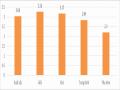
 Comparing Student Assessments with Assessments of Lecturers, Training Managers, and Student Managers on Planning Skills
 -
 Skills of Coordinating Educational Forces in Student Education
 -
 Concept of Observation Skills of 5-6 Year Old Preschool Children
 -
 Percentage of Investigation Articles Using Role-Playing Skills (%)
 -
 Skills for Working with Text Channels and Combining Image Channels
Cooperation skills are demonstrated in the individual's mastery of knowledge about cooperative activities/actions such as required purposes, implementation methods, necessary conditions to carry out planning activities/actions, organize implementation of plans and evaluate cooperation effectiveness and apply this knowledge into practical work accurately, flexibly and effectively in a positive and proactive spirit. A person with cooperation skills is a person who

Always strive, try to find solutions to complete individual tasks well, and at the same time be a volunteer, ready to connect, coordinate, collaborate, and support other members in the group to effectively complete the group's common work. It is the process of trying to find ways to coordinate, share, and support each other to work together that the knowledge, experience, and training skills of each individual are raised.
1.3.3. Concept of cooperative skills in student learning
* Student cooperation in learning
According to Johnson (1994), collaborative learning is a learning activity in which students work together to maximize their learning potential with other members to achieve set learning goals [78, pp. 149-150].
According to Joseph S. Krajcik et al (2003), learning collaboration is a joint intellectual effort of students, peers, teachers and other members of the community. Learning collaboration is the interaction between students, between students and teachers and between students and other members of the community related to the teaching and learning activities of the school [23, pp.232 - 233].
Slavin RE (2011) used the term “cooperative learning” to mean “a form of teaching in which teachers organize the class into small groups so that learners can cooperate with each other, help and share with each other, thereby acquiring knowledge of the lesson content” [70, pp.344-360].
Based on the above viewpoints on cooperation in learning, in this study we conceive: Cooperation in learning of students is the connection, sharing, support, mutual help in planning, organizing the implementation of plans and evaluating the effectiveness of cooperation in a positive and voluntary manner among group members to complete the common learning goal of acquiring knowledge, forming skills, and corresponding professional skills . With this conception, it can be seen that cooperation in learning of students has the following basic characteristics:
- As analyzed above, the necessary condition, the indispensable important factor of cooperation is the connection and mutual assistance between individuals in the group. Because each cooperative learning group is formed from individuals with different knowledge, skills, and experience. Therefore, for cooperation in learning to achieve results,
First of all, each individual must make an effort to complete the assigned individual work towards completing the common work. At the same time, there must be a positive attitude, a spirit of self-awareness, a willingness to support each other, connect with each other, proactively exchange, discuss, and negotiate with each other to effectively solve the assigned learning tasks.
- Cooperation in learning demonstrates the sense of responsibility of each individual for the assigned tasks and the common tasks of the group. Therefore, each individual must be aware and responsible for his or her own work and the common work of the group. Self-consciously complete assigned tasks, while checking, supervising, and urging other individuals in the group to complete the common work on schedule. Be willing to share knowledge with other individuals, support each other when facing difficulties, and help each other progress. The purpose of cooperation in learning is only achieved when and only when each individual is truly responsible for the group.
- Cooperation in learning shows the solidarity, positivity to make cooperation plans, organize the implementation of cooperation plans and evaluate the effectiveness of the implementation of plans to complete the common goal of acquiring and acquiring knowledge, forming skills and techniques. Therefore, to effectively carry out cooperative learning activities, individuals in the group need to coordinate with each other to assign tasks, outline plans to support each other; unite with each other to carry out tasks according to the assignment, regularly support, encourage and motivate each other to complete individual and group work on schedule; coordinate in checking, urging and supervising each other to complete the common goal.
In short, cooperation in learning is to coordinate and unite together to carry out learning activities in a positive and voluntary spirit to achieve a common goal. In that process, each individual not only acquires personal knowledge, skills, and techniques but also helps all members achieve that. Because cooperation in learning has a positive influence on each other in the group, complementing each other's deficiencies, helping each other develop together.
* Student collaboration skills in learning
According to Nguyen Thi Diem My: "Students' learning skills are the ability to apply students' knowledge and experience in cooperation (what is cooperation, how to do it)
how to cooperate effectively... to effectively carry out a task, a learning action of at least two people, in order to acquire knowledge, skills, and professional skills" [25, p. 71].
According to Ta Nhat Anh: Student group learning skills are the ability to apply knowledge and experience to coordinate actions; resolve conflicts and adjust communication in group learning activities [4, p. 43].
Based on the analysis of the concepts of KN, cooperation, and KNHT, along with the approach and inheritance of the above viewpoints, in this study we conceive that: Collaborative skills in students' learning are the application of knowledge and experience of individuals in connecting, sharing, supporting each other in planning, organizing the implementation of plans and evaluating the effectiveness of cooperation between members in the learning group to complete the common learning outcome of acquiring knowledge, forming KN, and professional skills in specific conditions.
According to this concept, it can be understood that cooperative learning skills represent both the technical aspect of cooperative action in group learning and the scientific aspect of group cooperation. From the technical perspective of activities/actions, to carry out cooperative action in learning, students must first have knowledge of cooperative learning skills, understand the requirements for coordination and mutual support in cooperative learning. This knowledge is a necessary condition for forming cooperative learning skills; without this knowledge, cooperative learning skills cannot be formed for students. However, if students only have knowledge of cooperative action in learning but do not have knowledge of planning and applying this knowledge to solve cooperation between themselves and others and between other members in the group, they cannot be called having cooperative learning skills in the learning group. People with cooperative learning skills are those who know how to coordinate and support each other to complete individual and group learning tasks. When knowing how to apply and effectively apply knowledge about learning skills in this condition, then in other conditions it will also give similar results. On the other hand, to have effective cooperative activities/actions, it is necessary to take into account the conditions of the action. Because actions that are suitable to the conditions will achieve results and vice versa. In short, to have learning skills, the following conditions must be satisfied:
- Students must have knowledge about cooperation in learning: purpose, requirements, methods, conditions, and means to implement cooperation in learning scientifically and effectively.
- Students must know how to effectively apply that knowledge in coordinating and supporting each other to solve individual learning tasks towards completing the group's common learning tasks; apply existing knowledge and experience to work with other group members to establish plans and organize the implementation of cooperation plans between group members correctly and effectively.
- Students must know how to effectively apply knowledge and experience in similar learning conditions.
1.4. Collaborative skills in practical learning of technical education students
1.4.1. Practical learning activities of technical education students
1.4.1.1. Technical Education University Students
Students are people who are actively studying, accumulating knowledge, forming professional skills to prepare to fulfill the social role of a citizen and affirm their expertise in different fields.
Vocational education students are basically the same as students in other majors. The difference is that vocational education students are specially trained to become engineers and vocational teachers - people who play the role of organizing and controlling the learning process of students, helping them to acquire and acquire knowledge, form corresponding professional skills and develop personalities to meet the human resource requirements of society. In this study, we assume that: Vocational education students are those who are studying technical pedagogical majors (machine manufacturing technology; automobile technology; electrical and electronic engineering technology; mechanical engineering technology; control and automation engineering technology; information technology; electronic and communication engineering technology...) at vocational education universities on professional technical skills and pedagogical skills to become engineers and technical teachers to meet the requirements of society.
* Psychological characteristics of technical university students
Like students of other majors, SPKT students are also between the ages of 18 and 25. Their physical development is complete and their personality traits are developed.
relatively stable. This is considered the stage of strong personality development. It is manifested in the following characteristics:
Cognitive development: at this age, the structure and function of the nervous system and the senses are relatively complete, the perception and memory of vocational training students develop at a high level, with flexibility and suppleness in thinking, and technical symbols develop with new quality. Vocational training students are sensitive and profound in perception, and technical thinking is more theoretical, practical, and practical. Therefore, vocational training students have the ability to study and research independently, to pose problems, and to find ways to solve problems.
Development of self-awareness: SPKT students have the ability to self-observe, self-check, self-evaluate, and self-adjust their behavior to suit activities and social relationships. Thanks to that, in the learning process in general, and technical practice in particular, students know how to self-regulate their behavior and learning attitude to suit the characteristics, content, and nature of the lesson content to absorb and acquire knowledge, form skills, and practice and develop professional personality.
Value orientation and learning motivation development: for SPKT students, when choosing a major to study at university, it means that they have oriented their values at a high level of education, with occupations that are easy to find jobs and have high incomes. Therefore, they actively study, absorb, and systematically acquire basic and specialized scientific knowledge, and professional content to become experts in a profession.
In short, at the age of students, psychological development has reached a stable level. Besides, with the positive, curious, and love to explore new things, this is a very favorable factor for students to study, practice, and form their professional personality qualities in the future.
1.4.1.2. Concept of technical practical learning activities of technical pedagogy students
The learning activities of students of Pedagogy have both common and special features compared to students of other majors such as students of Mathematics Pedagogy and students of Literature Pedagogy. The common point is that they are all pedagogy students, with the profession after graduation being teaching students in the specialized field they have been trained. Therefore, students of all pedagogy majors must have pedagogical skills.
related to subject education. The difference and specificity between the study of SPKT students and pedagogical students of other majors is in the content of specialized subjects. The nature of specialized subjects of SPKT creates the specificity of technical practice learning.
In the study of students as well as vocational training of students, there is often theoretical and practical learning, in the sense of applying theoretical knowledge to practice, on the one hand helping to deepen theoretical knowledge, on the other hand thereby developing practical capacity. In the Dictionary of Education, the group of authors Vu Van Tao, Bui Hien, Nguyen Van Giao, Nguyen Huu Quynh said: practice is a form of training to cultivate skills, operational skills, to understand and master theoretical knowledge. This is an important step to ensure the educational principle: "learning goes hand in hand with practice". Practice needs to be well organized, planned, systematic and closely linked to the theoretical issues being studied. Practice has many forms depending on the characteristics of each subject. However, all forms of practice contribute to enriching the form and improving thinking capacity, forming practical capacity [29, p.376].
For students of vocational education, the specialized content of vocational education students has common courses and subjects with those of other pedagogical students (common courses and subjects). With such subjects, practice is only one step in the entire learning process. However, in addition to such common subjects, most of the other courses and subjects in the specialized curriculum of vocational education students are technical and technological courses and subjects, in which technical and technological content is the main content. This is different from theoretical subjects. Therefore, practice in technical and technological subjects is not practice with the meaning of applying theory as in theoretical courses, but is the main content, compulsory, accounting for a large proportion of the course content. That is the same learning activity as other subjects. Therefore, it is not practice but practical learning.
According to author Nguyen Van Khoi [20, p30], practice in learning technical subjects is "the learning activity of learners to apply technical knowledge to form and practice necessary technical skills".
We believe that: " Technical practice is the process of applying accumulated technical theoretical knowledge into planned and systematic technical work activities to create specific products of the profession, thereby consolidating, verifying and expanding professional knowledge, forming professional skills and techniques ".
Based on the concept of practical learning in technical learning, we understand: Technical practical learning activities of technical pedagogical university students are activities controlled by the purpose of self-awareness, applying specialized technical theoretical knowledge into planned and systematic technical labor activities to create specific products of the profession, thereby consolidating, verifying and expanding specialized knowledge while forming professional skills and techniques according to defined goals.
Thus, practice in learning of SPKT students includes both subject practice in the common sense for learning subjects in general schools and vocational schools and practical learning in the sense of learning activities for technical and technological subjects.
In this study, we only focus on studying practical learning activities of subjects in the specialized fields of engineering and technology of SPKT students.
Technical practice activities have two specific forms: the first form is intellectual practice activities that require people to mobilize the highest level of intelligence, experience, and technical knowledge in the practice process, with little use of muscles; the second form is physical practice activities that mainly carry out technical operations. These two forms of activities perform different functions but are interrelated.
- Types of technical practice lessons, if based on the content, there are design and manufacturing practice lessons; machine and equipment inspection and appraisal practice lessons; assembly and operation practice lessons; maintenance and repair practice lessons... Depending on the specific teaching purpose and conditions, each type of lesson has different practice content: practice by movement, by technological step, by operation, by product (the whole technological process). Based on the learner's level of self-reliance, technical practice lessons can be divided into two main types: basic skill training practice lessons and task practice lessons.