
CHAPTER 2
RESEARCH METHODOLOGY
The research was conducted in phases:
- Phase 1: Descriptive cross-sectional study
- Phase 2: Community-based intervention research with participants
proof
2.1. Research subjects:
Criteria for selecting subjects for cross-sectional studies
- Children under 5 years old (from 0 - 59 months old).
- Head of household and parents of children.
- Currently living in the 3 communes mentioned above in the research area.
- The family voluntarily agreed to let the child participate in the study.
Criteria for selecting subjects to participate in intervention research
- Children aged 24 - 59 months at the time of the initial survey.
- Currently living in 03 communes in the research area.
- The family voluntarily agrees to let the child participate in the intervention study and comply with the intervention activities.
Exclusion criteria for intervention study participants :
- Children with severe anemia (Hb < 70g/L).
- Children with congenital malformations such as cleft lip, cleft palate, mental disorders
spirit, movement…
- Children with chronic diseases or severe infections.
2.2. Research location and time:
- The study was conducted in 03 communes (Bich Son, Nghia Trung and Van Trung) of Viet Yen district, Bac Giang province.
- Time: 03 years, starting from 2006 to 2008
General introduction to Viet Yen district, Bac Giang province
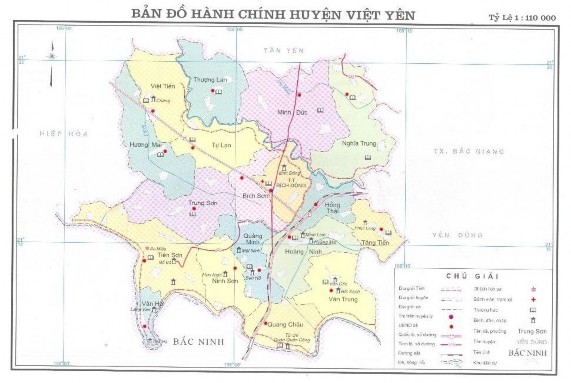
Figure 2.1. Research location
The study was conducted in Viet Yen district - Bac Giang province. Viet Yen is a district of Bac Giang province (formerly Ha Bac province), bordering Bac Ninh province to the south, Hiep Hoa district to the west, Yen Dung district to the east, Tan Yen district and Bac Giang city to the north. Viet Yen district has an area of 170.2 km2, a population of 158,324 people with a population density of 930 people/km2. The GDP economic growth rate of the district is 53%. In Viet Yen district, the average income per capita in 2010 was 12 million VND/person/year.
2.3. Research design
Descriptive cross-sectional study, with analysis of variables through community survey: epidemiological description of SDD in children under 5 years old, by location and time, blood test and worm infection test.
The survey was conducted at the household level and included interviews with the head of household, parents of children under 5 years of age in the household, and nutritional anthropometric measurements of children under 5 years of age and their parents. At the same time, blood tests and worm infection tests for children were studied.
Intervention study: community-based intervention trial with control group and pre- and post-intervention assessment.
After conducting a cross-sectional study to assess nutritional status, we conducted an intervention study based on the cross-sectional survey results to select a study group and a control group with similar characteristics in nutritional status, anemia, and worm infection.
2.4. Sample size:
2.4.1. Cross-sectional study sample size
* Sample size for investigation of nutritional status, anemia, intestinal parasite infection:
The number of children needed to be investigated for each study on nutritional status, anemia, and intestinal parasite infection in a province is calculated according to the following formula [1]:
In there:
n = Z 2 * p * (1-p)/ e 2
n: Number of children to be surveyed
Z: The required confidence level is 95%; Z=1.96
p: Rate of sick children (rate of children with malnutrition; anemia; or urinary tract infection)
intestine)
e: Allowable error, select threshold 5%.
The results of calculating the number of children needed to be investigated for each research content at each research site are shown in Table 2.6.
Table 2.1. Research content identifies factors affecting slow growth in the study.
Investigation content
References | Minimum sample size minimum | Sample size /research point | |
Nutritional status | |||
SDD weight by age | TTDD TE Vietnam Men 2010 | 377 | 400 |
SDD height by age | Vietnam National University Men 2010 | 308 | 400 |
SDD weight/height | Vietnam National University Men 2010 | 308 | 400 |
Anemia | Ha Huy Khoi and CS, 2006 | 100 | 100 |
Intestinal parasite infection: | Le Nguyen Bao Khanh and CS, year 2001 | 100 | 100 |
Maybe you are interested!
-
 Research on factors affecting the decision to purchase gypsum board of Huy An private trading enterprise from institutional customers in Ho Chi Minh City - 13
 -
 Research on factors affecting the behavior of using international bank cards in Vietnam - 21
 -
 Building a Research Model of Factors Affecting Agribank's Brand Value
 -
 Building a Scale and Research Model of Factors Affecting Customers' Decision to Choose a Bank to Deposit Savings at
 -
 Overview of Research on Factors Affecting the Linkage of Small and Medium Enterprises with Enterprises with Direct Investment Capital
* Sample size for individual diet survey:
Apply the formula:
n =
t 2 * 2 * N
--------------------
e 2 * N + t 2 * 2
In there:
n: sample size
t : standard percentile (usually = 2 at probability 0.954)
: standard deviation of estimated energy 300 Kcal
e: allowable error (choose e = 100 Kcal)
N: total number of children in the school (about 600 children/school)
The number of children needing to investigate the individual diet of one research site is: 58. The number of children needing to investigate the diet of three research sites is: 174.
Sampling process
Selecting 3 communes to participate in the survey, the total number of children to be surveyed at the 3 research sites is as follows:
Nutritional status survey sample: 1,200 children
Investigation of anemia: 300 children
Investigation of intestinal parasite infection status: 300 children
Diet survey: 174 children
Commune selection: Three communes in Viet Yen district, Bac Giang province were randomly selected. Local authorities and schools supported the study. There were no programs to prevent anemia and deworm children.
Select subjects: apply systematic random sampling method
The sample is based on a list of all children under 5 years old in the commune.
In each commune, a list of children under 5 years old was made. From this list, a systematic sample of 400 children was selected for the nutritional status survey. Of these 400 children, a systematic sample was selected for 100 children for the survey of anemia and intestinal parasites and 58 children for the dietary survey.
2.4.2. Intervention study sample size:
Applying the sample size formula for testing the difference
between the two observed means before and after intervention [10]

2s 2
N=
(d -d ) 2
1 2
In there:
+ s: standard deviation of serum Hb content before and after intervention. In the 2009 study of the Institute of Nutrition, s = 7.3 g/L [17].
+ α: Statistical significance level, is the probability of making a type 1 error, choose α:= 0.05, corresponding to a confidence level of 95%.
+ β: probability of committing a type 2 error, choose β = 0.1.
+ Z(α , β ) = 10.5 (look up the table for α = 0.05 and β = 0.1).
+ d1 -d2: the difference in average serum Hb content between the intervention group and the control group, according to research by the Institute of Nutrition, d1 - d2: = 4 g/L [17].
Thus, the sample size required for each group is 70 children in the 2-5 year old group.
Allowing for 20% dropout, we had a sample size of 84 children per group.
Sample selection and intervention study grouping:
After conducting a cross-sectional study to assess nutritional status according to the contents and assessment indicators in Table 2.1 above, we conducted an intervention study. The sequence of steps in selecting samples and dividing intervention study groups is as follows:
Selecting subjects for the intervention study: based on the results of cross-sectional surveys in 3 communes to select children for the study and control groups. Each group selected 84 children aged 24-59 months who met the criteria for selecting children for the study with similar characteristics in economic conditions, living standards, nutritional status, anemia and worm infection.
Research Grouping: Research grouping based on unit
commune. The study is divided into 2 groups:
- Control group: Children participating in the study were supplemented with sweetened condensed milk.
- Research group: Children participating in the study were given supplemental milk.
with added micronutrients and deworming.
Before the intervention, the selected subjects were informed about the purpose, requirements, content and explained the questions to voluntarily participate. All cases of severe anemia (Hb < 70g/dl) in the investigation were given iron tablets according to the treatment regimen of the Ministry of Health and then excluded from the research group. Cases of severe anemia during the 6-month study were also treated and excluded from the research group and at the same time notified to the local health department for further monitoring.
The two groups of children in the study and control groups were given 200 ml of milk daily. The study group (NNC) had milk fortified with 4.1 mg of iron, 450 IU of vitamin A and 4.6 mg of zinc along with some other micronutrients such as B vitamins, vitamin C and was dewormed every 6 months under supervision. This is a daily supplement dose within the limits prescribed by the Ministry of Health. The control group (NC) was given 200 ml of regular cow's milk, without iron or other micronutrients. The dosage and duration of use were the same as in the intervention group. In addition, both the intervention and control groups were allowed to use other health services available locally (such as taking vitamin A, regular medical examinations, etc.) and maintained their normal daily diet.
The intervention period is 6 months. The intervention is carried out according to
single blind method
Intervention Research Organization
Training for investigators: Investigators are trained on the purpose of the study, indicators, data collected at the time of baseline survey and evaluation survey.
Selecting collaborators to participate in the research: In each village, select collaborators (enthusiastic and responsible) to participate in the research. Each collaborator will be responsible for monitoring 15 children in the village. Collaborators will be trained on how to distribute, monitor milk intake, record distribution and monitoring logbooks.
weekly milk intake. The intervention collaborator will distribute milk weekly to children in the intervention group, instruct caregivers to feed their children milk, and record milk consumption according to a pre-designed form every week for 6 months of intervention. The collaborator will visit the household every week to monitor and record milk consumption in a logbook. The collaborator will instruct parents/caregivers to feed their children milk according to instructions, and the milk will only be used for children to drink. The collaborator will advise parents or caregivers to go to the health station if the child has diarrhea, fever, or respiratory infection, etc.
Milk distribution and monitoring:
Milk is delivered to the commune every two months and is kept at the commune health station. Every week, collaborators will go to the health station to receive milk for the children. Children will be given milk on a certain day of the week in a quantity of 7 boxes. Each day, children will drink one box at a certain time.
Collaborators directly distribute milk to children once a week according to the prescribed list under management.
During the 6-month period, the collaborator will visit the household every 2 weeks and record the child's milk drinking situation in a logbook.
Mothers are instructed to give their children milk every day at the same time.
certain day
Intervention implementation supervision: The researcher is responsible for supervising the implementation of the intervention with the support of the National Institute of Hygiene and Epidemiology staff experienced in implementing intervention studies in the community. The monitoring of the implementation of the intervention study in the community is carried out regularly, continuously every week in the first month of implementation and then once a month. The supervisor will meet with the collaborators and check the milk distribution records and monitor the use of the product.