
certain parts of the lesson. For example, when reading the lesson "Doctor Wolf" (3) (week 23 - Vietnamese Textbook Grade 2, Volume 2), with the question "What did the Wolf do to trick the Horse?" , most students could not give the correct answer to the question ( "The Wolf was bitten" - Ng. V. A - HB School - Vinh; "The Wolf bit the Horse's thigh" - T.Th.V - Medical School - Hanoi; " The Wolf came to get an injection" - HND - T. Tr School - Hanoi)... These reading comprehension limitations can be explained by the weakening of the ability to maintain attention on what is being read and control one's reading.
With the requirement to find pictures corresponding to the content of the sentence or lesson, students have difficulty completing their task. The pictures are selected not according to the meaning contained in the sentence or lesson, but only according to the meaning of each word in it. The students' understanding of the lesson is only in the form of excerpts, not in the general idea, and the general idea is only achieved by determining the direct connection between the meaning of individual words and the corresponding elements of the picture. The above manifestations of reading in students in this group are consistent with the findings in studies on children with CPT of the frontal level III brain function. Previous research results have described that the disorder of purposeful activity due to CPT of the frontal level III brain makes the subject's problem solving situational. Also in these studies, when referring to eye movements when reading, many researchers have argued that the focus of attention is the stopping point of the eyes, so the situation "chosen" to solve the reading comprehension problem is the stopping point of the eyes when children read. The detail "chosen" to answer questions about the content of the reading or to choose the corresponding picture is not the content of the reading/paragraph/sentence but just a certain detail (maybe a word) where the eye movement when reading has "rested" [31].
Analysis of disorders in children with CPT in the frontal level III brain region shows that the basis leading to this type of reading comprehension disorder comes from behavioral disorders and attention disorders. The lack of motivation and the loss of the ability to control their actions make it impossible for children to control their errors and as a result
Maybe you are interested!
-
 Teaching reading comprehension to elementary school students with borderline developmental delay from a neuropsychological perspective - 23
 -
 Teaching reading comprehension to elementary school students with borderline developmental delay from a neuropsychological perspective - 2
 -
 Directing the Implementation of Experiential Activities for Elementary School Students
 -
 Measure 2: Organizing Self-Study Math Activities for Elementary School Pedagogical University Students
 -
 Research Projects Related to Reading Comprehension and Developing Students' Competency in Teaching Reading Comprehension in High Schools
(3) Nguyen Minh Thuyet (editor) (2013), Vietnamese 2, volume 2 (tenth reprint) Vietnam Education Publishing House, Reading lesson week 23, page 41 .
leading to guessing when reading. But the guessing here is different in that it is not meaningful (not based on the meaning of the text to guess) but random. The "guessing reading" in the CPT of the frontal level III brain is the result of a disorder of higher forms of activity.
In addition to the limitations described above in children with CPT in the frontal level III brain region, the results of observing the process of solving complex exercises in previous research projects have also emphasized the preservation within normal limits of analysis - synthesis operations [31]. The preservation of analysis - synthesis operations in the reading process can be an orientation for designing effects in teaching reading comprehension correction for children.
3.1.2.4. Expression of reading comprehension difficulties in CPT students in the posterior level III brain region - area 39 (according to Brodman's diagram)
The posterior level III brain region is the direct apparatus for the transition from the level of direct visual synthesis to symbolic processes for manipulating word meanings, complex logical-grammatical structures, and manipulating numerical systems and abstract relations. Therefore, CPT localized in the posterior level III brain region is the direct cause of reading comprehension difficulties in CPTRG students in this group.
39
Slow brain development
Figure 3.4. CPT localized in the posterior level III brain region - area 39
(according to Brodman diagram) [36]
Analysis of the visual memory performance in the Luria - 90 test of this group of subjects reflects another mechanism of the disorder. Although at the level of writing / drawing from a model, some children cannot perform correctly, especially for shapes. More errors appear when asked to write / draw from memory. Some other children show signs of reversing direction when reproducing shapes. A closer look at this group of subjects shows that they show signs of losing the ability to orient the coordinate system in space (first of all, losing orientation to the right, left; up, down) and difficulty in analyzing spatial lines. As a result, these students cannot write / draw from a model, show signs of "mirror reflection", or reversing direction when reproducing. Here is an example of one of these cases:
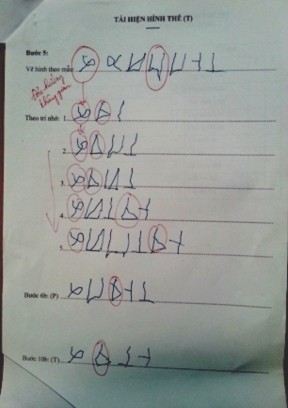
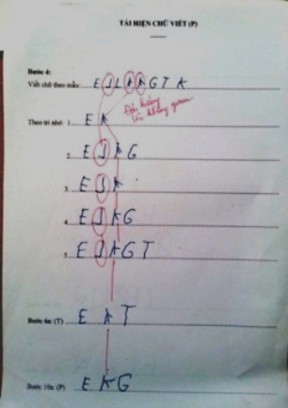
Figure 3.5. Results of visual memory test in CPT students in the posterior level III brain region
The test results of these CPTRG students are consistent with the symptoms described in the
studies in children with CPT in posterior level III brain regions. As presented in chapter 1, posterior level III brain regions (also known as posterior association areas of the cortex) play a major role in creating simultaneous synthesis. Research results have shown that when CPT functions are localized in posterior level III brain regions, the child has difficulty with both visual space and "virtual space" [31].
The first effect of CPT on the posterior level III brain function is spatial perception disorder, which disrupts the optical diagram of letters. The manifestation in these students is the loss of the ability to coordinate the components of letters in space. Difficulties in analyzing spatial lines lead to difficulties in distinguishing between letters with similar spatial lines but in opposite directions such as /u/ - /n/; /p/ - /q/; /b/ - /d/.... (Ng.ST - BT School - Vinh, HVTr - HB School - Vinh). Thus, difficulties arising in the first stage of the reading process will make reading inaccurate and therefore reading comprehension is not possible.
In this type of CPTRG, reading difficulties are not only in letter recognition but also appear when children read words. In some cases, they read the letters in the word correctly but do not connect them into a complete word (cannot spell), do not recognize the word leading to "guessing" about its meaning.
Thus, functional CPT disorders of posterior level III brain regions significantly affect reading levels, especially emphasizing a strong and direct influence on comprehension of reading content.
Disturbances in spatial perception and movement due to functional CPT of posterior level III brain regions are reflected in situations requiring analysis of visual and symbolic relations. These students not only show spatial coordinate orientation disorders but also have difficulty in comprehending information in grammatical structures due to disturbances in the transition from visual perception to abstract thinking. This disorder makes it difficult for children to establish and understand the meaning and intent of speech in grammatical structures. Thus, in some cases
In the case of children with CPT, the main problem is not the level of smooth reading (sensory-motor level). Smooth reading can still be performed, but the child has difficulty comprehending information contained in logical-grammatical structures, especially complex structures. Accordingly, the ability to comprehend knowledge in general will be very limited. For children with CPTRG, this group is easy to detect in math lessons, performing the requirements of "putting and calculating" (vertical calculation) with calculations with memory and solving word problems is a problem for them. Due to not being able to orient themselves with the "memorization" operation to continue performing the calculation, the results are often incorrect; With word problems, students have to "struggle" with reading and understanding the grammatical structures expressed in the problem title such as comparative relationships of greater than/less than, more than/less than between the quantities of the problem, or comparative relationships bridging spatial relationships and temporal relationships.... They are very confused with summarizing the problem and writing the solution for the problem, although in them, the motivation of intellectual activity is still within normal limits, the direction or diagram of the solution is also fully conscious. Not understanding the problem title leads to the result of not being able to summarize as well as not being able to solve word problems ( see the entrance test in appendices 3 and 4 ).
The results obtained on these students are consistent with the description in studies when CPT functions of the posterior level III brain region: it does not cause any simple specialized disorders, in children vision, hearing and touch are still preserved. Experimental studies in child neuropsychology also show that children can understand the content of math problems expressed in visual forms (for example: when the problem has been summarized by a line diagram, by drawing, then the calculation of the problem becomes easier for children). Therefore, in DCT reading comprehension, it is possible to mobilize the maximum of specialized functions as well as other functions that are still preserved to serve as a basis for compensating for CPT functions in these students.
In summary, the evaluation of the results obtained through neuropsychological clinical examination, with both quantitative and qualitative analysis, is the basis for dividing the
Reading comprehension difficulties of HSTH CPTRG into four types with corresponding neuropsychological syndromes and CPT functional localization in the brain. This result shows that the most fundamental cause of children's reading comprehension difficulties is functional CPT localized in different regions of the brain. CPT compared to age limits in the research subjects are all related to different forms of memory activities. The data obtained on the research subjects through neuropsychological clinical examinations correspond to the actual difficulties expressed in children's reading comprehension.
3.2. FORMATION EXPERIMENT: TEACHING READING COMPREHENSION TO PRIMARY SCHOOL STUDENTS WITH BORDERLINE DEVELOPMENTAL DELAY
3.2.1. Designing corrective reading comprehension teaching interventions for primary school students with borderline developmental delay from a neuropsychological perspective
3.2.1.1. Basis for designing corrective reading comprehension teaching interventions for primary school students with borderline developmental delay
- It is necessary to rely on the results of accurate neuropsychological examination to design DCT reading comprehension interventions for students with CPTRG. Clinical images, psychological images and neuropsychological images in CPTRG cases have allowed to determine that the obstacles to learning and general knowledge acquisition of these students are caused by functional CPT of one or several areas of the brain. The fact that functional CPT has different localizations in each case naturally leads to different difficulties and therefore, DCT impacts are also not the same in each case. Careful neuropsychological examination to have an accurate diagnosis of functional CPT localization is considered an important basis for designing compensatory impacts in DCT reading comprehension for students with CPTRG.
- The impacts in reading comprehension for high school students with CPTRG must closely follow the general education program, helping students develop cognitively to keep up with their peers. Based on the practical difficulties surveyed from students, it can be seen that reading comprehension disorders caused by CPTRG affect not only the acquisition of information when reading but also the acquisition of knowledge in other subjects, in particular, students have difficulty with both Math and Vietnamese.
In general. With the aim of helping students keep up with the program and study with their peers, the design of compensatory effects for CPT students in functional areas of the brain needs to closely follow the program, at the same time with the issue of raising awareness in general for students, compensatory effects must be applied in many subjects, especially Math and Vietnamese. Implementing compensatory effects in a synchronous manner like this will bring long-term and stable results.
- Conducting DCT reading comprehension for CPTRG high school students requires ensuring the facilities and necessary elements of teaching and learning. Therefore, designing impacts in DCT also needs to take into account the conditions of time, living and studying regime of students as well as the conditions of facilities... so that the impacts are feasible and effective.
3.2.1.2. The impact of teaching reading comprehension correction for primary school students with slow development of the frontal level III brain regions
As analyzed above, CPT of the frontal level III brain regions makes reading as a psychological activity, necessary to organize programming and control the disordered development in children. Reading comprehension disorder is manifested as the reading process is not controlled and controlled, thus leading to the appearance of many errors while reading. This makes it impossible to understand the content of the reading correctly and leads to the phenomenon of "guessing" about the content of the text. This is a prominent feature of these students. Thus, the cause of reading comprehension disorder in these cases is determined to be a disorder of high-level forms of activity. The origin and mechanism of the disorder are determined as the basis for designing effects in DCT reading comprehension.
* General principles
- Functional compensation for the slow-developing brain area in CPT students with the frontal level III brain is carried out by an external mechanism using a pre-designed program of operations and their order. The fulcrum for compensation is determined to be the preservation of the elements that execute the operations (children do not have a disorder at the operational level). Therefore, DCT aims to organize those operations into a oriented action program and help children consciously perform the operations in the system.
- Conducting programmed teaching is extremely necessary for CPT students in the frontal level III brain regions. To help them solve learning tasks, the creation of programs must be broken down into operations with an arranged order and brought out. Under the guidance of the teacher, performing the operations in the program in their order will help exploit the child's dominant potential areas to compensate for CPT function.
The specific purpose of each "case" depends on the nature and extent of CPT in each case.
individual
- Programmatic operations must be a "step backward" in children's cognition, considered
The child's existing abilities are a potential foundation on which to compensate for the deficient functions, in order to help the child develop cognitively, including improving reading comprehension.
- Use a variety of tools that have the function of materializing some intellectual operations in the program. Focus on transforming intellectual operations from "outside" to "inside" the head; from the step of materializing intellectual operations to the step of acting with "inside" words. When there is a sign of proficiency in performing operations, the program content will be gradually shortened and the supporting tools will be gradually eliminated.
* Purpose
The effects of DCT reading comprehension for CPT students on the third-order brain regions aim to help them move reading from unconscious to conscious level; replace the child's weak link corresponding to the structure of the CPT region with a program of operations and the order in which they are performed.
Implementing a systematic arrangement of operations will help students solve reading tasks.
With the aim of helping students "localize" their work, focus their attention, organize their perceptual activities, reduce the amount of perception needed, and remember (ie reduce stimulation) to be able to control reading, in the process of teaching reading, support tools can be used such as: pictures corresponding to the content of the reading, rulers with blank spaces used to read each line, paper with a blank space cut out like a window to read a paragraph...