
participate in entertainment activities, but also be proud of having experienced tourism in an eco-tourism area in another province far from Ho Chi Minh City during the holiday.
Tourist areas have the characteristics of services such as: first, intangibility - customers cannot touch, smell, use the service as a tangible tool to directly affect other objects, nor can they weigh, measure, test or verify (Nguyen Dinh Tho and Nguyen Thi Mai Trang, 2009, p.64); second, heterogeneity in tourist areas can be uniform in process or in service techniques, but cannot be uniform in service style and quality. One of the main reasons is that service is often performed by different employees, different people, if there is duplication of employees, it will be performed at different stages, in addition, it is mostly due to the perception of customers, who can be greatly affected by external conditions and circumstances, so the heterogeneity of service in tourist areas is completely basic and obvious; Third, the inseparability of the content of an entertainment program in a tourist area can be prepared in advance and rehearsed many times before the performance, but when it is performed, that is, when there is interaction with tourists, the quality and content will be perceived and evaluated by tourists, creating impacts on tourists at the same time. If tourists do not participate at that time, the content of the program will also drift with time.
1.2.2 The nature of the brand:
The nature of a brand includes: The perception of customers and the public; Influenced by messages and manufacturers; Influenced by consumer experience; Interaction between individual behavior and brand components; Mutual influence between customers and the public.
Maybe you are interested!
-

 Building a Research Model of Factors Affecting Agribank's Brand Value
 -
 Social Media Marketing Activities for Nestle's Nestcafé Brand in Vietnam
 -
 Positioning the My Le tourist area brand in Ho Chi Minh City market - 1
 -
 Theoretical Basis and Empirical Studies on Brand Valuation of Vietnam's NHTM
 -
 Brand Positioning and Development Associated with Corporate Culture
Normally, in Vietnam, the term "brand" is used to refer to trademarks of goods, service trademarks, trade names, geographical indications of goods, and export names.
goods country... Mr. Pham Dinh Chuong stated as follows (Thanh Loan, 2003): “... temporarily divided into several types of objects that the press and some people have called 'brands' in the recent past as follows: the first type is VINATABA (cigarettes), Trung Nguyen (coffee), SAGIANG (shrimp crackers), VINAMILK (milk), PETRO VIETNAM (oil and gas)... , the second type: Phu Quoc (fish sauce), Tan Cuong (tea), Cho Dao (rice), Made in Viet Nam ("Vietnamese brand motorbikes and computers")... , the third type is PETRO VIETNAM, VNPT (abbreviation of the Oil and Gas Corporation; Post and Telecommunications Corporation)... Obviously, all three of the above objects have been identified in official documents of the state, specifically "brand" for the first type, "geographical indication" for the second type and "trade name" (more precisely, a part of the trade name) commercial) for the third type. That is, the so-called “brand” is not a new object but just a different name (term) to refer to three types of identified objects…”. So, how should the My Le Eco-tourism brand be called? Call it a service brand (because the tourist area has more service characteristics), a trade name (a distinguishing business name), or a geographical indication (because this tourist area is in Binh Phuoc)? In the author’s opinion, calling My Le a trade name, My Le Eco-tourism is the service brand of the My Le trade name is most appropriate. However, within the framework of this topic, the author will still temporarily use the term “brand” My Le Eco-tourism.
1.2.3 Brand Components
After studying Aaker's work "Building Strong Brand", Nguyen Dinh Tho stated the components of a brand as follows:
(1) “Functional component: the functional component of a brand is intended to provide the functional benefits of the brand to the target customers and it is the product. It includes functional attributes such as product uses, additional features, quality.
(2) Emotional component: The emotional component of a brand includes symbolic values that create psychological benefits for target customers. These elements can be brand personality, symbols, value propositions or unique selling propositions (USP), organizational associations, such as country of origin, domestic or international company, etc.
The most important element of a brand that creates psychological benefits for its target customers is brand personality. Brand personality is defined as “a set of human attributes associated with a brand”.
(Excerpt from Nguyen Dinh Tho and Nguyen Thi Mai Trang, 2009b, pp. 48, 49) Based on the components of human personality, Nguyen Dinh Tho and Nguyen Thi Mai Trang (2009b) proposed 5 components of brand personality commonly known as "The big five" (five main personalities), which are: sincerity, excitement, energy, and creativity.
competence, sophistication, ruggedness.
1.2.4 Brand function
The basic functions of a brand include:
- Recognition and differentiation function: this is a typical and important function of a brand. Brand recognition is an important factor not only for consumers but also for businesses.
- Information and instruction function: expressed through images, language or other signs as well as brand slogans, consumers can partly recognize the value of goods, the real uses that goods bring to current and future consumption. Instructions, no matter how clear and rich, but do not satisfy the ability to distinguish and recognize, are also considered as
an unsuccessful brand, because it easily creates confusion for consumers.
- The function of creating perception and trust: that is the feeling of difference, luxury, feeling of security, comfort and trust when consuming that product or service. When talking about the perception function, people are talking about a certain impression of the product or service in the consumer's mind. The customer's perception does not come naturally, it is formed by the synthesis of brand elements and the consumer's experience. The trust and willingness to choose products with a certain brand has brought the business a loyal customer.
- Economic function: the brand carries with it a current and potential value. The value is most clearly shown when transferring the brand. The brand is considered an intangible and very valuable asset. Although the value of the brand is difficult to determine, thanks to the advantages that a famous brand brings, goods will sell more, even at higher prices, and penetrate the market more easily.
1.2.5 Brand value
There are many views and ways to evaluate brand equity. According to Nguyen Dinh Tho and Nguyen Thi Mai Trang (2009b) discussing brand equity, brand equity is divided into two main groups - brand equity evaluated from an investment or financial perspective and brand equity evaluated from a customer perspective. In addition, brand equity is also the customer's knowledge of the brand. Customer knowledge consists of two main components: brand awareness and brand impression.
Nguyen Dinh Tho and Nguyen Thi Mai Trang (2009b) also proposed 4 components of brand value: (1) Brand loyalty, (2) Brand awareness,
(3) Perceived quality, (4) Brand association attributes such as a brand personality, patents, relationships with distribution channels.
Nguyen Dinh Tho and Nguyen Thi Mai Trang (2009b, p.52) proposed three components of brand value, which are: “(1) Brand awareness, (2) Perceived quality, (3) Brand passion including enjoyment, consumer trends and brand loyalty.”
From a marketing perspective, brand equity is the result of consumers' evaluation of the value of a brand, the second perspective is based on consumers' evaluation.
Brand assets are a set of brand-related assets that add value to an asset or service for an organization or its customers. The main components of brand assets include: (1) Brand awareness, (2) Brand loyalty, (3) Perceived quality, (4) Brand associations, (5) Other brand assets (channel relationships, brand-related inventions, etc.)
1.2.6 Brand positioning
There are many views on brand positioning, in which Aaker's view on brand positioning expressed in the book "Building Strong Brand" is used by many researchers in their research. After researching in the book "Building Strong Brand", Huynh Thien Quy (2010, p. 12) summarized as follows:
“Brand positioning is part of brand identity and value proposition. Positioning actively communicates to customers the target and purpose of trying to demonstrate superiority over competitors. That means positioning must focus on solving four problems:
(1) Collection of brand identity programs.
(2) Proposition.
(3) Respond to the right target audience.
(4) Proactively communicate and provide competitive advantages.
For a positioning program to be successful, these elements must be those that the target customer considers most important.”
Thus, “Positioning is the process of building and communicating the brand's unique values into the minds of target customers” (Nguyen Dinh Tho and Nguyen Thi Mai Trang, 2009b, p.153)
Brand positioning is the main content of this topic. The process of brand positioning and its implementation will be described in detail in the following sections and chapters of the topic. Here, only some of the most basic views, as well as the origin of this term, are presented. Normally, brand positioning is the task of determining the position of the brand in relation to competitors in the market, especially from the perspective of customers. By using quantitative research, researchers often use 'perceptual maps' to draw the relative position of each brand in different dimensions. In business, managers often 'position' their brands in a position that can clearly distinguish them from competitors. However, there are opposite cases in which new brands want to position themselves close to the existing leading brands. New brands also want consumers to believe that the quality is exactly the same as the leading brand and the difference is a lower price. Or you can use positioning research to find out the weaknesses of the brand and attack this brand by proving that there is a difference in the direction of better and higher value than the old brand. Brand positioning focuses on the customer, that is, how the customer thinks and feels about the brand, brand positioning plays a fundamental role in building a brand.
1.2.7 Repositioning
Normally, the term "Repositioning" is understood by everyone as the second step of researching and implementing positioning after a period of implementing brand positioning programs in the minds of tourists and customers.
In the 70s of the 20th century, the term “Repositioning” was formed in the context of the market being overloaded with too many products, with hundreds of different brands for each type of goods, the opportunity to find a segment or a so-called “gap” in the market was very fragile. With such a situation, what should a company do with its advertising to open the way into the customer’s mind? The term “Repositioning” was used and became a foundation for a marketing strategy.
AL Ries and Jack Trout (2002, p.101) gave an example of repositioning, to put a new idea or product into the mind, the old one must first be pulled out.
“Galileo believed that the earth was round; the public at that time believed that the earth was not round but flat.” The most sophisticated mathematical theories in the world would not be as effective to the public as a simple observation that the public could verify for themselves. To prove this, a more convincing argument is that when sailors are at sea, they can first see the top of another ship's mast, then the sail, and finally the entire ship. If the earth were flat, people should immediately see the entire ship.
Or an example of the Soy Sauce market in Vietnam, in the past, people only thought that Soy Sauce was just a seasoning product that helped increase the deliciousness of the dish. After the harmful effects of the 3MCPD ingredient in Soy Sauce were proven to be harmful to health in the long term, Vietnamese consumers then realized that Soy Sauce is no longer a regular seasoning sauce, but must be a seasoning sauce that is harmless and beneficial to health. The Vietnamese Soy Sauce market has had a certain storm, soy sauce products without 3MCPD ingredient entered the market easily and were absolutely welcomed by consumers.
So, once the old idea is shaken, you will be able to sell the new idea with unbelievable ease.
That said, repositioning also needs to be distinguished from comparative advertising: Comparative advertising only stops at being different, superior to competitors; Repositioning gives customers a different view than the old concept.
When we carry out repositioning, we also need to pay attention to ethical and legal issues to avoid certain regrets.
1.2.8 Philip Kotler's view on 'positioning':
Nguyen Minh Quan (2010) mentioned the issue of 'positioning' in Kotler's marketing strategy implementation process as follows:
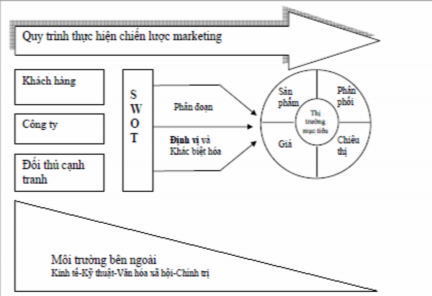
Figure 1.2: Marketing strategy model
(Source: Nguyen Minh Quan, 2010, p. 24) The components in the model are very familiar to strategic planners, which are: micro-environment analysis with three main objects: customers, companies and competitors; macro-environment analysis with four external factors including economic, technical, socio-cultural, political; using the SWOT matrix tool to find strengths-weaknesses, opportunities and threats; segmentation, positioning and product differentiation towards
target market and marketing mix elements.