
Competitive balance method
Some companies set their promotion budgets on the principle of keeping their advertising costs in line with their competitors. They believe that by spending the same percentage of sales on advertising as their competitors, they will maintain their market share.
This view holds that competitors' spending levels reflect the collective wisdom of the industry, and that maintaining competitive parity helps prevent promotion wars. However, there is no basis for believing that competitors know better how much to spend on promotion, because firms differ widely in their reputations, resources, opportunities, and marketing objectives.
Method based on goals and tasks
Maybe you are interested!
-

 Solution to Diversify European Tourism Products at Viet Travel Joint Stock Company - Vietnam Tourism
 -
 Solution to complete communication and promotion activities for Vietnam Tourism Joint Stock Company Vitours - 11
 -
 Overview of Eagle Media Advertising and Tourism Services Joint Stock Company
 -
 Overview of Tourism Development Issues in Vietnam's National Parks
 -
 Analysis of financial capacity and some solutions to improve financial capacity at Vietnam Telecommunications Technology Investment and Development Joint Stock Company - 5
This method requires marketers to develop their promotion budgets by identifying specific goals and tasks that must be completed to achieve those goals, and then estimating the costs of performing those tasks. The sum of these costs is the promotion budget.
- Determine market share spending.
- Determine the percentage of the market that the advertising needs to reach.
- Determine the percentage of potential customers who are aware of the brand and need to be convinced to try it.
- Determine ad impressions as a percentage of trial users.
- Determine the number of composite index points to achieve. One composite index point is one exposure to 1% of the target audience. For example, if a business wants to achieve 30 exposures to 70% of its audience, it needs 3,500 composite index points.
- Determine the necessary advertising budget based on the average cost for a composite score. For example, to ensure that 1% of the target audience is exposed to an advertising impression, an average of 50,000 VND must be spent, then the cost to have 3,500 composite index points is 17,500,000 VND.
This method has the advantage of requiring management to explicitly state its assumptions about the relationship between total costs, exposure, trial rates, and regular usage.
The key question is how much weight should be given to promotion in the overall Marketing Mix (compared to product improvement, price reduction, service improvement, etc.). The answer remains
depends on what stage of its life cycle the company’s product line is in, whether it is a commodity or a differentiated product, whether it is in constant demand or needs to be “sold,” and so on. In theory, the total promotion budget should be set at a level that ensures that the marginal return on a dollar spent on shareholders is equal to the marginal return on a dollar spent on non-promotional purposes. However, implementing this principle is not easy.
1.4.6. Evaluation of results
After implementing the promotion plan, the communicator must evaluate its impact on the target audience. This requires surveying the target audience to see whether they noticed or remembered the message. How many times did they see it and what features did they remember? How did they feel about the message? What were their past and present attitudes toward the product and the company? The communicator also needs to collect behavioral measures of the audience's response, such as how many people bought the product, liked it, and talked to others about it.
CHAPTER II: CURRENT STATUS OF PROMOTIONAL COMMUNICATION ACTIVITIES AT VIETNAM TOURISM JOINT STOCK COMPANY VITOURS.
2.1. OVERVIEW OF VIETNAM TOURISM JOINT STOCK COMPANY VITOURS
2.1.1. History of formation and development orientation of Vietnam Tourism Joint Stock Company Vitours
History and development of the company
History of formation
The history of formation and development of Vietnam Vitours Tourism Joint Stock Company, formerly Quang Nam - Da Nang Tourism Company, Vietnam Tourism Company in Da Nang is closely linked to the historical development of Vietnam's tourism industry. After the day the South was completely liberated and the country was unified, in order to promptly serve the foreign affairs of the Party and State, and serve international tourists, on May 31, 1975, Quang Da Special Zone Party Committee signed Decision No. 294/QD/TV to establish Quang Nam - Da Nang Tourism Company.
In October 1975, the People's Revolutionary Committee of the Central Central Region issued Decision No. 133/QD dated October 10, 1975 transferring the Quang Nam - Da Nang Tourism Company under the Revolutionary People's Committee of Quang Da province to the Revolutionary People's Committee of Quang Nam - Da Nang province.
According to Decision No. 78/QD-DD dated January 22, 1976 of the Central Party and Government Representative Office in Zone V, on February 20, 1976, Vietnam Tourism Company issued Decision No. 310/QD-DL to receive and merge the Central Coast Ship Supply Company into Quang Nam - Da Nang Tourism Company under the name Quang Nam - Da Nang Tourism - Ship Supply Company. In April 1976, Vietnam Tourism Company issued Decision No. 458/DL-TCL.ĐTL dated April 6, 1976 to receive the Quang Nam - Da Nang Tourism - Ship Supply Company under Vietnam Tourism Company.
Pursuant to Decision No. 441/TTg dated November 31, 1977 of the Prime Minister, in January 1978, the People's Committee of Quang Nam - Da Nang province issued Decision No. 103/QD-UB dated January 5, 1978 to establish Quang Nam - Da Nang Ship Supply Company, separated from the ship supply department of Quang Nam - Da Nang Tourism - Ship Supply Company.
In 1990, the Council of Ministers (now the Government) issued Decree No. 119/HDBT dated April 9, 1990 establishing Vietnam Tourism Corporation and Quang Nam - Da Nang Tourism Company as a member of the Corporation.
In 1991, Vietnam Tourism Corporation decided to separate 01 travel business department of Quang Nam - Da Nang Tourism Company to establish Vietnam Tourism Corporation Branch in Da Nang.
Pursuant to Decree No. 388/HDBT dated November 20, 1991 of the Council of Ministers on the establishment and dissolution of State-owned enterprises; Vietnam Tourism Corporation Branch in Da Nang became Vietnam Tourism Company in Da Nang according to establishment decision No. 77/QD-TCDL dated March 26, 1993 of the General Department of Tourism and Quang Nam - Da Nang Tourism Company was re-established according to decision No. 93/QD-TCDL dated March 27, 1993 of the General Department of Tourism. Both companies are under the General Department of Tourism.
Implementing the policy of reorganizing and innovating State-owned enterprises. In July 1999, the General Department of Tourism issued Decision No. 204A/QD-TCDL dated July 24, 1999 to merge Quang Nam - Da Nang Tourism Company into Vietnam Tourism Company in Da Nang from October 1, 1999.
Implementing the Government's policy of equitizing state-owned enterprises. The General Department of Tourism issued Decision No. 107/QD-TCDL dated March 7, 2007 allowing the equitization of Vietnam Tourism Company in Da Nang and Decision No. 346/QD-TCDL dated July 26, 2007 approving the equitization plan and converting Vietnam Tourism Company in Da Nang into a Joint Stock Company.
On December 30, 2007, the Company's General Meeting of Shareholders approved the Charter of organization, operation and establishment of Vietnam Tourism Joint Stock Company Vitours. The Company officially operated as a Joint Stock Company from January 2, 2008.
Development process
After more than 40 years of operation, the Company has grown strongly in all aspects, gradually building and consolidating the business system, reaching out to international markets, cooperating domestically and internationally, creating a brand that has exceeded the targets assigned by the State, ensuring jobs and income for employees, caring for and doing well in social work, gratitude and charity, etc.
With 18 newly established staff, not trained in the field of tourism business, but with the motto of overcoming difficulties "taking short-term to support long-term" to build short-term and long-term business plans, considering human factors as the driving force and goal of development, therefore, along with promoting existing human resources, the Company focuses on doing well the work of recruitment, training, professional training, creating a favorable working environment for employees to be dedicated and attached to the business, up to now the whole Company has 231 employees, 49% have university and post-graduate degrees, 23.38% have college and intermediate degrees, the remaining employees have high-level technical skills.
In addition to the initial facilities at the time of establishment, during the course of business operations, the Company has invested in building many facilities to serve its growing business, including a system of hotels, restaurants, passenger transportation, offices and many other equipment.
With the established foundation, the Company organizes and implements many business activities from a narrow scope, in a less developed area to a wide scope, in many areas, not only domestically but also abroad through a system of Branches, Agents, Representative Offices. The Company regularly invests in surveying, researching, building, advertising and selling products, with professionalism, and the relationship and cooperation with tourism organizations, travel agencies, service units, etc. are increasingly expanded. Therefore, the number of international and domestic tourists coming to the Company every year is increasing and has been affirmed and increasingly prestigious, due to the good quality of service. The number of tourists served by the Company every year has continuously increased, in the early years mainly serving international tourists from the Soviet Union and Eastern European countries and there were no domestic tourists. Since 1986, the Party and the State have had a policy of expanding foreign relations, having a foreign investment law, the country's socio-economy has been stable and continuously developing, the Company has focused on promoting the exploitation of international tourists, business visitors, visitors seeking investment opportunities, joint ventures, partnerships, etc. The Company has well organized domestic and international package tour programs, effectively implemented product promotion and sales, and linked with travel companies and airlines to create new products to meet the diverse needs of tourists.
To create brand position and reputation in domestic and foreign markets, there is an opportunity to
Integrating and developing business activities, the Company participates in many tourism promotion programs abroad, joins international and regional tourism associations and becomes an official member of the Pacific Asia Travel Association (PATA), Japan Travel Association (JATA), and American Society of Travel Agents (ASTA).
To achieve the results as today, the Company's staff is the decisive factor for the success of the enterprise. Therefore, in the process of business operations, the Company always pays attention to improving the material and spiritual life of employees on the basis of business efficiency, work results of each person, each unit. There are appropriate policies and levers to encourage employees to increase productivity, improve quality to create more profits, so the income of employees in recent years has continuously increased, in 2019 the average income was 6.5 million VND/person/month.
In addition to caring for the material life of its staff, the Company also cares about the spiritual life of its employees by organizing study tours, cultural and artistic movements, and sports activities to improve health, create joy and excitement in work. In addition, the Company has paid attention to social and charitable activities, gratitude funds, funds for the poor, natural disaster prevention funds, support for victims of Agent Orange, building gratitude houses, etc. with billions of VND and supporting 7 Vietnamese Heroic Mothers.
General Information About the Company
Company Name : VIETNAM TOURISM JOINT STOCK COMPANY VITOURS
English name : VIETNAMTOURISM – VITOURS JOINT – STOCK COMPANY
Abbreviation : VITOURS
Company logo :

Slogan : “All for adventurous aspirations”
Roughly translated “All for the passion of adventure” – a short but convincing slogan describing the company's image in the minds of customers.
Head office : 83 Nguyen Thi Minh Khai, Hai Chau District, Da Nang City
Phone : (0236) 3822213, 3896807
Fax : (0236) 3821560
Website: www.vitours.com.vn
Vision and mission of Vietnam Tourism Joint Stock Company Vitours.
Vision: Make Vitours a core value in customers' lives.
Mission: “The profits we earn are a worthy reward for our efforts based on bringing maximum benefits to customers, ensuring social benefits and business ethics. The stable development of the company is thanks to the long-term commitment of staff to the business, guaranteed by a worthy treatment regime and a favorable working environment.”
2.1.2. Organizational structure of Vietnam Tourism Joint Stock Company Vitours
Organizational chart of Vietnam Tourism Joint Stock Company Vitours
With a centralized travel model with full travel business functions, the company has rearranged the organizational model and divided it into departments and branches based on the nature of the work and the customer market. Vitours Company builds an organizational structure according to a functional online model and divides it into departments and branches based on the nature of the work and the customer market. Vitours Company builds an organizational structure according to a functional online model
- Advantages: employees only report to one superior, that is, they report directly, not to many levels. Members in different departments can help and give each other feedback in their work to perform better.
- Disadvantages: having too many people reporting to the director makes the director's tasks even more difficult and the director is responsible for too many departments, so it requires the leader to have real capacity.
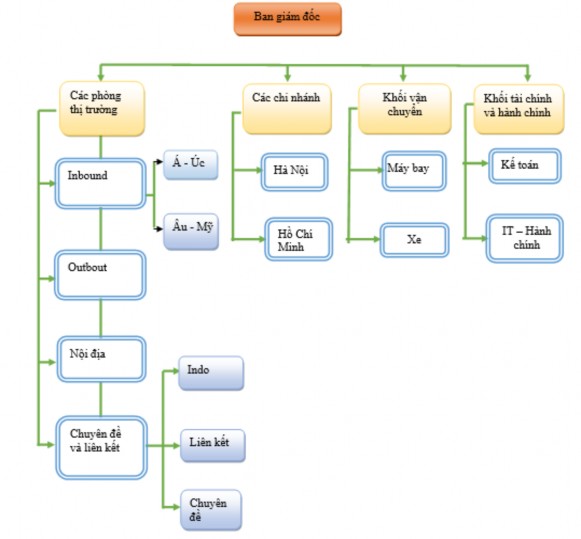
Figure 2.1. Organizational chart of Vietnam Tourism Joint Stock Company Vitours
Functions and tasks of departments in Vietnam Tourism Joint Stock Company Vitours
Functions and duties of the department:
Board of Directors : includes 1 director and 3 deputy directors
Manage and operate all company activities, have the right to decide and be responsible for the company before the law.
Decide on issues related to the company's daily operations, organize and implement business plans and business projects.
Urge and direct departments to implement the proposed plans:
- Director: responsible for coordinating with the General Director to operate and manage the company, discuss and make correct decisions to improve the company's business performance.