
The registration process for establishing intellectual property rights for geographical indications is specified in the table below: [16, page 31]
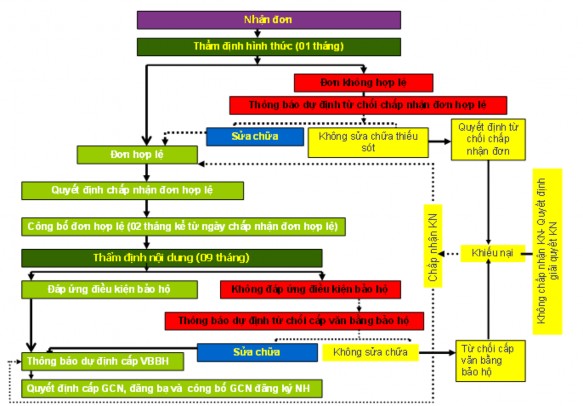
The regulations on the examination and re-examination of application content as stipulated in Points 15 and 16 of Circular 01 still have some shortcomings such as the time limit for examination of application content is too long for the public's needs (6 months from the date of signing the notice of acceptance of valid application). At the same time, the regulations on examination of application content do not have regulations on principles and procedures for assessing the subject of protection in the application according to the standards applicable to each type of application (part of this content is currently only available in the examination regulations issued by the National Office of Intellectual Property, so it is only considered as a guide to professional examination, so it has no legal value).
Not to mention the general, unclear regulations that can easily lead to abuse of power by the registration authority during the application examination process, such as the regulation on re-examination of applications that for " complicated cases ", the re-examination period may be extended " but not beyond the initial examination period " (point 16.1b). However, to explain what are complicated cases,
Maybe you are interested!
-

 Legal Status on Protection of Industrial Property Rights for Trade Names
 -
 Legal Provisions on Protection of Industrial Property Rights by Criminal Measures
 -
 Current Status of Industrial Property Protection Activities for Trade Secrets in Vietnam
 -
 Protection of industrial property rights for geographical indications under Vietnamese law - Ninh Thi Thanh Thuy - 2
 -
 Protection of industrial property rights for trade names according to the provisions of Vietnamese law - 2
There are no guiding regulations. For example, regarding the regulations on refusal to accept applications, point 13.7 of Circular 01 stipulates: “ In case the applicant has been sent a notice of intended refusal to accept a valid application by the National Office of Intellectual Property... but the applicant does not correct the deficiencies or the corrections do not meet the requirements or does not have an objection or the objection is not valid... ”, the National Office of Intellectual Property will refuse to accept the application. Similar to the regulations on re-examination of applications, there are no detailed regulations on what constitutes “ unsatisfactory correction ” or “ unvalid objection ”.
From the typical case of GI “Buon Ma Thuot Coffee” is a guide for green coffee, a famous product with special quality of the Central Highlands in general and Daklak in particular. Currently, Buon Ma Thuot Coffee Association has been established and will play an important role in controlling the quality and production process of coffee. The Association has also closely coordinated with the Department of Science and Technology of Daklak in granting the right to use GI “Buon Ma Thuot” to registered enterprises. It is expected that Buon Ma Thuot coffee output will reach about 8,000-10,000 tons in the near future. However, one of the difficulties of GI Buon Ma Thuot is that it only protects green coffee products, which has limited the development of GI, therefore, currently, Daklak Provincial People's Committee is carrying out the necessary procedures to request GI protection for ground coffee [15, p.10].
It is a fact that registering a GI for a product requires many steps. First of all, it is necessary to determine the name of the product. That name must meet the conditions and accurately reflect the quality of the product created by the geographical conditions of a region or a country. Next are the characteristics of the production process and product quality control. In addition, registering a GI for a product requires the participation of many different agencies and departments. The complexity of the registration process has caused many products to be delayed in registering for GI protection. Especially
We are lacking criteria to identify products and production areas because localities that want to register geographical indication protection for a product must, in addition to identifying the name, characteristics, quality, and production process, also clearly identify the quality control process of that product.
Regarding the authority of the State management agency related to the granting of Certificates of protection of geographical indications, Vietnamese law still has some shortcomings. There is no provision stipulating that the registration agency meets and discusses with the applicant about the application assessment. Therefore, the provisions of the law, especially the provisions on registration procedures issued by the registration agency, often tend to lack specificity, sometimes sketchy. The relationship between the National Office of Intellectual Property and the applicant is characterized by an administrative relationship, a subordinate command. When an officer of the National Office of Intellectual Property makes a request related to the registration process of geographical indications, the applicant often tries to meet that request without needing to know why it is necessary. The regulation that the application assessment activity is only performed by the registration agency is also somewhat unreasonable because the registration agency is both the agency assessing registration standards, the agency deciding to grant the certificate, and the agency handling complaints about the registration of geographical indications. When there is a lawsuit, the Court also mainly relies on the response of this agency to make a judgment in resolving the dispute. This leads to unfairness for the person requesting the registration of intellectual property protection when they make a complaint or sue the decision of the registration agency while the legal evidence is the professional test results of this agency itself. Circular 01 generally stipulates that " The National Office of Intellectual Property organizes a direct dialogue between a third party and the applicant to clarify the issue of objection if deemed necessary and requested by both parties " showing that this is still a provision that is only formal and not feasible.
One of the new points of the Law on Intellectual Property compared to previous regulations is the regulation on limiting rights to geographical indications to resolve conflicts.
between trademark protection and geographical indications according to current WTO regulations. It can be said that the issue of the relationship between trademarks and geographical indications has not been clearly regulated in the TRIPs Agreement, especially the content of rights for these two subjects (Articles 16 and 17 - rights and limitations for trademarks of TRIPs; Articles 22, 23 and 24 - rights and limitations for geographical indications of TRIPs). This ambiguity has led to different understandings and applications among WTO member countries, especially between the two groups of countries: the United States, Australia, New Zealand and the EU. According to a recent WTO ruling related to the DS174 dispute [38] on the results of the dispute settlement between these two groups of countries on trademark and geographical indication protection, the EU must amend its regulations on geographical indication protection in the direction of respecting the rights to previously protected trademarks. The above ruling is considered the official interpretation of the WTO on the relationship between these two subjects. This document affirms that, when considering the protection of a GI, it is necessary to take into account the rights to a previously established trademark, if the use of a GI causes significant confusion with a protected trademark, the GI must be refused protection. The exceptions provided by TRIPs are not considered to allow the coexistence of a GI and a pre-existing trademark (Article 24 of the TRIPs Agreement).
A reality that exists today is the trend of “branding” some geographical names, which is disadvantageous to manufacturers in the region whose geographical indications are protected as trademarks. Examples include Saigon Beer, Dalat Wine, Hanoi Beer, Ben Tre Coconut Candy, etc. This would be unfair and unreasonable when many people produce the same product locally, but only one person is granted protection for the geographical indication as a trademark because that person has registered it. Meanwhile, a product bearing a geographical indication must first satisfy the quality, specific characteristics, reputation, etc. created by its geographical origin, and when the producers meet such requirements, all entities have the right to use and attach the protected geographical indication to the product.
This leads to a problem if we do not have strict regulations to solve this problem, instead of the use belonging to the community of producers of the area bearing the GI, it now belongs to only one individual. Currently, Ben Tre coconut candy has been protected under the name of a trademark, but in fact this is a specialty of an entire region and it will be very disadvantageous for other Ben Tre people when they are not allowed to use Ben Tre GI on products produced by themselves in their locality just because the GI has been exclusively owned by one individual according to the provisions of the trademark law.
2.2 Legal status on industrial property rights for geographical indications
Because the ownership of GIs belongs to the State, the State still controls the use of GIs through the management of GIs by Collective Management Organizations. According to the provisions of the Law on Intellectual Property, organizations and individuals that produce and trade in products that meet the standards and characteristics, specific quality or reputation in the geographical area corresponding to the GI have the right to use the GI.
This is a new point of the Law on Intellectual Property compared to previous regulations to avoid the unconscious use of protected geographical indications, causing loss of national assets. The person exercising the right to register a geographical indication cannot become the owner of that geographical indication.
The person entitled to use a geographical indication is the organization or individual who carries out the production of goods bearing that indication in the respective national, regional or local territory, provided that the goods produced by that person must ensure the inherent prestige or reputation of that type of goods. The person entitled to legally use a geographical indication is confirmed by a competent state agency through the issuance of a Certificate of Right to Use a Geographical Indication. However, although the owner of a geographical indication belongs to the state, the person entitled to file an application belongs to the user or the collective management organization or the competent agency [Article 88 of the Law on Intellectual Property].
Foreign individuals and legal entities that are the right holders of geographical indications granted by competent authorities of foreign countries have the right to submit applications to the National Office of Intellectual Property to issue Certificates of right to use geographical indications for their products on the Vietnamese market, provided that such geographical indications have been granted protection in that country. Foreign individuals and legal entities from member countries of the Paris Convention or countries that have signed mutual protection agreements with Vietnam or have accepted the principle of reciprocity in the protection of industrial property, if they are permanently residing or have a legal representative in Vietnam, or have a real production and business establishment in Vietnam, may directly or authorize an industrial property representative to submit applications for appellations of origin of goods to the National Office of Intellectual Property. If such foreign individuals and legal entities are permanently residing or do not have a legal representative, or a production and business establishment in Vietnam, they must submit applications through an industrial property representative legally operating in Vietnam.
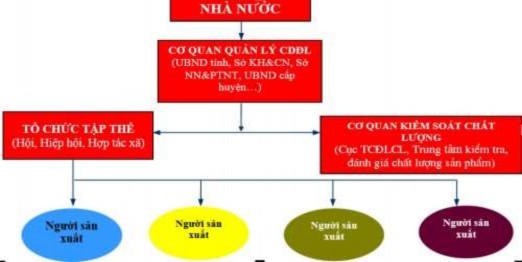
CDDL management activities in Vietnam
As of May 30, 2016, according to statistics from the National Office of Intellectual Property, there were only 79 applications for GI protection filed in Vietnam, of which 44 were domestic GI registration certificates and 4 were foreign GI registration certificates.
outside. Many dossiers are under review and have many shortcomings. In addition, there are also a number of geographical indications protected as collective marks. [16]
*With the characteristic of the ownership of geographical indications belonging to the State, the State can directly exercise the right to manage geographical indications or grant the right to manage geographical indications to an organization representing the interests of all organizations and individuals granted the right to use such geographical indications, also known as Collective Management Organizations. Organizations and individuals that produce and trade in products that meet the standards and characteristics, specific quality or reputation in the geographical area corresponding to the geographical indications have the right to use the geographical indications. Unlike trademarks, the right to use geographical indications does not belong to any organization or individual but to all establishments that produce and market such products, including processing and packaging establishments, provided that they meet the standards regarding the specific characteristics of the product and the conditions for producing the product. Therefore, to manage this common property right, there needs to be an organization representing the community of those subjects, such as the Association of Manufacturers, the Association of Craft Villages, called the Collective Management Organization for Geographical Indications. In addition to determining and proving the conditions for protection and registering the establishment of rights, this organization must also manage the implementation of the right to use of its members and protect the Geographical Indications against acts of infringement by other parties. In other words, the Collective Management Organization for Geographical Indications has the right and responsibility to carry out all activities to build, control the use, protect and develop the value of the property bearing the Geographical Indications.
The agency or organization authorized to manage the CDL is the People's Committee of the province or centrally-run city where the geographical area corresponding to the CDL is located in the case where the CDL belongs to a locality. In the case where the CDL belongs to many localities, the right to manage that CDL belongs to the People's Committee of the province or centrally-run city, representing the authorization of the remaining People's Committees of the provinces or centrally-run cities. In addition, the right to manage the CDL can also be granted by an agency or organization authorized by the People's Committee of the province or centrally-run city, provided that such agency or organization represents the interests of the
of all organizations and individuals who are granted the right to use geographical indications. Considered a national asset, therefore, to support communities that are not qualified to have their own representative organization, the Provincial People's Committee can establish or appoint an organization to temporarily perform the function of a Collective Management Organization for geographical indications. However, the Association of Producers, if established, will be the entity that protects its own rights in a more practical way. Therefore, the ultimate goal is still to establish a Collective Management Organization for geographical indications of the community of enterprises producing, processing, and trading that specialty.
In fact, most of the geographical indications have established associations or unions. However, most of these associations are still confused about the management of geographical indications. They only play a coordinating role and are not really the subjects in the management and development of geographical indications. Because in geographical areas, manufacturers/businesses cannot concentrate resources to protect, manage and develop their geographical indications. Therefore, the People's Committee of the province/city directly under the Central Government must request the establishment of rights for geographical indications (make records and register) and then also manage the geographical indications, and therefore the State has to spend a huge amount of money.
This has led to a situation where localities have only completed the establishment of rights, while the management mechanism and operations have not been established or, if they have been, have not been operating effectively. This has led to the effectiveness and efficiency of the Certificate of Protection of Geographical Indications not being as expected.
Before the Law on Intellectual Property was promulgated, there were no regulations regarding the rights and obligations of Collective Management Organizations. Accordingly, a Collective Management Organization is an organization authorized by the State to manage geographical indications and is an organization representing the interests of all organizations and individuals who are authorized to use geographical indications but are not allowed to participate in the production, processing, and trading of products bearing geographical indications in any form. In addition, this organization must have sufficient capacity or ability to mobilize human resources, technical means, and management capacity.