
in which the focus is on cultivating teaching capacity to meet the requirements of the current program and have an interest in the new program.
3.2.4.3. How to implement the measure
First of all, each teacher himself needs to be aware of his position, role, and responsibility for self-study, self-improvement, and improvement of professional qualifications, pedagogical skills, and teaching skills according to the University of Natural Sciences. Only when he has the right awareness can each teacher transform the needs and demands of society into personal motivation and goals, thereby being proactive, positive, and self-conscious in striving for self-study and self-improvement.
Right from the beginning of the school year, each teacher needs to develop a plan for self-study and self-improvement in terms of expertise and pedagogical skills. In which, it is necessary to clearly define the goals, content, form, method, and time for self-study and self-improvement, or to participate in advanced training courses on expertise and active teaching skills according to the new General Education Program.
The self-training plan needs to clearly demonstrate the knowledge, pedagogical skills, teaching methods, etc. that need to be supplemented according to the school's general plan.
To have a basis for self-training of teachers of literature, you can refer to the Circular on Regulations on regular training of general education No. 26/2012/TT/BGDDT, issued on July 10, 2012, from which teachers can select and list the tasks to be done, the specific requirements to be achieved, the time frame and the level of completion appropriate to their own conditions and abilities. After making a plan, each teacher needs to be determined, have a sense of responsibility, have a proactive spirit, and persevere in overcoming all difficulties to complete the set goals.
Teachers of Literature need to arrange time for self-study and self-improvement in accordance with the characteristics of teaching Literature in secondary schools. Time for self-study and self-improvement is very limited, so each teacher can arrange time for self-study through professional activities in groups, through class observation, through attending seminars, training sessions, seminars organized by the school, the Department of Education and Training, etc. at appropriate times.
Teachers teaching Literature in secondary schools need to identify the content of self-study, self-improvement of professional qualifications, skills and teaching skills to develop students' abilities, not only fostering professional qualifications and skills but also fostering ethics, style and pedagogical skills.
The training and self-training of professional qualifications, skills and teaching skills for teachers of Literature can be carried out through relationships with colleagues, parents, students and society. When training in professional qualifications, teachers need to know how to select documents, research and collect information selectively in accordance with the practical requirements of teaching Literature according to the new General Education Program.
Find sources of self-improvement materials through books, newspapers, mass media, the internet, professional activities, etc. In addition, it is necessary to promptly supplement knowledge about information technology, foreign languages, innovate teaching methods and skills, equip yourself with knowledge about culture, society, and the ability to teach Literature.
Choose a training method that suits your abilities and strengths. Self-study and self-training through individual teaching activities, document research, etc. Self-study and self-training through collective activities such as participating in professional activities, through political and social activities, through concentrated and non-concentrated training courses, and specialized training courses.
In the process of self-study and self-training, teachers of Literature need to self-examine and evaluate the training results, helping teachers review what they have done and what they have not done in the process of self-study and self-training, thereby promptly adjusting and supplementing the plan to achieve the goal of improving professional qualifications, pedagogical skills, and teaching skills of Literature according to the approach to learners' competencies.
3.2.4.4. Conditions for implementing measures
School managers and teachers need to be aware of the importance of professional training for teachers. There needs to be a teacher training plan for each specific stage. Each teacher must also actively participate in training activities and especially self-training.
The school creates conditions in terms of time, facilities, and funding for teacher training activities.
Building a core team of Literature teachers as the backbone in training teachers in professional groups. Promoting the role of group leaders, team leaders and core teachers.
3.2.5. Innovation in testing and evaluating learning outcomes of Literature subject towards developing students' capacity
3.2.5.1. Objectives of the measure
Help teachers understand the correct purpose of assessment and evaluation activities, which is to promote students' progress; not to compare one student with another; to attach importance to motivating and encouraging students' interest, positivity and overcoming difficulties in studying and practicing; to help students develop their personal talents; to ensure timeliness, fairness, objectivity, and not to create pressure for students and their parents.
Teachers know and implement various forms of assessment suitable for Literature in secondary schools such as: assessment by multiple choice tests, written essay tests, assessment by products, by student portfolios, by oral presentations, discussion/debate through group interaction, through group products.
Teachers organize and guide students to know how to self-assess and students assess each other.
Through innovation in teaching and assessment, students become more active, try harder, make progress, and change themselves (not only mastering knowledge and skills but also changing attitudes and beliefs).
3.2.5.2. Contents of the measure
- Directing teachers to innovate content and evaluate learning outcomes of Literature subject:
+ Currently, assessment and testing mainly test and evaluate students' knowledge, but rarely test their ability to apply knowledge to specific situations, which leads to students' practice learning.
+ In addition to testing and evaluating cognitive abilities such as intelligence and creativity, it is necessary to combine testing and evaluating non-cognitive abilities such as self-confidence, spirit of overcoming difficulties, civic responsibility; ability to cooperate, ability to work independently, etc. These are important abilities that help students adapt to the constantly changing circumstances and conditions of life.
- Directing teachers to innovate methods and forms of testing and evaluation
Require teachers to combine new and traditional assessment methods and systems. Pay special attention to effective methods and systems in developing students' competencies, such as: practical testing, scoring individual products, scoring group products, scoring creative ideas, scoring when students solve practical problems, etc.; combine assessment of learning outcomes with assessment of students' learning process.
- Instruct teachers to organize and guide students to know how to self-assess and students to assess each other.
- Teachers must develop students' ability to self-check and self-evaluate. Teachers help students understand their tasks and organize their own learning activities under guidance. This helps students become more active, more confident, and develop critical thinking, assessment and self-evaluation skills.
3.2.5.4. How to implement the measure
- The school's Board of Directors directs the professional team to organize training so that teachers can master and skillfully apply the forms and methods of assessment according to the students' learning outcomes. Training can be organized through organizing specialized training classes or through professional activities.
- Raise awareness of Literature staff and teachers about innovation in student assessment in the subject.
- Directing Literature teachers to design student tests according to the Law on Natural Sciences, paying attention to the teaching perspectives of differentiation, integration and interdisciplinary teaching; increasing questions that solve real-life situations; open questions; questions that assess personal views; trends, and creativity of students;...
- Instruct Literature teachers to diversify assessment forms such as assigning students to write reports on a topic, summarize a topic, create mind maps; evaluate through presentations; evaluate through students' learning products; and through group activity products.
- Instruct Literature teachers to implement the viewpoint of evaluating students' learning process, helping students realize their own level of progress; forming students' confidence; avoiding discouraging or hurting students.
- Instruct Literature teachers to seriously provide feedback to students after the assessment. This is an important activity to help students see their strengths and weaknesses so that they can make adjustments. Management staff check by looking at the comments section in students' work or observing Literature teachers' test returns to avoid the situation where teachers only grade without commenting or evaluating, or give general comments and evaluations, causing students to not understand what they have done well and what they have limited.
- Management staff regularly evaluates the assessment of students by teachers in the school. Timely encourage and praise teachers who do well and remind and correct teachers who do not.
- Directing Literature teachers to strictly implement the assessment process.
3.2.5.4. Conditions for implementing measures
- School managers and teachers must grasp and implement well the contents of innovation in assessment, especially the design of questions and tests according to learners' learning needs, and the use of new assessment systems and methods.
- All Literature teachers must be trained and fostered in innovation in assessment, especially in designing questions and tests according to students' learning needs, and in using new assessment systems and methods.
- Managers must closely direct and regularly evaluate teachers' performance.
3.3. Relationship between proposed measures
The measures to manage the teaching of Literature according to the National University of Languages and International Studies for students in secondary schools in Ha Long city, Quang Ninh province proposed above have a close and dialectical relationship with each other in the trend of movement and development. This measure is the basis and premise for implementing the other measures and vice versa.
Measure " Cultivating awareness for managers and teachers about teaching Literature according to students' capacity orientation " is the first measure that needs to be implemented, it is the foundation for implementing the following measures.
The measure " Directing and managing the development and implementation of goals and content of teaching Literature in secondary schools according to students' capacity orientation " aims to help school principals manage teaching activities of Literature according to the goals and content of the new general education program.
The measure " Directing the implementation of innovation in teaching methods and forms of organizing Literature according to students' capacity orientation " is an important measure. The quality of teaching cannot be high if teachers do not innovate teaching methods. Active teachers will certainly create conditions for students to be active and proactive. This is a target and decisive measure, affecting the subject of teaching activities. The quality of the teaching staff has a decisive meaning to the quality of teaching.
Measure " Organize training and self-training of professional qualifications for staff and teachers to organize teaching activities of Literature according to students' capacity orientation ". Helps improve teachers' qualifications, meeting the requirements in teaching Literature.
The measure " Innovation in testing and evaluating the learning outcomes of Literature subject according to the orientation of developing students' capacity" helps teachers test and evaluate students' learning outcomes according to the learners' capacity, promptly commend teachers who do well and correct teachers who do not do well. This measure is also an important function of management work.
Subject teaching activities. The innovation of assessment will help teachers accurately assess students' learning ability as well as their teaching methods. The innovation of assessment also helps managers conveniently monitor and evaluate the quality of subject teaching activities, thereby taking timely adjustment measures.
Managing teaching activities of Literature is the core activity of the subject. Only by managing the teaching activities of the professional group and teachers well can we manage the learning activities of students well. At the same time, we must collect feedback on teaching activities through testing and evaluating students' learning results, thereby adjusting the teaching methods of teachers to suit the purposes and requirements of the subject and also helping students adjust their learning methods to achieve higher results. When applying measures, they must be synchronous, flexible and adaptable to improve teaching effectiveness.
3.4. Testing the necessity and feasibility of proposed solutions
3.4.1. Purpose of testing
The author of the research conducted a survey to confirm the urgency and feasibility of measures to manage the teaching of Literature according to the student's learning outcomes at secondary schools in Ha Long city, Quang Ninh province.
3.4.2. Test subjects
To test the awareness of the urgency and feasibility of the proposed measures, we collected opinions from 85 people including: 20 managers and 65 teachers of Literature.
3.4.3. Test content
A study on the urgency or non-urgency of measures to manage teaching Literature subject according to the National University of Languages and International Studies for students in secondary schools in Ha Long city, Quang Ninh province and the feasibility of the measures proposed by the topic.
3.4.4. Testing method
Develop a questionnaire to seek expert opinion on the urgency and feasibility of proposed measures.
3.4.5. Test results
Surveying 85 managers and teachers on the urgency of measures to manage teaching Literature according to the National Curriculum for Students at secondary schools in Ha Long city, Quang Ninh province, we obtained the following results:
Table 3.1. Assessment of managers and teachers of secondary schools on the urgency of measures to manage teaching and learning Literature according to students' competency orientation
STT
Measure | Level of urgency | ||||||
Very urgent design | Less urgent | Not granted design | |||||
SL | % | SL | % | SL | % | ||
1 | Awareness training for managers and teachers on teaching Literature according to student capacity | 60 | 70.6 | 25 | 29.4 | 0 | 0 |
2 | Directing and managing the development and implementation of goals and content for teaching Literature in secondary schools according to regulations. student ability | 69 | 81.2 | 16 | 18.8 | 0 | 0 |
3 | Directing the implementation of method innovation, Form of organizing teaching Literature subject according to students' capacity orientation | 78 | 91.8 | 7 | 8.2 | 0 | 0 |
4 | Organize training and self-training of professional qualifications for staff and teachers to organize teaching activities of Literature subject according to the orientation. student ability | 71 | 83.5 | 14 | 16.5 | 0 | 0 |
5 | Innovation in testing and evaluating learning outcomes of Literature subject according to development orientation develop student capacity | 66 | 77.6 | 19 | 22.4 | 0 | 0 |
Maybe you are interested!
-
 Phan Khoi and the modernization of Vietnamese literature in the first half of the 20th century - 2
 -
 Literature and Buddhism in Vietnamese Buddhist Press before 1945 - 33
 -
 Literature and Buddhism in Vietnamese Buddhist Press before 1945 - 25
 -
 Old stories of Hanoi in To Hoai's literature - 2
 -
 Recommendations for Improving the Law on Copyright Protection for Folk Literature Works
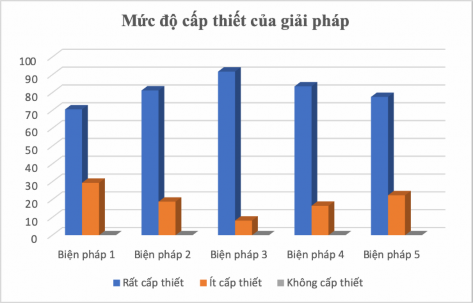
Chart 3.1. Assessment of managers and teachers of secondary schools on the urgency of measures to manage teaching and learning Literature according to students' competency orientation
From the survey results, it can be seen that the 05 proposed measures above are rated highest by managers and teachers at the very necessary level, and in this level, the measure to " Directing the implementation of innovation in methods and forms of organizing teaching Literature according to students' capacity orientation " has the highest number of people rating 91.8% as very urgent. The lowest rating in this level is " Raising awareness for managers and teachers about teaching Literature according to students' capacity orientation " with 70.6% considering it very necessary. Thus, the above table shows that the proposed measures are rated quite highly at the very urgent and urgent level. The results of the expert opinion survey show that the proposed measures are rated as necessary and applicable.
Surveying 85 managers and teachers on the feasibility of measures to manage teaching Literature according to the students' learning outcomes at secondary schools in Ha Long city, Quang Ninh province, we obtained the following results:
Table 3.2. Assessment of managers and teachers of secondary schools on the feasibility of measures to manage teaching and learning Literature according to students' competency orientation
STT
Measure | Feasibility | ||||||
Very feasible | Unlikely | Are not | |||||
feasible | |||||||
SL | % | SL | % | SL | % | ||
1 | Fostering awareness for managers and teachers about teaching Literature according to orientation student ability | 62 | 72.9 | 23 | 27.1 | 0 | 0 |
2 | Directing and managing the development and implementation of goals and content for teaching Literature in secondary schools. according to student capacity | 70 | 82.4 | 15 | 17.6 | 0 | 0 |
3 | Directing the implementation of innovation in methods and forms of organizing the teaching of Literature according to the orientation student ability | 65 | 76.5 | 20 | 23.5 | 0 | 0 |
4 | Organize training and self-training of professional qualifications for staff and teachers to organize teaching activities of Literature subject according to the orientation. student ability | 58 | 68.2 | 27 | 31.8 | 0 | 0 |
5 | Innovation in testing and evaluating learning outcomes of Literature subject according to the standard student capacity development direction | 74 | 87.1 | 11 | 12.9 | 0 | 0 |