
- Purpose of implementing the regime;
- Insured objects;
- Conditions for receiving subsidies;
- Social insurance subsidy level and duration.
Maybe you are interested!
-
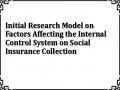
 Initial Research Model on Factors Affecting the Internal Control System on Social Insurance Collection
 -
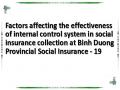 Factors affecting the effectiveness of internal control system in social insurance collection at Binh Duong Provincial Social Insurance - 19
 -
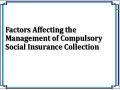 Factors Affecting the Management of Compulsory Social Insurance Collection
 -
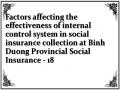 Factors affecting the effectiveness of internal control system in social insurance collection at Binh Duong Provincial Social Insurance - 18
 -
 Building a Research Model on Factors Affecting the Effectiveness of Internal Control System in Social Insurance Collection
The purpose of subsidies for each social insurance regime will help employees and employers clearly understand their responsibilities and rights when participating in social insurance. At the same time, it also clearly shows the orientation and goals of social insurance policies in each country. On the social aspect, the purpose of subsidies also reflects the role of each regime and creates more trust for employees in social insurance policies. Once employees and employers are fully aware of this issue, expanding the scope of social insurance participation will be easier and faster.
The insured object represents the scope of the social insurance policy in each regime. Depending on the type of regime, this object may be different. In some regimes, the subsidized object is the employee himself participating in social insurance; in others, the subsidized object is a number of family members of the employee (the employee's wife, husband, children and parents can be subsidized in the pension regime). In some regimes, the insured object is in the labor process (maternity allowance regime); in others, the subsidized object is outside the labor process (old age allowance regime)... Determining exactly the subsidized object in each regime will help the social insurance agency pay the right object, for the right purpose, minimizing confusion and negative phenomena that arise.
Subsidy conditions are also a very important content when designing social insurance regimes. In general, different social insurance regimes have different subsidy conditions, because the subsidy condition limitation comes from the risks or insurance events related to each regime. There are risks
Risks that cause workers to have their income interrupted but are not insured, such as war risks, riot risks. Or even risks that are recommended by the ILO to be insured but are not allowed by socio-economic conditions, such as unemployment risks, etc. Therefore, the prerequisite for being subsidized must be related to the risks or insurance events that are included in each regime. The following conditions are often related to the biological basis, the working environment and conditions of the workers, the financial capacity of the social insurance system, etc. If specified, these are the conditions of age, gender, occupation and work of the workers, and the period of social insurance premium payment. Clearly defining the conditions for social insurance subsidies for each regime is very important in the management and implementation of social insurance policies. First of all, it is to avoid abuse of the regime, and then to help calculate and determine the probability of risks and social insurance events arising in the total number of workers participating in social insurance. At the same time, it also helps forecasting to balance the social insurance fund in the future.
The subsidy level and subsidy period are the most important contents that make up each social insurance regime. The subsidy level is usually expressed in money and this amount is received by employees and their families from the social insurance agency when risks or social insurance events arise. In principle, the subsidy level of most social insurance regimes must be lower than the salary or income of employees participating in social insurance. But at the very least, it must meet the minimum needs of employees and their families. These needs may vary in scale and proportion in the social insurance subsidy levels related to each regime. To determine and quantify these needs, it is usually necessary to rely on the results of a survey of the population's living standards conducted in each country. In addition, when determining the social insurance subsidy level for each regime, it is also necessary to
based on a series of factors such as: health status, rate of labor capacity loss, occupation and job of the employee; insurance premium payment period; salary or income of the employee; number of social insurance participants; investment efficiency of idle funds... There are two types of social insurance subsidies: short-term subsidy level and long-term subsidy level. Short-term subsidy level is used to pay for needs arising in health care regimes, sickness allowance; maternity allowance... Long-term subsidy level is applied to pay for long-term social insurance regimes, such as old age allowance, occupational accident allowance, serious occupational disease allowance... Subsidy period depends mainly on the subsidy conditions. To avoid abuse of the regime, the subsidy period is regulated by the laws of each country in quite detailed and specific terms for each regime.
1.3.2. Factors affecting the establishment and implementation of social insurance regimes
1.3.2.1. Group of biological factors
The biological basis exists within the workers themselves who participate in social insurance. This is considered the most objective basis, because it is related to age, gender, natural health decline and the minimum needs in each person's life.
Each person's age is always limited. From the perspective of population and labor resource management, people often divide the population into 3 age groups: Young population (from 0 to 14 years old), working age population (from 15 to 60 years old), elderly population (from 61 years old and above). This division plays a very important role in building the social insurance system and especially the old age allowance system. The old age to receive pension benefits in different countries is not the same, because the "biological old age" of countries and regions has significant differences. Biological old age is mainly governed by physiological processes in the human body. With age, the assimilation process increasingly
aging, reduced metabolism and poor stability. These processes make people's ability to work and professional reflexes increasingly decrease. In addition, biological aging is also partly influenced by people's living conditions and environment, so when determining the retirement age for the old-age pension system, biological aging is the main basis.
Gender is related to many social insurance regimes. For the old-age allowance regime, the retirement age of men is often higher than that of women, because women's working capacity is significantly reduced after giving birth and raising young children. For the maternity allowance regime, gender is directly related to the pregnancy and childbirth of women, to their biological needs during the entire period of social insurance benefits. Therefore, to have the necessary financial resources to cover the period of income interruption, it is necessary to grasp the number and birth rate of each group of female workers of childbearing age.
Another factor that reduces the working capacity of workers in general is illness. Illness can happen to anyone, at any time and place. When sick, workers more or less have a reduced working capacity and if they have to be hospitalized for treatment or surgery, medical expenses and income will be interrupted. Therefore, when building a health care regime and a sickness allowance regime, it is necessary to grasp the probability of illness for workers, the average medical expenses of an illness and the average sick leave time in a year...
1.3.2.2. Working environment and conditions
The working environment and conditions between different industries, jobs and regions often have very large differences. This is one of the very important bases when establishing the social insurance system. These factors will be related to determining the retirement age of workers, the maternity leave of female workers, and the classification of industries.
to determine the subsidy level and subsidy period in social insurance regimes. In addition, it is also related to labor protection, occupational safety and hygiene and risk prevention.
1.3.2.3. Socio-economic conditions
When issuing social insurance policies and especially when establishing a system of social insurance regimes, socio-economic conditions have a great impact and sometimes play a decisive role. Socio-economic conditions are expressed in the level of education and social awareness of workers as well as employers, in the economic potential and strength of the country as well as employers, in the ability to organize and manage society of each country... These factors not only determine how many social insurance regimes a country can implement, but also directly affect the content of each regime. In the context of economic development, the income of workers is increasingly high, the ability to contribute to the social insurance fund will increase, thereby increasing the levels of social insurance benefits in each regime and vice versa. A country with strong and stable socio-economic conditions, which can implement all 9 social insurance regimes, will have a wider range of protection through social insurance policies, and the forms and levels of organization and implementation of social insurance policies will also be more diverse.
1.3.2.4. Law and political institutions
The system of social insurance regimes must be specified in legal documents on social insurance. These documents must be in relation to other relevant laws of each country. Therefore, the consistency and synchronization between legal documents, of which legal documents on social insurance are only a part, must be ensured. That means that when establishing and perfecting each regime as well as the entire system of social insurance regimes, their contents must not contradict other relevant laws.
The unity and synchronization here are reflected in many aspects related to social insurance, such as working age and retirement age of employees, list of occupations and toxic and dangerous occupations; foreign workers working in Vietnam and Vietnamese workers working abroad; salary scale and social insurance contribution salary; soldiers and police officers retiring before age...
In addition, the political system also affects the formation and content of the social insurance system. For example, in the past, socialist countries did not establish an unemployment benefit system in the social insurance system. Because they believed that under the social insurance system, there would be no unemployment among workers. Or, because of the goal of equality and progress for women, when establishing a maternity benefit system, the maternity leave period eligible for social insurance benefits was set too long, while socio-economic conditions did not allow it...
1.3.3. Contents of social insurance regimes
The contents of social insurance regimes are stipulated in the relevant Conventions and Recommendations. Over time, these contents can be amended and supplemented to suit the social context and working conditions. Moreover, countries also apply the Conventions and Recommendations very flexibly, suitable to their own circumstances in each stage of development of the country. The following are the main contents of the social insurance regimes presented based on the recommendations of the ILO.
a) Medical care regime
- Purpose: The purpose of this regime is to provide medical care services to maintain, restore and improve health and working capacity as well as meet the personal needs of the protected subjects. This regime helps social insurance participants quickly recover their health and ensure social security.
- Subjects of health care : Mainly include salaried workers. In addition, health care regimes in some industries
specific ones such as maritime or construction are mentioned in Conventions 164, 165 and 167…
- Conditions for receiving and receiving medical care :
In case of illness: Includes medical expenses for general or specialist treatment, inpatient or outpatient, including home visits; patient care services upon request and other expenses.
Pregnancy, childbirth and its consequences: Includes costs of care before, during and after childbirth by qualified medical personnel as well as hospitalisation costs (if applicable).
- Subsidy level and duration : The subsidy level of this regime is based on the amount of medical expenses incurred during the treatment and health care period but does not exclude other social insurance regimes. Social insurance beneficiaries or family breadwinners may have to bear part of the costs but are usually limited to a ceiling to avoid causing financial difficulties for their families as well as affecting the effectiveness of social and health protection. [18].
b) Sickness benefit
- Purpose : The purpose of the sickness benefit is to protect against loss of working capacity due to illness and resulting income interruption. This regime helps social insurance participants quickly stabilize their lives, thereby contributing to ensuring social security.
- Subjects receiving sickness benefits : are workers who are affected by illness and have lost their income. This regime helps social insurance participants quickly stabilize their lives, thereby contributing to ensuring social security.
- Conditions for receiving sick leave benefits : Social insurance participants who are sick or temporarily absent from work, leading to a disruption in income, will be considered eligible for sick leave benefits. If they have a sick child, they can also take time off to take care of the child, similar to being sick themselves. The benefits may be temporarily suspended.
stop in cases such as: fraud in claiming benefits, absence from the country...
- Benefit level and duration : The sickness benefit level is usually set as a percentage of the previous total income of the beneficiary or the breadwinner in their family. This percentage is always less than 100% to avoid abuse of the regime. In all cases, the benefit level must ensure that the beneficiary has enough conditions to live healthily and is not lower than the minimum level. [18].
c) Unemployment benefits
- Purpose : Anti-unemployment and employment policy often go hand in hand. These measures contribute to encouraging sufficient free choice of employment effectively and do not prevent employers from being required and employees from being able to find effective employment. Thus, the purpose of implementing the unemployment benefit regime is to stabilize the lives of social insurance participants, contributing to ensuring social security and socio-economic development of the country.
- Subjects receiving unemployment benefits : Including workers who are participating in social insurance and have lost their jobs due to objective reasons and not their fault.
- Conditions for receiving benefits : Employees who lose their jobs due to objective reasons, although they are able to work and are willing to work (showing that they are actively looking for work) but have not found a job, will be considered unemployed and receive unemployment benefits. In addition, the conditions for receiving unemployment benefits also depend on the length of service or the time of participating in social insurance as well as the unemployment benefits received before to avoid abuse of the regime.
- Benefit level and duration : the minimum unemployment benefit is 50% of the employee's previous income, but not