
SL23
VO 2 max, (maximum oxygen uptake index (ml/min/kg) | In activity, power increases gradually as circulation and respiration reach efficiency. maximum capacity | cardiovascular and respiratory function of athletes | |
SL27 | Pulmonary ventilation/minute –VE (liters) | Assess the degree of change in the respiratory system of Athlete to LVĐ | Assessment of respiratory function; |
SL29 | Volume of oxygen consumed at the time of anaerobic threshold/VO 2max -VO 2 LT/ max (%) | The higher the value of this index, the longer the exercise time in the aerobic metabolic zone, the greater the aerobic capacity. the better | Monitor and evaluate the development of aerobic endurance and the effectiveness of aerobic endurance training. |
SL30 | Relative maximum anaerobic power index - RPP ( W/kg ) | This value assesses the rapid energy supply capacity of the phosphate system. ATP and CP are stored in the body. | According to Maud's non-lactate anaerobic capacity classification, PJ and Schultz BB |
This value evaluates the ability | (1989) of Nam: | ||
SL31 | Relative total anaerobic capacity index- RAC ( W/kg) | The ability to provide energy synthesis from two non-lactate anaerobic sources (ATP and CP) in muscle cells) and membranes | - Good >10.89 - Fair 10.20 - 10.89 - Average 9.22- 10.19 - Weak 8.53 - 9.21 |
lactate gas | - Poor <8.52 | ||
Assessment of reasoning ability | The smaller this value is, the | ||
maintain energy source | then the ability to maintain | ||
Rate of impairment | anaerobic supply to the body | anaerobic energy | |
SL34 | anaerobic | can exercise with intensity | the better. This is the index |
= AF)- AF ( %) | maximum degree | selected as only | |
durability assessment | |||
speed | |||
Biochemistry | |||
SH4 | Hb (Hemoglobin) (g%) | Is the criterion to evaluate the ability to endure LVĐ and the level of deficiency. athlete's blood | Is an important factor reflecting the level of physical preparation |
SH6 | Testosterone (nMol/liter) | Reflects the level of fatigue of the body, especially accurate when considered | Testosterone in the blood changes as follows |
Maybe you are interested!
-
 Research on building a model of high-level male badminton athletes through biological, pedagogical and psychological values - 2
 -
 Research on building a model of high-level male badminton athletes through biological, pedagogical and psychological values - 1
 -
 Identify Rating Levels and Rating Scales
zt2i3t4l5ee
zt2a3gstourism,quan lan,quang ninh,ecology,ecotourism,minh chau,van don,geography,geographical basis,tourism development,science
zt2a3ge
zc2o3n4t5e6n7ts
of the islanders. Therefore, this indicator will be divided into two sub-indicators:
a1. Natural tourism attractiveness a2. Cultural tourism attractiveness
b. Tourist capacity
The two island communes in Quan Lan have different capacities to receive tourists. Minh Chau Commune is home to many standard hotels and resorts, attracting high-income domestic and international tourists. Meanwhile, Quan Lan Commune has many motels mainly built and operated by local people, so the scale and quality are not high, and will be suitable for ordinary tourists such as students.
c. Time of exploitation of Quan Lan Island Commune:
Quan Lan tourism is seasonal due to weather and climate conditions and festivals only take place on certain days of the year, specifically in spring. In Quan Lan commune, the period from April to June and from September to November is considered the best time to visit Quan Lan because the cultural tourism activities are mainly associated with festivals taking place during this time.
Minh Chau island commune:
Tourism exploitation time is all year round, because this is a place with a number of tourist attractions with diverse ecosystems such as Bai Tu Long National Park Research Center, Tram forest, Turtle Laying Beach, so besides coming to the beach for tourism and vacation in the summer, Minh Chau will attract research groups to come for tourism combined with research at other times of the year.
d. Sustainability
The sustainability of ecotourism sites in Quan Lan and Minh Chau communes depends on the sensitivity of the ecosystems to climate changes.
landscape. In general, these tourist destinations have a fairly high level of sustainability, because they are natural ecosystems, planned and protected. However, if a large number of tourists gather at certain times, it can exceed the carrying capacity and affect the sustainability of the environment (polluted beaches, damaged trees, animals moving away from their habitats, etc.), then the sustainability of the above ecosystems (natural ecosystems, human ecosystems) will also be affected and become less sustainable.
e. Location and accessibility
Both island communes have ports to take tourists to visit from Van Don wharf:
- Quan Lan – Van Don traffic route:
Phuc Thinh – Viet Anh high-speed boat and Quang Minh high-speed boat, depart at 8am and 2pm from Van Don to Quan Lan, and at 7am and 1pm from Quan Lan to Van Don. There are also wooden boats departing at 7am and 1pm.
- Van Don - Minh Chau traffic route:
Chung Huong high-speed train, Minh Chau train, morning 7:30 and afternoon 13:30 from Van Don to Minh Chau, morning 6:30 and afternoon 13:00 from Minh Chau to Van Don.
f. Infrastructure
Despite receiving investment attention, the issue of infrastructure and technical facilities for tourism on Quan Lan Island is still an issue that needs to be resolved because it has a direct impact on the implementation of ecotourism activities. The minimum conditions for serving tourists such as accommodation, electricity, water, communication, especially medical services, and security work need to be given top priority. Ecotourism spots in Minh Chau commune are assessed to have better infrastructure and technical facilities for tourism because there are quite complete and synchronous conditions for serving tourists, meeting many needs of domestic and foreign tourists.
3.2.1.4. Determine assessment levels and assessment scales
Corresponding to the levels of each criterion, the index is the score of those levels in the order of 4, 3, 2, 1 decreasing according to the standard of each level: very attractive (4), attractive (3), average (2), less attractive (1).
3.2.1.5. Determining the coefficients of the criteria
For the assessment of DLST in the two communes of Quan Lan and Minh Chau islands, the students added evaluation coefficients to show the importance of the criteria and indicators as follows:
Coefficient 3 with criteria: Attractiveness, Exploitation time. These are the 2 most important criteria for attracting tourists to tourism in general and eco-tourism in particular, so they have the highest coefficient.
Coefficient 2 with criteria: Capacity, Infrastructure, Location and accessibility . Because the assessment area is an island commune of Van Don district, the above criteria are selected by the author with appropriate coefficients at the average level.
Coefficient 1 with criteria: Sustainability. Quan Lan has natural and human-made ecotourism sites, with high biodiversity and little impact from local human factors. Most of the ecotourism sites are still wild, so they are highly sustainable.
3.2.1.6. Results of DLST assessment on Quan Lan island
a. Assessment of the potential for natural tourism development
For Minh Chau commune:
+ Natural tourism attractiveness is determined to be very attractive (4 points) and the most important coefficient (coefficient 3), so the score of the Attractiveness criterion is 4 x 3 = 12.
+ Capacity is determined as average (2 points) and the coefficient is quite important (coefficient 2), then the score of Capacity criterion is 2 x 2 = 4.
+ Exploitation time is long (4 points), the most important coefficient (coefficient 3) so the score of the Exploitation time criterion is 4 x 3 = 12.
+ Sustainability is determined as sustainable (4 points), the important coefficient is the average coefficient (coefficient 1), so the score of the Sustainability criterion is 4 x 1 = 4 points
+ Location and accessibility are determined to be quite favorable (2 points), the coefficient is quite important (coefficient 2), the criterion score is 2 x 2 = 4 points.
+ Infrastructure is assessed as good (3 points), the coefficient is quite important (coefficient 2), then the score of the Infrastructure criterion is 3 x 2 = 6 points.
The total score for evaluating DLST in Minh Chau commune according to 6 evaluation criteria is determined as: 12 + 4 + 12 + 4 + 4 + 6 = 42 points
Similar assessment for Quan Lan commune, we have the following table:
Table 3.3: Assessment of the potential for natural ecotourism development in Quan Lan and Minh Chau communes
Attractiveness of self-tourismof course
Capacity
Mining time
Sustainability
Location and accessibility
Infrastructure
Result
Point
DarkMulti
Point
DarkMulti
Point
DarkMulti
Point
DarkMulti
Point
DarkMulti
Point
DarkMulti
CommuneMinh Chau
12
12
4
8
12
12
4
4
4
8
6
8
42/52
Quan CommuneLan
6
12
6
8
9
12
4
4
4
8
4
8
33/52
b. Assessment of the potential for humanistic tourism development
For Quan Lan commune:
+ The attractiveness of human tourism is determined to be very attractive (4 points) and the most important coefficient (coefficient 3), so the score of the Attractiveness criterion is 4 x 3 = 12.
+ Capacity is determined to be large (3 points) and the coefficient is quite important (coefficient 2), then the score of the Capacity criterion is 3 x 2 = 6.
+ Mining time is average (3 points), the most important coefficient (coefficient 3) so the score of the Mining time criterion is 3 x 3 = 9.
+ Sustainability is determined as sustainable (4 points), the important coefficient is the average coefficient (coefficient 1), so the score of the Sustainability criterion is 4 x 1 = 4 points.
+ Location and accessibility are determined to be quite favorable (2 points), the coefficient is quite important (coefficient 2), the criterion score is 2 x 2 = 4 points.
+ Infrastructure is rated as average (2 points), the coefficient is quite important (coefficient 2), then the score of the Infrastructure criterion is 2 x 2 = 4 points.
The total score for evaluating DLST in Quan Lan commune according to 6 evaluation criteria is determined as: 12 + 6 + 6 + 4 + 4 + 4 = 36 points.
Similar assessment with Minh Chau commune we have the following table:
Table 3.4: Assessment of the potential for developing humanistic eco-tourism in Quan Lan and Minh Chau communes
Attractiveness of human tourismliterature
Capacity
Mining time
Sustainability
Location and accessibility
Infrastructure
Result
Point
DarkMulti
Point
DarkMulti
Point
DarkMulti
Point
DarkMulti
Point
DarkMulti
Point
DarkMulti
Quan CommuneLan
12
12
6
8
9
12
4
4
4
8
4
8
39/52
Minh CommuneChau
6
12
4
8
12
12
4
4
4
8
6
8
36/52
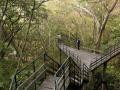
Basically, both Minh Chau and Quan Lan localities have quite favorable conditions for developing ecotourism. However, Quan Lan commune has more advantages to develop ecotourism in a humanistic direction, because this is an area with many famous historical relics such as Quan Lan Communal House, Quan Lan Pagoda, Temple worshiping the hero Tran Khanh Du, ... along with local festivals held annually such as the wind praying ceremony (March 15), Quan Lan festival (June 10-19); due to its location near the port and long exploitation time, the beaches in Quan Lan commune (especially Quan Lan beach) are no longer hygienic and clean to ensure the needs of tourists coming to relax and swim; this is also an area with many beautiful landscapes such as Got Beo wind pass, Ong Phong head, Voi Voi cave, but the ability to access these places is still very limited (dirt hill road, lots of gravel and rocks), especially during rainy and windy times; In addition, other natural resources such as mangrove forests and sea worms have not been really exploited for tourism purposes and ecotourism development. On the contrary, Minh Chau commune has more advantages in developing ecotourism in the direction of natural tourism, this is an area with diverse ecosystems such as at Rua De Beach, Bai Tu Long National Park Conservation Center...; Minh Chau beach is highly appreciated for its natural beauty and cleanliness, ranked in the top ten most beautiful beaches in Vietnam; Minh Chau commune is also home to Tram forest with a large area and a purity of up to 90%, suitable for building bridges through the forest (a very effective type of natural ecotourism currently applied by many countries) for tourists to sightsee, as well as for the purpose of studying and researching.
Figure 3.1: Thenmala Forest Bridge (India) Source: https://www.thenmalaecotourism.com/(August 21, 2019)
3.2.2. Using SWOT matrix to evaluate Quan Lan island tourism
General assessment of current tourism activities of Quan Lan island is shown through the following SWOT matrix:
Table 3.5: SWOT matrix evaluating tourism activities on Quan Lan island
Internal agent
Strengths- There is a lot of potential for tourism development, especially natural ecotourism and humanistic ecotourism.- The unskilled labor force is relatively abundant.- resource environmentunpolluted, still
Weaknesses- Poorly developed infrastructure, especially traffic routes to tourist destinations on the island.- The team of professional staff is still weak.- Tourism products in general
quite wild, originalintact
general and DLST in particularalone is monotonous.
External agents
Opportunity- Tourism is a key industry in the socio-economic development strategy of the province and Van Don economic zone.- Quan Lan was selected as a pilot area for eco-tourism development within the framework of the green growth project between Quang Ninh province and the Japanese organization JICA.- The flow of tourists and especially ecotourism in the world tends toincreasing
Challenge- Weather and climate change abnormally.- Competition in tourism products is increasingly fierce, especially with other localities in the province such as Ha Long, Mong Cai...- Awareness of tourists, especially domestic tourists, about ecotourism and nature conservation is not high.
Through summary analysis using SWOT matrix we see that:
To exploit strengths and take advantage of opportunities, it is necessary to:
- Diversify products and service types (build more tourism routes aimed at specific needs of tourists: experiential tourism immersed in nature, spiritual cultural tourism...)
- Effective exploitation of resources and differentiated products (natural resources and human resources)
div.maincontent .p { color: black; font-family:"Times New Roman", serif; font-style: normal; font-weight: normal; text-decoration: none; font-size: 14pt; margin:0pt; } div.maincontent p { color: black; font-family:"Times New Roman", serif; font-style: normal; font-weight: normal; text-decoration: none; font-size: 14pt; margin:0pt; } div.maincontent .s1 { color: black; font-family:"Times New Roman", serif; font-style: normal; font-weight: normal; text-decoration: none; font-size: 13pt; } div.maincontent .s2 { color: black; font-family:"Times New Roman", serif; font-style: normal; font-weight: normal; text-decoration: none; font-size: 13pt; } div.maincontent .s3 { color: #0D0D0D; font-family:"Times New Roman", serif; font-style: normal; font-weight: bold; text-decoration: none; font-size: 14pt; } div.maincontent .s4 { color: black; font-family:"Times New Roman", serif; font-style: italic; font-weight: normal; text-decoration: none; font-size: 14pt; } div.maincontent .s5 { color: black; font-family:"Times New Roman", serif; font-style: italic; font-weight: bold; text-decoration: none; font-size: 14pt; } div.maincontent .s6 { color: black; font-family:"Times New Roman", serif; font-style: italic; font-weight: normal; text-decoration: none; font-size: 14pt; vertical-align: -3pt; } div.maincontent .s7 { color: black; font-family:"Times New Roman", serif; font-style: italic; font-weight: normal; text-decoration: none; font-size: 14pt; vertical-align: -2pt; } div.maincontent .s8 { color: black; font-family:"Times New Roman", serif; font-style: italic; font-weight: normal; text-decoration: none; font-size: 14pt; vertical-align: -1pt; } div.maincontent .s9 { color: black; font-family:"Times New Roman", serif; font-style: normal; font-weight: normal; text-decoration: none; font-size: 14pt; } div.maincontent .s10 { color: black; font-family:"Times New Roman", serif; font-style: normal; font-weight: bold; text-decoration: none; font-size: 14pt; } div.maincontent .s11 { color: black; font-family:"Times New Roman", serif; font-style: normal; font-weight: normal; text-decoration: none; font-size: 14pt; } div.maincontent .s12 { color: black; font-family:Symbol, serif; font-style: normal; font-weight: normal; text-decoration: none; font-size: 14pt; } div.maincontent .s13 { color: black; font-family:Wingdings; font-style: normal; font-weight: normal; text-decoration: none; font-size: 14pt; } div.maincontent .s14 { color: black; font-family:"Times New Roman", serif; font-style: normal; font-weight: normal; text-decoration: none; font-size: 9pt; vertical-align: 5pt; } div.maincontent .s15 { color: black; font-family:"Times New Roman", serif; font-style: normal; font-weight: normal; text-decoration: none; font-size: 9pt; vertical-align: 5pt; } div.maincontent .s16 { color: black; font-family:Cambria, serif; font-style: italic; font-weight: normal; text-decoration: none; font-size: 14pt; } div.maincontent .s17 { color: #080808; font-family:"Times New Roman", serif; font-style: normal; font-weight: bold; text-decoration: none; font-size: 14pt; } div.maincontent .s18 { color: #080808; font-family:"Times New Roman", serif; font-style: normal; font-weight: normal; text-decoration: none; font-size: 14pt; } div.maincontent .s19 { color: black; font-family:"Times New Roman", serif; font-style: normal; font-weight: normal; text-decoration: none; font-size: 11pt; } div.maincontent .s20 { color: black; font-family:"Times New Roman", serif; font-style: normal; font-weight: normal; text-decoration: none; font-size: 10pt; } div.maincontent .s21 { color: black; font-family:"Times New Roman", serif; font-style: normal; font-weight: bold; text-decoration: none; font-size: 11pt; } div.maincontent .s22 { color: black; font-family:"Times New Roman", serif; font-style: normal; font-weight: normal; text-decoration: none; font-size: 11pt; } div.maincontent .s23 { color: black; font-family:"Times New Roman", serif; font-style: italic; font-weight: normal; text-decoration: none; font-size: 14pt; } div.maincontent .s24 { color: #212121; font-family:"Times New Roman", serif; font-style: normal; font-weight: normal; tex
Identify Rating Levels and Rating Scales
zt2i3t4l5ee
zt2a3gstourism,quan lan,quang ninh,ecology,ecotourism,minh chau,van don,geography,geographical basis,tourism development,science
zt2a3ge
zc2o3n4t5e6n7ts
of the islanders. Therefore, this indicator will be divided into two sub-indicators:
a1. Natural tourism attractiveness a2. Cultural tourism attractiveness
b. Tourist capacity
The two island communes in Quan Lan have different capacities to receive tourists. Minh Chau Commune is home to many standard hotels and resorts, attracting high-income domestic and international tourists. Meanwhile, Quan Lan Commune has many motels mainly built and operated by local people, so the scale and quality are not high, and will be suitable for ordinary tourists such as students.
c. Time of exploitation of Quan Lan Island Commune:
Quan Lan tourism is seasonal due to weather and climate conditions and festivals only take place on certain days of the year, specifically in spring. In Quan Lan commune, the period from April to June and from September to November is considered the best time to visit Quan Lan because the cultural tourism activities are mainly associated with festivals taking place during this time.
Minh Chau island commune:
Tourism exploitation time is all year round, because this is a place with a number of tourist attractions with diverse ecosystems such as Bai Tu Long National Park Research Center, Tram forest, Turtle Laying Beach, so besides coming to the beach for tourism and vacation in the summer, Minh Chau will attract research groups to come for tourism combined with research at other times of the year.
d. Sustainability
The sustainability of ecotourism sites in Quan Lan and Minh Chau communes depends on the sensitivity of the ecosystems to climate changes.
landscape. In general, these tourist destinations have a fairly high level of sustainability, because they are natural ecosystems, planned and protected. However, if a large number of tourists gather at certain times, it can exceed the carrying capacity and affect the sustainability of the environment (polluted beaches, damaged trees, animals moving away from their habitats, etc.), then the sustainability of the above ecosystems (natural ecosystems, human ecosystems) will also be affected and become less sustainable.
e. Location and accessibility
Both island communes have ports to take tourists to visit from Van Don wharf:
- Quan Lan – Van Don traffic route:
Phuc Thinh – Viet Anh high-speed boat and Quang Minh high-speed boat, depart at 8am and 2pm from Van Don to Quan Lan, and at 7am and 1pm from Quan Lan to Van Don. There are also wooden boats departing at 7am and 1pm.
- Van Don - Minh Chau traffic route:
Chung Huong high-speed train, Minh Chau train, morning 7:30 and afternoon 13:30 from Van Don to Minh Chau, morning 6:30 and afternoon 13:00 from Minh Chau to Van Don.
f. Infrastructure
Despite receiving investment attention, the issue of infrastructure and technical facilities for tourism on Quan Lan Island is still an issue that needs to be resolved because it has a direct impact on the implementation of ecotourism activities. The minimum conditions for serving tourists such as accommodation, electricity, water, communication, especially medical services, and security work need to be given top priority. Ecotourism spots in Minh Chau commune are assessed to have better infrastructure and technical facilities for tourism because there are quite complete and synchronous conditions for serving tourists, meeting many needs of domestic and foreign tourists.
3.2.1.4. Determine assessment levels and assessment scales
Corresponding to the levels of each criterion, the index is the score of those levels in the order of 4, 3, 2, 1 decreasing according to the standard of each level: very attractive (4), attractive (3), average (2), less attractive (1).
3.2.1.5. Determining the coefficients of the criteria
For the assessment of DLST in the two communes of Quan Lan and Minh Chau islands, the students added evaluation coefficients to show the importance of the criteria and indicators as follows:
Coefficient 3 with criteria: Attractiveness, Exploitation time. These are the 2 most important criteria for attracting tourists to tourism in general and eco-tourism in particular, so they have the highest coefficient.
Coefficient 2 with criteria: Capacity, Infrastructure, Location and accessibility . Because the assessment area is an island commune of Van Don district, the above criteria are selected by the author with appropriate coefficients at the average level.
Coefficient 1 with criteria: Sustainability. Quan Lan has natural and human-made ecotourism sites, with high biodiversity and little impact from local human factors. Most of the ecotourism sites are still wild, so they are highly sustainable.
3.2.1.6. Results of DLST assessment on Quan Lan island
a. Assessment of the potential for natural tourism development
For Minh Chau commune:
+ Natural tourism attractiveness is determined to be very attractive (4 points) and the most important coefficient (coefficient 3), so the score of the Attractiveness criterion is 4 x 3 = 12.
+ Capacity is determined as average (2 points) and the coefficient is quite important (coefficient 2), then the score of Capacity criterion is 2 x 2 = 4.
+ Exploitation time is long (4 points), the most important coefficient (coefficient 3) so the score of the Exploitation time criterion is 4 x 3 = 12.
+ Sustainability is determined as sustainable (4 points), the important coefficient is the average coefficient (coefficient 1), so the score of the Sustainability criterion is 4 x 1 = 4 points
+ Location and accessibility are determined to be quite favorable (2 points), the coefficient is quite important (coefficient 2), the criterion score is 2 x 2 = 4 points.
+ Infrastructure is assessed as good (3 points), the coefficient is quite important (coefficient 2), then the score of the Infrastructure criterion is 3 x 2 = 6 points.
The total score for evaluating DLST in Minh Chau commune according to 6 evaluation criteria is determined as: 12 + 4 + 12 + 4 + 4 + 6 = 42 points
Similar assessment for Quan Lan commune, we have the following table:
Table 3.3: Assessment of the potential for natural ecotourism development in Quan Lan and Minh Chau communes
Attractiveness of self-tourismof course
Capacity
Mining time
Sustainability
Location and accessibility
Infrastructure
Result
Point
DarkMulti
Point
DarkMulti
Point
DarkMulti
Point
DarkMulti
Point
DarkMulti
Point
DarkMulti
CommuneMinh Chau
12
12
4
8
12
12
4
4
4
8
6
8
42/52
Quan CommuneLan
6
12
6
8
9
12
4
4
4
8
4
8
33/52
b. Assessment of the potential for humanistic tourism development
For Quan Lan commune:
+ The attractiveness of human tourism is determined to be very attractive (4 points) and the most important coefficient (coefficient 3), so the score of the Attractiveness criterion is 4 x 3 = 12.
+ Capacity is determined to be large (3 points) and the coefficient is quite important (coefficient 2), then the score of the Capacity criterion is 3 x 2 = 6.
+ Mining time is average (3 points), the most important coefficient (coefficient 3) so the score of the Mining time criterion is 3 x 3 = 9.
+ Sustainability is determined as sustainable (4 points), the important coefficient is the average coefficient (coefficient 1), so the score of the Sustainability criterion is 4 x 1 = 4 points.
+ Location and accessibility are determined to be quite favorable (2 points), the coefficient is quite important (coefficient 2), the criterion score is 2 x 2 = 4 points.
+ Infrastructure is rated as average (2 points), the coefficient is quite important (coefficient 2), then the score of the Infrastructure criterion is 2 x 2 = 4 points.
The total score for evaluating DLST in Quan Lan commune according to 6 evaluation criteria is determined as: 12 + 6 + 6 + 4 + 4 + 4 = 36 points.
Similar assessment with Minh Chau commune we have the following table:
Table 3.4: Assessment of the potential for developing humanistic eco-tourism in Quan Lan and Minh Chau communes
Attractiveness of human tourismliterature
Capacity
Mining time
Sustainability
Location and accessibility
Infrastructure
Result
Point
DarkMulti
Point
DarkMulti
Point
DarkMulti
Point
DarkMulti
Point
DarkMulti
Point
DarkMulti
Quan CommuneLan
12
12
6
8
9
12
4
4
4
8
4
8
39/52
Minh CommuneChau
6
12
4
8
12
12
4
4
4
8
6
8
36/52
Basically, both Minh Chau and Quan Lan localities have quite favorable conditions for developing ecotourism. However, Quan Lan commune has more advantages to develop ecotourism in a humanistic direction, because this is an area with many famous historical relics such as Quan Lan Communal House, Quan Lan Pagoda, Temple worshiping the hero Tran Khanh Du, ... along with local festivals held annually such as the wind praying ceremony (March 15), Quan Lan festival (June 10-19); due to its location near the port and long exploitation time, the beaches in Quan Lan commune (especially Quan Lan beach) are no longer hygienic and clean to ensure the needs of tourists coming to relax and swim; this is also an area with many beautiful landscapes such as Got Beo wind pass, Ong Phong head, Voi Voi cave, but the ability to access these places is still very limited (dirt hill road, lots of gravel and rocks), especially during rainy and windy times; In addition, other natural resources such as mangrove forests and sea worms have not been really exploited for tourism purposes and ecotourism development. On the contrary, Minh Chau commune has more advantages in developing ecotourism in the direction of natural tourism, this is an area with diverse ecosystems such as at Rua De Beach, Bai Tu Long National Park Conservation Center...; Minh Chau beach is highly appreciated for its natural beauty and cleanliness, ranked in the top ten most beautiful beaches in Vietnam; Minh Chau commune is also home to Tram forest with a large area and a purity of up to 90%, suitable for building bridges through the forest (a very effective type of natural ecotourism currently applied by many countries) for tourists to sightsee, as well as for the purpose of studying and researching.
Figure 3.1: Thenmala Forest Bridge (India) Source: https://www.thenmalaecotourism.com/(August 21, 2019)
3.2.2. Using SWOT matrix to evaluate Quan Lan island tourism
General assessment of current tourism activities of Quan Lan island is shown through the following SWOT matrix:
Table 3.5: SWOT matrix evaluating tourism activities on Quan Lan island
Internal agent
Strengths- There is a lot of potential for tourism development, especially natural ecotourism and humanistic ecotourism.- The unskilled labor force is relatively abundant.- resource environmentunpolluted, still
Weaknesses- Poorly developed infrastructure, especially traffic routes to tourist destinations on the island.- The team of professional staff is still weak.- Tourism products in general
quite wild, originalintact
general and DLST in particularalone is monotonous.
External agents
Opportunity- Tourism is a key industry in the socio-economic development strategy of the province and Van Don economic zone.- Quan Lan was selected as a pilot area for eco-tourism development within the framework of the green growth project between Quang Ninh province and the Japanese organization JICA.- The flow of tourists and especially ecotourism in the world tends toincreasing
Challenge- Weather and climate change abnormally.- Competition in tourism products is increasingly fierce, especially with other localities in the province such as Ha Long, Mong Cai...- Awareness of tourists, especially domestic tourists, about ecotourism and nature conservation is not high.
Through summary analysis using SWOT matrix we see that:
To exploit strengths and take advantage of opportunities, it is necessary to:
- Diversify products and service types (build more tourism routes aimed at specific needs of tourists: experiential tourism immersed in nature, spiritual cultural tourism...)
- Effective exploitation of resources and differentiated products (natural resources and human resources)
div.maincontent .p { color: black; font-family:"Times New Roman", serif; font-style: normal; font-weight: normal; text-decoration: none; font-size: 14pt; margin:0pt; } div.maincontent p { color: black; font-family:"Times New Roman", serif; font-style: normal; font-weight: normal; text-decoration: none; font-size: 14pt; margin:0pt; } div.maincontent .s1 { color: black; font-family:"Times New Roman", serif; font-style: normal; font-weight: normal; text-decoration: none; font-size: 13pt; } div.maincontent .s2 { color: black; font-family:"Times New Roman", serif; font-style: normal; font-weight: normal; text-decoration: none; font-size: 13pt; } div.maincontent .s3 { color: #0D0D0D; font-family:"Times New Roman", serif; font-style: normal; font-weight: bold; text-decoration: none; font-size: 14pt; } div.maincontent .s4 { color: black; font-family:"Times New Roman", serif; font-style: italic; font-weight: normal; text-decoration: none; font-size: 14pt; } div.maincontent .s5 { color: black; font-family:"Times New Roman", serif; font-style: italic; font-weight: bold; text-decoration: none; font-size: 14pt; } div.maincontent .s6 { color: black; font-family:"Times New Roman", serif; font-style: italic; font-weight: normal; text-decoration: none; font-size: 14pt; vertical-align: -3pt; } div.maincontent .s7 { color: black; font-family:"Times New Roman", serif; font-style: italic; font-weight: normal; text-decoration: none; font-size: 14pt; vertical-align: -2pt; } div.maincontent .s8 { color: black; font-family:"Times New Roman", serif; font-style: italic; font-weight: normal; text-decoration: none; font-size: 14pt; vertical-align: -1pt; } div.maincontent .s9 { color: black; font-family:"Times New Roman", serif; font-style: normal; font-weight: normal; text-decoration: none; font-size: 14pt; } div.maincontent .s10 { color: black; font-family:"Times New Roman", serif; font-style: normal; font-weight: bold; text-decoration: none; font-size: 14pt; } div.maincontent .s11 { color: black; font-family:"Times New Roman", serif; font-style: normal; font-weight: normal; text-decoration: none; font-size: 14pt; } div.maincontent .s12 { color: black; font-family:Symbol, serif; font-style: normal; font-weight: normal; text-decoration: none; font-size: 14pt; } div.maincontent .s13 { color: black; font-family:Wingdings; font-style: normal; font-weight: normal; text-decoration: none; font-size: 14pt; } div.maincontent .s14 { color: black; font-family:"Times New Roman", serif; font-style: normal; font-weight: normal; text-decoration: none; font-size: 9pt; vertical-align: 5pt; } div.maincontent .s15 { color: black; font-family:"Times New Roman", serif; font-style: normal; font-weight: normal; text-decoration: none; font-size: 9pt; vertical-align: 5pt; } div.maincontent .s16 { color: black; font-family:Cambria, serif; font-style: italic; font-weight: normal; text-decoration: none; font-size: 14pt; } div.maincontent .s17 { color: #080808; font-family:"Times New Roman", serif; font-style: normal; font-weight: bold; text-decoration: none; font-size: 14pt; } div.maincontent .s18 { color: #080808; font-family:"Times New Roman", serif; font-style: normal; font-weight: normal; text-decoration: none; font-size: 14pt; } div.maincontent .s19 { color: black; font-family:"Times New Roman", serif; font-style: normal; font-weight: normal; text-decoration: none; font-size: 11pt; } div.maincontent .s20 { color: black; font-family:"Times New Roman", serif; font-style: normal; font-weight: normal; text-decoration: none; font-size: 10pt; } div.maincontent .s21 { color: black; font-family:"Times New Roman", serif; font-style: normal; font-weight: bold; text-decoration: none; font-size: 11pt; } div.maincontent .s22 { color: black; font-family:"Times New Roman", serif; font-style: normal; font-weight: normal; text-decoration: none; font-size: 11pt; } div.maincontent .s23 { color: black; font-family:"Times New Roman", serif; font-style: italic; font-weight: normal; text-decoration: none; font-size: 14pt; } div.maincontent .s24 { color: #212121; font-family:"Times New Roman", serif; font-style: normal; font-weight: normal; tex -
 Evaluating customer satisfaction with savings deposit services at National Citizen Commercial Joint Stock Bank NCB Tan Huong Transaction Office - 3
 -
 Criteria for Evaluating the Efficiency of Deposit Mobilization Activities of Commercial Banks

in relation to Cortisol | Impact of LVĐ training and competition | ||
SH7 | Blood urea (mmol/l) | Is an evaluation criterion LVĐ and functional status of the athlete's body | Reflects the magnitude of LVĐ affects the body |
Content review, | Reflecting function | ||
HL method and | supply activities | ||
SH10 | Blood lactic acid (mmol/liter) | exercise intensity | energy at intensity |
suitable or not | different degree of | ||
Senior athlete | |||
Urobilinogen is related | When raising LVĐ, | ||
closely with LVĐ in | Athletes are tired or | ||
SH11 | Urinary urobilinogen (mmol/l) | exercise. Reflects changes in liver function under the influence of | decreased body function, urobilinogen in morning urine |
LVD practice. | early morning will see increase | ||
significantly high. | |||
Evaluate the level of development | In TC Athletes have | ||
SH12 | Urinary creatinine | develop physical qualities and training efficiency. | Urinary creatinine can be used to assess muscle development. speed and power version |
power. Through a | |||
HL cycle can be | |||
used to evaluate effectiveness | |||
HL fruit | |||
Used to evaluate LVD | Proteinuria reached the price | ||
SH13 | Proteinuria (Pro) (mg%) | has high intensity in HL. | peak value at 15 minutes after training with high intensity high, proteinuria |
sensitive reaction | |||
with LVD factor: time | |||
space, density, intensity | |||
degree. |
Table 3.19. Determining the purpose and evaluating pedagogical characteristics indicators
Convention
Pedagogical characteristics index | Purpose and Assessment | |
General fitness | ||
TLC1 | Run 30m (s) | Quick power assessment |
TLC4 | 400m run (s) | Power and speed rating |
TLC6 | 1500m run (p) | Endurance assessment (for ages >12) |
Professional fitness | ||
TLCM1 | Move to pick up the 6-point bridge 5 rounds (s) | Assess strength, speed and coordination |
TLCM2 | Move across the court 10 times (s) | Assess strength, speed and coordination |
TLCM3 | Throw the ball far (m) | Hand strength assessment |
TLCM6 | Jump and hit the shuttlecock high continuously 15 times (s) | Assess strength, speed power, motor coordination |
TLCM7 | On the spot, jump and hit the bridge continuously. 100g racket 10 times (s) | Power rating, speed power degree, motor coordination |
TLCM9 | Jump and hit the ball continuously 20 times (s) | Assess strength, speed, and coordination |
TLCM12 | Move and pick up the ball in 2 corners on the net 15 times (s) | Evaluate speed, endurance, flexibility and coordination |
TLCM14 | Move up and down from the back of the court to the net 1 minute (times) | Assesses strength, speed endurance, flexibility and motor coordination |
TLCM16 | Move 4 corners 10 times (s) | Assesses strength, speed endurance, flexibility and coordination motor |
TLCM18 | Move to pick up and change the ball in the 2 corners of the field 15 times (s) | Assesses speed, endurance and motor coordination |
TLCM19 | Drop the net and combine with a 3m step back and hit the ball 10 times (s) | Assesses speed, strength, endurance, flexibility and ability motor coordination |
TLCM24 | Double jump rope 1 minute (times) | Evaluate speed and endurance |
Technique | ||
KT1 | Short serve into 30x30cm box 20 balls (balls) | Short serve technique review |
KT2 | High serve into 50x50cm box 20 balls | Evaluation of high and long serve technique |
KT3 | Backhand straight shot into the box 670x50cm 10 fruits | Backhand smash technique review straight line |
KT4
Backhand diagonal smash into box 670x50cm 10 balls (balls) | Review of diagonal backhand smash technique | |
KT8 | High and straight shot 20 fruit in 1x1m box (fruit) | Technical evaluation of high and long shots straight line |
KT9 | Hit the shuttlecock 20 balls diagonally into the 1x1m box (balls) | Evaluation of the technique of hitting the shuttlecock high and far from the diagonal line |
KT11 | Hang 20 diagonal balls into the box 100x100cm (fruit) | Technical evaluation of suspension bridges cross |
KT21 | Forehand straight hit into box 670x50cm 10 balls (balls) | Technical evaluation of straight line forehand smash |
KT22 | Diagonal forehand smash 670x50cm umbrella 10 pieces (pieces) | Forehand smash technique review diagonal |
KT23 | Hang 20 balls in a straight line in a 100x100cm square (balls) | Technical evaluation of straight line bridge suspension |
Strategy | ||
CT1 | Drop the net and combine with a 3m step back and hit the ball 10 times (s) | Assess flexibility, speed, and coordination |
CT2 | Attack 2 end corners 10 times (s) | Evaluate flexibility, adaptability and attack effectiveness |
CT3 | Move the shuttlecock to 2 corners on the net 10 times (s) | Assess flexibility, ability motor coordination |
CT4 | Combine short serve and high cross-court shot into 76x290cm box 20 balls (balls) | Assess motor coordination, flexibility, responsiveness and attack effectiveness |
CT5 | Combine low close serve and straight smash into 670x100cm box 10 fruits (fruits). | Assess motor coordination, flexibility, and adaptability and attack effectiveness |
CT6 | Combine low serve and diagonal serve into 198x100cm box 20 balls (balls). | Assess motor coordination, flexibility, responsiveness and attack effectiveness |
CT7 | Competition | Evaluate the athlete's tactical thinking ability, improvisation ability, flexibility, situation handling ability, motor coordination ability, and strengths. own and opponent's points, skillfully use techniques... |
Table 3.20. Determining the purpose and evaluating psychological characteristics indicators
Convention
Psychometric index | Purpose | Psychological assessment | |
TL1 | Single reflex (ms): | Assess the ability to concentrate, react quickly to signals sudden signal; | Psychomotor ability: ability to coordinate movements, sense of force, perception of space, time, rhythm. |
TL2 | Complex reflex (ms): | Assess the ability to concentrate and pay attention, respond to unexpected and unanticipated signals; | |
TL3 | Neurological Type (Score) | Is a combination of neurological properties that reflect the functional capacity of the nervous system. | Assess physical fitness; prescribe training and competition, rest, and sports regimen; Assess ability to grasp movement techniques and speed degree, coordination of movement. |
TL6 | Working memory efficiency (đ): | Predict the probability of match situations occurring accurately; | Psycho-intellectual abilities in terms of information acquisition (sensation, perception), operational thinking, memory (visual, motor), sense of energy distribution, attention qualities (including concentration, distribution and movement). |
TL7 | General note (p): | Predicting athletes' psychological reliability before competitions; | |
TL8 | Pay attention (s) (Multiple choice test) into concept): | Tests attention span and information processing speed; | |
TL9 | Attentional stability (D): | Assesses the ability to maintain the required intensity of attention over a long period of time; | |
TL11 | Feeling of hand muscle strength (%) | Assess the ability to sense force and power in each movement | |
TL12 | Operational thinking (p): | Assessing psychological stress in terms of perception time (information acquisition), situation evaluation (information processing), and decision time action (speed and accuracy of mental operations) is limited; | |
TL13 | Stress test | Assessing qualities and abilities: willpower, concentration, thinking to overcome stress and fatigue; | Psychological capacity: high willpower, perseverance, determination, courage, ambition, and high sense of purpose. |
TL14 | Willpower: | Assesses the effort required to overcome fatigue and muscle tension big during the competition; |
Discuss the results of the assessment of the level of suitability and determine the indicators and tests of pedagogical characteristics of high-level CL athletes
As with the above biological indicators/tests, the pedagogical indicators/tests on CL in many research works rarely have authors evaluate the suitability of the indicators/tests, but only stop at determining the reliability and correlation between the tests without confirming the specific suitability of the tests on the research subjects.
Continuing to determine the suitability of the indicators/tests with 2 interviews with experts, scientists, and professionals, it was found that all pedagogical indicators were suitable for the structure and characteristics of the research subject.
Determining the purpose of pedagogical characteristic indicators is the basis for assessing the suitability of pedagogical indicators/tests for high-level CL athletes. Presented in table 3.19.
Discuss the results of the assessment of the level of suitability and determine the indicators and tests of psychological characteristics of high-level CL athletes.
The psychology in sports competition requires a combination of psychological abilities in terms of intelligence, will, courage, and ambition to win of athletes in conditions of intense competition. For CL athletes, it is not outside the above psychological developments and there are also specific psychological characteristics of CL such as the tension when struggling for each point, if the athlete's psychology is unstable and lacks courage, they will lose the chance to win in the end. On that basis, the thesis determines the combination of typical psychological indicators: Single reflex (ms), Complex reflex (ms), Neurological type (Score), Operational memory efficiency (đ), Synthetic attention (p), Attention concentration (đ) (Concept formation test), Attention stability (đ), Feeling of hand muscle strength (%), Operational thinking (p), Stress test, Willpower, Achievement ambition (score) suitable for the structure and characteristics to build a model of high-level CL athletes with the purpose of specifically assessing the psychological capacities of CL athletes. Presented in table 3.20.
3.1.7.4. Discussion on the correlation through 2 tests of selected biological, pedagogical and psychological indicators and tests in building a high-level CL athlete model
Determine the correlation through 2 tests of the indicators/tests that have been emphasized by many scientists in scientific research works on sports performance such as Harre D (1996), Duong Nghiep Chi, Le Van Lam, Nguyen Xuan Sinh, Nguyen Kim Minh, Nguyen The Truyen...
According to Duong Nghiep Chi and colleagues (2004), "Test reliability is the level of agreement between the results of multiple tests on the same number of experimental subjects under the same conditions, called test reliability" [8, p. 77]. "In the case of only testing twice (and the test results do not increase or decrease systematically through the tests), the correlation coefficient within the classes and the pairwise correlation coefficient often overlap. In other words, the pairwise correlation coefficient between two quantities (the quantity of the first test result and the quantity of the second test result) can be used to evaluate the reliability of the test in the case of two repeated tests with the same conditions, the same method, and homogeneous subjects [8, pp. 79-80]".
Author Dam Tuan Khoi (2012) [24], used correlation coefficient (r) testing through 2 test setups to determine the reliability of the assessment criteria of male high-level CL athletes.
Author Ly Dai Nghia (2016) [43], conducting research on "Characteristics of physiological and psychological functions and physical qualities of Ho Chi Minh City Judo team athletes", conducted a correlation coefficient test twice to check the criteria in his research steps before putting the tests into practice on the research subjects.
In addition, there are many other authors such as Le Hong Son (2006), Trinh Toan (2013), Dam Tuan Khoi (2012), Tran Quang Cuong (2012), Ngo Huu Thang (2014), Khoa Trung Kien (2011), Bui Thi Hai Yen (2011), Dao Binh An (2011),...
Both used correlation assessment through 2 tests of indicators, test to determine the reliability of indicators, test in the research content.
Thus, the thesis conducts correlation determination through 2 tests of indicators, biological, pedagogical and psychological characteristics in building a high-level CL athlete model, which is appropriate in the research steps.
3.1.7.5. Discussion on the evaluation of the correlation between competition performance and selected biological, pedagogical and psychological indicators and tests in the construction of a high-level CL athlete model
According to Duong Nghiep Chi et al. (2014) [8], In sports measurement, the common index is sports performance, according to the Spirmen rank correlation formula. Experimental reporting includes comparing test results with a number of indicators. Therefore, people calculate the correlation coefficient between the test and the index (this coefficient is called the reporting coefficient). The reporting coefficient is very closely related to the reliability of the test. A test that is not reliable enough is often not reporting. In practice, if the reporting coefficient is not less than 0.3, the test can be used, and if the reporting coefficient is not less than 0.6, the test can also be used for prediction.
According to Le Van Lam, Pham Xuan Thanh (2007) [27], The same test can have many different informativeness, comparing the experimental results with an index. The correlation coefficient between the test results and the index is called the informativeness coefficient of the test, denoted as Rtc (t - test, c - index). A test with sufficient reliability (r>=0.8) has informativeness (r>=0.6). In practice: Rtc ≥ 0.3 Test can be used; Rtc ≥ 0.6 Test can be used for prediction; Rtc ≥ 0.6: Test has informativeness. The informativeness of a group of tests is greater than that of a single test.
In many research works on sports HL, many authors use the Spirmen rank correlation formula to evaluate the correlation between competition performance and indicators and tests such as: Le Hong Son (2006), Khoa Trung Kien (2011), Bui Thi Hai Yen (2011), Dao Binh An (2011), Dam Tuan Khoi (2012), Tran Quang Cuong (2012), Trinh Toan (2013), Ngo Huu Thang (2014), Ly Dai Nghia (2016),...