
regularly maintain a minimum capital adequacy ratio including the individual minimum capital adequacy ratio and the consolidated minimum capital adequacy ratio at 9%. The minimum capital adequacy ratio is calculated as a percentage (%) between equity and total assets adjusted for risk factors.
The regulations on standards and conditions for the acquisition and merger of commercial banks are not directly regulated by the Law on Credit Institutions but are regulated by Circular 04/2010/TT-NHNN of the State Bank of Vietnam. The Circular stipulates that after an acquisition or merger, a bank must ensure that its charter capital is at least equal to the legal capital as prescribed by current law. In addition, after an acquisition or merger, a bank must also comply with the prescribed safety ratios for operations. In fact, an acquisition or merger may cause the acquiring or merging bank to increase its bad debt level, but the safety ratios for operations must be at the prescribed level.
It can be seen that the current legal regulations have approached international capital and capital safety standards. The minimum consolidated capital safety ratio (CAR) is required at 9%, while the Basel II regulation is only 8%. The charter capital of commercial banks only accounts for a very small part of the total capital of commercial banks because the capital of commercial banks is mostly deposits from organizations and individuals in the economy. Choosing the CAR coefficient according to Basel standards applied in Vietnam will minimize risks when the economy is unstable, commercial banks may face more difficulties than in normal economic periods. Raising the capital safety level is similar to a "cushion" to help commercial banks against fluctuations from the business environment. In fact, many small-scale commercial banks operate effectively. Therefore, the requirement to meet an absolute number of charter capital may no longer be appropriate when commercial banks ensure safety ratios according to regulations and are still able to survive in the market economy.
- Regulations on standards and conditions on equity ownership ratio and foreign investors' purchase of shares of Vietnamese credit institutions when acquiring or merging commercial banks:
To limit takeovers, which are understood as preventing an individual or organization from controlling a bank, the Law on Credit Institutions stipulates the limit on share ownership ratio: An individual shareholder cannot own more than 5% of the charter capital of a credit institution; an organization shareholder cannot own more than 15% of the charter capital of a credit institution, except in some special cases; shareholders and those who
Maybe you are interested!
-

 Commercial bank mergers and acquisitions in Vietnam - 27
 -
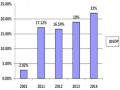 Current status of investment activities in bond trading of Vietnam Commercial Bank
 -
 Current status of credit risk at Saigon Thuong Tin Commercial Joint Stock Bank, Lam Dong branch - 1
 -
 Current Status of Credit Risk Management for Individual Customers at Vietnam Technological and Commercial Joint Stock Bank - Thai Nguyen Branch
 -
 Current Status of Lending Scale of Vietnam Technological and Commercial Joint Stock Bank
The related parties of that shareholder shall not own more than 20% of the charter capital of a credit institution (Article 55).
Regarding foreign investors purchasing shares of Vietnamese credit institutions, the law stipulates the conditions and procedures for purchasing shares, the maximum total shareholding level of foreign investors, the maximum shareholding ratio of a foreign investor in a Vietnamese credit institution; conditions for Vietnamese credit institutions to sell shares to foreign investors (Decree No. 01/2014/ND-CP dated January 3, 2014, stipulating foreign investors purchasing shares of Vietnamese credit institutions). According to current regulations, the shareholding ratio of a foreign individual must not exceed 5% of the charter capital of a Vietnamese credit institution; the shareholding ratio of a foreign organization must not exceed 15% of the charter capital of a credit institution in Vietnam, except in cases where the shareholding ratio of a foreign strategic investor must not exceed 20% of the charter capital of a Vietnamese credit institution; The shareholding ratio of a foreign investor and a related person of that foreign investor must not exceed 20% of the charter capital of a Vietnamese credit institution. The total shareholding level of foreign investors must not exceed 30% of the charter capital of a Vietnamese commercial bank. In addition to the ownership ceiling of 30%, the Decree also stipulates that in special cases to restructure weak and struggling credit institutions and ensure the safety of the credit institution system, the Prime Minister shall decide on the shareholding ratio of a foreign organization, a foreign strategic investor, and the total shareholding level of foreign investors in a weak and restructured joint-stock credit institution that exceeds the prescribed limit. Recently, Decree No. 60/2015/ND-CP regulating the foreign ownership ratio in the Vietnamese stock market, which has just been issued by the Government (effective from September 2015), has removed the foreign ownership ceiling of 49% in most sectors, except for some key sectors such as banking, which will still maintain foreign ownership at the ceiling of 30%.

In addition, the law also specifically stipulates the form, price, authority to decide on the plan to sell shares to foreign investors, conditions for buying, selling, and transferring shares. Foreign organizations wishing to buy shares leading to ownership of 10% or more of the charter capital of a Vietnamese credit institution must meet all conditions such as being rated by reputable international credit rating organizations as stable or equivalent or higher; having sufficient financial resources to buy shares; not affecting the safety and stability of the Vietnamese credit institution system, not creating a monopoly or restriction.
competition; not violating the laws on currency, banking, securities and securities markets; having total assets of at least 10 billion USD for foreign investors being banks, financial companies, financial leasing companies or having a minimum charter capital of 1 billion USD for foreign investors being other organizations. For foreign organizations buying shares to become foreign strategic investors, in addition to the above regulations, some additional conditions are required such as having total assets of at least 20 billion USD; having international experience in the banking sector for 5 years or more; not owning 10% or more of charter capital at any other credit institution in Vietnam... For Vietnamese credit institutions selling shares to foreign investors, the condition is that there must be an equitization plan, a conversion plan approved by the competent authority if the credit institution is converting its legal form. Joint stock credit institutions must have a plan to increase charter capital and a plan to sell treasury stocks approved by the general meeting of shareholders... (Decree No. 01/2014/ND-CP dated January 3, 2014 of the Government).
With the provisions of current law, the regulations on standards and conditions on the ratio of equity ownership, on foreign investors purchasing shares of Vietnamese credit institutions when acquiring and merging commercial banks are quite strict and somewhat cautious when the economy must gradually adapt in the integration process. The act of purchasing shares is an economic concentration according to the Competition Law. In the case where foreign investors and foreign credit institutions purchase shares of Vietnamese banks at the correct ratio above but can completely exceed the threshold for prohibiting the purchase and sale according to the Competition Law, this has not been taken into account [13, 80]. In the process of restructuring the banking system, the use of the state budget is very limited due to many economic difficulties, while the regulations on the ownership ratio of foreign investors in domestic commercial banks are still limited. Therefore, it is extremely necessary to utilize capital from foreign investors to restructure banks. There must be separate adjustments to increase the share ownership ratio for foreign investors participating in the process of acquiring and merging commercial banks.
- Regulations on standards and conditions for resolving the legitimate rights and interests of depositors and employees when implementing acquisitions and mergers of commercial banks:
Regarding the protection of customers' rights, the Law on Credit Institutions of Vietnam stipulates that one of the responsibilities of credit institutions and foreign bank branches is to "Create convenience for customers to deposit and withdraw money, ensure full and timely payment of principal and
interest on deposits.” (Clause 2, Article 10). Circular 04/2010/TT-NHNN regulates mergers, consolidations, and acquisitions between credit institutions based on the principle of agreement, according to which the parties participating in the merger, consolidation, and acquisition agree to resolve the rights and obligations between the parties involved in accordance with the provisions of current law.
The Law on Deposit Insurance emphasizes that the purpose of deposit insurance is to protect the legitimate rights and interests of depositors, contribute to maintaining the stability of the credit institution system, and ensure the safe and healthy development of banking activities (Article 3). The Law stipulates that deposit insurance is a guarantee to repay deposits to insured depositors within the insurance payment limit when the organization participating in deposit insurance becomes unable to pay deposits to depositors or goes bankrupt (Clause 1, Article 4). Organizations participating in deposit insurance are credit institutions and foreign bank branches established and operating under the Law on Credit Institutions that are allowed to receive individual deposits (Clause 3, Article 4). Article 6 of the Law on Deposit Insurance stipulates participation in deposit insurance, accordingly, credit institutions and foreign bank branches that are allowed to receive individual deposits must participate in deposit insurance, except for Policy Banks that are not required to participate in deposit insurance. According to regulations, commercial banks are organizations that are required to participate in deposits and will have the right to request the deposit insurance organization to pay insurance money to the insured depositors at the deposit insurance participating organization when the obligation to pay insurance money arises (Article 12, Law on Deposit Insurance).
Pursuant to Article 24, Article 27 of the Law on Deposit Insurance, Article 21 of Decree No. 68/2013/ND-CP dated June 28, 2013 detailing and guiding the implementation of the Law on Deposit Insurance, the insurance payment limit is the maximum amount that the deposit insurance organization pays for all insured deposits of a person at an organization participating in deposit insurance when the obligation to pay insurance arises. The maximum insurance payment level is prescribed by the Government upon the proposal of the State Bank of Vietnam in each period. At present, the regulations on deposit insurance premiums and insurance deposit amounts paid in Decree No. 89/1999/ND-CP dated September 1, 1999 on deposit insurance and Decree No. 109/2005/ND-CP dated August 24, 2005 amending and supplementing a number of articles of Decree No. 89/1999/ND-CP continue to be effective until the Prime Minister issues regulations on deposit insurance premium frameworks and insurance payment limits as prescribed by the Law on Deposit Insurance.
The deposit insurance organization will pay insurance money for all insured deposits of each customer at a participating deposit insurance organization up to a maximum of VND 50 million (including principal and interest). If the insured deposit (including principal and interest) exceeds the insurance payment limit, it will be resolved during the process of handling the assets of the participating deposit insurance organization according to the provisions of law.
In the world, the maximum deposit insurance payment varies widely, from thousands of USD to hundreds of thousands of USD, or the entire deposit amount. In general, there is no set standard. High insurance payment levels create competition to attract investors' deposits (in the US, this level is 5 times GDP per capita, in Thailand it is 7 times). The current regulation of a maximum of 50 million VND for deposit insurance payment is no longer suitable for socio-economic conditions in Vietnam in terms of factors such as GDP per capita, high inflation, deposit growth rate... and does not fully protect the interests of depositors. During the discussion session in the group on the Law on Deposit Insurance on the morning of November 3, 2011, National Assembly Delegate Pham Huy Hung said that the regulation that no matter how much money is deposited, the maximum insurance amount is only 50 million VND is too low, " This amount only guarantees the depositor to buy rice and vegetables to relieve hunger when the deposit is lost, but it is not truly insurance, while in Germany the minimum insurance level is 200 thousand Euros" [71]. Therefore, this limit should be proposed to be raised to a higher level to best protect the interests of depositors and maintain public trust.
The Labor Code stipulates that when merging, consolidating, dividing, or separating an enterprise or cooperative, the successor employer must be responsible for continuing to employ the existing workforce and amending and supplementing the labor contract. In the event that the existing workforce is not fully employed, the successor employer must develop and implement a labor utilization plan as prescribed (Clause 1, Article 45). In the event that the ownership or right to use the assets of the enterprise is transferred, the previous employer must develop a labor utilization plan as prescribed in Article 46 of this Code (Clause 2, Article 45). In the event that the employer lays off an employee, the employer must pay unemployment benefits to the employee as prescribed in Article 49 of this Code (Clause 3, Article 45). Regulations on severance pay and unemployment benefits in some special cases are specified in Point b, Clause 4, Article 14,
Decree No. 05/2015/ND-CP dated January 12, 2015 of the Government details and guides the implementation of a number of contents of the Labor Code as follows: "In case after the merger, consolidation, or separation of an enterprise or cooperative, the employee terminates the labor contract, the employer is responsible for paying severance pay or unemployment benefits for the time the employee worked for the employer and the time the employee worked for the employer before the merger, consolidation, or separation of the enterprise or cooperative" .
- Regulations on standards and conditions for acquisition and merger plans and approval of acquisition and merger plans by competent management agencies when implementing acquisition and merger of commercial banks:
According to current regulations, when implementing the acquisition or merger of commercial banks, there must be a plan for the acquisition or merger with contents that must not be contrary to the acquisition or merger contract, including at least the contents specified in Article 12 and Article 20 of Circular 04/2010/TT-NHNN such as: (1) Name, address and website of the credit institution participating in the acquisition or merger; (2) Name, address and contact phone number of the board members, supervisory board members, and general director of the credit institution participating in the acquisition or merger; (3) Reason for the acquisition or merger; (4) Charter capital before the merger of the credit institution participating in the merger and charter capital of the receiving credit institution after the merger; (5) List of shareholders holding significant shares (for joint-stock credit institutions) or owners (for other credit institutions) of the receiving credit institution after the merger; (6) Summary of financial situation and operations of the credit institution participating in the acquisition or merger; (7) Rights and obligations of the credit institution participating in the acquisition or merger and related organizations and individuals; (8) Expected business plan for the next 3 years of the acquiring credit institution after the acquisition, the receiving credit institution after the merger; (9) Merger roadmap; (10) Expected personnel, network, operational content and other issues related to the organization and operation of the credit institution after the acquisition or merger; (11) Measures to convert and combine management information systems, internal inspection and control, internal audit, and data transmission systems to ensure smooth operations during and after the acquisition or merger; (12) Acquisition price, term, payment method; deadline for handing over the acquired credit institution; (13) Method and time for converting contributed capital/equity capital; Forms of conversion of capital contributions/equity capital and corresponding conversion rates; (14) Responsibilities of credit institutions participating in acquisitions and mergers for costs incurred during the acquisition and merger of credit institutions; (15)
Handling options in case one or several participating credit institutions unilaterally cancel the acquisition or merger agreement.
The acquisition and merger plan is an important basis for the internal competent authority and the banking management agency to consider and decide to approve the acquisition and merger of the parties. Commercial banks participating in acquisitions and mergers that are required to notify of economic concentration may only carry out acquisitions and mergers after the competition management agency responds in writing that the economic concentration is not prohibited (Article 24, Competition Law) . The Law on Credit Institutions stipulates in Article 153 on the reorganization of credit institutions, according to which credit institutions may be reorganized in the form of division, separation, consolidation, merger, or conversion of legal form after receiving written approval from the State Bank. The State Bank shall specify the conditions, dossiers, procedures, and procedures for approving the reorganization of credit institutions. Based on the above regulations, there are three main agencies with the authority to approve the content of the acquisition and merger plan when implementing the acquisition and merger of commercial banks, which are the general meeting of shareholders of the commercial banks implementing the acquisition and merger, the Competition Management Department and the State Bank.
- Regulations on standards and conditions for implementing acquisitions and mergers of commercial banks in cases of voluntary and mandatory implementation:
To ensure the freedom of business of entities, the Law on Enterprises stipulates the rights of enterprises, according to which enterprises are “free to conduct business in sectors and occupations that are not prohibited by law” (Clause 1, Article 7) and are “proactive in adjusting the scale and sectors and occupations of business” (Clause 2, Article 7). The Law on Credit Institutions stipulates that “Credit institutions and foreign bank branches have the right to autonomy in business activities and are responsible for their own business results. No organization or individual is allowed to illegally interfere in the business activities of credit institutions and foreign bank branches” (Article 7). However, banking business is not prohibited by law, but it is a conditional business type and the conditions for banking business are very strict.
Circular 04/2010/TT-NHNN stipulates the conditions for the acquisition and merger of credit institutions and is understood to be in the case of voluntary implementation. Accordingly, the conditions for credit institutions to be acquired are: (1) Not falling under the prohibited economic concentration cases under the provisions of the Competition Law; (2) Having an acquisition plan that includes at least the contents specified in Article 20 of this Circular. The acquisition plan must not contain contents contrary to the acquisition contract; (3) The acquiring credit institution must ensure after the acquisition
The minimum charter capital is equal to the legal capital and complies with the safety ratios for operations as prescribed by current laws (Article 17). The conditions for a merger are: (1) Not falling under the prohibited economic concentration category as prescribed by the Competition Law; (2) Having a merger plan that includes at least the contents specified in Article 12 of this Circular. The merger plan must not contain any content that is contrary to the merger contract; (3) The receiving credit institution must ensure that after the merger, the minimum charter capital is equal to the legal capital category as prescribed by current laws (Article 9).
The Law on Credit Institutions stipulates that the State Bank shall consider and place a credit institution under special control when the credit institution falls into one of the following cases: “a) There is a risk of insolvency; b) The debt is irrecoverable and at risk of leading to insolvency; c) When the accumulated loss of the credit institution is greater than 50% of the actual value of the charter capital and reserve funds recorded in the most recent audited financial statement;
d) Being classified as poor for two consecutive years according to the regulations of the State Bank; dd) Failing to maintain the minimum capital safety ratio prescribed in Point b, Clause 1, Article 130 of this Law for one consecutive year or the minimum capital safety ratio is lower than 4% for 06 consecutive months." (Clause 3, Article 146). At the same time, the Law stipulates that the State Bank has the right to request the owner to increase capital, develop and implement a restructuring plan or compulsorily merge, consolidate or acquire a credit institution under special control if the owner is unable or fails to increase capital. The State Bank of Vietnam has the right to directly or assign another credit institution to contribute capital or purchase shares of a credit institution under special control in case the credit institution under special control is unable to fulfill the requirements prescribed by the State Bank of Vietnam, or when the State Bank of Vietnam determines that the accumulated losses of the credit institution have exceeded the actual value of the charter capital and reserve funds of the credit institution under special control recorded in the most recent audited financial statements and the termination of the operation of the credit institution under special control may cause insecurity to the credit institution system (Clause 2 and 3, Article 149).
According to the provisions of the Law on Credit Institutions, the State Bank of Vietnam has issued Circular No. 07/2013/TT-NHNN regulating special control over credit institutions, effective from April 27, 2013. The Circular stipulates that in case the charter capital is not increased as required and within the time limit determined by the State Bank of Vietnam, the State Bank of Vietnam may request the owner of this credit institution to develop and submit a restructuring plan or compulsorily merge, consolidate, or acquire other credit institutions. The Circular clearly states that the State Bank of Vietnam has the right to directly implement or assign other credit institutions to participate in contributing capital or purchasing shares of the credit institution.