
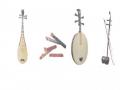
Prince Nam Sach was very good at playing the moon lute and composed the book Nguyet Cam Pho in 1859. Also during that time, Prince Mien Tham (poet Tung Thien Vuong) composed the book Nam Cam Pho. Prince Mien Buu (poet Tuong An district king) was famous for playing the pipa and wrote lyrics for many Hue songs.
In 1850, Prince Mien Trinh (poet Tuy Ly Vuong) composed a longer Ca Hue song called Nam Cam Khuc to send off his friend Nguyen Van Sieu to the North. This Nam Cam song was sung by a famous singer named Dau Nuong and accompanied by herself on the Nam Cam. After Dau Nuong passed away (around the end of the 19th century), the Nam Cam was also lost.

 (1848-
Maybe you are interested!
-
 Proposing Some Measures to Preserve and Develop Hue Singing Art
 -
 Improving the efficiency of exploiting Hue singing art in tourism - 15
 -
 Teaching Ly Hue singing to intermediate music students at Hue Academy of Music - 22
 -
 Teaching Ly Hue singing to intermediate music students at Hue Academy of Music - 26
 -
 Solution to Enhance Promotion and Provide Information to Tourists About Hue Singing Service on Huong River
1883).
During this period, we can clearly see that Ca Hue gradually became popular among the people. The musicians and artisans who were good at playing the instruments of Ca Hue  were
were  from the palaces of the kings to the powerful families. The kings of the Nguyen Dynasty also loved Ca Hue. The case of King Tu Duc leaving behind anecdotes about the use of talented folk artists as captains of orchestras such as Doi Chin, Doi Phuoc, descendants of Tong Van Dat is a specific case.
Hue was a favorable place for the gathering of a number of talented artists in singing and playing instruments during this period. Hue singing became an indispensable spiritual and cultural need in the capital.
1.1.2.3. Period of stagnation and recession (1886 - 1945)
That was the period  (1885) to before the August Revolution in 1945. The fall of the capital (1885) was a milestone marking the stagnation and decline of many art forms in Hue. Tuong and Ca Hue are two typical examples.
During this period, Ca Hue

. We already know that Ca Hue is a chamber music activity, the singers, the musicians and the audience are all soul mates. But in this period, that nature has changed. The Perfume River is an ideal place for gatherings of talented and talented people, but now on the same river, Ca Hue events have turned into debauchery for the rich.
Musicians and singers fell into a life of misery and despair. Some sold their talents, sometimes even their dignity, to entertain the rich and powerful, and were humiliated by the prejudice that “singers and singers are of no class”.
In that situation, a large number of upright and honest musicians wanted to preserve the precious heritage of their ancestors. They promoted their true character. We can name the musicians and singers of the late 19th and early 20th centuries who contributed to the protection of Hue music, including: "National guest Ung Dung, called Tro Dong, son of King Gia Hung, was good at the moon lute. Former district chief Doan Dieu, called Phu Thong, was good at rhythm and harmony. Inspector Tran Trinh Soan, often called Ca Soan, from Minh Huong village (Thua Thien), was good at the zither and the moon lute. Ninth-rank Nguyen Chanh Tam, called Cuu Tam, was good at the zither and the moon lute. Governor Nguyen Khoa Tan, originally from An Cuu (Thua Thien), was good at the zither. Ung An, a descendant of Tuy Ly Vuong, Khoa Hai, real name Ngo Pho, from Bac Vong village (Thua Thien), lived in An Cuu, knew many tunes and songs. Mr. Huyen Hau Ung Bieu, called Me Chin Thanh, was good at all kinds of stringed instruments, but was famous for playing the two-stringed fiddle and the monochord. Mr. Phan Dinh Uyen, called Mr. Am Ba, from Phu Luong (Thua Thien), was good at playing the monochord and was famous for playing the flute.
As for female musicians, we can mention: Ms. Pho, the widow of Tran Quang Pho, originally from An Cuu (Thua Thien) and Ms. Khoe, the daughter of Mr. Cung (from Kim Luong) and wife of Doc Soan, are female musicians who are good at playing the zither. We can also mention Ms. Phu Sau and Ms. Tra as good at Ca Hue. Regarding theoretical research,
There are works by Di Son Ung Du such as Van Thich Luc , Am Nhac Luoc ...; by Hoang Yen such as Music in Hue, Cam Hoc Tam Nguyen .
It was during the darkest period of the nation's history that those people - with their passion



During the period of lack of independence and autonomy, Ca Hue sometimes went astray, but thanks to the attention paid to preserving the nation's precious heritage, Ca Hue still has a chance to hope for recovery.
1.1.2.4. Rebirth and Renaissance Period (After 1954)
After the Dien Bien Phu victory (1954), Ca Hue had a chance to recover. Continuing the tradition of loving the nation, protecting the precious heritages of our ancestors, in the area where  Ca Hue was temporarily protected. This action was to fight against mixed and depraved influences, against plots, tricks, bribery, and degeneration to turn Ca Hue into a decadent pastime or a tool of psychological warfare. They established bands, music associations, and private conservatories to contribute to maintaining and protecting Ca Hue, such as musician Buu Loc establishing the Huong Binh band, musician Nguyen Huu Ba establishing the Ty Ba institute in Hue, and in Saigon, musicians Ton That Toan and Vien Dung established


 1971.
1971.
In the North, many artists who were previously actors and musicians in Ca Hue troupes, after peace was restored in 1954, gathered in the North. They sold their personal assets to recruit forces, establishing the Hue Opera Troupe to perform art at the Vinh Linh front line. One of the troupe's mottos is: To protect and promote the nation's traditional art, of which Ca Hue is a unique art form, a spiritual product of the people of Thua Thien - Hue province. Many Ca Hue artists matured during this period.

 In 1975, the troupe returned to its homeland and became the Binh Tri Thien Opera Troupe (after the province was divided in 1989), now the Hue Opera Troupe.
In 1993, the troupe decided to split up so that the actors could perform Ca Hue on the river, serving tourists because  it met the demand after Hue was recognized by the world as a cultural heritage of humanity in December 1993. Until now, Ca Hue is facing the opportunity for a strong revival. Ca Hue
 . The team of singers, musicians, and instrumentalists has been developed in many aspects, both in quantity and quality, the veteran artists harmonize with the younger generation. The number of Hue Ca fans has increased over time, including Hue people, domestic soul mates, and tourists from all over the world... All have been and are finding each other with the deep, lyrical Hue melodies. The Hue Ca genre has harmonized with the cultural and tourist life; has enriched the diverse, dreamy and poetic identity of Hue. The moonlit oars, the dreamy boat, thousands of twinkling stars at night; the hazy mist and the natural beauty converging with the peaceful Huong River are a wonderful resonance that elevates Hue Ca to a new level.
1.2. Artistic characteristics of Ca Hue
1.2.1. Characteristics of scales and modes in Ca Hue
In traditional Vietnamese music, our pitch system does not coincide with the equal-law system in Western classical music, meaning that the Vietnamese scale is not made up of a system of 12 semitones of an octave as in Western music. The difference in this pitch system is due to the distinct musical taste that carries the national identity of the residents of each region and each country. Another characteristic is that the pitch of each tone level in Vietnamese music is only relative, the standard tone level is only conventional in each mode, each musical breath, depending on the piece and each different region. The techniques in performance (emphasis, vibrato, stroking, pecking...) on each tone level of the scale have created a rich system of musical breaths in Vietnamese music[35].
Researcher Le Van Hao has analyzed quite deeply the issue of scales, tunes and breaths in Hue singing. Breaths, as he calls them, are the nuances of the tune: "Ca nhac
Hue has the Northern mode and four nuances (commonly called "tones"): Quang tone, Dao tone, and
Zen, musical breath, has the Southern mode and four nuances: spring breath, love breath, sorrow breath, resentment breath. Between the two Northern and Southern modes, there is an intermediate nuance: erect breath"[35]. But in general, researchers agree that Ca Hue has two main modes: the Northern mode and the Southern mode, in addition, there is also an amphitheater mode between these two modes. Regarding the musical breath in Ca Hue, it can be divided into main tones such as: Ai breath, Xuan breath, Oan breath, Dung breath, and Thien breath.
1.2.1.1. Northern Mode
With Hue music, we have a rather unique pentatonic scale system. First is the basic scale, which is the inheritance of the long-standing Dai Viet scale from history, which is the Bac tone (Hue people - people on the old Thuan Hoa land - also called the Khach tone), equivalent to the royal bell (the Thuong Gioc Chuy Vu tone) in Chinese music:
The Song of Songs (Do Re Fa Sol La Do)
We can easily find this scale in most of the royal court music and chamber music. The Northern tone is the mark of Chinese influence in Vietnamese music, however, the Vietnamese tone still has its own language with emphasis on the Xu and Cong tones with characteristic vibrato techniques and the Cong tones are also slightly played. The Northern tone is cheerful and solemn, the speed is usually leisurely or fast, rarely slow, often used in solemn ceremonies[35]. The Northern (guest) tones seem flexible and strong, suitable for the progressive and enthusiastic character of the Northern Vietnamese people, along with the scene of vast plantations and fierce rivers in the central region.
Typical melodies include:
- The original (old song) consists of 64 beats.
- Long diep (butterfly fluttering in the wind): consists of 16 beats, composed in the ancient melody, with an exciting, bustling character.
- Phu luc: has elegant music with 206 beats (slow phu luc), 27 beats (fast phu luc).
- Ten Chinese pieces (Pham Tuyet, Nguyen Tieu, Ho Quang, Lien Hoan, Binh Ban, Tay Mai, Kim Tien, Xuan Phong, Long Ho, Tau Ma). In the Northern melody system, the ten Chinese pieces are also called the 10 Royal pieces and are performed only during ceremonies, however, many Ca Hue artists have taken each section of the ten Chinese pieces to compose their own songs.
Different song titles enrich the Hue folk songs.
According to Professor Tran Van Khe, in Vietnamese music, all songs belonging to the Northern melody have the following basic elements: a pentatonic scale with the basic note being the ho (do) scale; any note in the pentatonic scale can be used as a starting note, ending note, or resting note; musicians playing the Northern melody all have ornate notes to add to the melody; instruments such as the zither or the moon lute are tuned according to the Northern string system; all Northern melody songs are cheerful in nature[35].
1.2.1.2. Nam Mode
The male palace songs such as Nam Ai, Nam Binh, and Nam Xuan have a sad and resentful tone, in line with the mentality of a devastated nation, the Champa people, along with the gentle landscape surrounding the capital.
The Nam mode is often melodies with sad tones, deep, lyrical music, including:
- Nam ai: The melody is divided into 5 layers, sad and mournful in nature.
- Nam Binh: Rhythm, even tone, sad, gentle.
- Widow: The song expresses the sadness and loneliness of a widow.
- Lovesickness: Evokes the deep longing of the soul in love
Love.
- Nam Xuan: Spring in the South, a lingering melody, a feeling of sympathy
pure way
This tune appeared when the Vietnamese people moved south to the new land. They brought with them their language, customs, habits and even music. However, in the process of living and cultural exchange with the indigenous people, the Vietnamese were influenced by the Cham people. Perhaps in the past, the Vietnamese people in the North
Originally used to using the correct pentatonic scale (do re fa sol la), when moving to the South, were they seduced by Cham music with its resentful pentatonic scale (do mi fa sol la) and created the ai pentatonic scale (do, re non, fa gia, sol, la non)?[35]. What is easily recognizable is the influence in the voice and language. For example, the sharp and tumbling tones of Hue people when pronouncing are lower, the asking tone is higher than in the outside regions, some people think that it is a lisping tone. It is this lisping sound that forms the Southern tone in Hue music.
In this scale, the two tones of Ho and Xe do not change compared to the Northern tone. The remaining tones have all changed to create the unique nuances of the Central tone, in which Ho and Xang use the vibrato technique.
1.2.1.3. Amphoteric mode
In addition to the two Northern and Southern modes above, in the Ca Hue repertoire, there are also some melodies with bisexual elements; they have both happy and sad musical notes, or in other words, the melodies in the Northern key that are played in the Southern key sound neither happy nor sad, which are called Hoi dung, Hoi xuan (wistful, lingering, expressing feelings). The musical quality therefore has its own characteristics, enriching the Ca Hue repertoire.
The song is played in a gentle and soft tone, with loud and soft sounds, slow and fast rhythms, giving us the feeling of listening to someone whispering and telling a story. Typical melodies include Co Ban Dung, Nam Binh Dung, Nam Xuan, Tu Dai Canh, Hanh Van...
1.2.1.4. Musical tones
Talking about the two melodies of Bac and Nam is to affirm the influence of China and Cham in Vietnamese music. However, in Hue music, with the two-step vibrato technique of Xu and Cong , Bac melodies have been Vietnamized, no longer Chinese. In addition, Hue people have created in a sophisticated and rich way the unique nuances in their music that Hue people call Hoi Nhac. That is the skillful application of musical language to express their emotional states, lyrical and diverse inner thoughts.
Hue music includes the following musical tones: ai tone, spring tone, and resentment tone.
slightly erect, slightly meditative.
- Ai tone is used to express sadness, sorrow, feelings of regret, loss, lamentation, slow tempo. Because of this characteristic, Ai tone is not used in royal court music but is often used in Hue chamber music, and is also sometimes used in worship music, in funerals. For example, the songs Nam Ai, Nam Binh, Tuong Tu Khuc ...
- Spring air can be found in Hue royal court music, Tuong music and is in the Northern melody system. Its scale is:
the song of the sandalwood bridge (do re fa sol la do)
However, the Hue spring breath has a special vibrato technique, the xang and liu tones are often vibrated up about a tone and then return to the main tone. The xu and cong tones are vibrated like the Bac tune. The xe tones use the moc technique (press and release very quickly). Sometimes the spring breath appears with the phan tone a little higher than the cong tone . The spring breath appears in the Thai bat dat song (accompaniment for the Bat dat dance in the royal court), the Nam xuan song (different from the Nam xuan song in Southern folk music with the scale of ho y xang xe phan liu ), often carrying a more dignified, majestic and cheerful character than the ai tone.
- The Oan tone expresses a deep sadness, with a resentful character. The origin of the Oan tone is the sound of the cong (la) in the song Chinh phu , which belongs to the Nam tone in Hue music. In this song, all the cong sounds must be read as oan , according to Hoang Yen in the article La musique à Hue , BAVH, July-August 1919 [36]. The Oan tone is mostly used in Southern amateur music, however, in Hue music, there is also this tone but the scale is different, such as in the songs Tu dai oan and Chinh phu.
- The pause is the transition from one pause to another, meaning that while performing this pause, there are passages in another pause, however, those passages are only temporary and then return to the main pause. The pause appears in the songs Hanh Van, Tu Dai Canh, Co Ban Dung, Qua Phu ...