
The process of regional and international economic integration, facing the globalization trend with a new civilization, is a matter of concern for leaders, educators as well as everyone in society.
1.4.2. Develop a plan to develop a team of high school management staff
This is the responsibility of government leaders at all levels and the Education and Training Sector. Personnel planning is a major policy of the Party, mentioned in the Central Resolutions of the 7th, 8th, and 9th terms on personnel work. Personnel planning aims to prepare a contingent of cadres in a proactive, planned manner, ensuring succession in quantity, quality, and structure. Overcoming the situation of arranging and using cadres in an unplanned, passive, unsynchronized, and ineffective manner. Personnel planning ensures that appointments are systematic, proactive, and visionary, meeting both immediate and long-term tasks. Therefore, in the planning process, it is necessary to grasp the Party's viewpoints on personnel work, grasp the goals, functions, and tasks of high schools to synchronously carry out measures to ensure that the planning work is close to reality, highly feasible, and practically effective. The work of planning cadres and managers must be reviewed, supplemented, and adjusted annually. It is necessary to proactively prepare personnel for appointment, arrangement, and use to ensure succession and development of the management team. Team planning must ensure the following requirements:
- Regarding quantity: Must come from political tasks, regulations of the Ministry of Education and Training and practical requirements of the locality. Pay attention to the requirement of streamlining, compactness but efficiency.
Maybe you are interested!
-
 Identify Rating Levels and Rating Scales
zt2i3t4l5ee
zt2a3gstourism,quan lan,quang ninh,ecology,ecotourism,minh chau,van don,geography,geographical basis,tourism development,science
zt2a3ge
zc2o3n4t5e6n7ts
of the islanders. Therefore, this indicator will be divided into two sub-indicators:
a1. Natural tourism attractiveness a2. Cultural tourism attractiveness
b. Tourist capacity
The two island communes in Quan Lan have different capacities to receive tourists. Minh Chau Commune is home to many standard hotels and resorts, attracting high-income domestic and international tourists. Meanwhile, Quan Lan Commune has many motels mainly built and operated by local people, so the scale and quality are not high, and will be suitable for ordinary tourists such as students.
c. Time of exploitation of Quan Lan Island Commune:
Quan Lan tourism is seasonal due to weather and climate conditions and festivals only take place on certain days of the year, specifically in spring. In Quan Lan commune, the period from April to June and from September to November is considered the best time to visit Quan Lan because the cultural tourism activities are mainly associated with festivals taking place during this time.
Minh Chau island commune:
Tourism exploitation time is all year round, because this is a place with a number of tourist attractions with diverse ecosystems such as Bai Tu Long National Park Research Center, Tram forest, Turtle Laying Beach, so besides coming to the beach for tourism and vacation in the summer, Minh Chau will attract research groups to come for tourism combined with research at other times of the year.
d. Sustainability
The sustainability of ecotourism sites in Quan Lan and Minh Chau communes depends on the sensitivity of the ecosystems to climate changes.
landscape. In general, these tourist destinations have a fairly high level of sustainability, because they are natural ecosystems, planned and protected. However, if a large number of tourists gather at certain times, it can exceed the carrying capacity and affect the sustainability of the environment (polluted beaches, damaged trees, animals moving away from their habitats, etc.), then the sustainability of the above ecosystems (natural ecosystems, human ecosystems) will also be affected and become less sustainable.
e. Location and accessibility
Both island communes have ports to take tourists to visit from Van Don wharf:
- Quan Lan – Van Don traffic route:
Phuc Thinh – Viet Anh high-speed boat and Quang Minh high-speed boat, depart at 8am and 2pm from Van Don to Quan Lan, and at 7am and 1pm from Quan Lan to Van Don. There are also wooden boats departing at 7am and 1pm.
- Van Don - Minh Chau traffic route:
Chung Huong high-speed train, Minh Chau train, morning 7:30 and afternoon 13:30 from Van Don to Minh Chau, morning 6:30 and afternoon 13:00 from Minh Chau to Van Don.
f. Infrastructure
Despite receiving investment attention, the issue of infrastructure and technical facilities for tourism on Quan Lan Island is still an issue that needs to be resolved because it has a direct impact on the implementation of ecotourism activities. The minimum conditions for serving tourists such as accommodation, electricity, water, communication, especially medical services, and security work need to be given top priority. Ecotourism spots in Minh Chau commune are assessed to have better infrastructure and technical facilities for tourism because there are quite complete and synchronous conditions for serving tourists, meeting many needs of domestic and foreign tourists.
3.2.1.4. Determine assessment levels and assessment scales
Corresponding to the levels of each criterion, the index is the score of those levels in the order of 4, 3, 2, 1 decreasing according to the standard of each level: very attractive (4), attractive (3), average (2), less attractive (1).
3.2.1.5. Determining the coefficients of the criteria
For the assessment of DLST in the two communes of Quan Lan and Minh Chau islands, the students added evaluation coefficients to show the importance of the criteria and indicators as follows:
Coefficient 3 with criteria: Attractiveness, Exploitation time. These are the 2 most important criteria for attracting tourists to tourism in general and eco-tourism in particular, so they have the highest coefficient.
Coefficient 2 with criteria: Capacity, Infrastructure, Location and accessibility . Because the assessment area is an island commune of Van Don district, the above criteria are selected by the author with appropriate coefficients at the average level.
Coefficient 1 with criteria: Sustainability. Quan Lan has natural and human-made ecotourism sites, with high biodiversity and little impact from local human factors. Most of the ecotourism sites are still wild, so they are highly sustainable.
3.2.1.6. Results of DLST assessment on Quan Lan island
a. Assessment of the potential for natural tourism development
For Minh Chau commune:
+ Natural tourism attractiveness is determined to be very attractive (4 points) and the most important coefficient (coefficient 3), so the score of the Attractiveness criterion is 4 x 3 = 12.
+ Capacity is determined as average (2 points) and the coefficient is quite important (coefficient 2), then the score of Capacity criterion is 2 x 2 = 4.
+ Exploitation time is long (4 points), the most important coefficient (coefficient 3) so the score of the Exploitation time criterion is 4 x 3 = 12.
+ Sustainability is determined as sustainable (4 points), the important coefficient is the average coefficient (coefficient 1), so the score of the Sustainability criterion is 4 x 1 = 4 points
+ Location and accessibility are determined to be quite favorable (2 points), the coefficient is quite important (coefficient 2), the criterion score is 2 x 2 = 4 points.
+ Infrastructure is assessed as good (3 points), the coefficient is quite important (coefficient 2), then the score of the Infrastructure criterion is 3 x 2 = 6 points.
The total score for evaluating DLST in Minh Chau commune according to 6 evaluation criteria is determined as: 12 + 4 + 12 + 4 + 4 + 6 = 42 points
Similar assessment for Quan Lan commune, we have the following table:
Table 3.3: Assessment of the potential for natural ecotourism development in Quan Lan and Minh Chau communes
Attractiveness of self-tourismof course
Capacity
Mining time
Sustainability
Location and accessibility
Infrastructure
Result
Point
DarkMulti
Point
DarkMulti
Point
DarkMulti
Point
DarkMulti
Point
DarkMulti
Point
DarkMulti
CommuneMinh Chau
12
12
4
8
12
12
4
4
4
8
6
8
42/52
Quan CommuneLan
6
12
6
8
9
12
4
4
4
8
4
8
33/52
b. Assessment of the potential for humanistic tourism development
For Quan Lan commune:
+ The attractiveness of human tourism is determined to be very attractive (4 points) and the most important coefficient (coefficient 3), so the score of the Attractiveness criterion is 4 x 3 = 12.
+ Capacity is determined to be large (3 points) and the coefficient is quite important (coefficient 2), then the score of the Capacity criterion is 3 x 2 = 6.
+ Mining time is average (3 points), the most important coefficient (coefficient 3) so the score of the Mining time criterion is 3 x 3 = 9.
+ Sustainability is determined as sustainable (4 points), the important coefficient is the average coefficient (coefficient 1), so the score of the Sustainability criterion is 4 x 1 = 4 points.
+ Location and accessibility are determined to be quite favorable (2 points), the coefficient is quite important (coefficient 2), the criterion score is 2 x 2 = 4 points.
+ Infrastructure is rated as average (2 points), the coefficient is quite important (coefficient 2), then the score of the Infrastructure criterion is 2 x 2 = 4 points.
The total score for evaluating DLST in Quan Lan commune according to 6 evaluation criteria is determined as: 12 + 6 + 6 + 4 + 4 + 4 = 36 points.
Similar assessment with Minh Chau commune we have the following table:
Table 3.4: Assessment of the potential for developing humanistic eco-tourism in Quan Lan and Minh Chau communes
Attractiveness of human tourismliterature
Capacity
Mining time
Sustainability
Location and accessibility
Infrastructure
Result
Point
DarkMulti
Point
DarkMulti
Point
DarkMulti
Point
DarkMulti
Point
DarkMulti
Point
DarkMulti
Quan CommuneLan
12
12
6
8
9
12
4
4
4
8
4
8
39/52
Minh CommuneChau
6
12
4
8
12
12
4
4
4
8
6
8
36/52
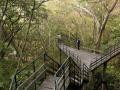
Basically, both Minh Chau and Quan Lan localities have quite favorable conditions for developing ecotourism. However, Quan Lan commune has more advantages to develop ecotourism in a humanistic direction, because this is an area with many famous historical relics such as Quan Lan Communal House, Quan Lan Pagoda, Temple worshiping the hero Tran Khanh Du, ... along with local festivals held annually such as the wind praying ceremony (March 15), Quan Lan festival (June 10-19); due to its location near the port and long exploitation time, the beaches in Quan Lan commune (especially Quan Lan beach) are no longer hygienic and clean to ensure the needs of tourists coming to relax and swim; this is also an area with many beautiful landscapes such as Got Beo wind pass, Ong Phong head, Voi Voi cave, but the ability to access these places is still very limited (dirt hill road, lots of gravel and rocks), especially during rainy and windy times; In addition, other natural resources such as mangrove forests and sea worms have not been really exploited for tourism purposes and ecotourism development. On the contrary, Minh Chau commune has more advantages in developing ecotourism in the direction of natural tourism, this is an area with diverse ecosystems such as at Rua De Beach, Bai Tu Long National Park Conservation Center...; Minh Chau beach is highly appreciated for its natural beauty and cleanliness, ranked in the top ten most beautiful beaches in Vietnam; Minh Chau commune is also home to Tram forest with a large area and a purity of up to 90%, suitable for building bridges through the forest (a very effective type of natural ecotourism currently applied by many countries) for tourists to sightsee, as well as for the purpose of studying and researching.
Figure 3.1: Thenmala Forest Bridge (India) Source: https://www.thenmalaecotourism.com/(August 21, 2019)
3.2.2. Using SWOT matrix to evaluate Quan Lan island tourism
General assessment of current tourism activities of Quan Lan island is shown through the following SWOT matrix:
Table 3.5: SWOT matrix evaluating tourism activities on Quan Lan island
Internal agent
Strengths- There is a lot of potential for tourism development, especially natural ecotourism and humanistic ecotourism.- The unskilled labor force is relatively abundant.- resource environmentunpolluted, still
Weaknesses- Poorly developed infrastructure, especially traffic routes to tourist destinations on the island.- The team of professional staff is still weak.- Tourism products in general
quite wild, originalintact
general and DLST in particularalone is monotonous.
External agents
Opportunity- Tourism is a key industry in the socio-economic development strategy of the province and Van Don economic zone.- Quan Lan was selected as a pilot area for eco-tourism development within the framework of the green growth project between Quang Ninh province and the Japanese organization JICA.- The flow of tourists and especially ecotourism in the world tends toincreasing
Challenge- Weather and climate change abnormally.- Competition in tourism products is increasingly fierce, especially with other localities in the province such as Ha Long, Mong Cai...- Awareness of tourists, especially domestic tourists, about ecotourism and nature conservation is not high.
Through summary analysis using SWOT matrix we see that:
To exploit strengths and take advantage of opportunities, it is necessary to:
- Diversify products and service types (build more tourism routes aimed at specific needs of tourists: experiential tourism immersed in nature, spiritual cultural tourism...)
- Effective exploitation of resources and differentiated products (natural resources and human resources)
div.maincontent .p { color: black; font-family:"Times New Roman", serif; font-style: normal; font-weight: normal; text-decoration: none; font-size: 14pt; margin:0pt; } div.maincontent p { color: black; font-family:"Times New Roman", serif; font-style: normal; font-weight: normal; text-decoration: none; font-size: 14pt; margin:0pt; } div.maincontent .s1 { color: black; font-family:"Times New Roman", serif; font-style: normal; font-weight: normal; text-decoration: none; font-size: 13pt; } div.maincontent .s2 { color: black; font-family:"Times New Roman", serif; font-style: normal; font-weight: normal; text-decoration: none; font-size: 13pt; } div.maincontent .s3 { color: #0D0D0D; font-family:"Times New Roman", serif; font-style: normal; font-weight: bold; text-decoration: none; font-size: 14pt; } div.maincontent .s4 { color: black; font-family:"Times New Roman", serif; font-style: italic; font-weight: normal; text-decoration: none; font-size: 14pt; } div.maincontent .s5 { color: black; font-family:"Times New Roman", serif; font-style: italic; font-weight: bold; text-decoration: none; font-size: 14pt; } div.maincontent .s6 { color: black; font-family:"Times New Roman", serif; font-style: italic; font-weight: normal; text-decoration: none; font-size: 14pt; vertical-align: -3pt; } div.maincontent .s7 { color: black; font-family:"Times New Roman", serif; font-style: italic; font-weight: normal; text-decoration: none; font-size: 14pt; vertical-align: -2pt; } div.maincontent .s8 { color: black; font-family:"Times New Roman", serif; font-style: italic; font-weight: normal; text-decoration: none; font-size: 14pt; vertical-align: -1pt; } div.maincontent .s9 { color: black; font-family:"Times New Roman", serif; font-style: normal; font-weight: normal; text-decoration: none; font-size: 14pt; } div.maincontent .s10 { color: black; font-family:"Times New Roman", serif; font-style: normal; font-weight: bold; text-decoration: none; font-size: 14pt; } div.maincontent .s11 { color: black; font-family:"Times New Roman", serif; font-style: normal; font-weight: normal; text-decoration: none; font-size: 14pt; } div.maincontent .s12 { color: black; font-family:Symbol, serif; font-style: normal; font-weight: normal; text-decoration: none; font-size: 14pt; } div.maincontent .s13 { color: black; font-family:Wingdings; font-style: normal; font-weight: normal; text-decoration: none; font-size: 14pt; } div.maincontent .s14 { color: black; font-family:"Times New Roman", serif; font-style: normal; font-weight: normal; text-decoration: none; font-size: 9pt; vertical-align: 5pt; } div.maincontent .s15 { color: black; font-family:"Times New Roman", serif; font-style: normal; font-weight: normal; text-decoration: none; font-size: 9pt; vertical-align: 5pt; } div.maincontent .s16 { color: black; font-family:Cambria, serif; font-style: italic; font-weight: normal; text-decoration: none; font-size: 14pt; } div.maincontent .s17 { color: #080808; font-family:"Times New Roman", serif; font-style: normal; font-weight: bold; text-decoration: none; font-size: 14pt; } div.maincontent .s18 { color: #080808; font-family:"Times New Roman", serif; font-style: normal; font-weight: normal; text-decoration: none; font-size: 14pt; } div.maincontent .s19 { color: black; font-family:"Times New Roman", serif; font-style: normal; font-weight: normal; text-decoration: none; font-size: 11pt; } div.maincontent .s20 { color: black; font-family:"Times New Roman", serif; font-style: normal; font-weight: normal; text-decoration: none; font-size: 10pt; } div.maincontent .s21 { color: black; font-family:"Times New Roman", serif; font-style: normal; font-weight: bold; text-decoration: none; font-size: 11pt; } div.maincontent .s22 { color: black; font-family:"Times New Roman", serif; font-style: normal; font-weight: normal; text-decoration: none; font-size: 11pt; } div.maincontent .s23 { color: black; font-family:"Times New Roman", serif; font-style: italic; font-weight: normal; text-decoration: none; font-size: 14pt; } div.maincontent .s24 { color: #212121; font-family:"Times New Roman", serif; font-style: normal; font-weight: normal; tex
Identify Rating Levels and Rating Scales
zt2i3t4l5ee
zt2a3gstourism,quan lan,quang ninh,ecology,ecotourism,minh chau,van don,geography,geographical basis,tourism development,science
zt2a3ge
zc2o3n4t5e6n7ts
of the islanders. Therefore, this indicator will be divided into two sub-indicators:
a1. Natural tourism attractiveness a2. Cultural tourism attractiveness
b. Tourist capacity
The two island communes in Quan Lan have different capacities to receive tourists. Minh Chau Commune is home to many standard hotels and resorts, attracting high-income domestic and international tourists. Meanwhile, Quan Lan Commune has many motels mainly built and operated by local people, so the scale and quality are not high, and will be suitable for ordinary tourists such as students.
c. Time of exploitation of Quan Lan Island Commune:
Quan Lan tourism is seasonal due to weather and climate conditions and festivals only take place on certain days of the year, specifically in spring. In Quan Lan commune, the period from April to June and from September to November is considered the best time to visit Quan Lan because the cultural tourism activities are mainly associated with festivals taking place during this time.
Minh Chau island commune:
Tourism exploitation time is all year round, because this is a place with a number of tourist attractions with diverse ecosystems such as Bai Tu Long National Park Research Center, Tram forest, Turtle Laying Beach, so besides coming to the beach for tourism and vacation in the summer, Minh Chau will attract research groups to come for tourism combined with research at other times of the year.
d. Sustainability
The sustainability of ecotourism sites in Quan Lan and Minh Chau communes depends on the sensitivity of the ecosystems to climate changes.
landscape. In general, these tourist destinations have a fairly high level of sustainability, because they are natural ecosystems, planned and protected. However, if a large number of tourists gather at certain times, it can exceed the carrying capacity and affect the sustainability of the environment (polluted beaches, damaged trees, animals moving away from their habitats, etc.), then the sustainability of the above ecosystems (natural ecosystems, human ecosystems) will also be affected and become less sustainable.
e. Location and accessibility
Both island communes have ports to take tourists to visit from Van Don wharf:
- Quan Lan – Van Don traffic route:
Phuc Thinh – Viet Anh high-speed boat and Quang Minh high-speed boat, depart at 8am and 2pm from Van Don to Quan Lan, and at 7am and 1pm from Quan Lan to Van Don. There are also wooden boats departing at 7am and 1pm.
- Van Don - Minh Chau traffic route:
Chung Huong high-speed train, Minh Chau train, morning 7:30 and afternoon 13:30 from Van Don to Minh Chau, morning 6:30 and afternoon 13:00 from Minh Chau to Van Don.
f. Infrastructure
Despite receiving investment attention, the issue of infrastructure and technical facilities for tourism on Quan Lan Island is still an issue that needs to be resolved because it has a direct impact on the implementation of ecotourism activities. The minimum conditions for serving tourists such as accommodation, electricity, water, communication, especially medical services, and security work need to be given top priority. Ecotourism spots in Minh Chau commune are assessed to have better infrastructure and technical facilities for tourism because there are quite complete and synchronous conditions for serving tourists, meeting many needs of domestic and foreign tourists.
3.2.1.4. Determine assessment levels and assessment scales
Corresponding to the levels of each criterion, the index is the score of those levels in the order of 4, 3, 2, 1 decreasing according to the standard of each level: very attractive (4), attractive (3), average (2), less attractive (1).
3.2.1.5. Determining the coefficients of the criteria
For the assessment of DLST in the two communes of Quan Lan and Minh Chau islands, the students added evaluation coefficients to show the importance of the criteria and indicators as follows:
Coefficient 3 with criteria: Attractiveness, Exploitation time. These are the 2 most important criteria for attracting tourists to tourism in general and eco-tourism in particular, so they have the highest coefficient.
Coefficient 2 with criteria: Capacity, Infrastructure, Location and accessibility . Because the assessment area is an island commune of Van Don district, the above criteria are selected by the author with appropriate coefficients at the average level.
Coefficient 1 with criteria: Sustainability. Quan Lan has natural and human-made ecotourism sites, with high biodiversity and little impact from local human factors. Most of the ecotourism sites are still wild, so they are highly sustainable.
3.2.1.6. Results of DLST assessment on Quan Lan island
a. Assessment of the potential for natural tourism development
For Minh Chau commune:
+ Natural tourism attractiveness is determined to be very attractive (4 points) and the most important coefficient (coefficient 3), so the score of the Attractiveness criterion is 4 x 3 = 12.
+ Capacity is determined as average (2 points) and the coefficient is quite important (coefficient 2), then the score of Capacity criterion is 2 x 2 = 4.
+ Exploitation time is long (4 points), the most important coefficient (coefficient 3) so the score of the Exploitation time criterion is 4 x 3 = 12.
+ Sustainability is determined as sustainable (4 points), the important coefficient is the average coefficient (coefficient 1), so the score of the Sustainability criterion is 4 x 1 = 4 points
+ Location and accessibility are determined to be quite favorable (2 points), the coefficient is quite important (coefficient 2), the criterion score is 2 x 2 = 4 points.
+ Infrastructure is assessed as good (3 points), the coefficient is quite important (coefficient 2), then the score of the Infrastructure criterion is 3 x 2 = 6 points.
The total score for evaluating DLST in Minh Chau commune according to 6 evaluation criteria is determined as: 12 + 4 + 12 + 4 + 4 + 6 = 42 points
Similar assessment for Quan Lan commune, we have the following table:
Table 3.3: Assessment of the potential for natural ecotourism development in Quan Lan and Minh Chau communes
Attractiveness of self-tourismof course
Capacity
Mining time
Sustainability
Location and accessibility
Infrastructure
Result
Point
DarkMulti
Point
DarkMulti
Point
DarkMulti
Point
DarkMulti
Point
DarkMulti
Point
DarkMulti
CommuneMinh Chau
12
12
4
8
12
12
4
4
4
8
6
8
42/52
Quan CommuneLan
6
12
6
8
9
12
4
4
4
8
4
8
33/52
b. Assessment of the potential for humanistic tourism development
For Quan Lan commune:
+ The attractiveness of human tourism is determined to be very attractive (4 points) and the most important coefficient (coefficient 3), so the score of the Attractiveness criterion is 4 x 3 = 12.
+ Capacity is determined to be large (3 points) and the coefficient is quite important (coefficient 2), then the score of the Capacity criterion is 3 x 2 = 6.
+ Mining time is average (3 points), the most important coefficient (coefficient 3) so the score of the Mining time criterion is 3 x 3 = 9.
+ Sustainability is determined as sustainable (4 points), the important coefficient is the average coefficient (coefficient 1), so the score of the Sustainability criterion is 4 x 1 = 4 points.
+ Location and accessibility are determined to be quite favorable (2 points), the coefficient is quite important (coefficient 2), the criterion score is 2 x 2 = 4 points.
+ Infrastructure is rated as average (2 points), the coefficient is quite important (coefficient 2), then the score of the Infrastructure criterion is 2 x 2 = 4 points.
The total score for evaluating DLST in Quan Lan commune according to 6 evaluation criteria is determined as: 12 + 6 + 6 + 4 + 4 + 4 = 36 points.
Similar assessment with Minh Chau commune we have the following table:
Table 3.4: Assessment of the potential for developing humanistic eco-tourism in Quan Lan and Minh Chau communes
Attractiveness of human tourismliterature
Capacity
Mining time
Sustainability
Location and accessibility
Infrastructure
Result
Point
DarkMulti
Point
DarkMulti
Point
DarkMulti
Point
DarkMulti
Point
DarkMulti
Point
DarkMulti
Quan CommuneLan
12
12
6
8
9
12
4
4
4
8
4
8
39/52
Minh CommuneChau
6
12
4
8
12
12
4
4
4
8
6
8
36/52
Basically, both Minh Chau and Quan Lan localities have quite favorable conditions for developing ecotourism. However, Quan Lan commune has more advantages to develop ecotourism in a humanistic direction, because this is an area with many famous historical relics such as Quan Lan Communal House, Quan Lan Pagoda, Temple worshiping the hero Tran Khanh Du, ... along with local festivals held annually such as the wind praying ceremony (March 15), Quan Lan festival (June 10-19); due to its location near the port and long exploitation time, the beaches in Quan Lan commune (especially Quan Lan beach) are no longer hygienic and clean to ensure the needs of tourists coming to relax and swim; this is also an area with many beautiful landscapes such as Got Beo wind pass, Ong Phong head, Voi Voi cave, but the ability to access these places is still very limited (dirt hill road, lots of gravel and rocks), especially during rainy and windy times; In addition, other natural resources such as mangrove forests and sea worms have not been really exploited for tourism purposes and ecotourism development. On the contrary, Minh Chau commune has more advantages in developing ecotourism in the direction of natural tourism, this is an area with diverse ecosystems such as at Rua De Beach, Bai Tu Long National Park Conservation Center...; Minh Chau beach is highly appreciated for its natural beauty and cleanliness, ranked in the top ten most beautiful beaches in Vietnam; Minh Chau commune is also home to Tram forest with a large area and a purity of up to 90%, suitable for building bridges through the forest (a very effective type of natural ecotourism currently applied by many countries) for tourists to sightsee, as well as for the purpose of studying and researching.
Figure 3.1: Thenmala Forest Bridge (India) Source: https://www.thenmalaecotourism.com/(August 21, 2019)
3.2.2. Using SWOT matrix to evaluate Quan Lan island tourism
General assessment of current tourism activities of Quan Lan island is shown through the following SWOT matrix:
Table 3.5: SWOT matrix evaluating tourism activities on Quan Lan island
Internal agent
Strengths- There is a lot of potential for tourism development, especially natural ecotourism and humanistic ecotourism.- The unskilled labor force is relatively abundant.- resource environmentunpolluted, still
Weaknesses- Poorly developed infrastructure, especially traffic routes to tourist destinations on the island.- The team of professional staff is still weak.- Tourism products in general
quite wild, originalintact
general and DLST in particularalone is monotonous.
External agents
Opportunity- Tourism is a key industry in the socio-economic development strategy of the province and Van Don economic zone.- Quan Lan was selected as a pilot area for eco-tourism development within the framework of the green growth project between Quang Ninh province and the Japanese organization JICA.- The flow of tourists and especially ecotourism in the world tends toincreasing
Challenge- Weather and climate change abnormally.- Competition in tourism products is increasingly fierce, especially with other localities in the province such as Ha Long, Mong Cai...- Awareness of tourists, especially domestic tourists, about ecotourism and nature conservation is not high.
Through summary analysis using SWOT matrix we see that:
To exploit strengths and take advantage of opportunities, it is necessary to:
- Diversify products and service types (build more tourism routes aimed at specific needs of tourists: experiential tourism immersed in nature, spiritual cultural tourism...)
- Effective exploitation of resources and differentiated products (natural resources and human resources)
div.maincontent .p { color: black; font-family:"Times New Roman", serif; font-style: normal; font-weight: normal; text-decoration: none; font-size: 14pt; margin:0pt; } div.maincontent p { color: black; font-family:"Times New Roman", serif; font-style: normal; font-weight: normal; text-decoration: none; font-size: 14pt; margin:0pt; } div.maincontent .s1 { color: black; font-family:"Times New Roman", serif; font-style: normal; font-weight: normal; text-decoration: none; font-size: 13pt; } div.maincontent .s2 { color: black; font-family:"Times New Roman", serif; font-style: normal; font-weight: normal; text-decoration: none; font-size: 13pt; } div.maincontent .s3 { color: #0D0D0D; font-family:"Times New Roman", serif; font-style: normal; font-weight: bold; text-decoration: none; font-size: 14pt; } div.maincontent .s4 { color: black; font-family:"Times New Roman", serif; font-style: italic; font-weight: normal; text-decoration: none; font-size: 14pt; } div.maincontent .s5 { color: black; font-family:"Times New Roman", serif; font-style: italic; font-weight: bold; text-decoration: none; font-size: 14pt; } div.maincontent .s6 { color: black; font-family:"Times New Roman", serif; font-style: italic; font-weight: normal; text-decoration: none; font-size: 14pt; vertical-align: -3pt; } div.maincontent .s7 { color: black; font-family:"Times New Roman", serif; font-style: italic; font-weight: normal; text-decoration: none; font-size: 14pt; vertical-align: -2pt; } div.maincontent .s8 { color: black; font-family:"Times New Roman", serif; font-style: italic; font-weight: normal; text-decoration: none; font-size: 14pt; vertical-align: -1pt; } div.maincontent .s9 { color: black; font-family:"Times New Roman", serif; font-style: normal; font-weight: normal; text-decoration: none; font-size: 14pt; } div.maincontent .s10 { color: black; font-family:"Times New Roman", serif; font-style: normal; font-weight: bold; text-decoration: none; font-size: 14pt; } div.maincontent .s11 { color: black; font-family:"Times New Roman", serif; font-style: normal; font-weight: normal; text-decoration: none; font-size: 14pt; } div.maincontent .s12 { color: black; font-family:Symbol, serif; font-style: normal; font-weight: normal; text-decoration: none; font-size: 14pt; } div.maincontent .s13 { color: black; font-family:Wingdings; font-style: normal; font-weight: normal; text-decoration: none; font-size: 14pt; } div.maincontent .s14 { color: black; font-family:"Times New Roman", serif; font-style: normal; font-weight: normal; text-decoration: none; font-size: 9pt; vertical-align: 5pt; } div.maincontent .s15 { color: black; font-family:"Times New Roman", serif; font-style: normal; font-weight: normal; text-decoration: none; font-size: 9pt; vertical-align: 5pt; } div.maincontent .s16 { color: black; font-family:Cambria, serif; font-style: italic; font-weight: normal; text-decoration: none; font-size: 14pt; } div.maincontent .s17 { color: #080808; font-family:"Times New Roman", serif; font-style: normal; font-weight: bold; text-decoration: none; font-size: 14pt; } div.maincontent .s18 { color: #080808; font-family:"Times New Roman", serif; font-style: normal; font-weight: normal; text-decoration: none; font-size: 14pt; } div.maincontent .s19 { color: black; font-family:"Times New Roman", serif; font-style: normal; font-weight: normal; text-decoration: none; font-size: 11pt; } div.maincontent .s20 { color: black; font-family:"Times New Roman", serif; font-style: normal; font-weight: normal; text-decoration: none; font-size: 10pt; } div.maincontent .s21 { color: black; font-family:"Times New Roman", serif; font-style: normal; font-weight: bold; text-decoration: none; font-size: 11pt; } div.maincontent .s22 { color: black; font-family:"Times New Roman", serif; font-style: normal; font-weight: normal; text-decoration: none; font-size: 11pt; } div.maincontent .s23 { color: black; font-family:"Times New Roman", serif; font-style: italic; font-weight: normal; text-decoration: none; font-size: 14pt; } div.maincontent .s24 { color: #212121; font-family:"Times New Roman", serif; font-style: normal; font-weight: normal; tex -
 Building a Strength Development Training Plan for 15-16 Year Old Male Weightlifters of the National Youth Team
 -
 Building a Team of Intellectuals Always Originates From the Political Tasks of Each Stage and Is Associated with the Goal of National Development
 -
 Building a Tourism Brand Development Plan
 -
 Building a method for training high school teachers under contract between Ho Chi Minh City University of Education and some southern provinces - 11
- Regarding structure: Ensure that the management team is consistent in terms of capacity and qualifications, but also needs to have individuals who are outstanding in terms of expertise, professionalism, and ethical ideology as the core. There needs to be older, middle-aged, and younger people to ensure continuity and succession. There needs to be a reasonable ratio between men and women, and schools with ethnic minority students also need to have management staff who are ethnic minorities.
The management team must be relatively stable, with long-term employees and a certain rate of innovation. Standardize the team according to the regulations of the Ministry of Education and Training for each position and improve beyond the standard.

1.4.3. Selection, use, appointment, rotation, and dismissal of high school management staff to develop the team
- Selection: Is the process of screening and selecting qualified people for a job in an organization.
- Appointment: The head of a competent authority makes a decision to assign an officer, civil servant, or public employee to a leadership position for a limited period of time in an agency or unit.
Selecting and appointing managers with sufficient qualities and capacity is a prerequisite for completing the educational goals and developing the school. The current work of appointing managers tends to emphasize structure over standards. Therefore, it is necessary to have a correct understanding of the relationship between structure and standards; Ensuring structure, at the same time managers must have enough virtue, talent, qualities and capacity commensurate with the assigned position and responsibilities.
- Rotation: The head of a competent authority appoints a cadre, civil servant, or public employee to a new leadership position during the planning and training process. When rotating high school managers, it is necessary to base it on requirements, tasks, planning, and usage plans. Rotation also helps managers diversify their work so that when necessary, they can perform tasks in different positions or in different school units.
- Dismissal: The head of a competent authority decides to remove a cadre, civil servant or public employee from his or her leadership position before the end of his or her term of appointment. Dismissal is carried out in cases where the management staff is not healthy enough, not competent enough, or is dismissed based on job requirements or for other reasons. Dismissal is to ensure that the management staff is consistent in quality and to correct errors in management work. This is one of the measures to improve quality and develop the team.
1.4.4. Training and fostering of high school management staff
It is necessary to determine the development goals of local education and training in each stage of the country's development, from which to organize regular and continuous training and fostering to perfect, supplement and enhance the necessary qualities and skills.
set standards for managers so that they can effectively complete school management work within the scope of their functions and powers.
Staff development is a multi-stage process, depending on the method of combining or connecting the stages of selection, training, appointment and use. The methods of combining or connecting these stages are as follows:
- Selection - appointment - use: Is the method of selecting, then appointing and using immediately in the position of management staff (without going through the training and development stage).
- Selection - appointment - training and development: This method starts with selection and appointment, then training and development according to the position held in the school.
- Selection - training - appointment: This method begins with selecting capable and promising people, then training and promoting them to school leadership positions.
- Training, fostering - selection - appointment: This method is based on the foundation of training knowledge and management skills for each position. Selection and appointment are based on trained human resources that meet the standards for appointment to management positions.
To improve the quality of the team, the process of "Training, fostering - selection - appointment" is superior. However, in practice, managers are often selected and then appointed, without paying attention to the training and fostering stage. This is an issue that needs to be carefully considered, especially in the context of integration with world education, school management is considered a profession, not just any teacher with many years of work experience and teaching experience can become a manager.
1.4.5. Leading the development of high school management staff
High schools are units under the Department of Education and Training. Therefore, the leaders of the Department of Education and Training have the functions and tasks of managing and directly directing high schools in the province. The development of high school management staff demonstrates the strategic vision of the leaders of the Department of Education and Training. To effectively lead the development of high school management staff, the leaders of the Department of Education and Training need to
Implement well the planning work associated with training and fostering work; at the same time, implement well the selection, appointment, rotation, and dismissal of managers. Through this, we see that the above contents are activities for the leaders of the Department of Education and Training to lead the development of the team of high school managers. By implementing these activities well, the Industry will build for itself a team of high school managers that ensures both quantity and quality. That team will contribute to the comprehensive development of the industry. It can be said that developing the team of high school managers is also developing the Industry for high school level.
1.4.6. Checking and evaluating the development of high school management staff
Checking and evaluating managers is a process of collecting and analyzing information about their work results in the changes and development of education, of schools in diverse and complex political and social relationships, from many specific and individual phenomena and events compared with the set goals and standards. On that basis, make judgments and comments, find out the nature of the qualities, personality and capacity of managers and propose changes and adjustments to create high quality and efficiency. When evaluating, it is necessary to comprehensively consider the roles that managers must perform for schools and society because when performing their management roles, the personality and professional skills of managers will be demonstrated.
The evaluation of high school managers is carried out according to Circular No. 29/TT-BGDDT dated October 22, 2009 of the Ministry of Education and Training with the following contents:
- Standard 1: Political qualities and professional ethics (5 criteria).
- Standard 2: Professional competence and pedagogical skills (5 criteria).
- Standard 3: School management capacity (13 criteria).
Through the results of the assessment, resolutely discipline and dismiss managers who have committed violations and are not trusted by the school and community.
Inspection and evaluation is one of the functions of management. Correctly evaluating the quality of the management team to understand the current situation and quality of all aspects of the management team, at the same time helping each individual manager to self-adjust to adapt to their management activities. Inspection and evaluation of the team
The team creates conditions for management work at all levels and management entities to grasp the reality of the management team and individual managers, thereby helping the work of organizing staff to achieve the desired results.
Thus, to improve the quality of staff in general and managers in particular, it is impossible not to accurately identify the quality of the staff through inspection and evaluation activities; from there, there will be feasible management solutions in this field.
1.5. Factors affecting the development of high school management staff
The management of high school management staff is influenced by many factors. In fact, we cannot calculate all the influencing factors, we only consider some factors that have a great influence on the management process.
1.5.1. Subjective factors
* Qualities and capacities of high school management staff
The management staff of high schools who want to complete the task of school management well must be managers with real qualities and abilities. These are two basic aspects of the personality standards of managers as President Ho Chi Minh said: "Having talent without virtue is useless, having virtue without talent makes it difficult to do anything".
Complacency, subjectivity, lack of effort after appointment; unscientific work, heavily dependent on the predecessor's way of doing things; failure to take advantage of the leadership and direction of management levels and local authorities; limited summarization of management experience and lessons learned; evaluation of results according to standards that are not true to reality; limited self-study awareness of management staff.
* Attention and initiative of the leaders of the Department of Education and Training
To improve the quality of the management staff, the Department of Education and Training needs to proactively pay attention to training and fostering for most of the management staff. In addition to professional and technical training, attention is paid to raising awareness of political ideology, sense of responsibility, and professional ethics. The work of planning, innovating management activities in educational institutions, and innovating professional activities is focused on.
- The leaders of the Department of Education and Training need to proactively select and appoint a team of high school managers with good political qualities and professional ethics, meeting the criteria in the standards of High School Principal Standards.
- The leaders of the Department of Education and Training fully implement activities to develop the team of managers of high schools in the province based on the theory of human resource development, including specific activities in areas such as:
+ Develop a plan for staff development in planning and developing educational human resources in general;
+ Select, use, appoint, rotate, and dismiss high school management staff according to current policies;
+ Send managers to participate in training at above-standard levels in educational management and ensure political theory level;
+ Annually, evaluate the team of high school managers according to the Standards for principals of general education institutions;
+ Fully implement current personnel policies for high school management staff in the province.
1.5.2. Objective factors
The system of documents is the legal corridor for high schools and the management staff to perform their duties. This synchronous system will promote the development of the school and vice versa. The current implementation is still lacking in synchronization, shown in the following aspects: inconsistent content, untimely issuance of documents, especially slow implementation at the local level, these issues greatly affect the performance of the tasks of the management staff of high schools.
Decentralization is the delegation of authority to create conditions for high schools and managers to proactively carry out assigned tasks. High schools can be autonomous in terms of organization and personnel; according to regulations, the Department of Education and Training is responsible for managing all aspects of the school. However, the current decentralization of management by localities is not thorough, so the Department of Education and Training and high schools are not proactive in many aspects of management, especially personnel work, which affects the development of the school.
In the context of innovation, requiring high school managers to have knowledge and skills in modern management, dynamism, and creativity in operation is a decisive factor for the development of the school. The policy of increasing autonomy is an internal factor of the organization, forcing managers to strive to improve to ensure the capacity to lead, manage, and operate the school. However, the low educational level of the Mekong Delta region and the low social demands on high school managers are factors that slow down the development of the school and its staff.
The socio-economic development is a favorable condition for the development of education, but that development also has a negative side, negatively affecting the team of managers and teachers of high schools. The market mechanism not only shows its superiority in economic development, in education, it creates competition to improve the quality of training but also some negative things (running for schools and classes, negative in exams, excessive tutoring causing social outrage...). Those problems have strongly impacted schools, greatly affecting the management work of the Department of Education and Training.
* Party and State orientation on education and training development
With the political system of our country, the Party comprehensively leads the work of organizing cadres, so with the Party's viewpoints and guidelines on cadre work, management agencies and managers have orientation in selecting, using, appointing, reappointing, dismissing and training and fostering cadres to improve the quality of the cadre team.
Directive 40-CT/TW clearly states: “Conduct a review and rearrangement of the team of teachers and educational managers to have a training and fostering plan to ensure sufficient quantity and balanced structure; improve the professional qualifications, skills and ethics of the team of teachers and educational managers; Innovate and improve the quality of teacher and educational manager management. Strengthen the Party's leadership in education. Party committees at all levels from central to local levels regularly lead and inspect the implementation of educational policies and guidelines, especially the socialization of education, political and ideological work, building order and discipline; consider the development and improvement of educational quality as a target to strive for and build.
"Consolidate the Party organization to truly become the core of leadership in schools" (Central Party Secretariat, 2004).
* Direction of the Ministry of Education and Training on developing the team of educational management staff
Educational institutions have done a good job of educating teachers in politics, ideology, style and lifestyle. Effectively implement Directive No. 05-CT/TW, dated May 15, 2016 of the Politburo (12th tenure) "On promoting the study and following of Ho Chi Minh's moral example and lifestyle, in conjunction with organizing the dissemination of the contents of Resolution 4 of the Central Committee (12th tenure) on strengthening Party rectification; preventing and repelling the degradation of political ideology, morality, lifestyle, and manifestations of "self-evolution" and "self-transformation" within the Party".
Thoroughly grasp Resolution No. 18-NQ/TW of the 6th Central Conference, term XII and Action Program No. 22-CTr/TU dated January 2, 2018 of the Provincial Party Committee to implement Resolution No. 18-NQ/TW of the 6th Central Conference, term XII on some issues on continuing to innovate and reorganize the apparatus of the political system to be streamlined and operate effectively and efficiently; Resolution No. 19-NQ/TW of the 6th Central Conference, term XII and Action Program No. 23-CTr/TU dated January 2, 2018 of the Provincial Party Committee to implement Resolution No. 19-NQ/TW of the 6th Central Conference, term XII on continuing to innovate the organization and management system, improving the quality and efficiency of public service units.
* Direction of the Provincial Party Committee and Provincial People's Committee on developing the team of high school managers
Action Program No. 07 dated July 26, 2016 of the Provincial Party Committee implementing Resolution No. 29-NQ/TW, 8th Conference, Central Executive Committee of the Party (11th tenure) "On fundamental and comprehensive innovation of education and training, meeting the requirements of industrialization and modernization in the conditions of a socialist-oriented market economy and international integration" (Central Executive Committee of the Communist Party of Vietnam, 11th tenure, 2013);
Action Program No. 22-CTr/TU dated January 2, 2018 of the Provincial Party Committee to implement Resolution No. 18-NQ/TW of the 6th Central Conference, Session XII "Some