
- 142 -
In fact, before the IFRS 13 was issued, fair value had been prescribed by the IASB to be used at different levels and in different ways in each specific standard. Up to now, there are still many debates surrounding the use of fair value (the most debated issues are the reliability and method of determining fair value). However, the advantages of fair value and the benefits of using fair value are undeniable. This is shown through the following aspects: fair value reflects market changes; the assumptions used to estimate fair value can be identified and verified; valuation models for cases where there is no market price are currently being developed and gradually improved.
Despite much debate, “fair value continues to be viewed as the current best practice for valuing and reporting financial instruments, as it increases the transparency of financial information to market participants” (Dennis Dally, 2009).
Maybe you are interested!
-
 Theoretical and Practical Basis of Applying Accounting Standards in Small and Medium Enterprises
 -
 Conclusions Regarding Factors Affecting the Application of Accounting Standards at Small and Medium Enterprises in Gia Lai Province
 -
 Conditions for Applying Coso International Standards When Establishing Internal Control Systems for Banks
 -
 Research on the application of accounting standards - the case of small and medium enterprises in Gia Lai province - 21
 -
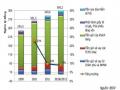 Business Results for the Period 2009-June 30, 2012 According to Consolidated Financial Statements According to Vietnamese Accounting Standards.
Regarding the trend of using fair value, the guidance provided in IFRS 13 and the updates in Topic 820 (formerly FASB Report No. 157) in May 2011 completed a major project to improve IFRS and US GAAP to bring about convergence between them. Leslie F Seidman, Chairman of the FASB, said: “This update represents a positive step towards the goal of worldwide shared convergence of accounting standards. Unifying the meaning of fair value will improve the consistency of financial information worldwide. We also meet the requirement for increased disclosure of the assumptions used in fair value measurement methods” (IFRS, 2011b). Currently, developed countries such as Australia, Hong Kong, etc. have issued and applied fair value measurement standards in their accounting systems.
Thus, the outstanding advantages of fair value have been revealed in both theory and practice. Along with the efforts of IASB and FASB and some countries in promoting the establishment of the basis and application of fair value, it can be affirmed that the use of fair value for valuation in accounting is becoming an inevitable trend today.
- 143 -
In Vietnam, as analyzed in section 2.3.3.2, the original price is defined as a basic principle of Vietnamese accounting. Fair value is currently defined and used in a fragmented and unsystematic manner; there is no clear long-term direction on the use of fair value, as well as a complete lack of principles and guidelines on methods for determining fair value in measuring elements of financial statements.
To meet the requirements of international accounting integration, the use of fair value in valuation is necessary and an inevitable trend in Vietnam. This comes mainly from the pressure of integration requirements and the pressure of development requirements of the Vietnamese economy itself. The development of the economy itself and the requirements of international integration require the application of international practices, for accounting standards in general and the use of fair value in particular, to meet the increasing demand for information transparency of the market. Vietnam has a system of developing markets, the stock market has been formed and developed for more than 13 years and achieved certain achievements. According to the project on capital market development until 2010 and vision to 2020 approved by the Vietnamese Government, by 2020 the capitalization value of the stock market will reach 70% of GDP; The legal corridor for Vietnamese enterprises to list securities abroad is also established in the Securities Law 62/2010/QH12 and Decree 84/2010/ND-CP...
In short, the use of fair value in the valuation of financial statement elements in Vietnam is only a matter of time. Besides the incompleteness of an active market system in Vietnam, as well as the absence of principles and guidelines on methods of determining fair value, perhaps the first problem that needs to be solved is the belief in the reasonableness of fair value.
(b) Principles and roadmap for using fair value in valuing elements of Vietnamese enterprises' financial statements
Principle
The basic principle of using fair value is to comply with international accounting standards and practices, and Vietnamese conditions.
- 144 -
The use of fair value in accordance with international standards and practices aims to: meet integration requirements, create harmony between Vietnam's assessment standards and international assessment standards, ensure consistency of the accounting system, and meet the market's increasing demand for information transparency.
Currently, the Vietnamese market economy and the Vietnamese stock market are still quite young, and many reference data are not yet available. Therefore, if we immediately apply all international standards, it will affect the reliability of information valued at fair value. Therefore, the use of fair value needs to be calculated in accordance with the economic characteristics of each stage. However, if we focus too much on the conditions of application and are overly cautious, it will lead to half-heartedness and disharmony in the integration process. From there, it shows that determining a reasonable roadmap for applying fair value in the valuation of elements of the financial statements of Vietnamese enterprises is extremely necessary.
Route
The roadmap for adopting fair value can be divided into two phases.
Phase 1 (from now until the end of 2016)
This is the stage of creating the initial fundamental conditions to be able to apply fair value firmly in valuing the elements of the financial statements.
- Firstly , implement measures to propagate, disseminate, train, increase seminars... to raise awareness, create consensus on the use of fair value in valuation, from authorities, accountants, to users of information on financial statements.
- Second , adjust the Accounting Law and General Standards related to valuation.
The Accounting Law needs to amend the principle of asset value being calculated at historical cost to the principle of combining historical cost with fair value. Similarly, VAS 1 also needs to stipulate the combined use of “fair value” with the “historical cost principle”.
- Third , issue the Fair Value Measurement Standard (VFRS 13). Contents
- 145 -
The standard should be developed in a manner that is consistent with IFRS 13- Fair Value Measurement.
- Fourth , supplement and update the content of current accounting standards related to fair value.
In the process of reviewing and adjusting the issued accounting standards, it is necessary to supplement the provisions on valuation in the direction of approaching international accounting standards. The supplementary provisions should aim at creating consistency, accordingly, it is necessary to stipulate in the standards the requirement to present information on fair value: fair value amount at the end of the period; determination of fair value (determination method, valuation agency, etc.); assumptions and data used, etc.
Fair value must be used after initial recognition for: investment real estate, financial instruments, business combinations; investments in joint ventures, associates, investments in subsidiaries, because if reflected at original cost, it will not reflect market changes, will not reflect unrealized profits and losses in the period in which they arise.
Phase 2 (From 2017-2020)
This is the phase of comprehensive implementation of VFRS 13.
- Firstly , Issue some guidance on the use of VFRS 13.
Based on VFRS 13, the Ministry of Finance issues regulations explaining the levels and methods of determining fair value, regulating the balance between quality characteristics and evaluation standards when there is limited information between relevance and reliability.
This is also the stage where accounting standards on financial instruments are starting to be applied. Therefore, depending on actual conditions, it is possible to prescribe a step-by-step application of some contents of VFRS 13.
- Second , gradually complete an active market system; synchronize and make transparent the legal corridor for business.
An active market is a market where buying and selling, transactions on the market are carried out on the basis of parity, buyers and sellers can be found at any time, there is voluntariness among market participants. The Vietnamese commodity market and financial market must be built
- 146 -
increasingly “active” to meet the need for reference data in fair value measurement.
(b) Orientation of some contents and methods of fair value measurement Based on the objectives and scope of the thesis, this part only presents orientation of basic issues on definition, contents and methods of fair value measurement, in the spirit of harmony with IFRS 13 - Fair value measurement, and
international practice
Definitions
Fair value : is the price received to sell an asset or paid for a liability in an orderly transaction between market participants at the valuation date.
Active market : is a market in which transactions of assets or liabilities occur frequently enough and the volume of transactions is sufficient to provide pricing information assuming that transactions continue to occur.
Exit price : is the price that can be received when selling an asset or must be paid to settle a debt.
Highest and best use : is the use of non-financial assets by market participants to maximize the value of assets or groups of assets and liabilities in the enterprise .
Most advantageous market : the market that maximizes the value of the asset sold or minimizes the value paid to transfer the liability, taking into account transaction costs and transportation costs .
Principal market : is the market with the largest volume and level of activity of assets or liabilities .
Other definitions of purchase price, expected cash flow, validated market data, market members… are presented in Appendix 16.
Levels of Fair Value Measurement
Input data used in valuation techniques are classified into three levels: level 1 input data; level 2 input data; level 3 input data.
- 147 -
(1) Level 1 input data
Level 1 inputs are quoted prices of assets or liabilities (unadjusted) in active markets accessible to the entity at the date of fair value determination (IASB, 2011).
Quoted prices in an active market provide the most reliable evidence of fair value and are used without adjustment to determine fair value whenever available.
Level 1 inputs are typically available for a wide range of financial assets and financial liabilities, some of which are actively traded in multiple markets (e.g., on multiple exchanges). Therefore, determining level 1 data requires consideration of both of the following factors:
- The principal market in which the asset or liability is traded, or the most favourable market where there is no principal market;
- Can the enterprise conduct asset or liability transactions at market prices at the time of valuation?
(2) Level 2 input data
Level 2 inputs are not quoted prices classified as level 1 inputs but are prices of assets or liabilities that are directly or indirectly observable.
If the asset or liability has a definite (contractual) life, level 2 inputs must be observable for substantially all of that life. Level 2 inputs primarily include:
- The quoted price of similar assets or liabilities in the active market
pole;
- The quoted price of identical or similar assets or liabilities on the market
negative school;
- Non-quoted but observable data for assets and liabilities, such as: interest rates and yield curves collected at common quoted price ranges; credit risk margins;
(3)Level 3 input data
Level 3 inputs are unobservable inputs to the
- 148 -
assets or liabilities
Unobservable inputs are used in measuring fair value when observable data are not available, which is applicable in cases where there are very few transactions of the asset or liability at the measurement date. However, the objective of measuring fair value remains the same, the selling price at the measurement date is considered from the perspective of a market participant holding the asset or liability. Therefore, unobservable data will reflect the assumptions used by market participants in determining the value of the asset or liability, including assumptions about risk.
An entity shall construct unobservable inputs using the best available information in the circumstances, which may include the entity's own data. In constructing unobservable inputs, an entity may start with its own data, but the entity should adjust the data if reasonably available information indicates that other market participants will use different data or there is something unique to the entity that is not available to market participants (such as the entity's ability to provide synergies) (IASB, 2011).
Fair value measurement methods
The objective of fair value measurement is to estimate the price of an orderly transaction to sell an asset or transfer a liability that would take place between market participants at the time of valuation (IASB, 2011).
Measuring fair value requires determining the following key issues:
- The type of asset or liability being measured (as appropriate to the business account);
- For non-financial assets, the valuation premise is consistent with measurement (consistent with the efficient use of assets and achieving the highest value);
- The principal market (most favorable market) for the asset or liability;
- Valuation techniques appropriate for measurement, considering available data to develop into input data that represents the investor's assumptions used in valuing the asset or liability and the level of fair value corresponding to the classified input data.
- 149 -
The application of the fair value measurement method must comply with the following main regulations:
- Fair value is determined for each specific asset or liability. Therefore, when determining fair value, an enterprise needs to consider the characteristics of the asset or liability that market participants would also consider when valuing that asset or liability at the date of determining fair value. Such characteristics may include: the condition and location of the asset; restrictions (if any) on selling or using the asset.
- Fair value determination assumes that the asset or liability could be exchanged in an orderly transaction between market participants to sell the asset or transfer the liability at the fair value determination date under current market conditions.
- Fair value is the price that would be received to sell an asset or paid to transfer a liability in an orderly transaction in the principal (or most advantageous) market at the measurement date based on current market conditions, whether observable or estimated based on another valuation method.
Valuation techniques
The entity shall use valuation techniques appropriate to the circumstances and having sufficient data to be able to determine fair value, maximizing the use of relevant observable inputs and minimizing the use of unobservable inputs.
The valuation technique used to measure fair value must be applied consistently. However, a change in the valuation technique or in its application (for example, a change in the weighting of multiple valuation techniques or a change in the adjustment applied to a valuation model) is appropriate if the change results in a measurement that is equivalent to or more representative of fair value in the circumstances. For example, new markets emerge; new information becomes available; valuation techniques improve; or market conditions change.