
Chart 1: Total registered and implemented FDI capital in Vietnam in the period 1988-2006
(Unit: million USD)
million dollars
12000
FDI capital registered and implemented in Vietnam in the period 1988-2006
10000
9428
10200
8000
7925
6000
4000
4262
5822
4781
4222
5300
4100
2829
2821 2923
3218
2375
2494
3224
2757
3064
2850
3300
2000
1582.3
1283
2077
1099
2213
2197 253 7 242 0 2430 2591 2650
478 542
0 0
88-90 91 92 93 94 95 96 97 98 99 00 01 02 03 04 05 06
year
registered capital, implemented capital
(Source: Data synthesis of the Ministry of Planning and Investment 2006)
In general, FDI capital flows into Vietnam from early 1988 to present have gone through different stages of development, with periods of very rapid development (91-96) and periods of continuous decline (97-2000). Realized capital compared to registered capital is generally low. Up to now, this capital flow is still not really stable, however, there are positive signs of future development. Countries in the same region are still the largest investors in Vietnam such as Korea, Singapore... Our State needs to focus on investment and pay more attention to attracting FDI to promote the economy, promote the industrialization and modernization of the country in the context of
international economic integration
2. Attracting foreign direct investment in the real estate sector in Vietnam
Real estate business people say that foreign investors have never paid as much attention to the Vietnamese real estate market as they do now. In line with the trend of FDI capital flows into this market worldwide, the Vietnamese real estate market has become a very "hot" destination in recent years and has attracted the attention of foreign investors more and more strongly. Moreover, with its accession to the WTO, Vietnam has become an ideal investment destination with the hope of an open policy and in line with the international development process. Strong adjustments in the stock market along with the government's efforts to reduce deflation, adjust gasoline prices ... are more motivation for investors to choose the real estate market as their destination.
The real estate market in Vietnam was officially formed in 1993 when the 1993 Land Law was enacted, allowing the transfer of land use rights. In 1996, in the documents of the 8th National Party Congress, the concept of "real estate market" officially appeared. However, for a long time from then until the end of the 90s, the real estate market was active but only on a small scale, mainly with the participation of domestic investors and real estate enterprises without much participation from foreign investors. Moreover, at that time, business activities in the real estate market still had many shortcomings, market participants lacked professionalism, the State had not yet proposed an effective solution to regulate and control the market, and there was also no clear document regulating this type of business. Information about this market was still lacking, ambiguous, and non-transparent, and procedures for granting certificates of rights to use and own real estate
unclear, the state could not regulate market prices. At that time, almost only domestic investors were operating in the real estate market. The only project at that time was a foreign-invested project of Ciputra Group of Indonesia with a total investment capital of 2.1 billion USD, registered in 1996 but due to financial difficulties, it was not until 2001 that construction could begin. This was also the first foreign-invested project in the urban sector in Vietnam. After 1996, due to the impact of the severe financial and monetary crisis in Thailand, our country's financial system was significantly affected. The banking system became extremely weak, credit institutions collapsed in series due to corruption. Moreover, during this time, the government only allowed foreign enterprises to invest in joint ventures and state-owned enterprises, where the business environment was a clear disadvantage for foreign enterprises. Therefore, FDI in Vietnam's real estate sector during this period had almost no remarkable movement. Only at the 9th Party Congress in 2001, did our state clearly define the policy on the real estate market with the main content being "Forming and developing the real estate market according to the provisions of law, gradually opening the real estate market for foreign investors to participate in investment".
Since then, over the past 6 years, Vietnam's real estate market has gone through many different ups and downs, such as extremely hot development in the years 2000-2002 when real estate prices continuously increased, investors and domestic real estate businesses rushed into the market, causing real estate prices to increase 2.3 times compared to the quiet period of 1996-2000. Then, it fell into a state of continuous "freezing", for a long time, the real estate market was colder year after year, the number of successful real estate transactions decreased consecutively by 28%, 56% and 78% in 2003, 2004, 2005 respectively. And the encouraging signs returned in early 2007, real estate investment projects
increased again, especially with the participation of many businesses and foreign investors. 17
However, slightly different from the fluctuations of the Vietnamese real estate market in general, the FDI flow into this market has gradually shown positive signs and is growing.
2.1 General situation of foreign direct investment in Vietnam's real estate sector:
In 2000, FDI poured into the commercial space, office, hotel and industrial park and export processing zone infrastructure sectors was over 11 billion USD. By 2002, the FDI capital poured into urban areas, housing, offices and hotels alone had reached 7 billion USD, including about 120 tourism hotel projects and 112 apartment office projects. Thanks to new, more open and flexible regulations for foreign investors stipulated in the 2003 Land Law, which allows foreign investors to invest in 100% capital real estate projects instead of having to form joint ventures with domestic companies, or investors can also invest in the field of building houses for sale, the investment environment in the real estate sector has expanded significantly and become increasingly attractive to foreign real estate investors. From 2004 to February 2006, Ho Chi Minh City and Hanoi alone had 8 licensed FDI projects with a total capital of approximately 1 billion USD. Although partly affected by the freezing of the real estate market, according to Mr. Marc Townsend - General Director of CB Richard Ellis Vietnam, the real estate market is still very dynamic and attractive. In fact, the freezing is only a temporary lull, due to domestic investors lacking professionalism and being easily confused by confusing information in the market. As for foreign investors, they still want to penetrate this potential real estate market of Vietnam. From the end of 2006 to now, FDI in the real estate sector has increased at a very fast rate, especially in the last 2 years.
17 http://vnexpress.net/Vietnam/Kinh-doanh/2007/08/3B9F8F5C/
Overview of Vietnam's real estate market - Special issue of Investment Newspaper 2007
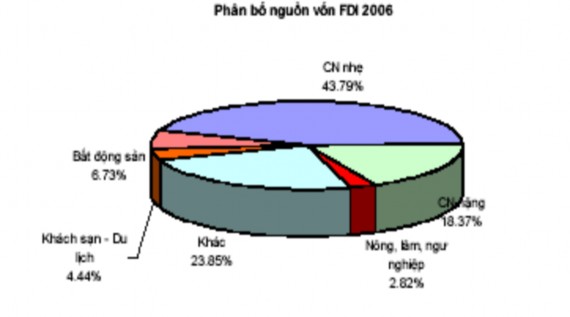
Coming here, it is estimated that the total investment capital and investment commitments from 2004-2010 will be about 8-9 billion USD. According to statistics, FDI in Vietnam in 2006 was about 10.2 billion USD, FDI in real estate alone accounted for 6.73%, or about 686.5 million. 18
Chart 2: FDI capital allocation by industry in 2006
(Source: General Statistics Office Report 2006)
After a few years of stagnation, the real estate market has started to heat up again with large projects such as the Saigon Pearl commercial complex project with a registered capital of 156 million USD and the Kumho Asian complex with a registered capital of 230 million USD in Ho Chi Minh City. In Hanoi, it has also started to operate strongly again with Keangnam Vina's investment project to deploy the Keangnam Hanoi Landmark Tower with an investment capital of up to 1.05 billion USD, or Gamuda's project to renovate Yen So Lake with an investment value of approximately 1 billion USD.
In the first 7 months of 2007, total FDI capital in Vietnam has
18 General Statistics Office Report 2006 www.gso.gov.vn
is 6.37 billion USD, of which the office apartment development area for rent accounts for 1.12% - about 71.34 million USD, the construction industry accounts for 6.14% and the hotel and tourism area is 3.07%. 19.
19 Tung Duong, Vietnam continues to attract strong foreign investment - Vietnam Real Estate Magazine No. 42
2.2 According to the investor
The main areas with FDI in Vietnam's real estate market are still countries in the Asian region due to advantages in location, geographical distance, the nature of the investment and social environment with some similarities, and at the same time due to the advantages and incentives between countries in the same region. The countries and territories with the highest investment capital so far are still Singapore, South Korea, Malaysia. Singaporean investors and enterprises, which invested early in Vietnam's real estate and have the largest projects such as Capitaland with Someset projects, Vista 750 apartments, Keppel Land with Sedona Suites, Saigon Center and the upcoming International Center, Villa Riviera with 101 villas ... South Korea is also a strategic FDI partner with many large projects of enterprises such as Posco E&C with the project to build the Bac An Khanh Ha Tay urban area in joint venture with Vinaconex JSC including 1,300 villas and 6,400 apartments. Korean investor Keangnam Vina with the Landmark Tower project with the largest registered capital ever of 1.05 billion USD … 20
Currently, thanks to the outstanding successes in Vietnam's economic integration such as the successful organization of the APEC Conference 2006, becoming an official member of the WTO ... has had a great impact on attracting investment from countries around the world to Vietnam. According to Mr. Howie Gelbtuch, an expert of the National Association of Real Estate Agents (NAR), in late 2006, US businesses rushed to build plans to invest about 25% of total capital in Vietnam's real estate. It can be seen that US investors also pay special attention to the Vietnamese real estate market.
20 Hoai Nam, The Time of Foreign Real Estate Traders - Vietnam Real Estate Magazine No. 36
Table 3: Largest FDI projects in real estate licensed in 2006
STT
Province/City | Partner | Project | Date of issue permission | Registered capital USD | |
1 | Hanoi | Korea | THT Development Co.,Ltd | January 19, 2006 | 314,125,000 |
2 | Ba Ria-Vung Tau | USA | Winvest Investment | April 14, 2006 | 300,000,000 |
3 | Ho Chi Minh City | Korea | Kumho Asiana Plaza Saigon Co.,Ltd | August 8, 2006 | 223,000,000 |
4 | Ha Tay | Korea | Booyoung | November 24, 2006 | 171,200,000 |
5 | Danang | USA | Silver Shores Hoang Dat JVC | June 21, 2006 | 86,000,000 |
Maybe you are interested!
-
 Total Registered Capital and Average Registered Capital of Enterprises
 -
 Attracting FDI into Vietnam's real estate sector. Current situation and prospects in the period of international economic integration - 11
 -
 Lessons Learned for Attracting FDI into Vietnam's Real Estate Sector
 -
 FDI Into Hai Phong Real Estate Sector By Investment Sector As Of December 2008
 -
 I. Solutions to Increase Attraction and Improve the Efficiency of Using Korean Direct Investment Capital in the Real Estate Sector of Vietnam
(Source: CBRE Report 2007)
It can be seen that in the 5 largest real estate projects licensed in 2006, 2 of them are from US enterprises. Financial institutions and professional investors from the UK and France are also researching the market to invest in this potential market. In the next few years, we can welcome many foreign investors from developed countries such as the US, UK ... in the real estate market. Moreover, a wave of investment from Arab countries is also potentially flowing into Vietnam's real estate, investors in these rich Gulf countries have identified China, India and Vietnam as the most important destinations for real estate investment.