
- Team orientation: support, cooperation in working within teams, departments as well as the company and team performance.
- Organizational communication: the exchange of information at work, as well as communication between individuals within the company.
- Rewards and recognition: fair and deserving recognition of employees' achievements and results.
- Training and development: facilitate learning, training, development and advancement.
Maybe you are interested!
-

 Factors affecting the debt repayment ability of corporate customers at Vietnam Joint Stock Commercial Bank for Investment and Development - Long An Branch - 1
 -
 Completing the appraisal of loans for additional working capital for corporate customers at Vietnam Joint Stock Commercial Bank for Industry and Trade - Dong Anh Branch - 5
 -
 Quality of corporate customer loans at Saigon Thuong Tin Commercial Joint Stock Bank - Bac Ninh Branch - 13
 -
 Credit Procedures Of Asia Commercial Joint Stock Bank - Hue Branch For Corporate Customers
 -
 Customer relationship management at Vietnam Joint Stock Commercial Bank for Investment and Development - Ha Long branch - 12
The study “Measuring cultural components: synthesizing research and developing a new tool” by Delobbe et al (2002) synthesized the corporate culture models that have been studied and proposed a new ECO corporate culture model consisting of 5 cultural components:
- Recognition - support: support from superiors to solve difficulties and obstacles for employees, and worthy recognition of employees' results and achievements.
- Solidarity - team spirit: spirit of cooperation, happy working, supporting each other in the group, department as well as the company.
- Innovation - work efficiency: create conditions for creativity and innovation to achieve the best work results.
- Principles and rules: comply with procedures, rules and ranks in the department as well as in the company.
- Continuous learning: the need for employee training and development to improve and grow.
O'Reilly et al (1991) Organizational Culture Profile (OCP) model
Among the proposed corporate culture models, the OCP (Organizational Culture Profile) model by O'Reilly et al (1991) stands out. This model has been applied to many subsequent studies. O'Reilly et al published in the magazine "The Academy of Management Journal" the OCP corporate culture model consisting of 7 cultural components with 54 variables:
- Respect for people: is a component that measures fairness, respect for people, behaviors, communication between employees, companies, superiors and employees, recognition, training, and employee development.
- Team orientation: is a component that measures human relationships in the group, in the company, team spirit and support and cooperation when working.
- Attention to detail: is a component that measures the carefulness, detail, and accuracy in work, and the requirement to comply with regulations and rules in work and the company.
- Stability: is a component that measures safety, stability, and peace of mind at work.
- Innovation: is a component that measures the desire to improve, change, explore, exploit opportunities, be creative, and accept risks in innovation.
- Outcome orientation: is a component that measures the priority towards the highest work results, puts work results as a priority to evaluate employees, and orients actions to achieve the highest results.
- Aggressiveness: is a component that measures the aggressiveness, resourcefulness, dedication, and initiative in work as well as other activities inside and outside the company.
* Application of O'Reilly et al (1991) OCP model
Sheridan (1992) published in the journal "The Academy of Management Journal" about the study of the relationship between corporate culture and employee retention. This study applied the OCP model of O'Reilly et al (1991) in which Sheridan grouped 7 cultural components into 3 groups: Work task values (including components Attention to detail, Stability, Innovation), Interpersonal relationship values (including components Respect for people, Team orientation) and Individual behavioral values.
behavior values (including the components Outcome orientation and Aggressiveness).
Windor and Ashkanasy (1996) applied the OCP model of O'Reilly et al (1991) and proposed 7 cultural components including 26 variables.
McKinnon et al (2003) published in the journal “The International Journal of Business Studies” a study on corporate culture and its relationship with commitment, job satisfaction, and information sharing in Taiwan, in which the OCP model of O'Reilly et al (1991) was applied as the theoretical basis for this study.
Tran Kim Dung (2009) in the study "The influence of leadership and organizational culture on employee performance and their loyalty to the organization"
The study applied Wallach's (1983) organizational culture scale, which includes three types of organizational culture: innovative culture, supportive culture, and administrative culture.
- Awareness of effort and trying: employees in the organization try their best to improve their skills to be able to contribute more to their work; ready to sacrifice personal interests when necessary to help the group and organization work successfully.
- Loyalty: employees intend to stay with the organization/company for a long time. They will stay even if other places offer relatively more attractive salaries.
- Pride and love for the organization: employees are proud to be members of the organization, will introduce the organization's products and services, the company is the best that customers can buy; is the best place to work in the community where employees live.
Author Ha Nam Khanh Giao in the article "Talking about measuring corporate culture at commercial banks"
In the article, the author has proposed a set of corporate culture measures including 4 main groups of factors: mission, adaptability, consistency, and involvement.
2.2 Organizational commitment
organizational commitment
The concept of organizational commitment and its impact on organizational outcomes is introduced by many organizational behavior researchers around the world.
According to Mowday et al (1979), organizational commitment is defined as the strength of an individual's identification with the organization and active involvement in the organization; employees with high levels of organizational commitment will be more satisfied with their jobs, will leave their jobs less often and will be more committed to the organization.
According to O'Reilly and Chatman (1986), organizational commitment is defined as the psychological state of a member in an organization, reflecting the extent to which an individual absorbs or accepts the characteristics of the organization.
According to Kalleberg et al. (1996) organizational commitment is defined as the willingness to devote effort to the organization, strong attachment to the organization and seeking to maintain relationships with the organization.
According to Allen and Meyer (1990), organizational commitment is defined as a psychological state that represents an employee's relationship with the organization, closely related to the decision to remain a member of the organization.
Components of organizational commitment
Each researcher has different definitions of organizational commitment, so there are different components to measure this concept:
Angle and Perry (1981:4) proposed two components of commitment, which are:
- Value commitment : commitment to serve the organization's goals.
- Commitment to stay : commitment to maintain their membership role in the organization.
Mowday, Porter and Steer (1979): proposed 3 components of engagement:
- Identification: having a strong belief in and acceptance of the organization's goals and values.
- Loyalty: a strong desire to maintain membership in an organization.
- Involvement: engage in the organization's activities, and always try to volunteer for the organization.
O'reilly & Chapman (1986:493) : proposed 3 components of commitment:
- Compliance: commitment for special rewards.
- Identification: identification due to the desire to integrate with the organization.
- Internalisation: commitment due to the compatibility and similarity between personal values and organizational values.
Meyer and Allen (2004) proposed the Three-Component Model (TCM) consisting of three factors to assess the level of commitment to the organization as follows:
- ACS (The Affective Commitment Scale): measures the level of employee engagement based on employee feelings and desire to be committed to the organization (desire-based).
- NCS (The Normative Commitment Scale): measures the level of employee commitment based on the "obligation" that employees have to pay to the organization, for example, employees who are trained and developed in the organization should have a commitment to the organization to "pay back the debt" (obligation-based).
- CCS (The Continuance Commitment Scale): measures the level of employee engagement based on the “cost” that employees have to pay when leaving the organization (cost-based).
Each factor is a scale, which can be used individually to build a scale to measure the level of employee commitment to the organization. According to Meyer at al (2002), ACS is a popular scale, highly appreciated and recommended for use in many studies on organizational commitment. This is also the scale used by McKinnon et al (2003) in the study of corporate culture and its relationship with commitment, job satisfaction, and information sharing in Taiwan, and published in the journal "The International Journal of Business Studies". Therefore, this study proposes to use the revised ACS (Affective Commitment Scale) of Meyer et al.
(1993) included 6 variables, 5-point Likert scale to measure employee commitment to the organization.
2.3 The relationship between corporate culture and organizational commitment
The relationship between corporate culture and organizational commitment has been recognized by researchers since the early days of research on this topic. Deal, Kennedy (1982) stated that corporate culture affects many organizational and individual factors such as work efficiency, achievement, organizational commitment, self-confidence and employee behaviors.
Lee, Mathur (1998) pointed out the relationship between corporate culture and employee commitment, effort, and performance. Brief (1998) also pointed out the relationship between corporate culture and job satisfaction, employee behaviors, attitudes, and performance. Shaw et al (1998) pointed out the relationship between corporate culture and organizational benefits, employee retention costs, and turnover.
Veeri Arumugam's (2006) study on the influence of corporate culture on organizational commitment of employees in a semiconductor company in Malaysia concluded that there is a strong relationship between corporate culture and employee organizational commitment.
O'Reilly et al (1991) published in the journal "The Academy of Management Journal" a study on the compatibility between employees and organizations through corporate culture, including organizational commitment, job satisfaction, intention to leave the organization, organizational performance (revenue, etc.).
Sheridan (1992) published in “The Academy of Management Journal” a study on the relationship between corporate culture and employee retention. McKinnon et al (2003) published in “The International Journal of Business Studies” a study on corporate culture and its relationship with commitment,
job satisfaction, and information sharing in Taiwan.
Positive cultural values reflect a good corporate image and an attractive working environment with the aim of retaining human resources, especially those who
Good and talented employees because culture is also one of the factors that affect the tendency of employees to leave the organization. At the same time, a positive culture also helps attract the workforce, especially those with capacity, external talents because employees, in addition to considering factors such as salary, nature of work, ... they are increasingly interested in cultural factors before joining a new organization. A positive organizational culture will increase the cohesion and cooperation of the staff, resulting in improved organizational efficiency, high consensus on strategic directions, increased labor productivity, better decision making, high engagement at all levels of employees and creating competitive advantages for the organization (Saeed and Hassan, 2000).
General comments on previous studies
Comparing between authors and research models, it is found that the OCP (Organizational Culture Profile) corporate culture model of O'Reilly et al (1991) adjusted by McKinnon et al in the study of corporate culture in Taiwan (2003) is a comprehensive model and fully reflects the components of corporate culture. This model has been used as a scientific basis in many studies published in world scientific journals for the cultural environment in the West (O'Reilly et al (1991); Sheridan (1992); Windor and Ashkanasy (1996), as well as applied, researched and rebuilt to suit the East Asian cultural environment (McKinnon et al (2003). In addition, Taiwan is an Asian territory with a rapidly developing economy, so competition between companies is very fierce. The results of the studies have also shown that the urgent requirement for employees in this competitive environment is dynamism and creativity to improve and develop. These are also outstanding characteristics that are very suitable when studying at Asia Commercial Joint Stock Bank in Ho Chi Minh City. Therefore, applying the research model that has been researched and applied in the West and re-applying it in Taiwan, a country with an East Asian culture similar to Vietnam, is the theoretical basis. solid theory, helping the study apply the model suitable to the research conditions of Asia Commercial Joint Stock Bank in Ho Chi Minh City.
2.4 Proposed research model
From the theoretical bases mentioned above, the OCP (Organizational Culture Profile) scale of O'Reilly et al (1991) was adjusted by McKinnon et al (2003) and the ACS (Affective Commitment Scale) scale of Meyer et al (1993) was selected. The proposed research model is as follows:
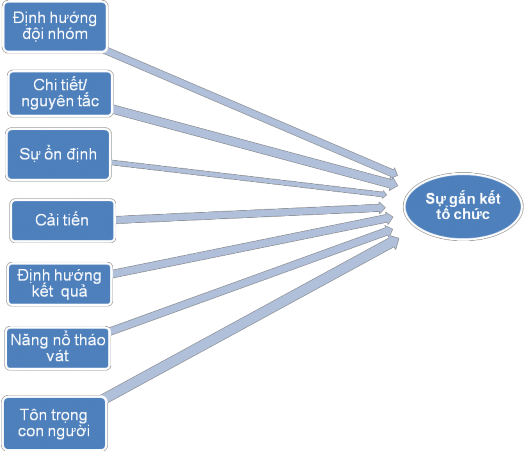
Figure 2.2: Research model
This study examines the relationship between corporate culture components and employee organizational commitment. With the research model constructed as above, the hypotheses are built when conducting the research as follows: