
- What do customers love or might love about your business or product?
- Do you have any really unique ideas?
- What resources do you have that your competitors don't?
Maybe you are interested!
-
 Research on the treatment of seafood wastewater by electrocoagulation method combined with USBF - 19 tank
 -
 Using Traditional Formulas to Understand the Question Pattern
 -
 Revenue Forecast of Nam Viet Corporation 2014 Using Brown Method
 -
 Percentage of Investigation Articles Using Role-Playing Skills (%)
 -
 Skills for Working with Text Channels and Combining Image Channels
- What has made you or your business the most money?
- In what areas will people remember you or your business?
- What qualifications/certifications/licenses/technology do you have that your competitors don't?
- What talents does your business have?
- What dominant relationship do you have?
- What would you say about this business that would make you very confident? Etc.
You can ask more questions to analyze your strengths, the more specific the better. Then determine what are the core strengths of your business.
Weaknesses – Weaknesses
- What does your competitor do better?
- What makes you special that you can't have?
- What are the weaknesses of your brand or your business?
- What do customers dislike about your business or product?
- What resources do your competitors have that you don't?
- What has cost you or your business the most money?
- In what areas do people rarely remember you or your business?
- What degrees/certifications/licenses/technology do your competitors have that you don't?
- What talents is your business lacking?
- What advantage do you have over your competitors?
- What would make you feel self-conscious or anxious about this business? Etc.
You can ask more questions to analyze your weaknesses, the more specific the better. Then identify what are the core weaknesses in your business.
Opportunities – Opportunities:
- What are the current social market trends in the field you intend to start a business in?
- What does the market need that no one can meet?
- What technology trends are coming?
- How can the new technology era help you?
- Is your industry growing? If so, how can you take advantage of it?
- What important event is coming up? What opportunities will it bring?
- What trends do you see your competitors doing? How can you take advantage of that opportunity or get ahead of them?
- What problems/complaints do customers often have in your field? If so, what good solutions can you provide for them?
- What government policies will help you?
- What potential customers are not being exploited?
- What types of media will be most effective in driving customer acquisition?
- Are there any trends that are happening abroad and will come to Vietnam in the near future that you can prepare to "catch the wave"?
- Are there any investment funds or other resources that your business is not fully utilizing?
Etc.
You can ask more questions to analyze the opportunities that exist in the market, the more specific the better.
Additionally, do you look at your analyzed strengths and ask yourself if these strengths can open up any opportunities.
Also, if you overcome your weaknesses and turn them into strengths, can you create any new opportunities?
Threats – Challenges:
- Who are the competitors in this industry?
- What policies or laws negatively affect your business?
- Is this industry in decline, decline, disappearance or replacement in the future?
- What challenges will new technology bring to your business?
- What socio-economic factors will cause your business to collapse? (For example: financial crisis, epidemic...)
Etc.
Of course, there will be many potential challenges that you cannot foresee, such as pandemics or legal changes or market fluctuations. Therefore, you can list some potential risks and assess whether your business can survive if it happens or what you will do to cope.
Step 2. Combine the 4 factors and make a decision
There are the following combination directions:
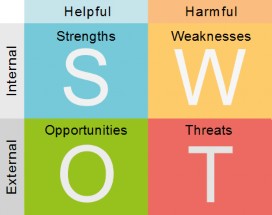
* S + O: Use strengths to seize market opportunities => Create business ideas, or create development advantages.
* Avoid W + T : Avoid starting a business in a direction that is both your weakness and will encounter many challenges.
* W + O : Must overcome weaknesses, turn them into strengths if you want to seize opportunities.
* S - T : Use strengths to handle challenges.
=> If you want to find ideas for business, you should try combining S + O to easily generate ideas.
=> If you want to develop your business, you should use S + O to find a direction for expansion.
=> If you want to improve a weak business, or improve a current business project, you should carefully consider the S - T direction to handle difficulties, and carefully consider W + O to overcome weaknesses to turn them into strengths to seize opportunities, and carefully consider W + T to eliminate tasks that are both beyond your ability and too risky.
However, whether using SWOT to find good ideas to establish a business or renovate a business, renovate a project... we still have to carefully analyze all the directions of combining SWOT to avoid being one-sided.
For example:
Here is a SWOT analysis of a student with a small business idea:
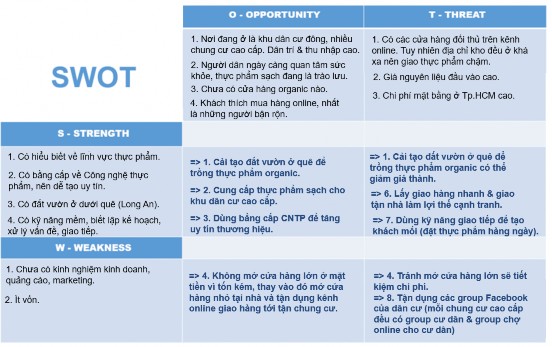
Through the S + O combination, you find three ideas to leverage strengths to seize opportunities.
By combining W + O, you find a solution to overcome the weakness while still seizing the opportunity.
By combining S + T, you find two new solutions to overcome the difficulty.
Through the W + T combination, you know what to avoid and find a safer business solution.
Of course, this is an analysis to find ideas, and also to have an overview before starting a real business; while in practice, many difficulties will arise. At that time, we need to analyze SWOT again, add new SWOT factors to have a more realistic view and find solutions to improve our business project.
d. Advantages & disadvantages of SWOT analysis:
- Advantage:
+ SWOT analysis is easy to do.
+ No cost.
+ Help generate new ideas to seize opportunities.
+ Helps us have a comprehensive view, "know yourself and your enemy", thereby effectively orienting the business process.
- Disadvantages:
+ The analysis results are general in nature and therefore not in-depth. Therefore, we need to conduct more detailed studies using other methods.
+ The analysis is subjective. These judgments are made by ourselves, they may be true to reality but they may also be wrong. Therefore, we need to find more reliable data, with figures, evidence, and comparisons, from which we can make business decisions.
EXERCISE 2. PRACTICE SWOT ANALYSIS
Use the SWOT model to come up with at least one startup idea.
Case analysis:
1. Technology ride-hailing company Grab :
+ Grab's core strength is technology (ride-hailing app).
+ Grab's core opportunity was a completely empty market with no competitors in Vietnam at that time.
=> S + O: Using strengths to seize opportunities, Grab launched in Vietnam and captured an overwhelming market share.
2. Vinasun taxi company :
+ Weakness: Vinasun taxi company only had a call center or customers could call directly, there was absolutely no call app at that time.
+ Threats: The appearance of Grab is a new challenge.
=> It can be said that when Grab appeared and competed for the market with Vinasun, Threats hit Vinasun directly at its Weakness (attacked directly at its weakness by its competitors).
=> After a while, Vinasun tried to design its own ride-hailing app. However, because it was too late to convert Weakness to Strength, and it was not convincing enough (because they had no experience in designing ride-hailing apps, while Grab had successfully tested this app in several Southeast Asian countries before entering the Vietnamese market); therefore, Vinasun's business results went down and it lost market share to Grab.
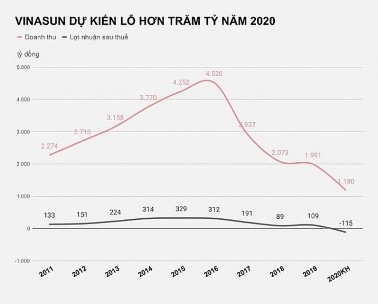
The chart shows Vinasun's declining revenue since Grab took over market share in Vietnam (Source: Vietnam Finance Magazine)
Actual revenue and profit situation in the last two years:
- In 2020, Vinasun lost more than 210 billion VND.
- 2021: Vinasun lost nearly 274 billion VND, and had to cut more than
2,500 employees.
If the loss situation cannot be improved in 2022, Vinasun will face forced delisting due to three consecutive years of losses.
(Source: Lao Dong Newspaper)
The above is the first way to find a business idea using SWOT analysis. In addition, there are many other methods to find a business idea.
2. The “MAGNET QUESTION” method to solve “pain”:
“To have 1 million dollars, think of a way to help 1 million people” (Proverb). Business is essentially providing customers with a solution to solve their “pain” and satisfy their needs. Therefore, we need to do the following 2 things:
a. Step 1: Find the “pain” or discover the “need”
- Get into the real world and observe the components of society to find out the hidden “pains” in the market.
- Observe trends, "trends", movements... to discover potential needs in the market.
- Conduct market research surveys using written questionnaires - in-depth interviews - online surveys to discover social “pains” or “needs”.
- Read the news and find out the fears, risks, and dangers that no one has yet found a solution to.
- Experience many different types of products and services and discover service gaps, weak products, and flawed business content that have made you frustrated, angry, hurt, and tired.
- Predict what events will happen in the near future, what "pain" will those events cause.
b. Step 2: Find the “pain” or discover the “need”
Keep this “pain” in mind, attached to the question: “How can I solve that pain?”. The “question” in the mind acts like a magnet attracting to it the relevant “idea” nails to solve that question.